Advertisement
)

AT A GLANCE
- Concept: Xenon Ionization: Trapped electrons collide with inert gas atoms to strip away negative charge and create plasma.
- Concept: Magnetic Confinement: A radial magnetic field forces fast-moving electrons into a continuous, closed-loop circular orbit.
- Concept: Electrostatic Acceleration: A strong voltage potential flings heavy positive ions out the back of the engine.
- Concept: Specific Impulse: Electric propulsion produces minimal raw thrust but operates with extreme, sustained fuel efficiency over time.
HOW IT WORKS
Chemical rockets rely on explosive combustion to produce massive, short-lived bursts of thrust. Once a satellite reaches low Earth orbit, it no longer needs to fight atmospheric drag or launch gravity. Maintaining an orbit requires tiny, highly efficient adjustments over several years, a physical environment that demands electric propulsion.
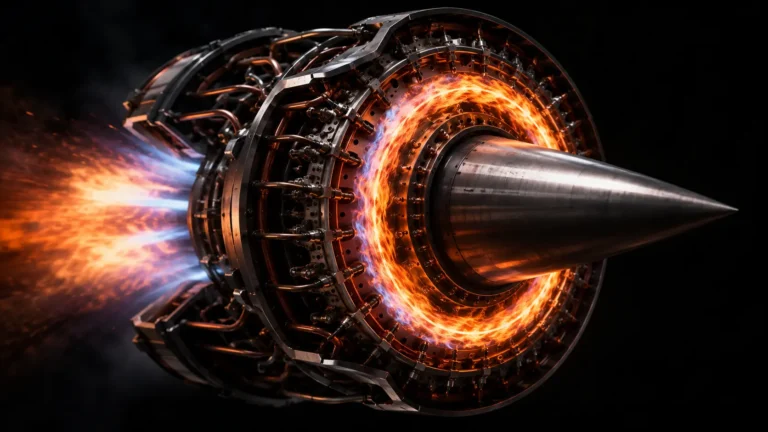
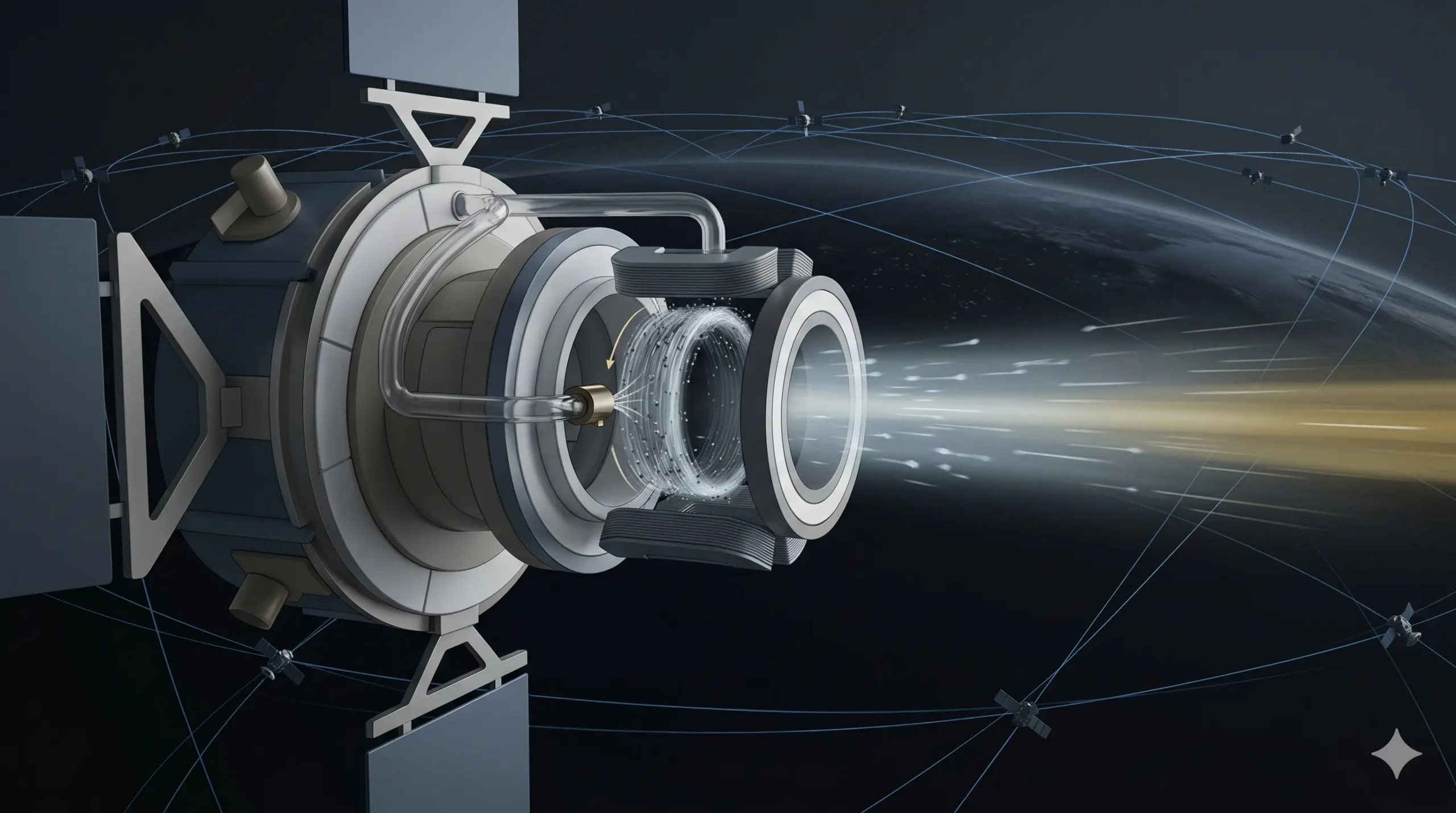
A Hall effect thruster removes explosive chemistry entirely. The system injects a heavy, inert propellant—traditionally xenon or krypton gas—into a circular ceramic channel. At the exit of this channel, an external component called a cathode fires a stream of high-energy electrons backward into the engine.
A powerful electromagnet creates a radial magnetic field across the open end of the channel. As the electrons try to move toward the positively charged anode at the back of the engine, this magnetic field catches them. The physics of this entrapment relies on the Lorentz force equation:
$$\mathbf{F} = q(\mathbf{E} + \mathbf{v} \times \mathbf{B})$$
Where F represents the resulting force, q is the particle charge, E is the electric field, v is the particle velocity, and B is the magnetic field. This exact physical force pushes the electrons into a continuous spiral path, trapping them in a dense, rotating ring known as the Hall current.
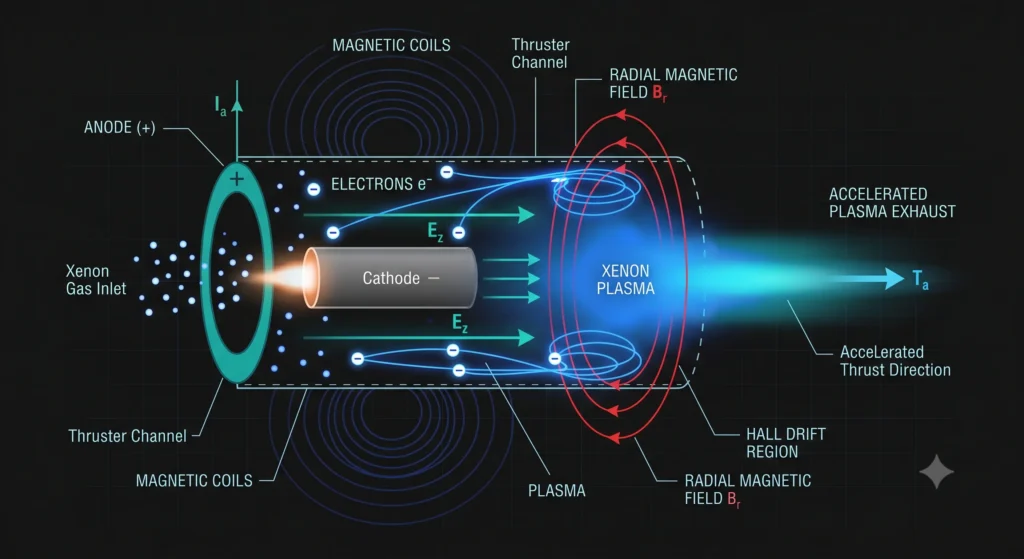
As the injected xenon atoms drift into this dense ring of trapped electrons, violent collisions occur. The trapped electrons physically strike the neutral xenon atoms, knocking away their outer electrons to create positively charged ions.
Because the dense electron ring acts as a negative electrical wall, the positive anode at the back of the chamber violently repels the newly formed positive xenon ions. The ions shoot out of the thruster at velocities exceeding 15 kilometers per second, generating the necessary forward thrust to push the satellite through the vacuum of space.
WHY IT MATTERS NOW
The economics of low Earth orbit changed permanently with the deployment of commercial mega-constellations. Companies like SpaceX launch thousands of Starlink satellites to provide global broadband internet. These massive grids require constant physical manipulation to avoid space debris and maintain precise geographic spacing.
If these satellites relied on traditional chemical thrusters, they would exhaust their fuel reserves within months. A satellite without fuel instantly becomes an uncontrollable, multi-million-dollar piece of space junk. Hall effect thrusters solve this mass problem by maximizing specific impulse, a metric that measures how efficiently an engine extracts momentum from its propellant.
Because electric propulsion accelerates plasma using magnetic fields rather than chemical pressure, it requires a fraction of the propellant mass. A heavy chemical satellite might consist of fifty percent fuel by weight. A modern communications satellite equipped with Hall thrusters carries only a few kilograms of krypton or argon, freeing up massive weight capacity for revenue-generating communication antennas.
This efficiency dictates the financial viability of orbital constellations. Aerospace manufacturers like Safran mass-produce these plasma engines to ensure satellites can execute collision-avoidance maneuvers continuously for five to ten years. When the satellite reaches the end of its hardware lifespan, the thruster burns its remaining plasma to safely de-orbit the unit, preventing catastrophic collisions.
WHAT MOST PEOPLE MISS
Public aerospace commentary fixates on raw thrust metrics, assuming an engine must produce massive physical force to be effective. A standard Hall effect thruster generates roughly the same physical force as the weight of a piece of paper resting on a human hand.
They miss the physics of continuous orbital acceleration. In the friction-free vacuum of space, that tiny fraction of a Newton of force applies constantly for thousands of hours. Over weeks of continuous operation, this microscopic plasma exhaust gradually accelerates a multi-ton satellite to extreme orbital velocities that short-burst chemical rockets could never match.
THE TRAJECTORY
Next 12–36 Months: Constellation operators will universally shift from expensive xenon propellant to cheaper, lighter argon gas. This chemical transition requires higher ionization energy but drastically lowers the operational refueling cost of maintaining thousands of active nodes.
Next Five Years: Deep space exploration missions will deploy magnetically shielded Hall thrusters. By perfectly shaping the magnetic circuit to prevent the plasma from touching the ceramic walls, engineers will eliminate physical erosion, extending engine lifespans to tens of thousands of continuous hours.
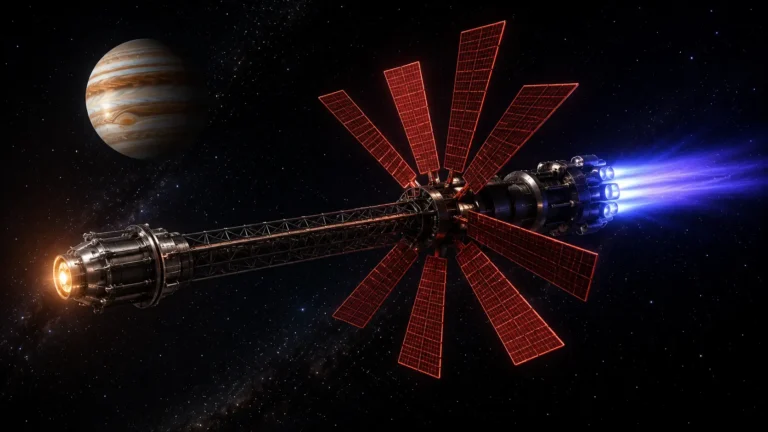
Next Ten Years: Heavy orbital tugs will scale Hall thruster arrays into the megawatt power range. These autonomous vehicles will use large deployable solar arrays to generate massive electrical currents, allowing them to slowly haul defunct satellites into distant graveyard orbits.
What Could Go Wrong: An intense solar maximum could induce severe geomagnetic storms, physically expanding the Earth’s upper atmosphere. The increased aerodynamic drag in low Earth orbit would easily overpower the low-thrust output of the Hall engines, causing hundreds of satellites to rapidly lose altitude and burn up.
Most Likely Outcome: The Hall effect thruster will remain the absolute standard for commercial satellite mobility. As chemical propulsion becomes restricted entirely to atmospheric launch vehicles, the mastery of plasma physics will determine which nations successfully commercialize cislunar space.
KEY TERMS
- Specific Impulse: A measure of efficiency defining how effectively a rocket engine uses its propellant mass to generate forward thrust.
- Plasma: A distinct state of matter consisting of a highly energetic, electrically conductive gas of freely moving ions and electrons.
- Lorentz Force: The combined electrical and magnetic physical force exerted on a charged particle as it moves through an electromagnetic field.
- Station-Keeping: The continuous sequence of minor orbital adjustments required to keep a satellite in its exact assigned functional position.
- Kessler Syndrome: A theoretical scenario where the density of orbital debris becomes so high that collisions generate a cascading chain reaction of physical destruction.
SOURCES
- NASA Glenn Research Center — Hall Effect Thruster Physics and Magnetic Shielding
- IEEE Transactions on Plasma Science — Electron Cyclotron Resonance and Ionization in Electric Propulsion Systems
- SpaceX — Starlink Environmental Space Interoperability and Propulsion Mechanisms
- Journal of Propulsion and Power — Specific Impulse Optimization for Krypton and Argon Hall Thrusters