Advertisement
)

AT A GLANCE
- Concept: Atmospheric Boundary: The outside air pressure acts as the physical outer wall of the rocket exhaust plume.
- Concept: Altitude Compensation: The exhaust gas automatically expands outward as the vehicle climbs into thinner atmospheric pressure.
- Concept: Plug Truncation: Engineers cut off the bottom of the central spike to save weight while maintaining aerodynamic thrust.
- Concept: Single-Stage Economics: Consistent thrust efficiency across all altitudes theoretically enables orbital insertion without dropping spent booster stages.
HOW IT WORKS
Traditional bell nozzles suffer from a strict physical limitation governed by gas dynamics. A steel bell is shaped perfectly for exactly one atmospheric altitude. At sea level, dense external air pressure crushes the exhaust plume inward, causing flow separation against the metal wall and severe kinetic energy loss. In the vacuum of space, the exhaust expands too rapidly past the bell lip, wasting energy sideways instead of pushing the rocket directly forward.
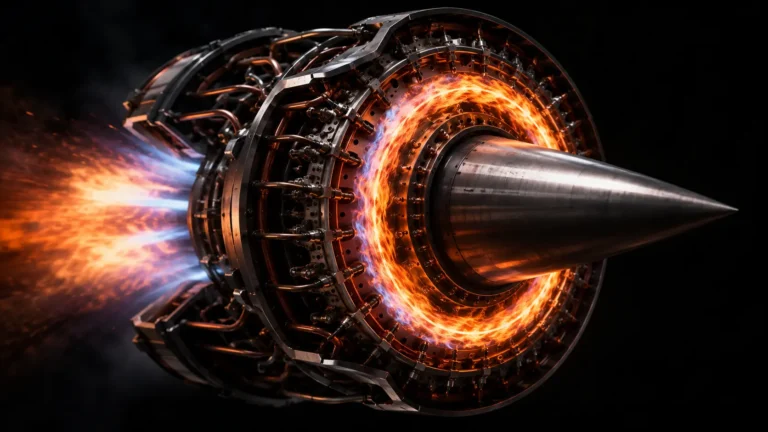
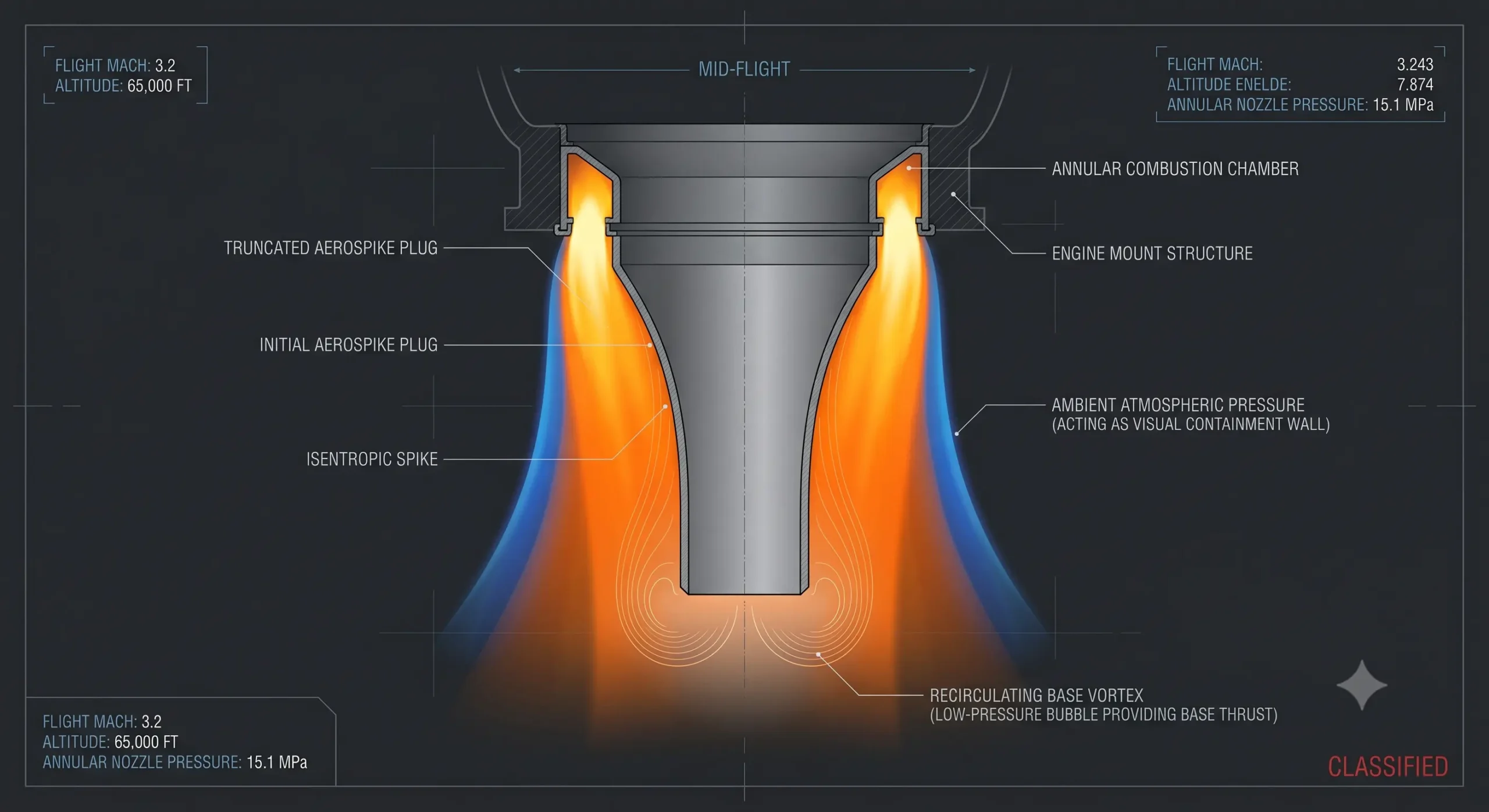
The aerospike engine solves this by turning the traditional bell inside out. Instead of firing hot gas through a confined steel cone, combustion chambers fire exhaust inward along the exterior surface of a central, tapered spike. The high-pressure exhaust hugs the metal spike on the inside, while the ambient atmospheric air pressure holds the exhaust plume together on the outside.
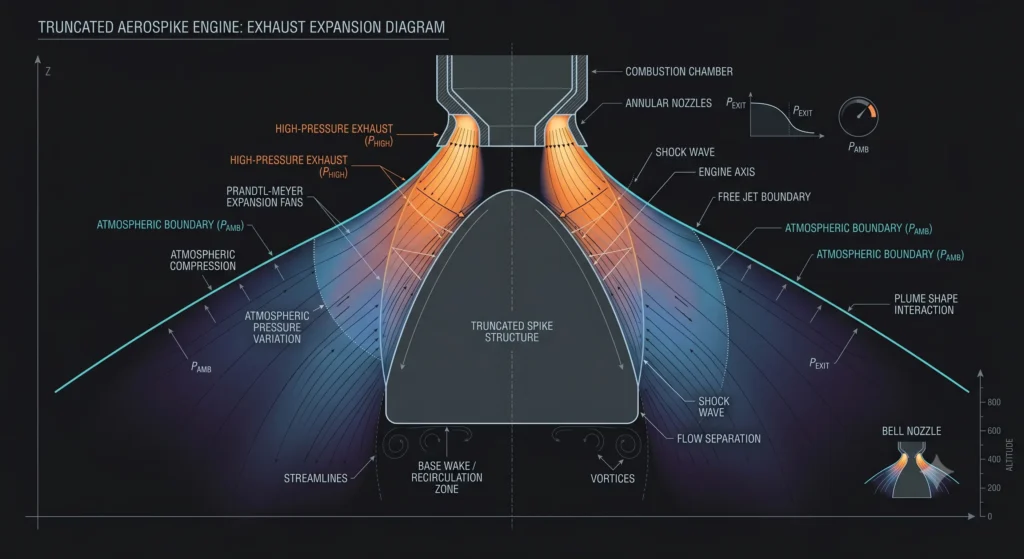
As the rocket climbs, the outside air pressure naturally drops. Because there is no outer steel wall to constrain the gas, the exhaust plume simply expands outward, automatically adjusting its shape to maintain the optimal expansion ratio at every single altitude. The Earth’s atmosphere itself acts as an invisible, continuously variable nozzle.
A full-length mathematical spike would be physically too heavy to fly. Engineers fix this mass constraint through a process called truncation, chopping off the bottom half of the spike to create a flat, blunt base. As the high-speed gas races past this blunt end, it creates a recirculating low-pressure bubble. This aerodynamic bubble acts exactly like the missing physical metal, pushing back against the rocket base to generate continuous forward thrust without the structural mass penalty.
WHY IT MATTERS NOW
Space launch economics rely entirely on the mass fraction equation. To reach orbit, current launch providers must stack multiple rocket stages on top of each other. The heavy first-stage boosters burn their fuel in the thick lower atmosphere, detach, and fall back to Earth to shed dead weight, allowing a specifically vacuum-optimized second stage to finish the orbital insertion.
This multi-stage architecture dictates the financial floor of the space economy. Even with highly reusable boosters landing autonomously on ocean platforms, dropping secondary stages and refurbishing massive mechanical separation systems incurs severe operational taxes. A true Single-Stage-To-Orbit (SSTO) vehicle would operate like a commercial airliner, taking off, reaching space, and landing as one unified hardware structure.
The aerospike nozzle represents the only thermodynamic mechanism capable of generating the required specific impulse across all atmospheric densities to make an SSTO vehicle mathematically possible. Without altitude compensation, a single-stage rocket carries too much dead weight to reach orbital velocity before running out of liquid fuel.
Aerospace startups and defense agencies are currently pouring capital into aerospike development to bypass legacy heavy-lift monopolies. If a commercial entity perfects the structural cooling requirements of the spike, they eliminate the multi-billion-dollar supply chain of staging rings, vacuum-optimized engines, and ocean recovery fleets. They collapse the baseline cost of moving freight to low Earth orbit.
WHAT MOST PEOPLE MISS
Observers assume the aerospike failed historically because the underlying physics was flawed. The NASA X-33 program famously canceled its linear aerospike vehicle in 2001. However, the failure belonged to the composite liquid hydrogen fuel tanks, not the engine. The thermodynamic principles functioned perfectly in ground tests; the aerospace industry simply lacked the advanced metallurgy to build the surrounding flight hardware.
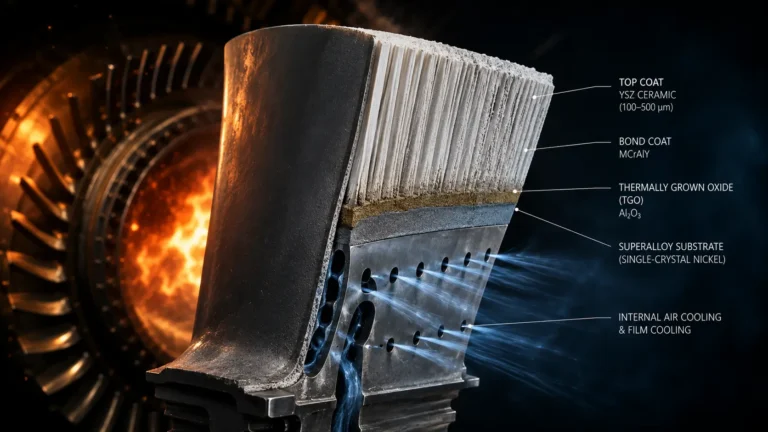
They miss the extreme thermal reality of the central plug. Unlike a standard bell nozzle that safely radiates heat outward into empty space, an aerospike wraps the hottest part of the combustion fire directly around a central metal structure. Cooling this spike requires pumping cryogenic liquid fuel through microscopic internal channels just milliseconds before igniting it, a manufacturing feat only recently made viable by modern 3D printing and copper-alloy additive manufacturing.
THE TRAJECTORY
Next 12–36 Months: Additive manufacturing will enable the rapid prototyping of actively cooled, complex copper-alloy aerospikes. Commercial space startups will execute successful suborbital flight tests to validate computational fluid dynamic models in real-world atmospheric transitions.
Next Five Years: Small-lift launch providers will deploy linear aerospikes exclusively on upper stages to maximize payload capacity. These orbital deployments will prove the thermal management software in a strict vacuum environment before engineers attempt a full single-stage launch.
Next Ten Years: The first fully operational SSTO cargo planes will enter service. These vehicles will use hybrid air-breathing aerospike engines to take off horizontally from standard reinforced runways and deliver commercial satellite constellations directly to low Earth orbit.
What Could Go Wrong: If additive manufacturing cannot produce internal cooling channels completely free of microscopic structural defects, the central spike will suffer immediate thermal failure. The extreme heat will melt the engine block in seconds, causing a catastrophic detonation mid-flight.
Most Likely Outcome: Aerospikes will capture the highly lucrative niche market of reusable, rapid-cadence orbital spaceplanes. Heavy-lift deep space and lunar missions will continue to rely on traditional staged rockets due to absolute physical payload mass constraints.
KEY TERMS
- Aerospike Engine: A type of rocket engine that maintains aerodynamic efficiency across a wide range of altitudes by using atmospheric pressure as the outer wall of its exhaust plume.
- Single-Stage-To-Orbit (SSTO): A theoretical spacecraft design that achieves orbital velocity from the surface of a planet without jettisoning any hardware components during the flight.
- Flow Separation: An aerodynamic phenomenon where exhaust gas detaches from the physical wall of a rocket nozzle, creating destructive turbulence and severe thrust loss.
- Base Bleed: A structural technique used in truncated aerospikes where a small amount of gas is injected into the blunt base of the plug to increase localized pressure and generate additional thrust.
- Specific Impulse: A thermodynamic metric defining how efficiently a rocket engine uses its stored propellant mass to generate forward kinetic momentum.
SOURCES
- National Aeronautics and Space Administration (NASA) — Aerospike Engine Exhaust Dynamics and Linear Nozzle Testing
- Air Force Research Laboratory (AFRL) — Computational Fluid Dynamics of Truncated Plug Nozzles
- Journal of Propulsion and Power — Heat Transfer and Thermal Management in Aerospike Combustion Chambers
- American Institute of Aeronautics and Astronautics (AIAA) — Single-Stage-To-Orbit Feasibility Utilizing Altitude-Compensating Nozzles