Advertisement
)

AT A GLANCE
- Concept: Liquidity Pipelines: Money is not static wealth; it is kinetic energy that must flow constantly to prevent industrial stagnation and economic collapse.
- Concept: The Cost of Time: Interest rates function as the universal price tag for moving physical resources and industrial capacity from the future into the present.
- Concept: Fiat and Faith: Sovereign currencies derive their value purely from the violent enforcement of taxation and the continuous servicing of national debt.
- Concept: Weaponized Access: Geopolitical dominance no longer relies exclusively on invading territory, but on restricting an adversary’s ability to clear dollar transactions through the international banking network.
WHY THIS SYSTEM MATTERS
Capital is the foundational substrate of human civilization. Without a mechanism to aggregate surplus savings and deploy them toward massive, multi-decade projects, human ambition remains physically trapped by the limits of individual wealth. Building a $30 billion semiconductor fabrication plant, laying transoceanic fiber-optic cables, or funding a ten-year pharmaceutical clinical trial requires pulling future value into the present. The capital system exists strictly to facilitate this temporal arbitrage, turning abstract human trust into concrete industrial output.
When analysts measure national security, they instinctively look at aircraft carriers, hypersonics, and ballistic missiles. They ignore the stark reality that military-industrial complexes exist entirely downstream of bond market liquidity. A nation cannot project force, subsidize energy grids, or fund artificial intelligence research if it cannot issue sovereign debt at sustainable interest rates. The bond market acts as the ultimate geopolitical referee, punishing fiscally undisciplined nations with currency collapse and hyperinflation long before a single kinetic shot is fired.
The global economy is currently undergoing a structural rewiring of its financial plumbing. For eighty years, the US Dollar has operated as the undisputed global reserve currency, granting the United States an exorbitant privilege. America can mathematically print the money required to buy real physical goods from the rest of the world, effectively outsourcing its inflation. This architecture forces every other nation to stockpile dollars, heavily dictating global maritime trade routes, commodity pricing, and diplomatic alliances.
However, this system is being actively weaponized. By freezing sovereign central bank reserves and expelling adversarial banks from international clearing networks, Western powers have fundamentally altered the risk profile of holding dollar assets. This forces rival economies to engineer parallel financial rails. Understanding the capital system is no longer just an exercise for Wall Street traders; it is a mandatory requirement for comprehending how modern global conflict is executed, how strategic industries are funded, and why the physical distribution of planetary wealth is rapidly shifting.
HOW THE SYSTEM WORKS
At its most fundamental level, the capital system operates as an expansive, interconnected ledger of promises. Money, in the modern fiat architecture, is not a physical commodity stored in a vault. It is a digital accounting entry representing a simultaneous asset and liability.
When a commercial bank issues a loan to a corporation to build a new factory, the bank does not lend out pre-existing customer deposits. It literally creates new digital money into existence by expanding its balance sheet, simultaneously recording the loan as an asset and the newly created funds as a deposit liability.
This process of commercial credit creation is governed by central banks, which sit at the absolute apex of the financial hierarchy. Central banks, like the Federal Reserve or the European Central Bank, control the base layer of money (reserves). They set the short-term cost of borrowing by adjusting the interest rate they charge commercial banks for overnight liquidity.
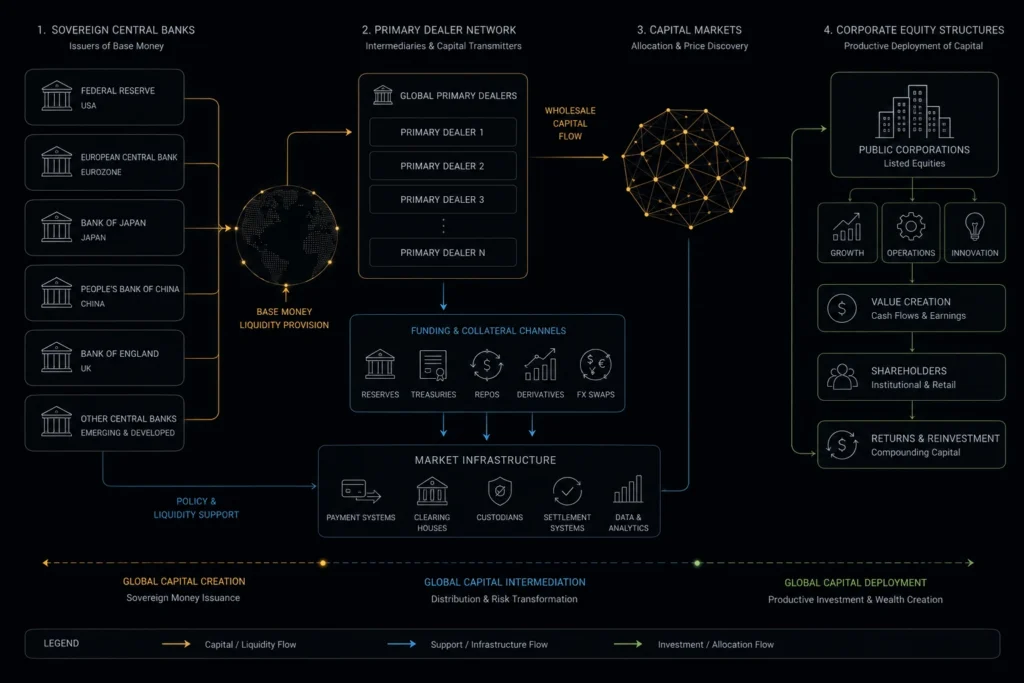
When the central bank lowers interest rates, borrowing becomes mathematically cheaper. Commercial banks aggressively expand their lending, flooding the economy with fresh credit. This newly created liquidity chases finite physical assets—like real estate, equities, and commodities—driving their prices upward. Conversely, when inflation runs too hot, the central bank raises rates, physically destroying credit demand and forcing the economy to deleverage and contract.
These localized banking loops are connected globally through foreign exchange markets and cross-border clearing networks like SWIFT. If a Japanese automaker buys steel from a Brazilian mining firm, the transaction rarely settles in Yen or Real. It routes through the Eurodollar market—a massive, unregulated offshore banking system where non-US banks lend and borrow dollars. This forces global trade to rely on a continuous, uninterrupted flow of US dollar liquidity, completely detaching the currency from the physical borders of the United States.
MAJOR COMPONENTS
The Central Bank and Base Money: Central banks act as the absolute monopoly issuers of base money, known as reserves. These reserves never enter the real economy; they exist exclusively on a closed ledger accessible only to authorized commercial banks and the government treasury. Central banks manage the economy through monetary policy, utilizing open market operations to buy and sell sovereign bonds. When a central bank executes Quantitative Easing (QE), it creates reserves out of nothing to buy bonds from commercial banks, forcing those banks to seek yield elsewhere by pushing capital out into riskier corporate and consumer markets.
Commercial Banking and Fractional Reserve Credit: Commercial banks are the physical engine of global economic expansion. While central banks manage the base money, commercial banks create the broad money supply through fractional reserve lending. They function as highly leveraged risk managers, constantly monitoring the creditworthiness of the population. A commercial bank engages in maturity transformation: borrowing short-term, cheap liabilities (customer deposits) and lending them out as long-term, expensive assets (30-year mortgages or corporate debt facilities). If depositors panic and demand their money simultaneously, the bank faces a run, requiring central bank intervention to provide emergency overnight liquidity.
The Fixed Income and Sovereign Debt Markets: The bond market is mathematically vastly larger and more critical than the stock market. Governments run continuous fiscal deficits, spending more money on military, infrastructure, and social programs than they collect in taxes. To cover this deficit, the Treasury issues sovereign bonds. Primary dealer banks purchase these bonds and distribute them to pension funds, insurance companies, and foreign nations. The yield (interest rate) on these bonds dictates the “risk-free rate” for the entire planet. If bond vigilantes—institutional investors who dump sovereign debt to protest reckless government spending—drive sovereign yields too high, the government mathematically cannot afford to service its own debt, leading to catastrophic sovereign default.
Equities and Corporate Capital Structure: The equity market allows corporations to sell fractional ownership (shares) to the public to raise permanent, non-repayable capital. Stock markets operate as massive, continuous pricing algorithms, absorbing global information to determine exactly what a specific company’s future cash flows are worth discounted back to the present day. Modern equity markets are dominated by passive index funds and algorithmic high-frequency trading firms. These systems provide extreme liquidity, allowing institutional capital to enter and exit multi-billion dollar positions in milliseconds without crashing the price of the underlying asset.
The Eurodollar System and Offshore Clearing: The Eurodollar system is the true shadow architecture of global capital. It represents US dollar-denominated deposits held in banks outside the regulatory jurisdiction of the United States, such as in London, Tokyo, or the Cayman Islands. Because international trade operates on dollars, foreign banks constantly lend these offshore dollars to each other to facilitate global supply chains. This market is entirely unregulated, possesses no central bank backstop, and relies strictly on the pledged collateral of the participating institutions. When the Eurodollar interbank lending market freezes, global trade stops instantly, forcing the Federal Reserve to open emergency swap lines to bail out foreign central banks.
Global Trade and Current Account Deficits: Capital does not flow in a vacuum; it flows specifically to settle the physical exchange of atoms. Global trade encompasses the maritime shipping networks, supply chains, and commodities markets that move energy, food, and manufactured goods across borders. Trade deficits force capital to flow in the exact opposite direction. Because the United States imports massive amounts of electronics and manufactured goods from Asia, Asian nations accumulate a massive surplus of US dollars. To earn a return on these dollars, they must recycle them back into US capital markets by purchasing Treasury bonds, effectively funding the US government deficit in exchange for exporting their physical goods.
Commodities and Physical Settlement: The base layer of the economy relies on the physical extraction of planetary resources: crude oil, copper, lithium, and wheat. Commodity markets operate through futures contracts, allowing industrial producers and consumers to lock in prices months in advance to hedge against volatility. The pricing of these commodities is heavily tethered to the US dollar. When the dollar strengthens, global commodities mathematically become more expensive for emerging markets to purchase, suffocating their industrial growth and triggering debt crises in nations that rely heavily on imported energy and food.
Strategic Industries and Venture Allocation: Capital system dynamics ultimately dictate which physical technologies cross the chasm from theoretical research to commercial reality. Deep-tech sectors—like artificial intelligence, semiconductor fabrication, and commercial aerospace—require extreme, sustained capital expenditure for years before generating a single dollar of profit. Venture capital and private equity firms aggregate massive pools of high-risk capital from university endowments and sovereign wealth funds to subsidize these sectors. They effectively act as decentralized, profit-seeking central planners, deciding which nation will dominate the next generation of industrial innovation based purely on asymmetric return-on-investment modeling.
THE ECONOMICS
The economics of the global capital system revolve entirely around the mathematical relationship between yield, risk, and time. Investors demand to be compensated for three specific variables: the opportunity cost of locking up their money (time value), the degradation of purchasing power (inflation), and the probability they will not be paid back (default risk).
The baseline for this entire calculation is the yield curve, primarily the US Treasury curve. Because the US government has the legal authority to print infinite dollars to pay its nominal debts, its bonds are considered to have zero default risk. Every other financial asset on Earth—from a high-yield corporate junk bond to a volatile technology stock—is priced as a mechanical spread above this sovereign baseline.
The most critical mathematical relationship in macroeconomics is the Fisher equation, which defines the real interest rate:
$$i = r + \pi^e$$
Where i is the nominal interest rate, r is the real interest rate, and $\pi^e$ is the expected rate of inflation. If a central bank suppresses nominal rates below the rate of inflation, the real interest rate becomes negative. In this environment, cash loses value daily, forcing capital to flee bank accounts and blindly chase highly speculative, risk-on assets just to maintain its purchasing power.
Financial institutions generate extreme wealth by arbitraging these spreads and leveraging collateral. In the modern plumbing of repurchase agreements (repo markets), a single pristine US Treasury bond can be pledged, re-pledged, and rehypothecated multiple times by different banks to secure overnight cash loans. This creates long, fragile chains of counterparty dependency. If the price of the underlying collateral drops sharply, it triggers algorithmic margin calls across the entire chain, forcing immediate, fire-sale liquidations that can crash global markets in hours.
The global economy is fundamentally defined by the Triffin Dilemma. As the issuer of the world’s reserve currency, the United States must run perpetual, massive trade deficits to supply the rest of the world with enough dollars to conduct international trade. However, running perpetual deficits mathematically guarantees that the US will eventually accumulate a level of debt that undermines confidence in the dollar itself. The system requires the US to continuously print money to sustain global growth, while that exact printing physically destroys the long-term viability of the currency.
GEOPOLITICAL IMPORTANCE
Financial dominance is the modern equivalent of kinetic military superiority. The United States maintains its unipolar status not just through carrier strike groups, but through the absolute weaponization of the dollar clearing system and international payment messaging networks like SWIFT.
Over 80% of global trade finance and foreign exchange transactions involve the US dollar. If a nation, corporation, or individual is added to the Office of Foreign Assets Control (OFAC) sanctions list, they are instantly severed from this network. They cannot clear a transaction, purchase international commodities, or participate in the modern global economy. This grants Washington the power to economically siege an adversarial nation, collapsing its currency and sparking hyperinflation, without deploying a single soldier.
In response, strategic adversaries are aggressively pursuing sovereign financial immunity. Nations are actively repatriating their physical gold reserves from Western vaults, executing bilateral trade agreements settled in local currencies (like the Yuan or Rupee), and developing parallel financial messaging systems, such as China’s Cross-Border Interbank Payment System (CIPS), to bypass Western monitoring entirely.
This de-dollarization effort is not merely a political talking point; it is a structural necessity for non-Western nations seeking immunity from sanctions. The fracturing of the global capital system into competing regional blocs threatens to permanently destroy the capital efficiency and hyper-globalization of the post-Cold War era. It ushers in a decade of sticky inflation, suppressed global growth, and extreme supply chain redundancies as nations prioritize absolute physical security over localized economic efficiency.
CURRENT CHALLENGES
The global capital system is currently laboring under the greatest debt supercycle in recorded human history. To survive the 2008 global financial crisis and the 2020 pandemic shutdowns, central banks artificially suppressed interest rates to the zero lower bound and monetized trillions of dollars of sovereign debt through aggressive Quantitative Easing.
This flooded the system with excess, zero-cost liquidity, creating massive, localized asset bubbles in commercial real estate, equities, and venture capital. However, the resurgence of structural, supply-side inflation has forced central banks to violently raise interest rates back to historical norms.
This transition exposes the extreme fragility of the “shadow banking” sector. Trillions of dollars of corporate debt, private equity leverage, and commercial real estate loans were underwritten under the strict mathematical assumption that money would remain permanently free. As these loans mature and reset at vastly higher interest rates, massive waves of hidden corporate insolvency are threatening to bleed into the highly regulated commercial banking tier.
Simultaneously, the global system faces a profound collateral shortage. As governments issue trillions in new debt, the market struggles to absorb the supply without driving yields to catastrophic levels. The banking system requires pristine, high-quality liquid assets (HQLA) to function, but the sheer volume of newly issued sovereign debt threatens to overwhelm the primary dealer networks, causing systemic liquidity vacuums during periods of market stress.
WHAT MOST PEOPLE MISS
The general public assumes that central banks “print money” and directly cause consumer inflation. They completely miss the reality that central banks only print bank reserves—a specialized, closed-loop form of wholesale money that only exists between commercial banks and the central bank.
The actual broad money supply that causes consumer inflation—the digital dollars sitting in a citizen’s checking account—is almost entirely created by private commercial banks when they issue new loans. If commercial banks are terrified of a recession, they tighten lending standards and stop issuing credit. If they stop lending, the money supply physically shrinks, regardless of how many trillions in reserves the central bank pumps into the wholesale banking tier. Central banks can push liquidity into the banks, but they cannot force the banks to lend it into the real economy.
Furthermore, the public fundamentally misinterprets the nature of national debt. Sovereign debt issued in a country’s own fiat currency is not comparable to a household credit card bill. It is the foundational collateral upon which the entire private sector banking system rests. Retiring the national debt entirely would physically destroy the pristine collateral required to back the global derivatives market, instantly collapsing the modern financial system. The risk is not the absolute size of the debt; the risk is the rate of inflation and the interest expense required to service it.
THE FUTURE
- Next 12–36 Months: The proliferation of wholesale Central Bank Digital Currencies (CBDCs) for interbank clearing. Central banks will replace legacy, batch-processed settlement rails with permissioned distributed ledger technology, allowing multi-currency cross-border transactions to settle atomically in milliseconds rather than days, drastically reducing counterparty settlement risk.
- Next Five Years: The complete tokenization of real-world assets (RWA). Trillions of dollars of highly illiquid assets—like commercial real estate, private credit facilities, and municipal bonds—will be fractionalized into cryptographic smart contracts on public and private blockchains. This will allow them to be instantly traded globally and utilized as pristine, programmatic collateral in decentralized finance (DeFi) liquidity pools, completely bypassing legacy investment bank syndication desks.
- Next Ten Years: The deployment of Sovereign AI Trading Agents. Central banks and massive sovereign wealth funds will hand over the execution of foreign exchange stabilization, yield curve control, and bond market interventions to autonomous neural networks. This will trigger hyper-fast, algorithmic economic warfare operating at microsecond speeds that human policymakers fundamentally cannot comprehend or override in real-time.
- What Could Go Wrong: A severe failure in the US Treasury market. If global liquidity dries up and foreign central banks simultaneously dump US Treasuries to defend their own collapsing currencies, the market could experience a catastrophic “no-bid” event. The foundational collateral of the entire global financial system would freeze, instantly halting the clearance of all global trade and forcing the Federal Reserve to intervene with hyper-inflationary, unlimited bond purchasing.
- Most Likely Outcome: The capital system will bifurcate. A primary, highly regulated, dollar-denominated Western sphere will operate alongside a secondary, commodity-backed, digitally settled BRICS financial block. This geopolitical friction will permanently reverse globalization, structurally increase the baseline cost of global capital, and embed sustained inflation into the core of the global macro economy.
FREQUENTLY ASKED QUESTIONS
- What is the difference between fiscal policy and monetary policy? Fiscal policy is controlled by the government (taxing and spending) and injects money directly into the real economy. Monetary policy is controlled by the central bank (interest rates and bank reserves) and primarily dictates the cost and availability of credit in the banking system.
- How do commercial banks create money? When a commercial bank issues a loan, it does not physically hand over cash from a vault. It types a digital credit into the borrower’s account while recording the loan contract as an asset on its own balance sheet. This dual accounting entry mathematically creates new broad money out of thin air.
- What is a yield curve inversion? In a normal economy, investors demand higher interest rates to lock up their money for longer periods. An inversion occurs when short-term interest rates become mathematically higher than long-term rates. This signals that the market heavily expects central banks to slash rates in the near future to combat an impending, severe economic recession.
- What is the Eurodollar market? The Eurodollar market consists of US dollar-denominated deposits held in banks physically located outside the United States. It is a massive, unregulated offshore shadow banking system that provides the vital dollar liquidity required to settle international trade between non-US entities.
- What does “liquidity” mean in financial markets? Liquidity measures how quickly and easily an asset can be bought or sold for cash without significantly impacting its market price. A highly liquid market (like US Treasuries) has thousands of active buyers and sellers; an illiquid market (like commercial real estate) can take months to find a single buyer.
- What is Quantitative Easing (QE)? QE is an emergency monetary policy tool where a central bank creates new digital reserves to purchase massive quantities of sovereign bonds and mortgage-backed securities from commercial banks. This suppresses long-term interest rates and forces capital out of safe bonds and into riskier corporate assets.
- Why do countries hold foreign exchange reserves? Nations hold massive stockpiles of foreign currencies (primarily US Dollars, Euros, and Gold) to guarantee they can pay for vital international imports like energy and food, and to provide their central bank with the ammunition required to defend their own currency from speculative devaluation attacks.
- What is the SWIFT network? The Society for Worldwide Interbank Financial Telecommunication (SWIFT) is not a bank; it is a highly secure messaging system used by thousands of global financial institutions to transmit information and instructions regarding cross-border payments. Being banned from SWIFT functionally exiles a bank from the global economy.
- How does inflation destroy debt? Inflation mathematically benefits debtors at the expense of creditors. If a government owes a trillion dollars, but inflation devalues the purchasing power of the currency by ten percent, the real economic burden of that debt physically shrinks, allowing the government to pay back the loan with “cheaper” dollars.
- What is a Repurchase Agreement (Repo)? A repo is a form of short-term, secured borrowing utilized by financial institutions. One party sells a highly safe asset (like a Treasury bond) to another party for cash, with a strict legal agreement to buy it back the next day at a slightly higher price. It functions as a collateralized overnight loan.
- What is the difference between equity and debt? Debt represents a legal obligation that must be repaid with interest; debt holders are paid first in the event of bankruptcy. Equity represents fractional ownership in a company; equity holders absorb all the ultimate risk but capture the infinite upside of future profits.
- What is a primary dealer? Primary dealers are massive, elite commercial and investment banks (like JPMorgan or Goldman Sachs) that are legally authorized to trade directly with a sovereign central bank. They act as the mandatory middlemen, buying government debt directly at auction and distributing it to the broader global market.
- How does the petrodollar system work? The petrodollar system refers to the historical geopolitical agreement where Saudi Arabia and OPEC nations price and sell all their crude oil exports exclusively in US dollars. This guarantees perpetual, massive global demand for dollars, structurally supporting the value of the US currency.
- What is a margin call? When an investor borrows money to buy assets (leverage), the lender requires them to maintain a minimum percentage of equity. If the asset’s price drops severely, the lender issues a margin call, forcing the investor to instantly deposit more cash or face the forced, automatic liquidation of their assets.
- What are Capital Controls? Capital controls are strict government regulations that limit the flow of foreign capital in and out of a domestic economy. They are typically deployed by emerging markets during severe crises to prevent terrified investors from simultaneously pulling all their money out of the country and collapsing the local banking system.
KEY TERMS
- Central Bank: The supreme sovereign institution responsible for managing a nation’s fiat currency, controlling the money supply, and setting baseline interest rates.
- Fiat Money: A government-issued currency that is not backed by a physical commodity like gold, deriving its value purely from the trust and taxation power of the issuing state.
- Yield: The annual mathematical return on investment generated by a bond, expressed as a percentage of its current market price.
- Rehypothecation: The controversial banking practice where a lender takes collateral posted by a client and re-uses it as collateral for their own separate borrowing, creating fragile chains of counterparty risk.
- Spread: The mathematical difference between the interest rate of a risk-free sovereign bond and the higher interest rate of a riskier corporate bond.
- Clearinghouse: A highly regulated financial institution that stands between two trading parties, guaranteeing the completion of the trade even if one party defaults.
- Sovereign Wealth Fund: A massive, state-owned investment fund that manages a country’s excess national savings, aggressively deploying capital into global equities and strategic infrastructure.
- Deleveraging: The painful economic process where corporations, consumers, and banks simultaneously attempt to pay off debt and reduce their borrowing, physically shrinking the economy.
- Basel III/IV: The strict international regulatory frameworks dictating exactly how much high-quality capital and liquid assets commercial banks must hold to survive financial panics.
- Arbitrage: The simultaneous purchase and sale of the same asset in different markets to mathematically exploit a temporary price discrepancy for risk-free profit.
- Collateral: A pristine, highly liquid asset (like a US Treasury bond) pledged by a borrower to a lender to secure a loan against the risk of default.
- Foreign Exchange (Forex): The massive, continuous global market where sovereign currencies are traded against one another to facilitate international trade and investment.
- Shadow Banking: The complex network of non-bank financial institutions (like hedge funds and private credit firms) that provide bank-like lending and liquidity outside the scope of traditional banking regulation.
- Smart Contract: A self-executing line of computer code living on a blockchain that automatically executes and settles a financial transaction when predefined mathematical conditions are met.
- Real Interest Rate: The actual cost of borrowing money after mathematically subtracting the expected rate of inflation from the nominal interest rate.
SOURCES
- Bank for International Settlements (BIS) — The Macroeconomic Implications of Cross-Border Capital Flows and Shadow Banking
- Federal Reserve Board of Governors — Monetary Policy Implementation and the Mechanics of the Federal Funds Market
- International Monetary Fund (IMF) — The Geopolitics of Global Currency Reserves and the Future of the Dollar Standard
- U.S. Department of the Treasury — The Architecture of the US Government Securities Market and Primary Dealer Networks
- National Bureau of Economic Research (NBER) — The Eurodollar System, Offshore Dollar Creation, and International Liquidity
- World Economic Forum (WEF) — The Tokenization of Global Capital Markets and Distributed Ledger Infrastructure
- Financial Stability Board (FSB) — Systemic Risk in Non-Bank Financial Intermediation and Collateral Rehypothecation Dynamics