Advertisement
)

At a Glance
- Concept: Stacking specialized III-V semiconductor materials to capture different colors of sunlight, doubling the efficiency of standard solar panels.
- Why it matters: Space launch costs thousands of dollars per kilogram. Satellites require the maximum amount of power from the smallest, lightest possible surface area.
- Who uses it: Aerospace prime contractors, deep space scientific missions, and Low Earth Orbit (LEO) telecommunication megaconstellations.
- Biggest takeaway: Space solar cells do not fail because they wear out; they fail because cosmic radiation physically knocks their atomic structure out of alignment, making radiation-hardening more critical than raw power.
In Simple Words
If you look at the solar panels on a neighborhood roof, they are made of silicon. They are cheap, heavy, and convert about 20% of sunlight into electricity.
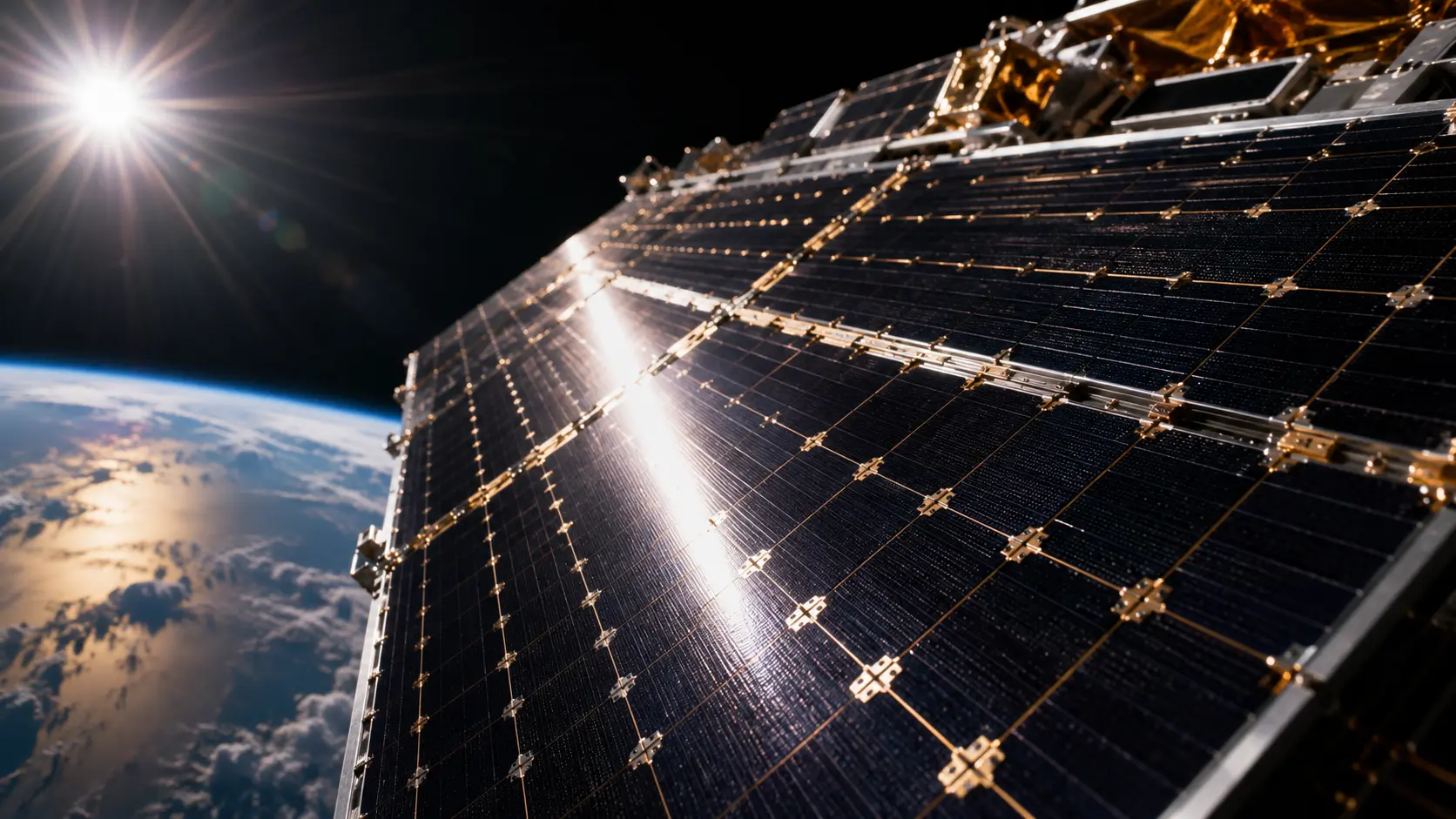
If you look at the solar panels on a multi-million-dollar satellite, they look entirely different. They have a dark, almost black mirror-like finish. These panels are not made of silicon; they are made of a synthetic material called Gallium Arsenide (GaAs).
Instead of being a single thick slab of material, a GaAs cell is a microscopic layer cake. Each layer acts like a customized net designed to catch a specific color of sunlight. The top layer catches blue light, the middle catches green and yellow, and the bottom catches red and infrared.
Because they capture almost the entire spectrum of light, they generate vastly more electricity per square inch than a normal solar panel. Furthermore, they are engineered to survive the brutal radiation of outer space. The trade-off is the cost. While a terrestrial silicon panel costs pennies per watt to manufacture, a space-grade GaAs panel costs hundreds of dollars per watt. It is a highly expensive, meticulously engineered solution to the problem of keeping spacecraft alive in the dark vacuum of orbit.
Why This Matters
A satellite without power is just space debris.
Every function of a modern spacecraft—from firing electric propulsion thrusters to transmitting high-bandwidth internet down to Earth—requires a massive, continuous electrical budget. But a satellite is heavily restricted by physics and economics. A launch vehicle like the Falcon 9 or Starship can only fit a satellite of a certain physical volume inside its payload fairing. If the satellite’s solar wings are too large, it will not fit inside the rocket, or it will create too much atmospheric drag in Low Earth Orbit (LEO), causing it to fall back to Earth prematurely.
This creates a strict engineering mandate: maximize the power output while minimizing the physical surface area.
Gallium Arsenide multi-junction cells answer this mandate. By 2026, leading aerospace manufacturers like Spectrolab and Azur Space are commercially producing cells that operate at 33% efficiency under the harsh, unfiltered light of space. In laboratory settings, advanced techniques like shingled matrix cell-to-cell contacts have pushed these III-V materials to 34.4% efficiency.
This efficiency dictates the financial viability of entire satellite constellations. A more efficient solar cell means the satellite requires fewer panels. Fewer panels mean less weight and a smaller deployment mechanism. This allows aerospace companies to launch more satellites on a single rocket, completely altering the unit economics of the orbital telecommunications industry.
The Big Picture
Before examining the micro-circuitry of a solar cell, we must understand the environment it operates within.
The light hitting Earth’s surface is filtered. Our atmosphere absorbs significant amounts of ultraviolet and infrared radiation. In the aerospace industry, this filtered light is called Air Mass 1.5 (AM1.5).
In space, there is no atmosphere. Satellites are exposed to the raw, unfiltered output of the sun, known as Air Mass Zero (AM0). The AM0 spectrum contains vastly more energy, but it also carries highly destructive, high-energy particles. When a satellite passes through the Van Allen radiation belts, it is bombarded by protons and electrons traveling at near light-speed.
Designing a power system for this environment requires abandoning terrestrial supply chains. The silicon industry is built for the AM1.5 spectrum and a benign environment. The aerospace industry relies on the III-V semiconductor family—elements from columns III and V of the periodic table, like Gallium, Indium, and Arsenic—to build devices that can harvest the AM0 spectrum while surviving the radiation bombardment of the cosmos.
HOW SPACE-GRADE SOLAR PANELS WORK
Extracting electricity from light in a high-radiation vacuum requires atomic-level precision engineering.
Here is exactly how aerospace engineers achieve maximum orbital power.
1. The Fundamental Problem
A solar cell generates electricity when a photon (a particle of light) hits a semiconductor atom and knocks an electron loose. However, light travels in different wavelengths (colors), each carrying a different amount of energy. To knock an electron loose, the photon must carry an exact minimum amount of energy, known as the material’s “bandgap.”
2. The Insufficiency of Silicon
Traditional silicon has a single bandgap. This creates two massive inefficiencies. First, if a low-energy red photon hits the silicon, it passes straight through without knocking an electron loose (wasted light). Second, if a high-energy blue photon hits the silicon, it knocks the electron loose, but the excess energy above the bandgap is instantly wasted as heat. This physical law, known as the Shockley-Queisser limit, permanently caps the efficiency of single-material solar cells.
3. The Core Mechanism: The Multi-Junction Stack
To bypass this limit, engineers use “multi-junction” cells. Instead of one material, they stack three different semiconductor materials on top of each other.
- The Top Layer (e.g., Gallium Indium Phosphide – GaInP): Has a wide bandgap. It acts as a net that captures the high-energy blue and ultraviolet photons, efficiently turning them into electricity while letting the rest of the light pass through.
- The Middle Layer (e.g., Gallium Arsenide – GaAs): Has a medium bandgap. It catches the green and yellow photons that passed through the top layer.
- The Bottom Layer (e.g., Germanium – Ge): Has a narrow bandgap. It catches the low-energy red and infrared photons that survived the first two layers.
4. Technical Depth: Epitaxial Growth and Lattice Matching
Stacking these materials is incredibly difficult. You cannot simply glue them together. The atomic crystal structure (the lattice) of each layer must align perfectly with the layer below it. If the atomic spacing does not match, it creates “dislocations”—microscopic cracks in the crystal. When a loose electron hits a crack, it gets trapped and never reaches the electrical wire, killing the cell’s efficiency.
To achieve perfect alignment, manufacturers use Metal-Organic Chemical Vapor Deposition (MOCVD). This process uses toxic, high-temperature gases to literally grow the solar cell atom by atom, creating a flawless, continuous crystal lattice across three entirely different chemical compounds.
5. Real-World Consequences: End-of-Life (EOL) Degradation
No matter how perfect the crystal lattice is on Earth, it will be destroyed in space. When a high-speed cosmic proton slams into the solar cell, it physically knocks Gallium and Arsenic atoms out of place, creating permanent damage. Over a 10-year mission, a 33% efficient cell might degrade to 26% efficiency. Aerospace engineers must calculate the satellite’s power requirements based entirely on this “End of Life” (EOL) efficiency metric, deliberately over-sizing the solar arrays before launch to ensure the satellite still has enough power to function a decade later.
Real-World Applications
Gallium Arsenide multi-junction technology is the exclusive power source for advanced orbital missions.
Low Earth Orbit (LEO) Megaconstellations: Companies launching thousands of internet-beaming satellites (such as Starlink or Project Kuiper) operate in low orbits where atmospheric drag is a constant threat. Silicon panels would require massive, drag-inducing wings to generate enough power for the high-bandwidth antennas. By using compact GaAs cells, the satellites maintain a slim profile, reducing drag and extending the lifespan of their orbital thrusters.
Deep Space Probes: Missions traveling away from the sun, such as the Jupiter Icy Moons Explorer (JUICE), face severe light starvation. At Jupiter’s orbit, sunlight is 25 times weaker than at Earth. Only ultra-efficient, highly sensitive multi-junction cells can extract enough electrical current from this faint light to power the probe’s scientific instruments and communication arrays.
Defense and Reconnaissance: Military early-warning satellites and highly classified optical reconnaissance platforms demand massive, sudden spikes in power to operate high-resolution radar and imaging systems. Space-grade GaAs arrays provide the intense power density required to rapidly charge the satellite’s onboard battery banks between transmission bursts.
Economic & Strategic Impact
The space solar market is defined by a massive disparity in manufacturing costs.
Terrestrial silicon solar panels benefit from massive global economies of scale, pushing the cost down to roughly $0.20 per watt. Space-grade multi-junction GaAs cells require expensive raw materials (like Germanium substrates), slow atom-by-atom MOCVD growth processes, and individual radiation testing. As a result, the cost frequently exceeds $200 to $300 per watt.
Despite this astronomical price tag, the economics justify the expense. Launching a kilogram of mass into orbit costs thousands of dollars. If an aerospace company uses cheap, heavy silicon panels, the increased launch mass will completely erase any savings on the solar cell itself. The industry optimizes entirely for “Specific Power” (Watts per Kilogram) and “Power Density” (Watts per Square Meter).
Strategically, the supply chain for III-V semiconductors is a national security priority. Both the United States and the European Union actively subsidize their domestic space-solar manufacturers (like Spectrolab in the US and Azur Space in Germany). Relying on foreign adversaries for the specialized metallurgy required to power military satellites is considered an unacceptable geopolitical risk.
Advantages
Extreme AM0 Efficiency
Modern triple-junction cells routinely convert over 30% of unfiltered orbital sunlight into usable electrical power, nearly doubling the maximum theoretical limits of space-rated silicon.
High Radiation Tolerance
The dense atomic structure of GaAs and related III-V compounds is inherently more resistant to proton and electron bombardment, ensuring the satellite maintains functional power levels throughout a 10 to 15-year orbital lifespan.
Favorable Temperature Coefficients
In space, solar panels can reach temperatures exceeding 100°C when in direct sunlight. Silicon panels lose significant voltage as they heat up. GaAs cells have a much lower temperature coefficient, allowing them to maintain high power output even under extreme thermal stress.
Limitations
Exorbitant Manufacturing Costs
The reliance on MOCVD equipment, expensive precursor gases, and complex lattice-matching constraints prevents these cells from achieving the massive cost reductions seen in the commercial silicon market.
Substrate Weight
The bottom layer of most modern cells is a thick wafer of Germanium. While Germanium is excellent for capturing infrared light and providing a structural base, it is physically heavy. This dead weight reduces the overall specific power (W/kg) of the final solar array.
Mechanical Brittleness
III-V semiconductor wafers are highly fragile. They must be carefully bonded to lightweight honeycomb panels and protected with microscopic layers of radiation-shielding coverglass (CICs), making the final array vulnerable to micro-meteoroid impacts and launch vibrations.
Common Misconceptions
Misconception: Solar panels in space are the same as solar panels on Earth, just packaged differently.
Reality: They use entirely different chemistry. Earth panels use silicon and capture the filtered AM1.5 spectrum. Space panels use III-V compounds (like GaAs) to capture the unfiltered AM0 spectrum and withstand cosmic radiation.
Misconception: Satellites use solar heat to generate power.
Reality: Photovoltaics generate power from light, not heat. In fact, heat is actively detrimental to solar cells. As the panel gets hotter in direct sunlight, its electrical efficiency drops.
Misconception: Space solar cells last forever because there is no weather in space.
Reality: Space is a highly corrosive environment. Atomic oxygen strips the protective coatings, extreme thermal cycling (-150°C to +100°C) cracks the wiring, and radiation systematically destroys the crystal lattice.
What Most People Miss
The future of aerospace power relies on turning the solar cell upside down.
The traditional limitation of a triple-junction cell is the heavy Germanium substrate at the bottom. To solve this, engineers developed the Inverted Metamorphic Multijunction (IMM) cell.
Instead of growing the cell from the bottom up, they grow it upside down on a temporary manufacturing wafer. Once the active, microscopic semiconductor layers are grown, they chemically dissolve the heavy manufacturing wafer entirely. What remains is a solar cell that is essentially a flexible sheet of plastic, only a few micrometers thick.
Because the dead weight of the substrate is removed, IMM cells provide a massive leap in specific power, jumping from traditional ratios to over 1,000 Watts per Kilogram. This allows satellites to roll out massive, flexible solar blankets in orbit, rather than unfolding rigid, heavy mechanical wings.
Comparison Table
| Feature | Terrestrial Silicon Cell | Triple-Junction Space Cell (GaAs) | Inverted Metamorphic (IMM) Cell |
| Primary Material | Silicon (Si). | GaInP / GaAs / Germanium. | GaInP / GaAs / InGaAs. |
| Bandgap Structure | Single Junction. | 3 to 4 Junctions. | 3 to 6 Junctions. |
| Typical Efficiency | ~20% – 24% (AM1.5). | 30% – 33% (AM0). | 32% – 35% (AM0). |
| Radiation Hardness | Very Low. | High. | Extremely High. |
| Physical Flexibility | Rigid (Glass/Silicon). | Rigid (Germanium substrate). | Highly Flexible (Thin-film). |
| Cost per Watt | ~$0.20/W. | >$200/W. | >$400/W. |
Case Study
Situation: The rapid expansion of Low Earth Orbit (LEO) telecommunications required companies to manufacture and deploy thousands of satellites per year.
Challenge: Historically, building a space-grade solar array was an artisanal, handcrafted process. Technicians manually welded the delicate GaAs cells, bypass diodes, and coverglass together into “CIC” (Cell, Interconnect, Coverglass) assemblies. This slow, manual process could not scale to support the production of ten satellites per week.
Solution: In 2026, leading manufacturers like Azur Space and Sierra Space fully commercialized Surface Mount Technology (SMT) for space solar cells. Instead of manual welding, the positive and negative contacts were moved entirely to the back of the GaAs cell.
Outcome: This allowed the aerospace industry to feed the solar cells into standard, high-speed automated “pick-and-place” robotics lines—the same machines used to print consumer computer motherboards.
Lessons Learned: The bottleneck in space commercialization was not just the chemical efficiency of the solar cells, but the physical packaging. By redesigning the cell for automated robotics (SMT), manufacturers slashed the assembly time of satellite wings from months to hours, enabling the rapid deployment of global megaconstellations.
Future Outlook
Next 12–24 Months
The adoption of SMT-compatible space cells will become the industry standard for LEO constellations. Manufacturers will focus heavily on reducing the thickness of the protective coverglass to shed excess weight, relying on the inherent radiation hardness of advanced 4-junction (4G32) architectures to maintain EOL performance targets.
Next 3–5 Years
Inverted Metamorphic (IMM) arrays will reach commercial maturity, shifting the industry away from rigid, folding honeycomb panels toward flexible “Roll-Out Solar Arrays” (ROSA). These ultra-lightweight blankets will be deployed using simple centrifugal booms, drastically reducing the mechanical complexity and failure risk of satellite deployment sequences.
Next 10 Years
The space industry will begin integrating Perovskite-GaAs tandem cells. Perovskites are incredibly cheap, highly efficient synthetic materials. Recent laboratory tests have shown promising radiation resistance in space environments. By coating a traditional GaAs cell with a microscopic layer of perovskite, engineers will create a low-cost, 4-junction cell that exceeds 35% AM0 efficiency without requiring the expensive, slow MOCVD growth process for the top layer.
Most Likely Scenario
Gallium Arsenide will remain the undisputed king of deep-space and high-radiation power generation. While the manufacturing costs will remain prohibitively high compared to terrestrial solar, the ongoing shift toward flexible substrates (IMM) and robotic assembly will maximize the Watts-per-Kilogram ratio, providing the exact power density required for humanity’s permanent return to the Moon and the subsequent expansion to Mars.
Key Takeaways
- Space-grade photovoltaics rely on multi-junction architectures, stacking different III-V materials (like GaAs) to capture the full spectrum of unfiltered sunlight.
- These cells bypass the physical efficiency limits of standard silicon, routinely exceeding 30% AM0 efficiency in orbit.
- The primary threat to a satellite’s power is cosmic radiation, which physically damages the atomic lattice of the solar cell over time.
- Satellites are engineered based on “End of Life” (EOL) efficiency, sizing the array to ensure it still produces enough power after a decade of radiation degradation.
- Lattice matching via MOCVD is required to grow flawless, continuous atomic crystals, driving the manufacturing cost to hundreds of dollars per watt.
- The shift to Surface Mount Technology (SMT) allows space panels to be built rapidly by automated robots rather than by manual technicians.
- Future advancements like Inverted Metamorphic (IMM) cells eliminate the heavy germanium substrate, creating ultra-efficient, flexible solar blankets.
Glossary
Air Mass Zero (AM0): The solar spectrum outside Earth’s atmosphere, representing the raw, unfiltered energy of the sun in the vacuum of space.
Bandgap: The exact amount of energy a photon must possess to knock an electron loose within a specific semiconductor material.
End of Life (EOL) Efficiency: The calculated power output of a solar array at the very end of a satellite’s mission, factoring in years of continuous radiation damage.
Epitaxial Growth: A highly complex manufacturing process that deposits semiconductor materials atom by atom to form a continuous, flawless crystal lattice.
Inverted Metamorphic Multijunction (IMM): An advanced solar cell grown upside down and stripped of its heavy substrate, resulting in a lightweight, flexible, highly efficient film.
MOCVD (Metal-Organic Chemical Vapor Deposition): The specific industrial machinery and chemical process used to grow III-V semiconductor wafers.
Shockley-Queisser Limit: The fundamental physics law that calculates the maximum theoretical efficiency of a solar cell made from a single material (roughly 33% for single-junction).
Frequently Asked Questions
Why are space solar panels black or dark purple?
They are coated with highly specialized anti-reflective layers. The goal of a solar cell is to absorb light; any light that bounces off is wasted energy. The dark color indicates that almost 100% of the visible spectrum is being successfully absorbed into the cell.
Do solar cells work better closer to the sun?
Yes and no. They receive vastly more raw light energy (irradiance), but they also become physically hotter. Because high heat causes electrical resistance and voltage drops within the cell, probes traveling to Mercury or Venus must carefully tilt their panels away from the sun to prevent overheating.
What happens when a satellite passes through Earth’s shadow?
The satellite enters an eclipse and loses all solar power. During this period, the spacecraft relies entirely on its internal lithium-ion battery banks, which were charged by the GaAs solar array while the satellite was in the sun.
How does a solar cell survive micro-meteoroid impacts?
Every individual cell is shielded by a microscopic layer of specialized space-grade glass (Coverglass). This glass protects the cell from microscopic debris and filters out certain wavelengths of destructive ultraviolet light.
Why don’t we use GaAs solar panels on Earth?
Cost. Equipping a standard house with space-grade GaAs panels would cost millions of dollars. Because real estate on Earth is cheap, it is far more economical to buy a large amount of cheap, inefficient silicon panels than a small amount of expensive, highly efficient GaAs panels.
What is a CIC assembly?
CIC stands for Cell, Interconnect, and Coverglass. It refers to the traditional, fully assembled single unit of a space solar cell before it is wired into a larger panel array.
How long does a satellite’s solar array last?
Most commercial communications satellites are designed for a 10 to 15-year operational lifespan. The solar arrays will physically continue to generate power after this, but their efficiency will have degraded significantly due to radiation exposure.
Sources
- Wikipedia: Solar-Cell Efficiency Profiles and Shingled Matrix Innovations (2026 Updates)
- Lucintel: Gallium Arsenide Solar Cell Market Report: Trends and Forecast to 2031
- Azur Space: 3G30-Advanced and 4G32 Space Solar Cell Configurations
- Spectrolab: XTE+ Multijunction Photovoltaic Technologies
- OAE Publishing Inc.: Perovskite Solar Cells for Low Earth Orbit Space Applications