Advertisement
)

At a Glance
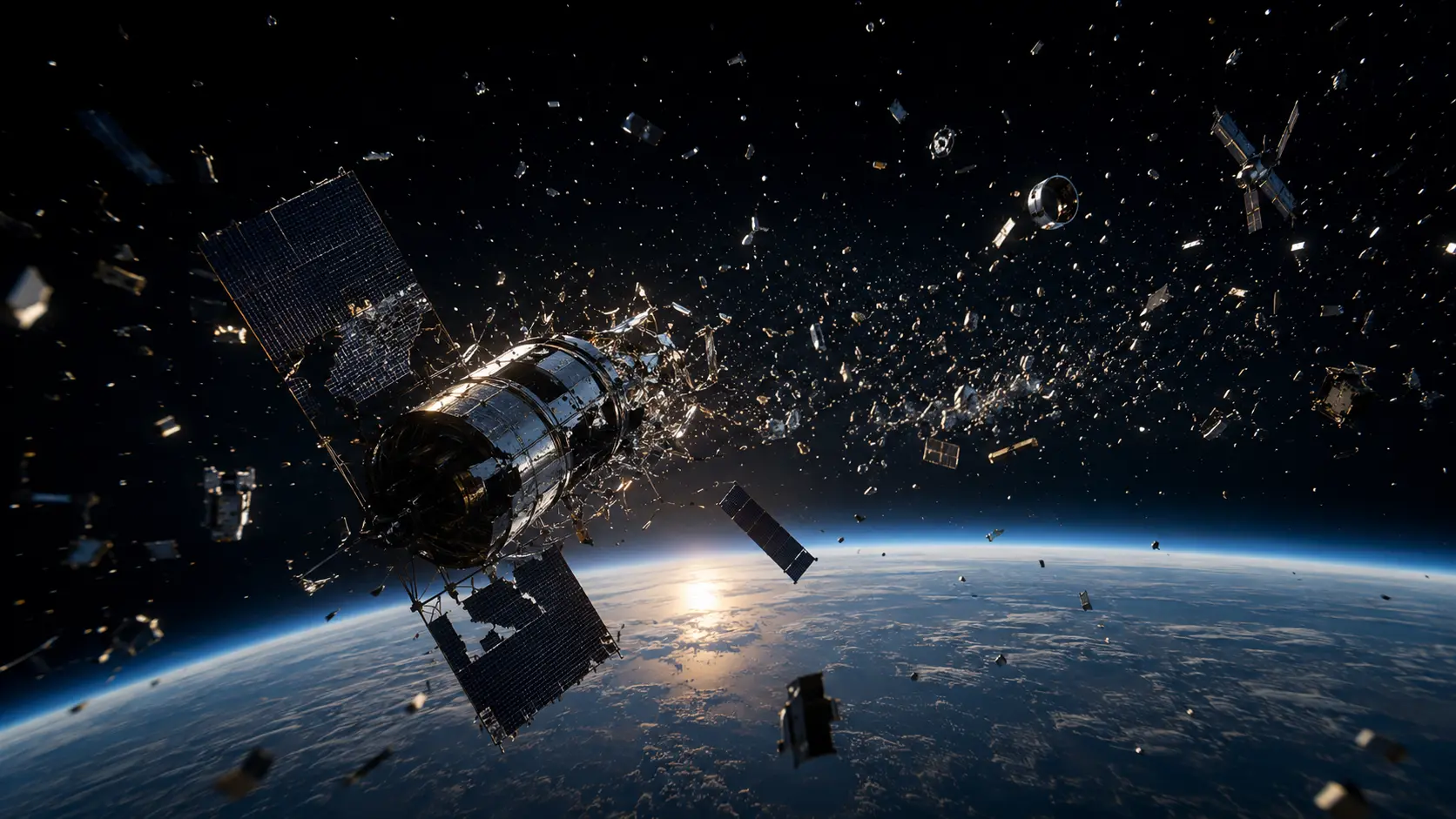
- Concept: An “ablation cascade” where artificial satellites collide, generating thousands of fragments that act as hypervelocity projectiles, causing further collisions in a runaway loop.
- Why it matters: The global economy relies on satellites for GPS, internet, weather tracking, and financial timestamping. Kessler Syndrome threatens to destroy this infrastructure and trap humanity on Earth.
- Who uses it: Aerospace engineers, defense strategists, and space traffic management algorithms.
- Biggest takeaway: Unlike Hollywood movies, Kessler Syndrome does not happen in a single afternoon. It is a slow, mathematical decay that plays out over decades, and researchers warn we may have already crossed the tipping point.
In Simple Words
Space is incredibly vast, but the specific “highways” around Earth where satellites live are narrow and increasingly crowded.
To stay in orbit and not fall back to Earth, a satellite in Low Earth Orbit (LEO) must travel at roughly 17,500 miles per hour (7.8 kilometres per second). At that extreme speed, there is no such thing as a “fender bender.” If two satellites collide, they do not just bounce off each other; they instantly shatter into tens of thousands of microscopic pieces of shrapnel.
Because space is a vacuum with no air resistance, this shrapnel does not slow down. It continues orbiting the Earth at 17,500 mph.
In 1978, NASA scientist Donald Kessler ran the math on this problem. He realized that if space gets crowded enough, one collision creates a cloud of shrapnel. That shrapnel spreads out and hits three more satellites. Those three satellites explode, creating more shrapnel, which hits ten more satellites. Eventually, the entire orbit becomes a blinding sandstorm of metal flying at ten times the speed of a rifle bullet, destroying every satellite in the sky and making it a suicide mission to launch future rockets through the debris field.
Why This Matters
As of June 2026, the European Space Agency (ESA) estimates there are over 16,100 functioning satellites in Earth’s orbit, operating alongside more than 16,600 tonnes of dead rocket bodies and orbital trash.
This matters because humanity is currently executing the most aggressive expansion into space in history. Commercial megaconstellations are launching thousands of units per year to provide global broadband. But space has no borders and no centralized air traffic control. The sky is an unregulated commons.
If Kessler Syndrome is fully triggered, the economic and societal consequences are apocalyptic. The loss of GPS alone would paralyze the global shipping industry, ground commercial aviation, and crash the international banking system, which relies on satellite timestamps to clear high-frequency trades. Earth observation satellites used to predict hurricanes, monitor crop yields, and detect military troop movements would be wiped out. Securing the orbital environment from a cascading collision is not just an environmental issue; it is a tier-one geopolitical security mandate.
The Big Picture
The orbital debris environment is divided into three distinct risk categories based on size.
Modern ground-based radars (like the U.S. Space Surveillance Network) can track objects larger than 10 centimetres. As of 2026, there are roughly 46,130 of these trackable objects in the catalogue. If a tracked object is on a collision course with the International Space Station (ISS), the station fires its thrusters and moves out of the way.
On the other extreme, objects smaller than 1 millimetre (like paint flecks) are harmlessly absorbed by heavy physical shielding (Whipple shields) built into modern spacecraft.
The catastrophic threat lies in the middle: objects between 1 and 10 centimetres. ESA statistical models estimate there are roughly 1.2 million of these “lethal untrackables” currently orbiting Earth. They are too small for ground radars to see, but too massive for physical shields to stop. A single 1-centimetre aluminium sphere hitting a satellite at 10 kilometres per second carries the kinetic energy equivalent of a hand grenade.
HOW KESSLER SYNDROME WORKS
Understanding how a single collision destroys an entire orbit requires understanding the strict physics of kinetic energy and atmospheric drag.
1. The Fundamental Problem: Orbital Velocity
In Low Earth Orbit, objects travel at 7.8 km/s. In a head-on collision between two satellites traveling in opposite directions, the closing velocity can exceed 15 km/s (54,000 km/h). The destructive power is governed by the kinetic energy formula: KE = ½mv². Because velocity is squared, the speed is far more lethal than the mass. At 15 km/s, the energy released vaporizes metal on impact.
2. The Insufficiency of Infinite Space
People assume space is too big for things to hit each other. However, satellites are not placed randomly. To perform specific jobs—like mapping the Earth at the exact same time every day—thousands of satellites are squeezed into identical “Sun-Synchronous Orbits” at an altitude of 700 to 1,000 kilometres. This creates dense, high-traffic intersections where collision probabilities spike.
3. The Core Mechanism: The Ablation Cascade
When two objects collide at hypervelocity, they experience catastrophic fragmentation. A 1,000-kilogram satellite does not break into five large pieces; it atomizes into tens of thousands of jagged fragments. This single event drastically increases the mathematical density of the orbital plane. The original collision was an accident, but the resulting debris cloud guarantees the next collision is a statistical certainty. This chain reaction is the Ablation Cascade.
4. Technical Depth: Covariance and Conjunction Assessment
To prevent collisions, operators use Conjunction Assessment algorithms. Ground radars produce a “Two-Line Element” (TLE) predicting a satellite’s path. However, radar is not perfect. The prediction creates a “covariance ellipsoid”—a 3D bubble of probability showing where the satellite might be. When two bubbles intersect, computers calculate the Probability of Collision (Pc). If Pc exceeds 1 in 10,000, operators burn precious fuel to execute a Collision Avoidance Maneuver (CAM).
5. Real-World Consequences: The Drag Bottleneck
If debris is created below 600 kilometres, atmospheric drag (friction from the very thin upper atmosphere) will slow the debris down, causing it to safely burn up in Earth’s atmosphere within a few years. However, above 700 kilometres, the atmosphere is too thin to provide meaningful drag. Debris generated at this altitude will remain lethal for decades or centuries. If a cascade starts at 900 kilometres, physics dictates that the orbit will be permanently ruined for multiple human generations.
Real-World Applications
Aerospace engineers are deploying advanced hardware and software to mitigate the debris threat.
Active Debris Removal (ADR): Leaving dead satellites in orbit is no longer acceptable. Space agencies are actively funding robotic garbage trucks. The European Space Agency’s ClearSpace-1 mission, targeted for the 2026 timeframe, is designed to intercept a dead rocket upper stage using a robotic “space claw,” grappling the debris and intentionally dragging it down into the atmosphere to burn up.
Autonomous Avoidance Systems: Megaconstellations like SpaceX’s Starlink are too massive for human operators to fly manually. They utilize onboard AI and autonomous propulsion. The satellites continuously ingest tracking data from the U.S. Space Force and autonomously fire their krypton/argon ion thrusters to dodge incoming debris without human intervention.
Design for Demise (D4D): Satellite manufacturers now engineer their spacecraft to guarantee complete disintegration upon atmospheric reentry. By replacing titanium components with specialized aluminium alloys, engineers ensure that when the satellite reaches the end of its life and reenters the atmosphere, no large chunks of metal survive the heat to strike populated areas on Earth.
Economic & Strategic Impact
The Kessler Syndrome acts as a heavy tax on the global space economy.
To operate in LEO, telecommunications companies must purchase complex space insurance policies. As the density of the 700-1,000 km band increases, insurance underwriters raise premiums to account for the heightened risk of a lethal, untrackable strike. Furthermore, satellites must now be launched with 10% to 15% more fuel reserved strictly for dodging debris and executing a final de-orbit burn. This excess fuel adds dead weight, costing companies millions in lost payload capacity per launch.
Regulatory bodies have stepped in forcefully. The U.S. Federal Communications Commission (FCC) recently overhauled its orbital debris rules. Previously, operators had 25 years to de-orbit a dead satellite. Today, the FCC mandates a strict “5-Year Rule,” requiring all domestic LEO satellites to be removed from orbit within 5 years of mission completion.
Strategically, space debris is a weapon. Anti-Satellite (ASAT) missile tests conducted by China (2007) and Russia (2021) intentionally blew up their own dead satellites, generating thousands of pieces of lethal, long-lasting debris. The global intelligence community views the intentional creation of space debris as a highly aggressive asymmetric warfare tactic designed to deny orbital access to adversaries.
Advantages
- Forces Technological Innovation: The threat of a cascading collision has single-handedly spawned an entirely new commercial industry focused on space domain awareness, commercial radar networks (like LeoLabs), and orbital robotics.
- Drives International Law: Because the debris cloud threatens all nations equally, it acts as a rare catalyst for global geopolitical cooperation, such as the Inter-Agency Space Debris Coordination Committee (IADC) mitigation guidelines.
- Promotes Sustainable Engineering: The requirement to maneuver and de-orbit is ending the era of “throwaway” aerospace engineering, forcing companies to design more efficient, sustainable propulsion systems.
Limitations
- The Untrackable Threat: No amount of software can dodge a 5-centimetre bolt traveling at Mach 22 if the ground radar cannot see it coming.
- The Cost of Cleanup: Active Debris Removal is astronomically expensive. Spending $100 million to launch a robotic claw to capture a single $50,000 dead rocket body breaks commercial unit economics.
- Fuel Constraints: Satellites have finite fuel tanks. If the orbital environment becomes too dense, a satellite may run out of fuel simply dodging debris, leaving it stranded as a dead, uncontrolled hazard.
Common Misconceptions
Misconception: Kessler Syndrome happens all at once, like an explosion.
Reality: Hollywood movies like Gravity compress the cascade into minutes for dramatic effect. In reality, an ablation cascade unfolds over years or decades. One collision happens today, the resulting debris cloud hits a second satellite three years later, which hits a third satellite a decade later. It is a slow, creeping cancer, not a sudden explosion.
Misconception: Debris stays in orbit forever.
Reality: It depends on altitude. Debris in extreme LEO (under 500 km) is dragged down by the atmosphere and burns up within months or years. Debris in Geostationary Orbit (GEO at 35,786 km) experiences no drag and will stay there for millions of years.
Misconception: We can use lasers from Earth to vaporize the space junk.
Reality: Firing high-powered lasers through the atmosphere diffuses their energy. While some theoretical models suggest lasers could be used to gently “nudge” debris into a lower orbit by altering its momentum, using them to outright vaporize metal at a distance of 1,000 kilometres is currently physically impossible.
What Most People Miss
Solar weather completely dictates the timeline of Kessler Syndrome.
The Sun goes through an 11-year cycle of activity. During a “Solar Maximum,” the Sun emits massive amounts of radiation, heating up the Earth’s upper atmosphere. When the atmosphere heats up, it physically expands outward into space.
This is highly beneficial for space debris mitigation. When the atmosphere expands, it reaches up and grabs low-orbiting space junk, significantly increasing the atmospheric drag and flushing thousands of pieces of debris out of the sky to burn up safely. Conversely, during a “Solar Minimum,” the atmosphere shrinks, the drag disappears, and the debris lingers, accelerating the statistical risk of a collision cascade.
Comparison Table
| Orbital Regime | Altitude | Debris Decay Time | Primary Risk Factor |
| Low LEO | < 600 km | Months to a few years. | High traffic density (Megaconstellations/ISS). |
| High LEO | 700 – 1,000 km | Decades to centuries. | Severe congestion; prime zone for Kessler cascade. |
| Medium Earth Orbit (MEO) | ~ 20,000 km | Thousands of years. | Navigation satellites (GPS) sharing overlapping planes. |
| Geostationary Orbit (GEO) | 35,786 km | Millions of years. | Zero atmospheric drag; objects must be pushed to a graveyard orbit. |
Case Study
Situation: Prior to 2009, aerospace engineers considered hypervelocity collisions between two intact satellites to be a mathematical improbability.
Challenge: On February 10, 2009, an active American communications satellite (Iridium 33) and a dead, uncontrolled Russian military satellite (Kosmos-2251) were both traveling at roughly 7.5 km/s at an altitude of 789 kilometres over Siberia.
Solution (The Failure): At the time, global space traffic management was primitive. While predictive algorithms showed a close approach, the specific “Probability of Collision” was deemed too low to waste the precious fuel required for the Iridium satellite to execute an avoidance maneuver.
Outcome: The two satellites collided in a nearly head-on intersection at a closing speed of 11.7 km/s. They instantly atomized, generating a massive cloud of over 2,000 trackable fragments and hundreds of thousands of lethal, untrackable pieces of shrapnel.
Lessons Learned: The 2009 Iridium-Kosmos collision proved that space is no longer big enough to rely on luck. It forced the United States military to drastically upgrade its Space Surveillance Network and begin proactively sharing precise conjunction data (collision warnings) with commercial satellite operators globally. The event officially verified the early mechanics of Donald Kessler’s 1978 hypothesis.
Future Outlook
Next 12–24 Months
The volume of orbital traffic warnings will overwhelm human operators. With over 16,000 active payloads in orbit, Space Traffic Management (STM) will transition entirely to automated, AI-driven platforms. Cloud-based algorithms will dictate collision avoidance maneuvers directly to satellites in real-time, completely bypassing manual ground control.
Next 3–5 Years
Active Debris Removal (ADR) will transition from theoretical proof-of-concept into a monetized commercial service. Governments and regulatory bodies will begin levying heavy fines on aerospace companies that abandon upper-stage rockets in orbit. This will incentivize companies to pay third-party robotics firms (like Astroscale or ClearSpace) a premium fee to grapple and de-orbit their legacy space junk.
Next 10 Years
We will witness the establishment of orbital toll roads and strict zoning laws. The “Wild West” era of space will end. International treaties will force operators to pay access fees to launch into the highly congested 700-1,000 km bands. Spacecraft launched into these critical zones will be legally mandated to carry standardized, hack-proof autonomous docking plates to guarantee they can be easily towed away if their internal engines fail.
Most Likely Scenario
Humanity will not lose access to space entirely, but the cost of doing business in Low Earth Orbit will skyrocket. The Ablation Cascade is likely already underway in specific high-density bands. In the 2030s, certain orbital altitudes will be officially declared “condemned zones,” completely restricted from new satellite deployments until heavily subsidized, fleet-scale robotic cleaning operations can scrub the shrapnel from the sky.
Key Takeaways
- Kessler Syndrome is an “ablation cascade” where one collision creates debris that triggers subsequent collisions, exponentially multiplying the amount of space junk.
- The primary danger is not the mass of the debris, but its kinetic energy; a 1-centimetre object traveling at orbital velocity (7.8 km/s) hits with the force of a grenade.
- Ground radars can track objects over 10cm, allowing satellites to dodge. Physical shielding stops objects under 1mm. The lethal threat is the estimated 1.2 million untrackable fragments between 1 and 10cm.
- Atmospheric drag naturally cleans extreme Low Earth Orbit, but debris above 700 kilometres will remain a lethal hazard for decades or centuries.
- To prevent the cascade, regulators like the FCC now enforce a strict “5-Year Rule,” legally requiring companies to de-orbit dead satellites promptly.
- The 2009 collision between Iridium 33 and Kosmos-2251 proved the cascade theory is real, generating thousands of pieces of shrapnel still threatening satellites today.
Glossary
Ablation Cascade: The scientific term for Kessler Syndrome; a chain reaction where hypervelocity collisions generate debris that causes further collisions.
Active Debris Removal (ADR): The deployment of specialized robotic spacecraft designed to physically capture and de-orbit dead satellites and rocket bodies.
Conjunction Assessment: The mathematical process of analyzing orbital trajectories to determine if two space objects will closely intersect.
Design for Demise (D4D): An engineering philosophy where satellites are built using materials that guarantee complete vaporization upon atmospheric reentry, preventing danger to populated areas.
Kinetic Energy: The energy an object possesses due to its motion. In space, extreme velocity makes even microscopic mass highly destructive ($KE = \frac{1}{2}mv^2$).
Low Earth Orbit (LEO): The region of space below an altitude of roughly 2,000 kilometres, hosting the vast majority of active satellites and space debris.
Two-Line Element (TLE): A standardized text format used by military and civilian radars to encode the orbital elements of an Earth-orbiting object for trajectory prediction.
Frequently Asked Questions
Can a piece of space debris fall and hit me on Earth?
It is extremely unlikely. The vast majority of satellites are designed to completely burn up from extreme friction when they reenter the Earth’s atmosphere. Very rarely, large, dense components (like titanium fuel tanks) survive and strike the ground, but most Earth surface is ocean or uninhabited land.
Why don’t we just shoot the debris with missiles?
Shooting a satellite with a missile (an Anti-Satellite or ASAT test) is the absolute worst thing you can do. The explosion does not vaporize the satellite; it breaks it into 10,000 smaller, untrackable pieces of debris, drastically accelerating Kessler Syndrome.
Will Kessler Syndrome trap us on Earth forever?
No. Even in a worst-case scenario, the debris is concentrated in specific orbital bands (like 800 km). Rockets traveling to the Moon or Mars pass through these bands in a matter of minutes. The risk of being hit during a 5-minute transit is mathematically minuscule compared to a satellite living in that band for 10 years.
Who cleans up the space junk?
Currently, no one. It is an international tragedy of the commons. However, space agencies (like ESA) and private startups are currently developing the first commercial garbage-collector satellites to begin actively cleaning the most dangerous dead rocket bodies by the late 2020s.
If space is a vacuum, what causes atmospheric drag?
Space does not begin as a perfect vacuum immediately. The Earth’s atmosphere fades away gradually. In Low Earth Orbit, there are still microscopic traces of oxygen and nitrogen molecules. At 17,500 mph, hitting these sparse molecules creates enough friction to slowly drag a satellite downward over months or years.
How does the ISS survive the debris?
The International Space Station is the most heavily shielded object in orbit, covered in multi-layered “Whipple Shields” that shatter and absorb sub-centimetre impacts. For larger, trackable debris, the station routinely fires its engines to change its altitude and dodge the incoming threat.
Sources
- European Space Agency (ESA): Space Environment Statistics (June 2026)
- United Nations Office for Outer Space Affairs (UNOOSA): IADC Report on the Status of the Space Debris Environment (January 2026)
- Space Daily: The Kessler Syndrome Threshold (July 2026)
- Federal Communications Commission (FCC): Orbital Debris Mitigation and 5-Year De-orbit Rule