Advertisement
)

At a Glance
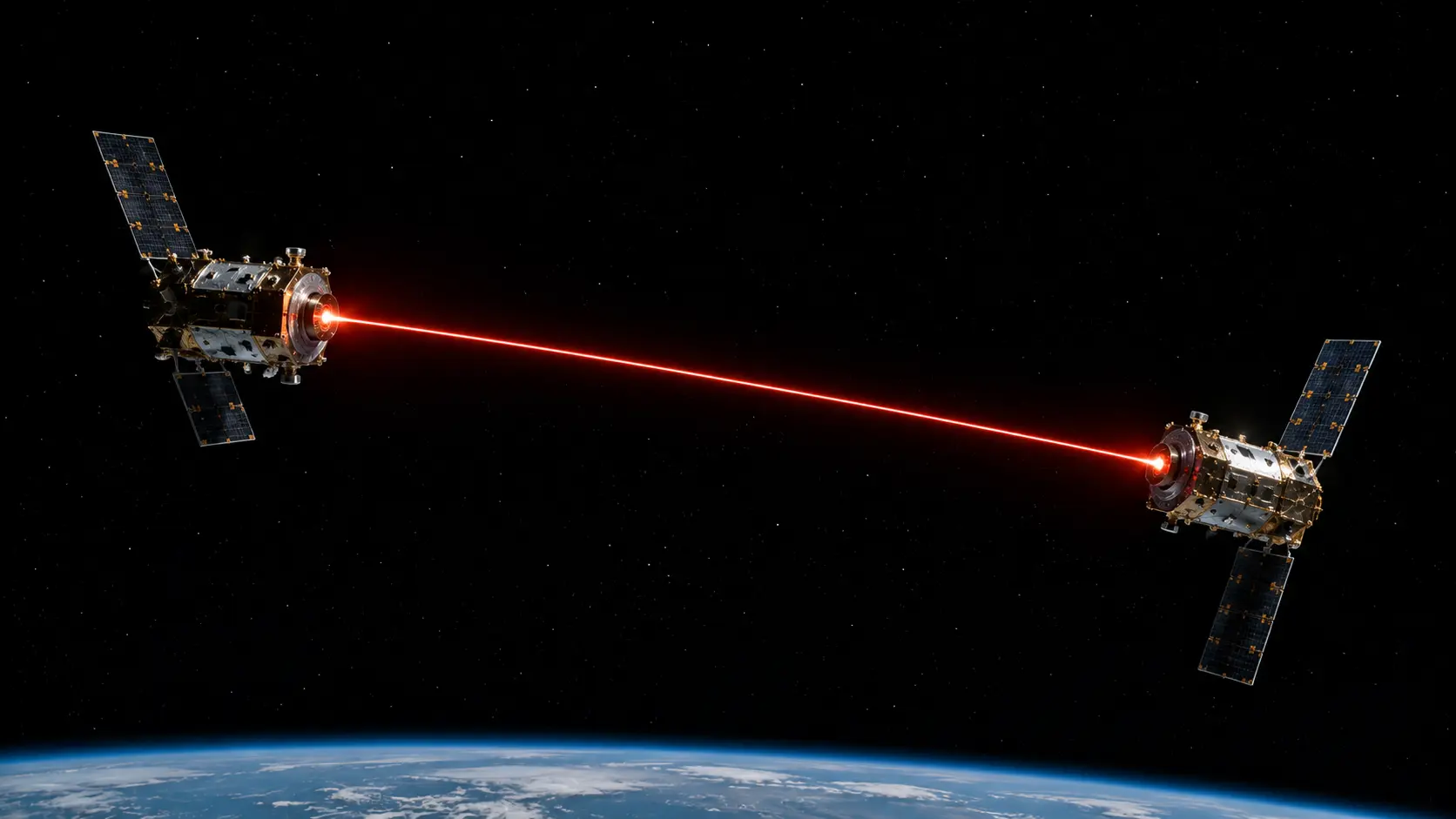
- Concept: Replacing traditional radio wave communications with invisible laser beams to shoot data point-to-point between moving satellites in orbit.
- Why it matters: Terrestrial fiber-optic cables slow light down by roughly 33 percent. Because OISLs operate in the vacuum of space, data travels at the absolute speed of light. For long-haul global routes, this shaves critical milliseconds off transmission times, revolutionizing High-Frequency Trading (HFT) and global military communications.
- Who uses it: SpaceX (Starlink), Amazon (Project Kuiper), and the U.S. Department of Defense (via the Space Development Agency’s PWSA network) alongside optical terminal manufacturers like Mynaric, Tesat, and CACI.
- Biggest takeaway: OISLs transform satellites from simple “mirrors” that bounce signals back to Earth into active “routers” in the sky. This eliminates the need to build vulnerable ground stations in hostile or remote territories.
In Simple Words
For the last 50 years, satellite internet worked like a giant mirror. If you wanted to send an email from a ship in the middle of the ocean, your dish beamed a radio signal up to a satellite, and that satellite immediately bounced it back down to a massive ground station on land. If there was no ground station nearby, you had no internet.
Optical Inter-Satellite Links (OISLs) change the entire architecture.
Instead of bouncing signals immediately back to Earth, modern satellites are equipped with highly advanced laser pointers. When you send that email from the ship, the satellite receives it, translates it into light, and fires a laser beam to another satellite 2,000 miles away. That satellite fires it to another, creating a chain of light that wraps entirely around the globe in a fraction of a second. The data only drops back down to Earth when it is directly above its final destination. Because this light travels through the empty vacuum of space, it is significantly faster than data traveling through the glass cables at the bottom of the ocean.
Why This Matters
The commercial and geopolitical implications of OISLs are staggering. The global OISL market, valued at roughly USD 2.1 billion in 2025, is projected to scale at a massive 28 percent Compound Annual Growth Rate (CAGR) over the next decade.
For the military, radio frequency (RF) signals are highly vulnerable. Adversaries can easily detect radio waves to locate a transmitter, and they can jam the broad frequencies to cut off communications. A laser, however, is a microscopic, invisible beam of light traveling point-to-point in space. It is mathematically nearly impossible to intercept or jam unless an enemy spacecraft physically positions itself directly in the beam’s incredibly narrow path.
For the commercial tech sector, OISLs break the tyranny of geography. Hyperscalers no longer need to negotiate with foreign governments to build vulnerable fiber-optic landing stations on sovereign beaches. The internet backbone has officially migrated into Low Earth Orbit (LEO), enabling secure, low-latency connectivity to the most remote oceans, polar caps, and contested regions on Earth.
The Big Picture
The evolution of the space internet is moving from “Mega-Constellations” to “Mesh Networks.”
When SpaceX first launched Starlink, the satellites were isolated. They provided great local coverage, but relied entirely on terrestrial infrastructure to route global traffic. By aggressively retrofitting their entire constellation with laser crosslinks—resulting in over 5,500 active laser-equipped satellites by mid-2026—SpaceX built the largest optical mesh network in human history.
This success triggered a frantic response from the defense sector. Recognizing that commercial space was outpacing military capabilities, the Pentagon established the Space Development Agency (SDA) to build the Proliferated Warfighter Space Architecture (PWSA). Instead of relying on a few massive, billion-dollar satellites, the military is now deploying hundreds of cheaper, disposable satellites permanently chained together by lasers. This ensures that if one satellite is shot down, the laser mesh instantly reroutes the data around the damaged node, creating an unkillable, self-healing nervous system for the military.
How Optical Inter-Satellite Links Works
Shooting a laser between two objects moving at orbital velocities requires a mastery of optics, kinetics, and quantum mechanics. Here is the first-principles breakdown.
1. The Fundamental Problem: The Bent-Pipe Bottleneck
Traditional communications satellites operate on a “bent-pipe” architecture using Radio Frequency (RF). RF beams are wide and messy. They spread out over distance, requiring massive antennas to catch the signal, and compete for highly congested spectrum bandwidth. Furthermore, the signal must bounce down to a terrestrial ground station immediately, adding latency and geographical constraints.
2. The Insufficiency of Microwave Crosslinks
Early attempts to connect satellites in space used microwave crosslinks. However, the data throughput was terribly low, and the antennas were large and power-hungry. To achieve the 100 Gigabits per second (Gbps) speeds required by modern cloud computing and sensor-to-shooter military targeting, the wavelength of the transmission had to shrink drastically.
3. The Core Mechanism: Optical Laser Terminals
OISLs replace radio waves with near-infrared lasers (typically operating around the 1550-nanometer wavelength). A satellite is equipped with an optical terminal featuring a telescope and a laser emitter. The data is encoded into the light pulses. Because the wavelength of light is so incredibly small, the beam remains tightly focused over thousands of kilometers, allowing massive amounts of data to be packed into the transmission without spreading out or degrading.
4. Technical Depth: PAT and Doppler Compensation
Operating an OISL involves two extreme engineering challenges:
- Pointing, Acquisition, and Tracking (PAT): Hitting a receiving satellite moving at 27,000 kilometers per hour from 5,000 kilometers away requires tracking accuracy measured in microradians. This is equivalent to hitting a dime with a laser pointer from dozens of miles away. Fast-steering mirrors mounted on ultra-precise gimbals make micro-adjustments thousands of times a second to keep the beam locked on target.
- Doppler Shift Compensation: Because the two satellites are in different orbital planes, they are constantly accelerating toward or away from each other. This relative velocity causes the light waves to stretch or compress (the Doppler effect). The optical transceiver must dynamically compensate for this frequency shift in real-time, or the receiving modem will fail to decode the data stream.
5. Real-World Consequences: Latency Arbitrage
Because light travels roughly 47 percent faster in a vacuum than it does in solid glass, the physics are absolute: a signal routed through an OISL space mesh between London and Tokyo will arrive fractions of a second faster than a signal routed through a submarine fiber-optic cable. This physical phenomenon is unlocking new paradigms in high-frequency algorithmic trading, where shaving a single millisecond off a transatlantic trade yields millions of dollars in arbitrage profits.
Real-World Applications
The technology has officially graduated from experimental defense projects into high-volume commercial manufacturing.
SDA Proliferated Warfighter Space Architecture (PWSA): The U.S. military is deploying hundreds of satellites in Low Earth Orbit to track advanced threats, including hypersonic glide vehicles. In September 2025, the SDA launched the first satellites for Tranche 1. These satellites use OISLs to pass targeting data instantly from a tracking satellite over the Pacific directly to a weapons platform over the Atlantic, entirely bypassing ground infrastructure.
Mega-Constellation Backbones: Amazon’s Project Kuiper, approved for over 3,200 satellites and ramping up manufacturing in 2026, is fundamentally reliant on OISL technology to compete with Starlink. By equipping every satellite with optical terminals, these mega-constellations can offer enterprise-grade, highly secure intranet services to multinational corporations, completely bypassing the public, terrestrial internet.
Earth Observation Data Relay: Commercial satellite imagery companies historically had to wait until their imaging satellite flew over a friendly ground station to download pictures of the Earth. By plugging their imaging satellites directly into a commercial OISL relay network, they can beam high-resolution imagery back to Earth in real-time, providing instant intelligence on natural disasters or military movements.
Economic & Strategic Impact
The proliferation of OISLs is creating a massive new hardware supply chain, shifting value away from traditional RF antenna manufacturers toward precision optical engineering firms.
Prior to 2022, building an optical space terminal was a bespoke, multi-million-dollar artisanal process. Today, companies like Mynaric and Tesat are adopting automotive-style assembly lines to mass-produce these terminals at drastically lower costs. The SDA’s aggressive procurement strategy—awarding nearly USD 10 billion for Tranche 1 and Tranche 2 development—has artificially subsidized this manufacturing scale-up.
Strategically, OISLs redefine digital sovereignty. Authoritarian regimes have historically controlled their populations by monitoring and choking physical fiber-optic cables at the national border. A fully laser-meshed space internet operates entirely above sovereign airspace. Citizens equipped with smuggled user terminals can access a global, un-censorable internet, fundamentally eroding the effectiveness of terrestrial digital firewalls.
Advantages
- Absolute Speed: Data travels at nearly 300,000 kilometers per second in the vacuum of space, physically beating the latency of solid glass subsea cables.
- Immunity to Jamming: Because the laser beam is incredibly narrow and tightly focused, it is mathematically nearly impossible for adversaries to jam or intercept the signal from the ground.
- Ground Station Independence: Satellites can route data entirely around the Earth in space, providing high-speed connectivity to deep oceans, polar regions, and denied airspace where building ground stations is impossible.
- Spectrum Relief: Traditional RF communication is heavily regulated by the ITU, and the spectrum is crowded. Laser light operates outside of these congested radio frequencies, providing virtually unlimited, unregulated bandwidth.
Limitations
- Cloud Cover Attenuation: While OISLs are flawless between satellites in the vacuum of space, using lasers to beam data from space down to Earth (Space-to-Ground optical links) is severely limited. Clouds, fog, and atmospheric turbulence scatter the light, forcing networks to still rely on RF for the final connection to the user’s dish.
- PAT Complexity: The Pointing, Acquisition, and Tracking mechanisms require incredibly delicate moving parts (gimbals and fast-steering mirrors). If a micrometeorite strike or extreme thermal variance damages these micro-mechanics, the laser link is permanently severed.
- Interoperability Challenges: A February 2025 GAO report highlighted that integrating optical terminals from different manufacturers (e.g., making a Mynaric terminal talk to a Tesat terminal) remains a software and alignment headache, causing initial delays in the military’s Tranche 0 demonstration phase.
Common Misconceptions
Misconception: Satellite internet is always slower than fiber optics.
Reality: While the “last mile” from the satellite to your house adds minor latency, the long-haul journey through the space mesh is actually faster. For routes like New York to Singapore, a fully optimized OISL network is physically faster than subsea fiber cables.
Misconception: The lasers can be weaponized to burn things on Earth.
Reality: These are communications lasers operating at very low power levels (often under 5 watts). They are designed for data transmission, not kinetic destruction, and they would instantly scatter into harmless heat if pointed into the Earth’s thick atmosphere.
Misconception: OISL networks are a military-only technology.
Reality: While the military is heavily funding the R&D, SpaceX currently operates the largest commercial OISL network in existence. The technology is rapidly commoditizing for civilian and commercial enterprise use.
What Most People Miss
The geopolitical weaponization of the Optical Standard.
Just as the world fought over 5G telecom standards on Earth, a quiet war is raging over the optical standards in space. The SDA established a baseline standard for interoperability, forcing defense contractors to ensure their lasers can talk to each other. However, if a massive commercial entity like SpaceX refuses to adopt the open standard and locks its massive network behind a proprietary optical protocol, it could create an Apple-versus-Android scenario in Low Earth Orbit. The entity that dictates the standard protocol for how lasers “handshake” in space will control the tolls for the 21st-century space economy.
Comparison Table
| Feature | Terrestrial Fiber Optic Cable | Traditional Satellite (RF Bent-Pipe) | Space Mesh (OISL) |
| Transmission Medium | Solid Silica Glass | Radio Waves | Vacuum of Space |
| Speed of Light | ~200,000 km/s | ~300,000 km/s | ~300,000 km/s |
| Jamming / Intercept Risk | High (Physical tapping) | High (Electronic warfare) | Extremely Low |
| Ground Station Dependency | Absolute | Absolute | Zero (In-orbit routing) |
| Primary Limitation | Geopolitics / Deep ocean trenching | Congested spectrum / Latency | High terminal cost / PAT precision |
Case Study
Situation: The U.S. Department of Defense realized that its legacy satellite communications and missile warning systems were highly vulnerable. They relied on large, billion-dollar satellites that acted as single points of failure, and the data had to be beamed down to vulnerable foreign ground stations, creating dangerous delays in the sensor-to-shooter kill chain.
Challenge: The military needed to build an un-jammable, resilient intranet in space that could globally track advanced threats (like hypersonic glide vehicles) and instantly pass targeting data to weapons platforms, regardless of whether ground stations were destroyed.
Solution (The PWSA Tranche 1 Rollout): The Space Development Agency launched the Proliferated Warfighter Space Architecture. Rather than relying on a single defense prime, the SDA utilized an iterative acquisition model. Despite a February 2025 GAO report indicating that the initial Tranche 0 had struggled to fully demonstrate the mesh network capabilities, the SDA aggressively pushed forward, launching the first Tranche 1 satellites in September 2025 equipped with advanced optical terminals from Mynaric, Tesat, and CACI.
Outcome: The deployment initiated the first true, multi-vendor military mesh network in Low Earth Orbit. By linking hundreds of tracking and transport satellites via OISLs, the SDA created a system where data can bounce continuously around the globe in a fraction of a second. If an adversary attempts to shoot down a satellite with an anti-satellite (ASAT) missile, the optical network instantly heals itself, rerouting the laser connection to the next available satellite in the constellation.
Lessons Learned: The case study proved that achieving space superiority requires abandoning monolithic hardware. By prioritizing modular optical terminals and enforcing interoperability standards, the military successfully transitioned its communications infrastructure from a fragile, hardware-centric architecture to a dynamic, software-defined optical mesh.
Future Outlook
Next 12–24 Months
The industry will brutally focus on achieving perfect multi-vendor interoperability. As the SDA continues its monthly Tranche 1 launches throughout 2026, the success of the PWSA hinges entirely on proving that a Lockheed Martin satellite can instantly laser-handshake with a Northrop Grumman satellite at 27,000 kilometers per hour. Concurrently, Amazon’s Project Kuiper will begin deploying its initial constellation batches, injecting massive commercial capital into the OISL component supply chain and driving unit costs down further.
Next 3–5 Years
The scaling of Space-to-Air Optical Links. The next frontier is connecting the space mesh directly to moving assets within the Earth’s atmosphere. We will see the deployment of specialized optical terminals on high-altitude military drones and commercial airliners. These terminals will look up, piercing the thin upper atmosphere to lock onto a satellite’s laser beam, providing gigabit-speed, un-jammable connectivity to aircraft flying over contested airspace.
Next 10 Years
The establishment of the Deep Space Optical Network. As humanity returns to the Moon and pushes toward Mars, radio frequency communications simply do not possess the bandwidth required to stream high-definition video or complex scientific data across millions of miles. OISL technology will scale up in power, creating deep-space laser relays. A satellite orbiting Mars will use a massive optical terminal to shoot data back to a receiver in Earth orbit, fundamentally establishing the interplanetary internet.
Most Likely Scenario
Optical Inter-Satellite Links will become the undisputed, mandatory baseline for all future satellites. Launching a satellite without a laser crosslink will be akin to buying a computer without a Wi-Fi card. The technology will seamlessly merge with terrestrial fiber networks, creating a hybrid planetary infrastructure where data intelligently and automatically routes itself either under the ocean or through the vacuum of space based entirely on which path offers the absolute lowest physical latency.
Key Takeaways
- Optical Inter-Satellite Links (OISLs) use infrared lasers to transmit data point-to-point between satellites, operating at speeds exceeding 100 Gbps.
- Because light travels roughly 47 percent faster in a vacuum than in solid glass, space-based laser networks can physically beat the latency of terrestrial fiber-optic cables over long distances.
- OISLs create mesh networks in space, allowing data to route globally without needing to bounce down to vulnerable ground stations, bypassing geographical and geopolitical constraints.
- The technology requires extreme Pointing, Acquisition, and Tracking (PAT) precision, utilizing fast-steering mirrors to hit moving targets thousands of kilometers away with microradian accuracy.
- The U.S. Space Development Agency (SDA) is actively launching its Tranche 1 PWSA satellites in 2025 and 2026, investing nearly USD 10 billion to build a jam-resistant, laser-linked military intranet.
- SpaceX currently operates the world’s largest commercial OISL mesh network, utilizing lasers on over 5,500 Starlink satellites to provide global, uninterrupted broadband coverage.
Glossary
Bent-Pipe Architecture: The traditional satellite communications model where a satellite simply acts as a mirror, receiving a radio signal from Earth and immediately bouncing it back down to a ground station without processing it.
Doppler Shift: The change in frequency of a light wave caused by the relative motion of the satellites. Optical terminals must constantly adjust for this to prevent data corruption.
Low Earth Orbit (LEO): An orbit relatively close to Earth’s surface (typically under 2,000 kilometers) where mega-constellations like Starlink and the PWSA operate to minimize latency.
Microradian: An incredibly small unit of angular measurement used to describe the extreme accuracy required by optical terminals to aim a laser at a distant satellite.
PAT (Pointing, Acquisition, and Tracking): The mechanical and software systems (usually involving gimbals and fast-steering mirrors) that allow a laser terminal to find, lock onto, and maintain a connection with another moving satellite.
PWSA (Proliferated Warfighter Space Architecture): The U.S. military’s next-generation satellite network, built by the SDA, featuring hundreds of smaller satellites connected by optical links to ensure continuous global threat tracking and communication.
Frequently Asked Questions
Are space lasers dangerous to people on Earth?
No. OISLs use very low-power communication lasers (similar to the lasers used in fiber-optic cables). They are designed for data transfer, not physical destruction. Furthermore, they are fired horizontally between satellites in space, not down at the Earth.
Why is laser communication faster than fiber optics?
It is not about the laser itself, but the medium it travels through. The fiber-optic cables that run under our oceans are made of solid glass. Light interacts with the glass, which slows it down by roughly a third. In the empty vacuum of space, light travels at its maximum possible speed.
Can clouds block the lasers?
Clouds absolutely block lasers, which is why OISLs are primarily used between satellites in the vacuum of space, far above the weather. To get the data from the satellite down to a user on Earth, the network usually switches back to radio waves, which can pass through clouds and rain.
What happens if a meteor hits one of the satellites?
This is the beauty of a mesh network. If one satellite is destroyed or breaks down, the lasers on the surrounding satellites instantly detect the missing link and reroute the data to another nearby satellite, ensuring the internet connection never goes down.
Who makes these laser terminals?
It is a highly specialized aerospace market. Companies like Mynaric (Germany), Tesat-Spacecom (Germany), CACI (USA), and SA Photonics are the primary manufacturers supplying the terminals for major government and commercial constellations.
Sources
- Global Market Insights: Optical Inter-Satellite Link Systems Market Size, Analysis Report 2035 (June 2026)
- U.S. Government Accountability Office (GAO): Laser Communications: Space Development Agency Should Create Links Between Development Phases (February 2025)
- Potomac Officers Club: Mynaric To Build Optical Ground Station For SDA Demonstration In 2024
- Market Intelo: Optical ISL (Inter-Satellite Link) Market Research Report 2034 (June 2026)
- Apogee – Envisioning: Optical Inter-Satellite Links – Hardware and Mesh Networking Analysis