Advertisement
)

At a Glance
- Concept: Utilizing advanced chemical engineering to manufacture liquid hydrocarbons (kerosene) from renewable sources rather than pumping crude oil out of the ground.
- Why it matters: Aviation accounts for roughly 2% to 3% of global CO2 emissions, but batteries are physically too heavy to power long-haul jumbo jets. Liquid fuel is mandatory. SAF is the only mathematically viable pathway to achieve net-zero aviation by 2050.
- Who uses it: Major airlines (United, Delta, Air France-KLM), corporate clients purchasing Scope 3 carbon offsets, and global refineries (Neste, LanzaJet, BP) pivoting away from fossil fuels.
- Biggest takeaway: SAF is a “drop-in” fuel. Because it is chemically identical to conventional jet fuel, it requires zero modifications to existing aircraft engines or airport pipeline infrastructure, allowing the aviation industry to decarbonize immediately using the trillions of dollars of hardware it already owns.
In Simple Words
Imagine a Boeing 777 preparing for a flight from New York to London. To cross the ocean, the plane needs massive amounts of energy.
If we tried to power that plane with lithium-ion batteries, the batteries would be so incredibly heavy that the plane could not even lift itself off the runway, let alone carry passengers. To fly long distances, we absolutely must use liquid fuel because it packs a massive amount of energy into a very light, small space.
For the last century, we got that liquid fuel by drilling deep into the Earth, pulling up ancient fossilized carbon (crude oil), refining it into jet fuel, and burning it in the sky. This takes carbon that was buried underground and releases it into the atmosphere, causing global warming.
Sustainable Aviation Fuel (SAF) changes the source of the carbon. Instead of digging underground, chemists collect carbon that is already sitting above ground—in the form of used french-fry oil from restaurants, rotting corn stalks from farms, or even carbon dioxide sucked directly out of the air. In a massive refinery, they use heat and pressure to rearrange the molecules of this trash until it becomes perfect, crystal-clear jet fuel. When the airplane burns this SAF, it is simply recycling carbon that was already in the environment, stopping the addition of new, fossil-based carbon to the atmosphere.
Why This Matters
The aviation industry is staring down a massive, legally binding regulatory cliff.
In the European Union, the ReFuelEU Aviation mandate became law, demanding that 2% of all fuel at EU airports be SAF in 2025, scaling aggressively to 6% by 2030 and 70% by 2050. Airlines can no longer view sustainable fuel as a voluntary public relations exercise; it is a strict operational compliance mandate.
Financially, this represents a monumental disruption. In 2026, SAF still trades at a massive premium—roughly two to four times the price of conventional Jet A-1 fuel, translating to an extra USD 1,500 to USD 3,000 per metric ton. Because fuel represents an airline’s single largest operating expense, the integration of SAF will fundamentally alter airline ticket pricing, air freight logistics costs, and the global demand for agricultural waste products over the next decade.
The Big Picture
The SAF market is currently dominated by a single bottleneck: Feedstock availability.
The vast majority of SAF today is produced using Used Cooking Oil (UCO) and animal fats. However, there are only so many fast-food restaurants in the world. As global SAF demand surges past 1 billion gallons annually in the mid-2020s, the aviation sector is rapidly depleting the global supply of used oil, sparking fierce competition with the trucking industry (which uses the exact same oil to make renewable diesel).
To survive the 2030 and 2050 mandates, the industry must cross the “technology valley of death.” Chemical producers are racing to commercialize advanced pathways that rely on infinitely abundant feedstocks—like municipal solid waste (garbage) and pure electricity (e-fuels)—moving the industry from agricultural scavenging to true synthetic manufacturing.
Sustainable Aviation Fuel (SAF): How Airlines Are Decarbonizing Flight
Building jet fuel from scratch requires mimicking millions of years of geological pressure inside a steel refinery. Here is the first-principles breakdown.
1. The Fundamental Problem: Energy Density vs. Weight
Aviation requires a very specific type of molecule: kerosene. It must contain immense chemical energy per kilogram, but it also must not freeze solid at 35,000 feet when the outside air is -50 degrees Celsius. Batteries fail the weight test. Hydrogen gas fails the volume test (it takes up too much physical space). Only liquid hydrocarbons work.
2. The Insufficiency of First-Generation Biofuels
Early attempts at biofuels (like ethanol from corn) were disastrous for aviation. Ethanol absorbs water, which can freeze in fuel lines and crash an airplane. Furthermore, clearing forests to plant fuel crops destroyed the environment, completely negating the climate benefits. The industry needed a fuel that was chemically identical to fossil kerosene, without competing with the global food supply.
3. The Core Mechanism: Synthetic Pathways
Chemists developed strict production pathways recognized under the global ASTM D7566 standard. The two most critical are:
- HEFA (Hydroprocessed Esters and Fatty Acids): You take used cooking oil or animal fat and react it with hydrogen gas under extreme heat and pressure. The hydrogen rips the oxygen atoms out of the fat molecules. What remains is a pure hydrocarbon chain—virtually indistinguishable from fossil jet fuel.
- Fischer-Tropsch (FT) Synthesis: You take municipal garbage, wood waste, or captured CO2, and gasify it into “syngas” (a mixture of carbon monoxide and hydrogen). You then pass this syngas over an iron or cobalt catalyst. The catalyst acts like a molecular zipper, stitching the short gases together into long, liquid kerosene chains.
4. Technical Depth: The Aromatic Constraint
While SAF is incredibly pure, its purity is actually a slight problem for older airplanes. Conventional fossil jet fuel contains “aromatics” (ring-shaped carbon molecules). These aromatics are toxic and cause soot, but they also cause the rubber O-ring seals inside older jet engines to swell up, preventing fuel leaks. Because HEFA SAF is so clean, it lacks these aromatics. Therefore, safety regulators currently cap SAF blends at 50%. You must mix 50% SAF with 50% dirty fossil fuel to ensure the engine seals stay swollen and safe.
5. Real-World Consequences: Drop-in Certification
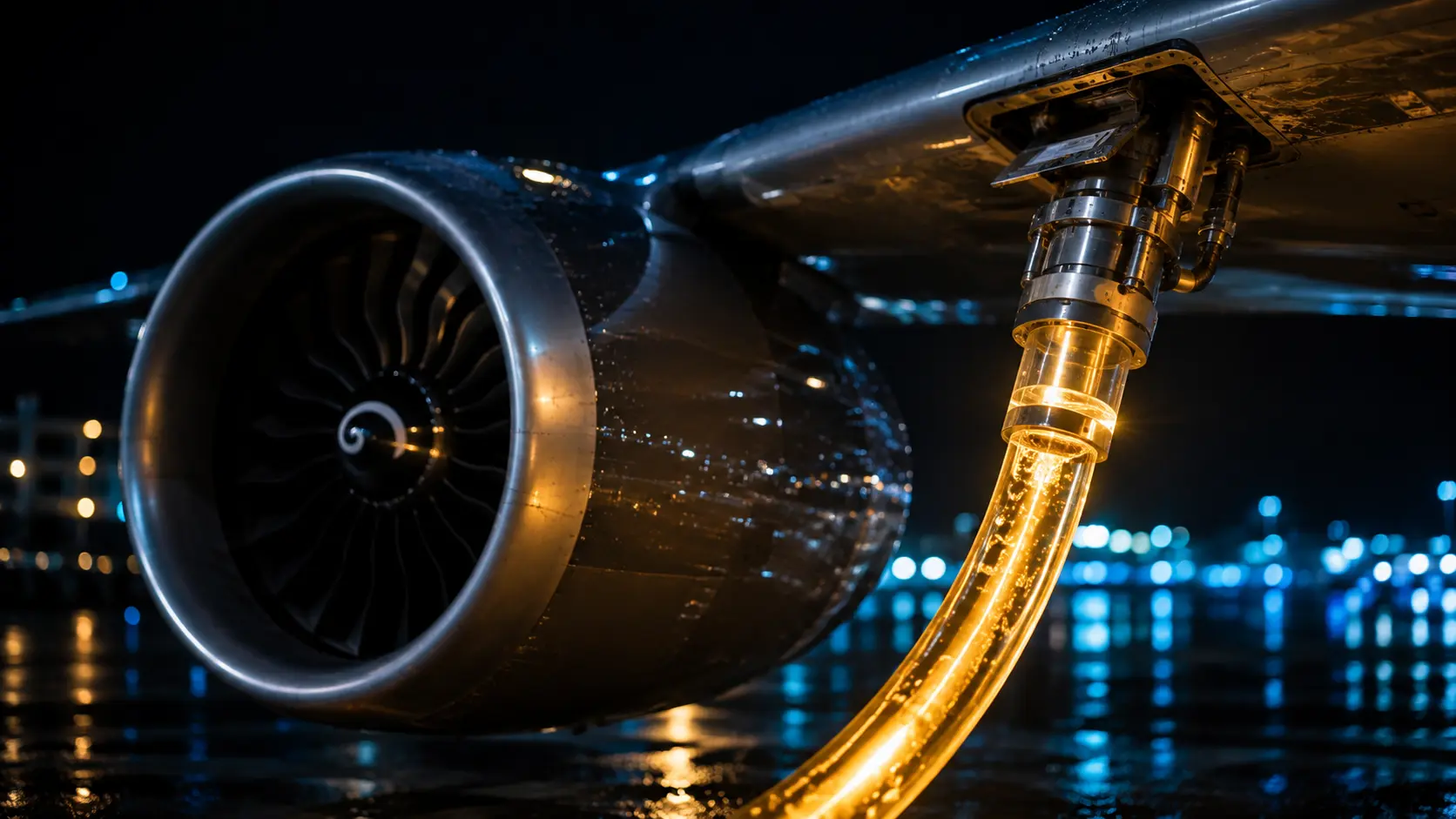
Once the SAF is blended with conventional fuel at a 50/50 ratio, it is legally certified as Jet A/Jet A-1. From that moment on, it is handled exactly like fossil fuel. It travels through the same underground airport pipes, sits in the same airport tanks, and is pumped into the wings of the exact same airplanes. The pilot does not even know the difference, ensuring the entire global aviation network can transition without replacing a single piece of hardware.
Real-World Applications
The deployment of SAF has shifted from test flights to commercial off-take agreements.
Corporate Scope 3 Emissions Reduction: Massive corporations (like Microsoft, Deloitte, and Amazon) have committed to net-zero targets. A huge portion of their carbon footprint comes from employees flying on commercial airlines (Scope 3 emissions). Because it is impossible to guarantee that a specific employee’s flight uses SAF, corporations utilize a “Book-and-Claim” system. The corporation pays a premium to buy SAF certificates. The physical SAF is pumped into an airplane at a major hub like Los Angeles, but the corporation in New York gets the legal credit for the carbon reduction, subsidizing the cost for the airline.
Refinery Conversions (HEFA Scale-Up): Legacy oil giants are reading the writing on the wall. Companies like BP, Eni, and Neste are executing massive Capital Expenditure (CapEx) projects to retrofit old, unprofitable petroleum refineries into HEFA biorefineries. Because the hydroprocessing equipment used to strip sulfur from crude oil is remarkably similar to the equipment used to deoxygenate cooking oil, retrofitting saves hundreds of millions of dollars compared to building a factory from scratch.
Military Aviation Procurement: The U.S. Department of Defense, recognizing the geopolitical vulnerability of relying on foreign oil, is a massive catalyst for SAF. Military programs are aggressively testing 100% unblended SAF in fighter jets and cargo planes, driving R&D into specialized, fully synthetic aromatics that will eventually allow the commercial sector to bypass the 50% blending limit.
Economic & Strategic Impact
The evolution of the SAF market is creating a bizarre new commodity supercycle: the race for waste.
In 2025 and 2026, the price of Used Cooking Oil (UCO) from Asia became a heavily traded global commodity. Because the ReFuelEU Aviation mandate penalizes airlines that fail to hit their blending targets, airlines are willing to pay massive premiums to secure long-term offtake agreements. This demand has fundamentally altered global supply chains, where the grease traps of restaurants in Indonesia and China are now critical energy assets for European airlines.
However, this reliance on UCO is a strategic vulnerability. The global supply of waste oil is hard-capped (humans only eat so much fried food). The ultimate strategic endgame is Power-to-Liquid (PtL). By building massive solar farms in deserts (like the Middle East or Australia) to run hydrogen electrolyzers, and pulling CO2 straight from the air, energy companies intend to manufacture infinite jet fuel using nothing but sunlight and air. The countries that master PtL engineering will become the new “petrostates” of the 21st century.
Advantages
- Lifecycle Emissions Reduction: Depending on the feedstock, SAF can reduce lifecycle greenhouse gas emissions by up to 80% compared to conventional jet fuel.
- Infrastructure Compatibility: As a “drop-in” fuel, SAF utilizes the existing multi-trillion-dollar global network of airport pipelines, fuel trucks, and jet engines without requiring retrofits.
- Improved Local Air Quality: Because SAF contains virtually no sulfur and fewer aromatics, burning it produces significantly less soot and particulate matter, improving air quality for communities living near busy airports and reducing contrail formation in the sky.
Limitations
- Severe Price Premium: SAF currently costs between two to four times as much as conventional Jet A-1. Without government subsidies (like the US Inflation Reduction Act tax credits) or strict mandates (like ReFuelEU), airlines struggle to absorb the cost without raising ticket prices.
- Feedstock Scarcity: The HEFA pathway relies on waste fats and oils, the supply of which is highly limited and fiercely contested by the road transport sector (renewable diesel).
- The 50% Blend Wall: Current ASTM safety regulations prohibit flying on 100% HEFA SAF due to the lack of aromatics required for legacy engine seals, forcing the industry to continue burning at least 50% fossil fuels in the near term.
Common Misconceptions
Misconception: SAF is just ethanol or biodiesel put into an airplane.
Reality: Putting standard biodiesel or ethanol into a jet engine would be catastrophic because those fuels freeze at high altitudes. SAF is heavily refined and hydroprocessed until it is pure kerosene, behaving exactly like fossil jet fuel at -50 degrees Celsius.
Misconception: We need to build new electric or hydrogen planes instead of using SAF.
Reality: While small electric planes will work for short hops, the physics of energy density dictate that long-haul flights (like New York to Tokyo) will require liquid fuel for the foreseeable future. The aviation industry cannot wait until 2050 to invent a new plane; it must decarbonize the fleet operating today.
Misconception: SAF produces zero carbon dioxide when burned.
Reality: When a plane burns SAF, it emits the exact same amount of CO2 from its tailpipe as fossil fuel. The climate benefit comes from the lifecycle. Because the plant (or used oil) absorbed CO2 from the atmosphere while it was growing, burning it simply returns that same CO2 to the air, creating a net-zero loop, rather than pulling ancient, buried carbon out of the ground.
What Most People Miss
The impact of Contrail Avoidance.
While the media focuses entirely on CO2 emissions, scientists now know that the white fluffy trails (contrails) left behind by airplanes trap a massive amount of heat in the atmosphere—potentially causing just as much global warming as the CO2 itself.
Contrails form when water vapor condenses around tiny particles of soot ejected from the jet engine. Because SAF is a manufactured, ultra-clean chemical, it contains significantly fewer impurities and aromatics than dirty fossil fuel. Burning SAF produces drastically less soot. Fewer soot particles mean fewer contrails form in the upper atmosphere. Therefore, the adoption of SAF provides a massive, immediate double-impact on climate change by simultaneously recycling CO2 and physically preventing heat-trapping artificial clouds.
Comparison Table
| Feature | Conventional Jet Fuel | HEFA SAF | PtL e-Fuel |
|---|---|---|---|
| Primary Source | Crude Oil | Waste Cooking Oil | Captured CO2 + Hydrogen |
| Current Market Share | ~98%+ | 62-87% (Dominant SAF) | < 1% (Emerging) |
| Cost Premium | Baseline ($) | High (2x to 3x) | Extreme (5x to 10x) |
| Feedstock Scalability | High | Low (Supply capped) | Infinite (Sunlight/Air) |
| Drop-in Ready? | Yes | Yes (Max 50% blend) | Yes (Max 50% blend) |
Case Study
Situation: Moving into the mid-2020s, the European Union passed the ReFuelEU Aviation mandate, fundamentally shifting SAF from a voluntary corporate ESG initiative into a strict legal requirement for operating at European airports. Airlines faced severe fines if they failed to blend 2% SAF by 2025.
Challenge: Airlines needed massive, guaranteed volumes of SAF to maintain compliance, but traditional oil refineries were still optimized for fossil fuels, creating a severe supply shortage and extreme price volatility.
Solution (The Neste & Air Canada Offtake Blueprint): In late 2024 and continuing into the 2026 operational cycle, major airlines abandoned the spot market and turned to massive, multi-year offtake agreements. For example, Air Canada signed a landmark agreement with Neste (the global leader in HEFA SAF refining) to supply 60,000 tons (roughly 77.6 million liters) of unblended SAF.
Outcome: By locking in these massive, multi-year contracts, Air Canada secured the exact physical supply needed to meet its near-term corporate goal of 1% total fuel usage by 2025 and ensure compliance on European routes. Conversely, the guaranteed revenue from this offtake agreement allowed Neste to de-risk its capital investments, justifying the hundreds of millions of dollars required to scale up their refinery operations in North America and Europe.
Lessons Learned: The case study proves that the SAF market cannot scale through spot trading. The industry requires long-term, symbiotic partnerships between airlines and chemical refiners. Guaranteed demand visibility is the only financial mechanism powerful enough to convince the traditional fossil fuel infrastructure to retool its refineries for the green transition.
Future Outlook
Next 12–24 Months
The industry is locked into a brutal scaling phase dominated by the ReFuelEU 2025 and 2026 mandates. Airlines will aggressively purchase Book-and-Claim certificates to offset their obligations while physical supply slowly catches up. Expect severe regulatory scrutiny on the origins of Used Cooking Oil, with the EU and US implementing strict digital tracing software to ensure that cheap, fraudulent palm oil from Asia is not being disguised as UCO to cash in on SAF subsidies.
Next 3–5 Years
The certification of 100% SAF (Unblended) Flights. By 2030, the ASTM D7566 standard will likely be updated to allow for 100% synthetic fuel usage. Chemical engineers will perfect the synthesis of “renewable aromatics,” allowing refineries to bake the exact chemical compounds needed to swell engine seals directly into the SAF. This will completely sever the aviation industry’s physical reliance on mixing its clean fuel with fossil kerosene, unlocking true net-zero flight paths.
Next 10 Years
The explosive ascent of Power-to-Liquid (PtL) e-fuels. By 2035, the global supply of waste cooking oil and agricultural residue will be entirely maxed out. To hit the aggressive 34% mandate in Europe by 2040, the industry must transition to e-fuels. Massive industrial megaprojects—pairing gigawatt-scale solar farms with Direct Air Capture (DAC) CO2 vacuums and Fischer-Tropsch refineries—will come online. While currently astronomically expensive, economies of scale will drive PtL prices down, transitioning global aviation fuel from a geological extraction industry into an automated software and solar manufacturing industry.
Most Likely Scenario
Aviation will successfully decarbonize, but the era of ultra-cheap flying will permanently end. The physical laws of thermodynamics dictate that manufacturing jet fuel from scratch will always require more raw energy and capital than simply pumping it out of the ground. The cost of this synthetic alchemy will inevitably be passed down to the consumer, leading to a permanent structural increase in global passenger ticket prices and air freight logistics costs throughout the 2030s.
Key Takeaways
- Sustainable Aviation Fuel (SAF) is a drop-in liquid hydrocarbon that is chemically identical to conventional jet fuel but made from renewable waste, agricultural residue, or captured carbon.
- Because batteries are too heavy for long-haul flight, SAF is the only viable technological pathway to decarbonize the global aviation industry by 2050.
- The HEFA pathway (using hydrogen to deoxygenate used cooking oil and animal fats) is currently the dominant production method, representing over 62% of the market in 2025-2026.
- Current ASTM safety standards cap SAF at a 50% blend with fossil fuel to ensure the fuel retains enough aromatic compounds to keep older engine seals functioning properly.
- The market is heavily driven by the EU’s ReFuelEU Aviation mandate, which legally requires all fuel suppliers at EU airports to provide a 2% SAF blend in 2025, rising to 6% by 2030.
- Corporate clients utilize “Book-and-Claim” certificates to purchase the environmental benefits of SAF, allowing them to offset their Scope 3 business travel emissions without physically transporting the fuel to their specific airport.
Glossary
ASTM D7566: The global safety and technical standard that specifies exactly how synthetic aviation turbine fuel must be manufactured and blended before it is legally allowed to be pumped into a commercial airplane.
Book-and-Claim: A digital accounting system where a company pays the premium for SAF to be pumped into an aircraft at one airport, but claims the carbon reduction credit for themselves, regardless of where they actually fly.
CORSIA (Carbon Offsetting and Reduction Scheme for International Aviation): A global scheme adopted by the UN’s aviation agency (ICAO) requiring airlines to cap their emissions and purchase offsets or SAF to cover any growth above a baseline.
Fischer-Tropsch (FT) Synthesis: A chemical reaction that converts a mixture of carbon monoxide and hydrogen (syngas) into liquid hydrocarbons, critical for turning solid waste or captured CO2 into jet fuel.
HEFA (Hydroprocessed Esters and Fatty Acids): The most mature and widely used chemical process for making SAF today. It uses high-pressure hydrogen to strip oxygen away from used cooking oils and animal fats.
Power-to-Liquid (PtL / e-fuel): A futuristic, highly scalable SAF pathway that uses renewable electricity (solar/wind) to split water into green hydrogen, combines it with captured CO2, and synthesizes it into liquid jet fuel.
Frequently Asked Questions
Do airplanes need new engines to use SAF?
No. This is the greatest advantage of SAF. It is a “drop-in” fuel. Once it is blended to meet ASTM standards, it is chemically indistinguishable from regular Jet A-1 fuel. It can be used in any existing commercial jet engine today.
Why is SAF so expensive compared to normal jet fuel?
Extracting crude oil from the ground and refining it is a 100-year-old, highly optimized process. Manufacturing jet fuel from scratch by collecting waste oil, heavily processing it with hydrogen, or synthesizing it from CO2 requires massive amounts of raw capital, energy, and brand-new refinery infrastructure.
Does flying with SAF mean zero carbon comes out of the airplane?
No. The exact same amount of carbon dioxide comes out of the tailpipe. However, because that carbon was recently absorbed from the atmosphere by a plant (or captured directly from the air), burning it simply puts it back. It creates a closed loop, rather than pulling new, ancient carbon out of the deep earth.
Will we eventually run out of used cooking oil?
Yes. The aviation industry is fully aware that global waste oil supplies will max out within the decade. This is why the industry is pouring billions of dollars into Power-to-Liquid (PtL) technology, which can manufacture fuel infinitely using only sunlight, water, and air.
Sources
[1] Fortune Business Insights: Sustainable Aviation Fuel Market Size, Outlook Report, 2026 (July 2026)
[2] Grand View Research: Sustainable Aviation Fuel Market Size Report, 2026-2033 (June 2026)
[3] Market Research Future: Sustainable Aviation Fuel Market Size, Share, Trends 2035 (July 2026)
[4] European Business Aviation Association (EBAA): RefuelEU Aviation – Legislative Instrument and Anti-Tankering Rules (2025/2026)
[5] Neste: ReFuelEU: what is it and how will it impact the aviation industry? (December 2025)