Advertisement
)
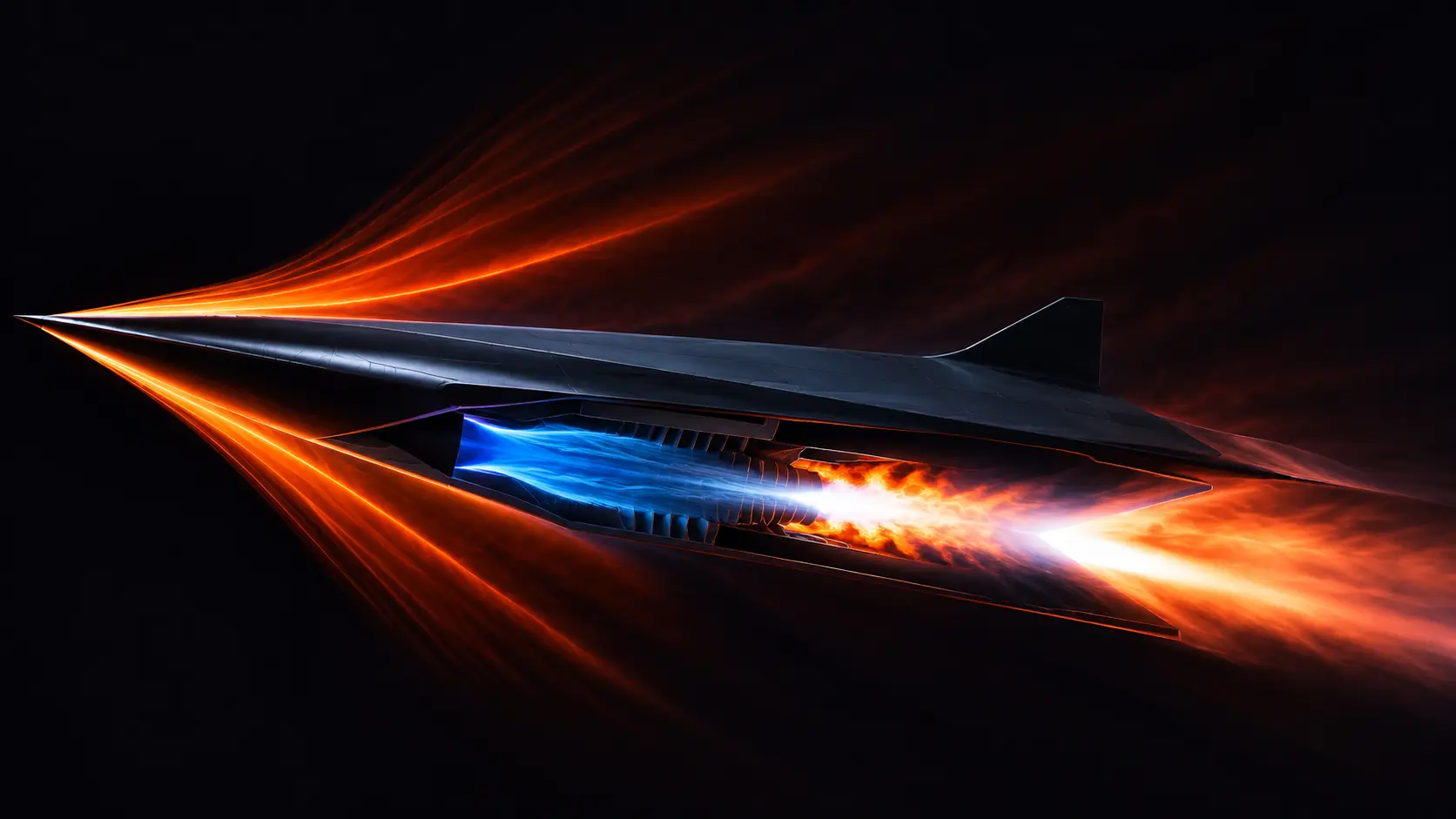

A missile is launched. Within seconds, it is moving so fast that the atmosphere entering its engine begins to behave like solid concrete. At Mach 5, traditional jet engines literally melt and disintegrate, their rotating titanium fan blades sheared apart by the sheer kinetic force and friction of the air. Yet, global superpowers are locked in a relentless arms race to build vehicles that cruise at these exact, catastrophic speeds. The strategic goal is absolute: to strike any target on Earth in under an hour, rendering all existing missile defense systems mathematically obsolete.
To achieve this, aerospace engineers had to throw away a century of aviation design. They removed the turbines, fans, and moving parts that define modern flight. Instead, they built an engine that weaponizes the very shock waves threatening to destroy it. This engine swallows air at supersonic velocities, ignites it in a fraction of a millisecond, and spits it out faster than a bullet. It is the defining propulsion architecture of the 21st-century military, and understanding how it works explains why the global balance of power is currently shifting at 7,000 miles per hour.
What is Scramjet Propulsion?
Scramjet propulsion is an advanced air-breathing engine technology designed for hypersonic flight. Operating without any moving parts, a scramjet relies on the extreme forward speed of the aircraft to compress incoming air using shock waves. It then injects and ignites fuel within a supersonic airstream to generate immense thrust.
At a Glance
- Concept: An engine with zero moving parts that uses the geometry of its air intake to compress air, inject fuel, and sustain a continuous explosion while traveling at hypersonic speeds (Mach 5 and above).
- Why it matters: Traditional rockets carry both fuel and heavy liquid oxygen, limiting their range and maneuverability. Scramjets “breathe” oxygen from the atmosphere, allowing hypersonic missiles to be smaller, fly closer to the ground, and maneuver unpredictably to evade radar.
- Who uses it: Top-tier defense contractors (Lockheed Martin, Raytheon, Northrop Grumman) developing hypersonic cruise missiles for the United States, alongside advanced military engineering divisions in China and Russia.
- Biggest takeaway: Igniting fuel inside a scramjet is often compared to “lighting a match in a hurricane.” Because the air is moving through the engine at supersonic speeds, the fuel has less than a millisecond to mix and burn, requiring extreme advancements in fluid dynamics and computational modeling.
In Simple Words
To make an airplane fly, an engine must suck in air, squeeze it tightly, mix it with fuel, and set it on fire. The expanding fireball shoots out the back, pushing the plane forward.
In a normal passenger jet, spinning metal fan blades do the sucking and squeezing. But if you try to fly faster than three times the speed of sound (Mach 3), the air hits the engine so hard and fast that the spinning blades melt from friction and shatter.
To fly faster, engineers invented the Ramjet. They removed the fan blades completely. The engine is just a shaped tube. The sheer speed of the plane rams the air into the tube, squeezing it naturally. However, a ramjet has to slow that air down to subsonic speeds inside the tube to keep the fire lit. If you fly past Mach 5, slowing the air down creates so much friction that the engine melts.
The ultimate solution is the Scramjet (Supersonic Combustion Ramjet). A scramjet does not slow the air down. It lets the air rip through the engine at supersonic speeds. Engineers use ultra-advanced chemistry to inject fuel and ignite it instantly before the air shoots out the back. This allows the vehicle to reach Mach 10, outrunning interceptor missiles and changing the rules of warfare.
Why This Matters
The geopolitical landscape is defined by the concept of “Anti-Access/Area Denial” (A2/AD). Nations like China and Russia have built massive arrays of advanced radar and surface-to-air missiles to prevent the United States Navy and Air Force from approaching their coastlines.
Standard Tomahawk cruise missiles fly at subsonic speeds (around 550 mph). They are easily tracked and shot down by modern defenses. Intercontinental Ballistic Missiles (ICBMs) are incredibly fast, but they fly in a predictable, arched arc through space; defenders can calculate exactly where they will land the moment they launch.
Scramjets shatter both defense models. A scramjet-powered hypersonic cruise missile flies low inside the Earth’s atmosphere, hiding beneath the curvature of the Earth to evade long-range radar. It travels at over 4,000 mph (Mach 5+), leaving defenders with mere seconds to react. Crucially, because it breathes air, it can maneuver aerodynamically, changing direction mid-flight. Defending against a maneuverable, Mach 10 threat is currently an unsolved military problem, making scramjets the most coveted strategic asset of the decade.
The Hypersonic Arms Race: Boost-Glide vs Scramjet Propulsion
The hypersonic arms race is split into two distinct technological pathways: Boost-Glide Vehicles and Air-Breathing Scramjets.
Boost-Glide systems rely on massive traditional rockets to shoot a vehicle into the upper atmosphere. The vehicle detaches and unpowered, glides back to Earth at hypersonic speeds. This is easier to build, but it requires a massive, expensive rocket and loses speed as it glides.
Scramjets represent the second, far more difficult pathway. Because they breathe atmospheric oxygen, they generate continuous thrust, maintaining extreme speeds throughout their entire flight profile. While boost-glide weapons dominated the early 2020s, mastering the scramjet is the ultimate prize, promising smaller, cheaper, air-launched missiles that can be strapped to the wings of standard fighter jets like the F-35 or F-15EX.
How a Scramjet Works: Supersonic Combustion Explained
Creating sustained thrust at Mach 10 requires defeating the thermal and kinetic extremes of atmospheric compression. Here is the first-principles breakdown.
1. The Fundamental Problem: Thermal Choking
To burn fuel efficiently, air must be compressed. In high-speed flight, simply ramming air into a narrowing tube compresses it. However, compressing air drastically increases its temperature. In a standard ramjet, slowing Mach 5 air down to subsonic speeds for combustion raises the internal temperature so high that the heat actually prevents the fuel from burning (the chemical bonds instantly break apart). Furthermore, this “thermal choking” creates a pressure wall that violently blocks incoming air, destroying the engine.
2. The Insufficiency of Traditional Jets and Rockets
Turbojets fail because their moving parts cannot survive supersonic internal airflow. Rockets solve the speed problem, but because space has no oxygen, rockets must carry heavy tanks of Liquid Oxygen (LOX). A rocket is often 80 percent oxidizer by weight. To build a nimble, long-range cruise missile, you must leave the heavy oxidizer tanks on the ground and use the atmosphere.
3. The Core Mechanism: Supersonic Combustion
The scramjet solves thermal choking by refusing to slow the air down. The air enters the inlet, compresses via a series of carefully designed shock waves, and enters the combustion chamber still traveling at supersonic speeds (greater than Mach 1). Because the air is not forcefully slowed, the internal temperatures remain manageable enough to sustain a chemical reaction without melting the engine structure.
4. Technical Depth: Mixing in a Millisecond
The primary engineering hurdle of a scramjet is fuel mixing. Air travels through a scramjet’s combustion chamber in roughly one millisecond. In that tiny fraction of a second, liquid fuel must be injected, atomized, mixed with the supersonic air, and fully ignited. If the fuel burns too slowly, the flame is blown out the back of the engine, producing zero thrust. Engineers use specialized strut injectors and cavity flameholders—tiny recesses in the engine wall that create localized turbulence—to hold a stable pocket of burning fuel that ignites the rest of the supersonic stream as it blasts past.
5. Real-World Consequences: The Takeoff Problem
A scramjet is mathematically incapable of generating thrust when sitting still. It relies entirely on the ram-force of high-speed air to compress its intake. Therefore, a scramjet vehicle cannot take off from a runway under its own power. It must be dropped from a mothership (like a B-52 bomber) and accelerated by a solid-rocket booster to approximately Mach 4. Only when the vehicle reaches Mach 4 is there enough air pressure rushing into the inlet for the scramjet to turn on and take over.
Military Applications of Scramjet Technology
The theoretical physics of the late 20th century are now active military acquisition programs in 2026.
Hypersonic Attack Cruise Missile (HACM): The U.S. Air Force and Raytheon (in partnership with Northrop Grumman) are heavily developing the HACM. Following the spectacular successes of the DARPA HAWC (Hypersonic Air-breathing Weapon Concept) flight tests in 2022 and 2023, the HACM program aims to provide fighter pilots with a tactical scramjet missile capable of striking high-value, time-sensitive targets from stand-off ranges, immune to advanced air defense systems.
Naval Anti-Ship Warfare (OASuW Increment 2): The U.S. Navy is seeking scramjet-powered solutions for its Hypersonic Air-Launched Offensive Anti-Surface Warfare program. Striking a moving aircraft carrier requires extreme speed to minimize the target’s reaction time. A scramjet missile launched from an F/A-18 Super Hornet can cover hundreds of miles in minutes, devastating enemy carrier strike groups before they can deploy countermeasures.
Commercial Hypersonic Flight (The Horizon Goal): Startups like Hermeus are aggressively testing Combined Cycle Engines. These engines use a traditional turbojet to take off from a runway and accelerate to Mach 3. The engine then mechanically transitions into a ramjet/scramjet mode to cross the ocean at Mach 5, before shifting back to a turbojet to land safely at a commercial airport. While military applications are here, solving the combined-cycle engine is the key to passenger hypersonic travel.
Economic & Strategic Impact
The perfection of the scramjet engine is forcing a massive reallocation of global defense budgets.
Nations are realizing that legacy surface-to-air missile (SAM) systems—like the Patriot or the S-400—are fundamentally inadequate against maneuverable scramjets. Consequently, the defense market is experiencing a massive pivot toward “Hypersonic Missile Defenses,” stimulating a multi-billion-dollar surge in space-based sensor layers (to track the heat signatures of scramjets from orbit) and directed-energy weapons (lasers) capable of striking targets moving at Mach 10.
Financially, the scramjet supply chain heavily favors advanced materials science. Because the leading edges of a scramjet vehicle endure atmospheric friction exceeding 2,000°C, traditional aerospace aluminum and titanium fail. The industry is reliant on Ultra-High-Temperature Ceramics (UHTCs) and Carbon-Carbon composites. Companies controlling the intellectual property and manufacturing capability for these extreme thermal materials have secured a highly lucrative, decades-long moat in the aerospace sector.
Advantages
- Extreme Speed and Range: Capable of sustained atmospheric flight between Mach 5 and Mach 15, drastically shrinking the “kill chain” timeline for military strikes.
- Payload Efficiency: Because they breathe atmospheric oxygen, scramjets do not need to carry heavy liquid oxygen tanks. This allows the vehicle to carry a significantly larger explosive payload or more fuel for an extended range compared to a similarly sized rocket.
- Maneuverability: Unlike ballistic missiles that follow a predictable, unpowered trajectory through space, scramjets remain in the atmosphere, utilizing aerodynamic fins to weave and dodge interceptors during their terminal approach.
Limitations
- The Mach 4 Minimum: Scramjets are useless at low speeds. They absolutely require a primary propulsion system (like a rocket booster or turbojet) to push them to Mach 4 before they can ignite, adding weight and complexity to the overall vehicle system.
- Material Melting Points: The kinetic friction of the atmosphere at Mach 10 creates a plasma sheath around the vehicle. Designing engine geometries that do not warp, melt, or ablate under these extreme thermal loads is an agonizingly difficult metallurgical challenge.
- Testing Infrastructure Deficit: You cannot test a Mach 10 engine in a standard wind tunnel. The U.S. and allied nations face a severe shortage of hypersonic blow-down wind tunnels and arc-heated facilities capable of replicating Mach 5+ airflow for sustained durations, creating a massive bottleneck in R&D.
Common Misconceptions
Misconception: Scramjets are used to fly into space.
Reality: Scramjets are strictly atmospheric engines. Because they must breathe oxygen, they suffocate if they fly too high. They typically operate in the upper stratosphere (around 80,000 to 100,000 feet) but cannot cross the Kármán line into the vacuum of space.
Misconception: Hypersonic weapons are essentially nuclear weapons.
Reality: While a scramjet could carry a nuclear warhead, their primary value is conventional. A vehicle hitting a target at Mach 10 possesses so much kinetic energy that it often does not even need an explosive warhead; the sheer physical impact of the heavy metal frame traveling at 7,000 mph is enough to obliterate a bunker or a warship.
Misconception: The Space Shuttle used a scramjet.
Reality: The Space Shuttle used traditional chemical rockets (Liquid Hydrogen and Liquid Oxygen). To date, no crewed vehicle has ever flown using a scramjet engine. The technology has only been successfully demonstrated on experimental, unmanned drones and cruise missiles.
What Most People Miss
The genius of Active Regenerative Cooling.
When flying at Mach 8, the friction from the air wants to melt the metal walls of the scramjet engine. But engineers cannot wrap the engine in heavy insulation, because that adds weight.
Instead, they turn the fuel into the coolant. Before the hydrocarbon fuel (like JP-7) is injected into the combustion chamber, it is pumped through a labyrinth of tiny micro-channels built directly into the walls of the engine. The freezing cold fuel absorbs the massive heat of the engine walls, acting as a heat sink that prevents the metal from melting. Simultaneously, absorbing this heat causes the fuel to boil and crack into highly reactive smaller molecules (endothermic cracking). When this super-heated, highly reactive fuel is finally injected into the combustion chamber, it ignites almost instantly—neatly solving both the engine’s melting problem and the millisecond-ignition problem at the exact same time.
Comparison Table
| Engine Type | Moving Parts? | Maximum Speed | Air Compression Method | Combustion Airflow |
| Turbojet | Yes (Turbines/Fans) | ~ Mach 3 | Mechanical spinning compressors | Subsonic |
| Ramjet | No | ~ Mach 5 | Vehicle speed (Ram effect) | Subsonic |
| Scramjet | No | Mach 15+ | Vehicle speed (Shock waves) | Supersonic |
| Rocket | No (Pumps only) | Unlimited (Space) | None (Carries liquid oxygen) | N/A |
Case Study
Situation: The U.S. Department of Defense realized it was falling behind adversaries in the deployment of tactical hypersonic weapons. While large boost-glide systems were in development, the military desperately needed an air-breathing cruise missile that could fit under the wing of an F-35 fighter jet and reliably sustain Mach 5+ flight.
Challenge: Lighting and sustaining a fire in a supersonic wind tunnel is incredibly difficult. Previous experimental scramjets (like the X-51 Waverider in the 2010s) provided invaluable data but suffered from flameouts and limited flight durations.
Solution (The HAWC Program): DARPA partnered with the U.S. Air Force to launch the Hypersonic Air-breathing Weapon Concept (HAWC). Lockheed Martin and Aerojet Rocketdyne developed one variant, while Raytheon and Northrop Grumman developed another. Both teams utilized advanced additive manufacturing (3D printing) to create complex active-cooling fuel channels and intricate scramjet geometries that were impossible to machine traditionally.
Outcome: Between 2021 and 2023, the HAWC program achieved spectacular, repeated successes. Released from B-52 bombers, the vehicles’ solid-rocket boosters pushed them to supersonic speeds, where the scramjet engines ignited and flawlessly sustained Mach 5+ flight at altitudes exceeding 60,000 feet, traveling hundreds of miles.
Lessons Learned: The HAWC successes retired the fundamental physics risk of scramjet propulsion. It proved that hydrocarbon-fueled scramjets were mature enough to transition from DARPA science experiments into operational military acquisition programs, leading directly to the establishment of the multi-billion-dollar HACM (Hypersonic Attack Cruise Missile) program.
Future Outlook
Next 12–24 Months
The transition to Operational Fielding. Following successful prototyping, defense contractors will shift focus from demonstrating thrust to proving targeting and lethality. Scramjet missiles will undergo complex live-fire testing against moving maritime targets. The supply chain will be heavily stressed, driving intense capital investment into advanced manufacturing foundries capable of mass-producing Carbon-Carbon composites and thermal shielding at military scale.
Next 3–5 Years
The emergence of the Combined Cycle Engine. As military scramjets mature, the focus will expand to reusable platforms. Aircraft like Lockheed Martin’s theoretical SR-72 (the successor to the SR-71 Blackbird) will require Turbine-Based Combined Cycle (TBCC) engines. These engines seamlessly transition from a standard turbojet for takeoff, to a ramjet for acceleration, into a scramjet for Mach 6 cruise. Successfully mastering the mechanical mode-transition between these engine types without losing thrust is the ultimate aerospace challenge of the late 2020s.
Next 10 Years
The dawn of Commercial Hypersonic Logistics. By the mid-2030s, the military technologies pioneered by scramjet programs will trickle down to the commercial sector. Startups will initially deploy unmanned, scramjet-powered cargo drones for high-value, rapid intercontinental logistics (e.g., organ transport or critical semiconductor supply chain emergencies). True passenger hypersonic flight will remain elusive due to the violent sonic booms produced overland, but trans-oceanic cargo routes will establish the viability of Mach 5 commercial aviation.
Most Likely Scenario
Scramjets will become the standard propulsion architecture for long-range tactical strike weapons, fundamentally altering the geography of naval warfare. Aircraft carriers will be forced to operate much further from enemy coastlines to stay out of the “scramjet threat ring.” Meanwhile, the extreme cost of thermal materials will likely restrict scramjets to military and elite rapid-cargo applications for decades, preventing them from displacing traditional jet engines in the mass-market passenger aviation sector.
Key Takeaways
- A scramjet (Supersonic Combustion Ramjet) is an air-breathing engine with no moving parts that utilizes its own extreme forward velocity to compress air.
- Unlike traditional ramjets, which slow air down, scramjets maintain supersonic airflow throughout the combustion process, allowing them to exceed Mach 5 without melting from friction.
- Because air moves through the engine in less than a millisecond, injecting and igniting fuel is the primary engineering challenge, solved using cavity flameholders and super-heated hydrocarbon fuels.
- Scramjets cannot operate from a standstill; they must be accelerated to at least Mach 4 by a rocket booster or traditional jet engine before there is enough air pressure to ignite them.
- By breathing atmospheric oxygen rather than carrying heavy liquid oxygen tanks, scramjet missiles are lighter, have longer ranges, and can maneuver aerodynamically to evade missile defenses.
- The technology is rapidly maturing from DARPA prototypes (the HAWC program) into active military acquisitions, driving a surge in ultra-high-temperature ceramics (UHTCs) and advanced aerospace manufacturing.
Glossary
A2/AD (Anti-Access/Area Denial): A military strategy utilizing advanced long-range radar and missiles to prevent an adversary’s forces from entering a specific geographic region.
Endothermic Cracking: A chemical process where a hydrocarbon fuel absorbs intense heat (acting as a coolant for the engine walls) causing the fuel molecules to break down into smaller, highly reactive components that ignite faster.
Mach Number: A measure of speed relative to the speed of sound. Mach 1 is the speed of sound (approx. 767 mph at sea level). Mach 5 is five times the speed of sound, universally defined as the threshold for hypersonic flight.
Ramjet: The predecessor to the scramjet. An engine with no moving parts that compresses air using the vehicle’s speed, but must slow the air down to subsonic speeds before igniting fuel. Maxes out around Mach 5.
Specific Impulse (Isp): A measure of how efficiently an engine generates thrust from its fuel. Because they pull oxygen from the air, scramjets have a significantly higher Isp than rockets.
Thermal Choking: A catastrophic aerodynamic condition where heating air too rapidly inside an engine creates a massive pressure buildup that blocks incoming airflow, starving the engine of oxygen and causing failure.
Frequently Asked Questions
Why can’t a scramjet take off from the ground?
Scramjets do not have spinning turbine blades to suck air into the engine. They rely entirely on the ram-force of the air hitting the front of the vehicle. If the vehicle is sitting on a runway, no air is being forced into the engine, making it impossible to start.
Are scramjets used on space rockets?
Not currently. Rockets go into the vacuum of space where there is no oxygen to breathe. Scramjets only work inside the Earth’s atmosphere. However, future designs propose using scramjets for the first stage of a space launch to save fuel while the vehicle is still in the atmosphere, before switching to rockets for the final push into orbit.
How hot does a scramjet get?
Friction from the air hitting the front of a vehicle at Mach 8 or Mach 10 can push temperatures well beyond 2,000°C (3,600°F). This is hot enough to melt standard aerospace metals like aluminum and titanium, requiring carbon-carbon composites and advanced ceramic shielding.
What kind of fuel does a scramjet use?
Early experimental scramjets (like NASA’s X-43) used highly volatile hydrogen gas because it burns incredibly fast. However, modern tactical military scramjets use liquid hydrocarbon fuels (like jet fuel/JP-7) because hydrogen is too difficult to store safely on a military base or an aircraft carrier.
Will I be able to fly on a scramjet passenger plane?
Eventually, yes, but not soon. While companies are developing commercial hypersonic aircraft, the extreme heat, massive fuel consumption, and the deafening sonic boom created when flying over populated areas make passenger scramjet travel economically unviable for the near future.
Sources
[1] DARPA: HAWC (Hypersonic Air-breathing Weapon Concept) Program Updates (2023)
[2] U.S. Air Force: Hypersonic Attack Cruise Missile (HACM) Acquisition Overview (2025/2026)
[3] American Institute of Aeronautics and Astronautics (AIAA): Thermodynamics of Supersonic Combustion and Active Cooling (2025)
[4] Congressional Research Service (CRS): Hypersonic Weapons: Background and Issues for Congress (2026 Update)
[5] Raytheon Technologies: Advancing Hypersonic Scramjet Propulsion