Advertisement
)
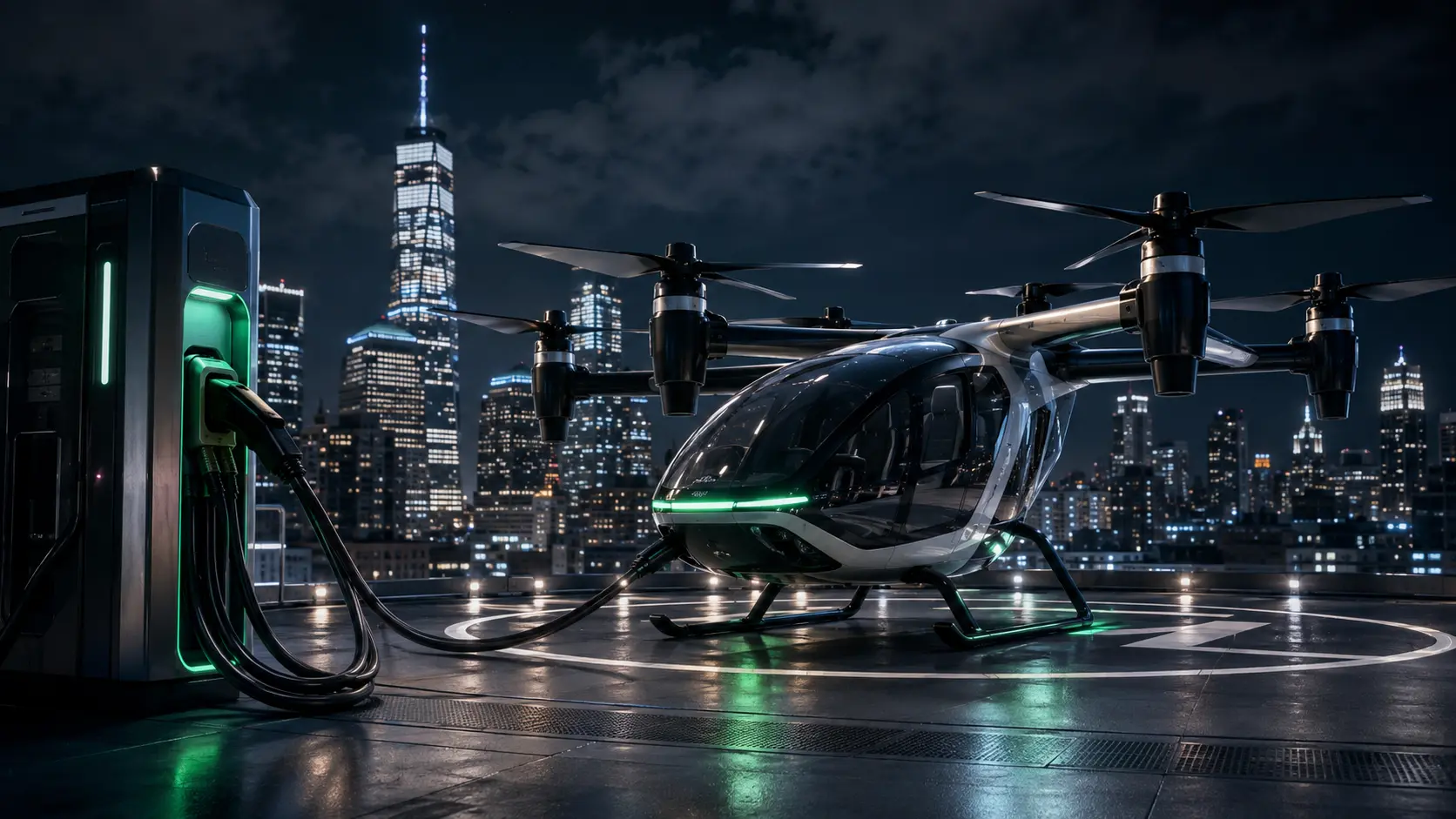

Imagine looking up at the sky over Manhattan or Dubai and seeing a fleet of silent, electric air taxis commuting seamlessly between skyscrapers. The aircraft themselves are no longer science fiction—they exist today, built by well-funded aerospace pioneers, and are currently executing piloted transition flight tests. But here is the multi-billion-dollar reality check: they have almost nowhere to land, and no way to charge.
While the media focuses entirely on the sleek, futuristic design of the aircraft, the true bottleneck of the flying car revolution is urban infrastructure and civil engineering. To fast-charge a single electric air taxi in 20 minutes requires up to two megawatts of instantaneous power. Attempting to build a five-pad “vertiport” on top of a downtown parking garage threatens to completely overwhelm the local municipal power grid.
Why should you care right now? Because the race to commercialize the sky has officially shifted from aerospace engineering to infrastructure logistics and regulatory lobbying. As global aviation authorities finalize their historic “powered-lift” certifications for a late-2020s commercial launch, the ultimate winners of this new era will not just be those who build the best aircraft, but those who successfully dominate the brutal economics of megawatt charging and urban airspace integration.
What is Advanced Air Mobility (AAM)?
Advanced Air Mobility (AAM) is a next-generation transportation system that uses highly automated, electric Vertical Takeoff and Landing (eVTOL) aircraft to move passengers and cargo at lower altitudes. It aims to bypass urban ground congestion using zero-emission, low-noise aerial networks supported by dedicated “vertiport” charging infrastructure.
At a Glance
- Concept: Transitioning urban commuting from 2D roads to 3D airspace using electric aircraft that take off like helicopters but cruise on wings like traditional airplanes.
- Why it matters: Ground congestion costs global economies billions in lost productivity. AAM offers a quiet, zero-emission alternative, but requires an unprecedented overhaul of city power grids to support megawatt-class charging.
- Who uses it: Pioneers like Joby Aviation, Archer Aviation, and Wisk Aero, alongside infrastructure developers like Skyports, working directly with the FAA and EASA to establish flight corridors.
- Biggest takeaway: The aircraft are ready, but the grid is not. A single high-volume vertiport requires massive electrical upgrades, making power procurement—not aircraft manufacturing—the primary constraint on commercial scaling in the late 2020s.
In Simple Words
Think of a traditional helicopter. It is incredibly loud, burns massive amounts of expensive jet fuel, and is mechanically complex, making it extremely expensive to operate and maintain. Because of the noise and cost, helicopters are reserved for the ultra-wealthy, military, or emergency services.
Advanced Air Mobility (AAM) replaces the helicopter with an eVTOL (electric Vertical Takeoff and Landing) aircraft. Instead of one giant, loud, gas-powered rotor, an eVTOL uses several smaller, electric propellers powered by lithium-ion batteries. This makes the aircraft drastically quieter, mechanically simpler, and entirely emission-free.
The goal is to make a 30-mile trip from a city center to an airport take 10 minutes by air, rather than an hour sitting in gridlock. You book a flight on an app, go to a designated rooftop “vertiport,” and fly over the traffic. The challenge? Helicopters can refuel in minutes from a gas tank. eVTOLs require massive, high-speed electrical chargers that must pull immense amounts of power from the city’s electrical grid without causing a blackout.
Why This Matters
The commercialization of AAM represents the first entirely new category of civil aviation since the introduction of the commercial jet engine. To accommodate these vehicles, the Federal Aviation Administration (FAA) officially created a new “powered-lift” category, combining fixed-wing and rotorcraft rules to regulate aircraft that do both.
For mobility investors and urban planners, the capital expenditure (CapEx) requirements are staggering. Building the aircraft is only phase one. The global eVTOL charging facilities market alone is projected to surge to $4.4 billion by 2035, compounding at a 31.2% annual growth rate.Vertiports demand 1 to 2 MW of reliable, high-quality power per pad. A commercial vertiport running 100 flights a day will consume levels of electricity that force municipalities into multi-year utility upgrade negotiations. Cities that successfully streamline grid connections will attract the first wave of commercial air taxi fleets, while cities with stagnant infrastructure will be completely bypassed by the aerospace boom.
The Global Advanced Air Mobility (AAM) Market
In 2026, the AAM industry is transitioning from regulatory exemptions and prototypes to structured, rules-based execution.The FAA’s Innovate28 implementation plan and the eVTOL Integration Pilot Program (eIPP) are actively designating operational test beds to facilitate data sharing between operators and the government.Meanwhile, international markets are aggressively accelerating: the UAE recently certified the world’s first purpose-built commercial vertiport in Dubai, clearing the way for Skyports Infrastructure to commence operations.
However, a fundamental divergence in certification philosophy remains. The European Union Aviation Safety Agency (EASA) established the SC-VTOL framework, requiring a safety case of 10^-9 (meaning the probability of a catastrophic failure must be less than one in a billion flight hours)—the most stringent threshold ever applied to a commercial aircraft. Navigating these overlapping, strict regulatory regimes while simultaneously securing real estate and power for vertiports is the ultimate crucible for AAM operators.
How eVTOL Aircraft Work: Distributed Electric Propulsion
Building an electric aircraft that can hover and fly on wings requires mastering the physics of battery density and distributed propulsion. Here is the first-principles breakdown.
1. The Fundamental Problem: The Energy Density of Batteries
Jet fuel is incredibly energy-dense. It packs a massive amount of energy into a very light liquid, and as the aircraft flies, it burns the fuel, becoming lighter. Batteries are extremely heavy, and they do not get lighter as they discharge. To make an electric aircraft fly, engineers had to wait for lithium-ion battery specific energy to cross the crucial threshold of roughly 250 to 300 Watt-hours per kilogram (Wh/kg), allowing the aircraft to carry passengers without the batteries weighing it down to the point of being unflyable.
2. The Insufficiency of Traditional Helicopters
A helicopter relies on a single main rotor driven by a complex gearbox and a turboshaft engine. If the engine or gearbox fails, the helicopter must autorotate to survive. Furthermore, the massive rotor tip speeds generate the deafening “wop-wop” sound that prevents helicopters from operating continuously in dense urban neighborhoods due to strict noise ordinances.
3. The Core Mechanism: Distributed Electric Propulsion (DEP)
eVTOLs abandon the single massive rotor. Instead, they use Distributed Electric Propulsion (DEP)—mounting 6 to 12 smaller electric motors across the wings and tail. Electric motors are incredibly reliable and have very few moving parts. If one or two motors fail mid-flight, the Flight Control Computer (FCC) instantly redistributes power to the remaining motors, keeping the aircraft perfectly stable. Because the propellers are smaller and spin at different, optimized speeds, they generate a fraction of the noise of a traditional helicopter, blending seamlessly into the ambient hum of a city.
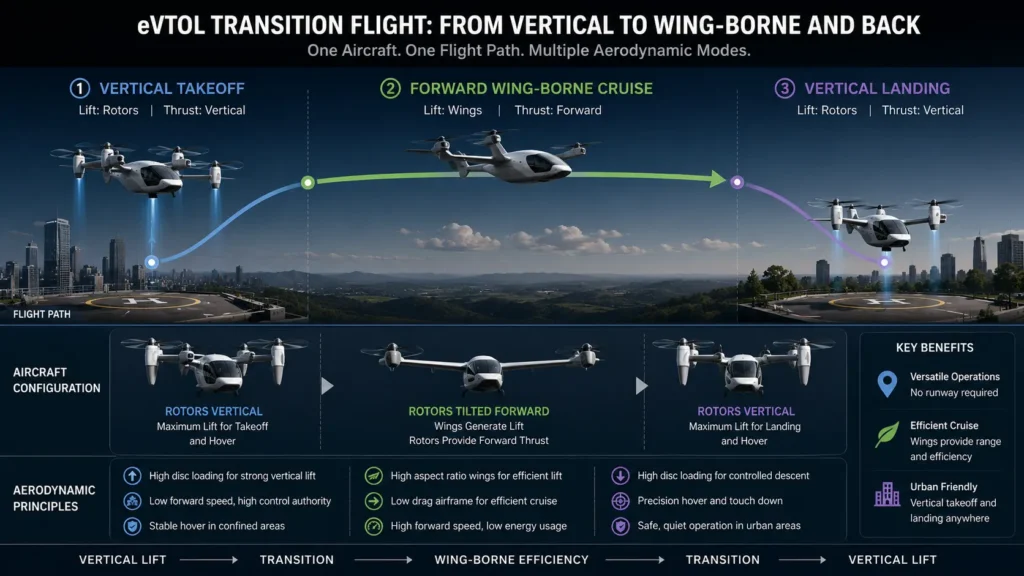
4. Technical Depth: Transition Flight
The true genius of an eVTOL is “transitioning.” The aircraft takes off vertically using downward-facing thrust. Once in the air, the rotors tilt forward (or separate dedicated push-rotors engage), and the aircraft begins flying forward like a normal airplane. Flying on wings generates aerodynamic lift, which is vastly more efficient than hovering. The aircraft “rests” on its wings during the cruise phase, drastically conserving battery power for the eventual vertical landing.
5. Real-World Consequences: The Megawatt Charging Bottleneck
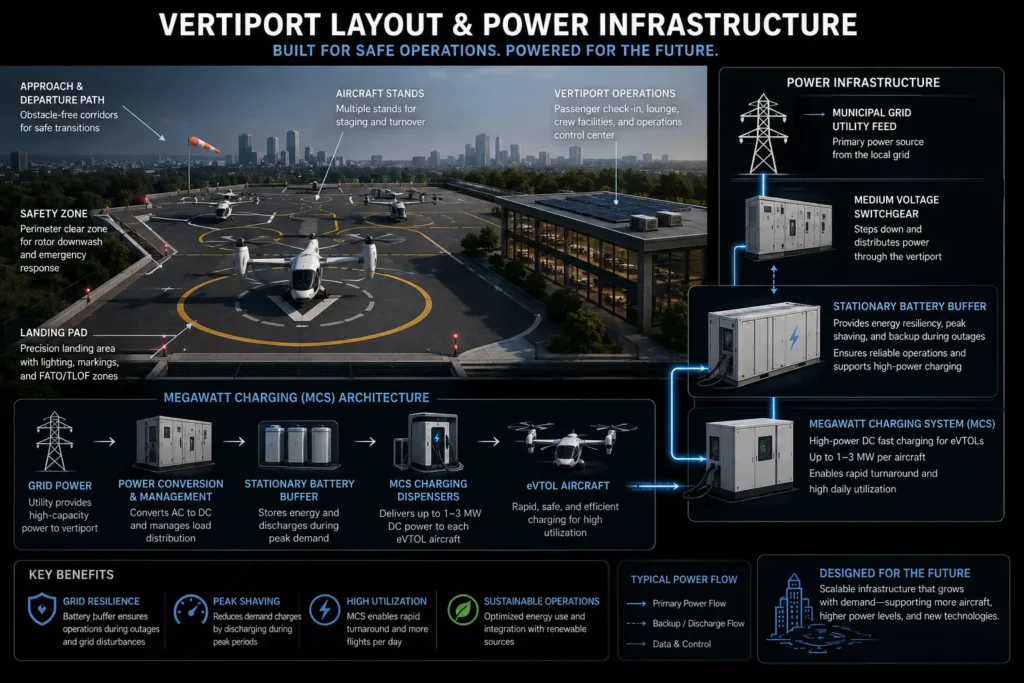
To achieve the high utilization rates required to be profitable, an eVTOL cannot sit on a helipad charging for four hours. It must land, discharge passengers, recharge, and take off again in 20 to 30 minutes. This requires Megawatt Charging Systems (MCS)—pushing massive amperage directly into the aircraft’s Battery Management System (BMS) using standards like SAE J3271. Delivering this surge of power requires heavy, liquid-cooled charging cables and massive on-site energy storage systems (1 to 5 MWh battery buffers) at the vertiport so the facility doesn’t crash the local city grid every time an aircraft plugs in.
Real-World Commercial Air Taxi Operations
The theoretical promises of AAM are now heavily funded, operational realities across multiple sectors.
Commercial Air Taxis: Leading the U.S. market, companies like Joby Aviation and Archer Aviation are advancing through the final stages of FAA Type Certification. They are partnering directly with major airlines (Delta and United, respectively) to operate dedicated shuttle routes. A passenger will book a single ticket that includes a Joby flight from a downtown Manhattan heliport directly to the tarmac at JFK or Newark, seamlessly connecting their urban commute to their international flight.
Autonomous Fleet Operations: While most companies are launching with piloted aircraft to appease regulators, companies like Wisk Aero (backed by Boeing) are bypassing the piloted phase entirely. Wisk is actively expanding its autonomous flight test fleet with its Generation 6 aircraft. By eliminating the pilot, they save weight, add a paying passenger seat, and dramatically lower the operating cost per mile, targeting a true, pilotless Uber-style aerial network.
Infrastructure Pure-Plays: Recognizing that aircraft are useless without landing pads, specialized infrastructure developers like Skyports are securing exclusive “air rights” and roof-top leases globally. Their recent certification of the VDX facility in the UAE proves that operating a vertiport—complete with passenger lounges, biometric security, and megawatt charging—is a distinct, highly lucrative business model separate from manufacturing the aircraft.
Economic & Strategic Impact
The AAM revolution is triggering a massive real estate and energy land grab.
Because eVTOLs are quiet and emission-free, they can operate in dense residential and commercial zones where traditional helicopters are banned. Real estate developers are actively retrofitting the top floors of parking garages into revenue-generating vertiports. However, a parking garage rarely has a 5-megawatt grid connection.
This infrastructure deficit is forcing AAM companies to act as energy developers. To avoid 24- to 36-month utility upgrade delays, vertiport operators are deploying localized microgrids—combining rooftop solar arrays, massive stationary battery buffers, and harmonic filtration systems to protect the grid from voltage sags during fast-charging cycles. The companies that control this distributed energy network will possess a strategic monopoly over urban airspace access.
Advantages
- Zero Operating Emissions: Powered entirely by electricity, eVTOLs eliminate the carbon and localized particulate emissions associated with jet fuel and internal combustion engines.
- Acoustic Stealth: Distributed electric propulsion relies on smaller, slower-spinning rotors, producing a noise footprint that is virtually imperceptible from street level, allowing for high-frequency flights over populated areas.
- Mechanical Reliability: Electric motors lack the thousands of moving parts, complex gearboxes, and combustible fluids of a traditional helicopter engine, drastically reducing operational maintenance costs and improving safety margins.
Limitations
- Battery Cycle Life Degradation: The brutal economics of fast charging. Blasting a lithium-ion battery with a megawatt of power multiple times a day generates extreme heat and degrades the cell chemistry rapidly. Operators will likely have to replace entire aircraft battery packs every few thousand cycles, creating a massive ongoing maintenance expense.
- The Grid Bottleneck: The local utility grid cannot support multiple vertiports without multi-million-dollar substation upgrades. The 1 to 2 MW requirement per pad remains the industry’s hardest physical constraint.
- Rotor Downwash and Outwash: Even though the aircraft are quiet, their rotors still generate massive downward wind velocity (downwash) when hovering. Managing this turbulent air in dense urban environments to prevent it from damaging nearby structures, high-voltage gear, or pedestrians is a significant engineering challenge.
Common Misconceptions
Misconception: These are “flying cars” that everyone will own and park in their driveway.
Reality: eVTOLs are commercial, ride-sharing assets. They will be owned and operated by airlines or massive fleet operators (like Uber or Delta) and flown along strictly regulated, predefined virtual corridors. You will buy a ticket on an app, not own the aircraft.
Misconception: They will cause traffic jams in the sky.
Reality: AAM airspace will be managed by highly advanced, automated software systems (Unmanned Aircraft System Traffic Management, or UTM). These systems will digitally separate aircraft and allocate specific arrival/departure slots at vertiports to ensure safe, orderly flow without overwhelming human air traffic controllers.
Misconception: If the battery dies, the aircraft drops like a rock.
Reality: eVTOLs are designed with massive redundancy. The battery packs are isolated into multiple independent segments. If one pack fails or catches fire, the remaining packs possess enough reserve energy to independently power the motors and execute a safe, controlled emergency landing.
What Most People Miss
The strategic friction of the Other Transaction Authority (OTA) bottleneck.
While the FAA’s Innovate28 plan and the eIPP (Integration Pilot Program) are designed to accelerate the testing of AAM infrastructure, the government moves slower than Silicon Valley. Once an eIPP project is selected, the FAA and the operator must negotiate an Other Transaction Agreement (OTA) to legally facilitate the sharing of proprietary flight data.
What most people miss is that this legal contracting phase is currently stalling operations. As of mid-2026, several critical eIPP projects remain pending simply because the transition from “selection” to “OTA execution” is bottlenecked by lawyers. The technology is ready to test, but the bureaucratic gating items required to actually turn on the radar and share the data are keeping the aircraft grounded.
Comparison Table
| Feature | Traditional Helicopter | eVTOL (Piloted) | eVTOL (Autonomous) |
| Propulsion | Internal Combustion (Jet A fuel) | Distributed Electric (DEP) | Distributed Electric (DEP) |
| Noise Profile | High (Restricted flight paths) | Low (Blends with city ambient noise) | Low |
| Operating Cost / Mile | Very High ($8 – $10+) | Moderate ($3 – $5) | Very Low ($1 – $2) |
| Mechanical Complexity | High (Single point of failure risks) | Low (Redundant motors/batteries) | Low |
| Refueling/Recharging | Fast (5-10 minutes, liquid fuel) | Slow (20-40 mins, Megawatt charging) | Slow (20-40 mins) |
| Emissions | High localized carbon output | Zero operating emissions | Zero operating emissions |
Case Study
Situation: The Federal Aviation Administration (FAA) needed a safe, controlled environment to test how commercial eVTOLs would actually integrate into the busiest airspace in the world before officially rewriting the national airspace rules.
Challenge: Integrating experimental electric aircraft into the arrival and departure streams of major international airports without causing massive delays for commercial passenger jets like Boeing 737s. Furthermore, the FAA needed a legal mechanism to securely harvest flight telemetry data from private companies.
Solution (The eIPP and the Port Authority): In 2026, the FAA heavily leaned into the eVTOL Integration Pilot Program (eIPP). One of the most operationally advanced projects emerged in New York. The Port Authority of New York and New Jersey formed a coalition with partners including Archer Aviation, BETA Technologies, and Joby Aviation. They successfully negotiated an active Other Transaction Agreement (OTA) with the FAA.
Outcome: With the OTA signed, Joby Aviation was able to conduct a highly publicized, deeply monitored test flight from Kennedy International Airport (JFK) directly to the Downtown Manhattan Heliport. This flight proved that an eVTOL could successfully navigate the complex Class B airspace of New York without disrupting traditional jet traffic, while simultaneously transmitting critical radar and battery performance data back to the FAA.
Lessons Learned: The JFK-Manhattan flight demonstrated that the physical aircraft are capable of the mission. However, it also proved that success in the AAM industry requires immense political capital. Companies that excel at navigating public-private partnerships, securing municipal endorsements, and rapidly executing OTAs with federal regulators will dominate the airspace long before their less-connected competitors are legally allowed to take off.
Future Outlook
Next 12–24 Months
The era of Type Certification and Exemption Resolution. By 2027, the first major players (Joby, Archer) will finalize their FAA Type Certifications under the new powered-lift category. We will witness the first true commercial, revenue-generating flights in early-adopter markets like the UAE and specific U.S. launch cities (e.g., Miami, Chicago, New York). Simultaneously, the construction of “megawatt-ready” vertiports will surge, heavily subsidizing the manufacturers of specialized liquid-cooled aviation charging cables.
Next 3–5 Years
The scaling of Regional Air Mobility (RAM). As urban air taxi routes mature, the focus will expand outward. Battery energy density will incrementally improve, pushing the effective range of eVTOLs from 50 miles to over 150 miles. This will unlock Regional Air Mobility—connecting smaller, underutilized regional airports (that currently have no commercial service) directly to major city centers. Companies like Beta Technologies will dominate this middle-mile logistics and cargo market, bypassing the congestion of interstate highways entirely.
Next 10 Years
The transition to Full Autonomy and Solid-State Batteries. By the mid-2030s, the pilot will be removed from the cockpit. Backed by billions in flight hours and data, the FAA and EASA will certify fully autonomous passenger operations, drastically crashing the cost-per-mile of an eVTOL flight. Concurrently, the commercialization of solid-state batteries will replace traditional lithium-ion packs, virtually eliminating the risk of thermal runaway (battery fires) while doubling the range and significantly reducing the charging turnaround times required at the vertiport.
Most Likely Scenario
Advanced Air Mobility will not replace cars, nor will it replace commercial jets. It will insert a highly efficient, premium “middle layer” into the global transportation network. In the late 2020s, it will serve as a premium shuttle service for business travelers and urgent cargo. By the 2030s, as autonomous software scales and economies of manufacturing drive down aircraft costs, it will democratize into a standard, affordable transit option, turning a two-hour suburban gridlock commute into a 15-minute aerial hop.
Key Takeaways
- Advanced Air Mobility (AAM) utilizes electric vertical takeoff and landing (eVTOL) aircraft to provide quiet, zero-emission transportation over congested urban and regional corridors.
- The FAA has created a new “powered-lift” category to regulate these aircraft, combining the rules of both traditional airplanes and helicopters.
- Distributed Electric Propulsion (DEP) makes eVTOLs mechanically simpler, inherently safer through redundancy, and drastically quieter than traditional gas-powered helicopters.
- The primary bottleneck to commercial scaling is infrastructure. Vertiports require 1 to 2 Megawatts of instantaneous power per landing pad, demanding massive, expensive upgrades to local municipal power grids.
- To operate profitably, eVTOLs must utilize Megawatt Charging Systems (MCS) to recharge in 20 to 30 minutes, a process that severely degrades battery cycle life over time.
- Regulatory coordination is actively transitioning from isolated waivers to structured programs like the FAA’s Innovate28 and eIPP, paving the way for scalable commercial operations by the late 2020s.
Glossary
Distributed Electric Propulsion (DEP): An aerospace architecture that uses multiple small electric motors and propellers spread across an aircraft, providing high redundancy, lower noise, and precise flight control.
EASA SC-VTOL: The Special Condition for VTOL aircraft established by the European Union Aviation Safety Agency, containing the strict regulatory safety frameworks required to fly in Europe.
eVTOL: Electric Vertical Takeoff and Landing. An aircraft that uses electric power to hover, take off, and land vertically.
Megawatt Charging System (MCS): A high-power electrical charging standard (like SAE J3271) capable of delivering up to 1,000+ volts and massive amperage to rapidly charge heavy-duty batteries in minutes.
Powered-Lift: A new regulatory category of aircraft defined by the FAA that encompasses vehicles capable of vertical takeoff (like a helicopter) and aerodynamic flight (like an airplane).
Vertiport: A dedicated physical facility designed specifically for the dispatch, landing, and high-speed electrical charging of eVTOL aircraft in urban environments.
Frequently Asked Questions
Are eVTOLs flying cars?
No. A flying car implies a vehicle that you can drive on a highway and then take off into the sky. eVTOLs are strictly aircraft. They do not have wheels for highway driving and are designed exclusively to operate between designated aviation vertiports.
How safe are they compared to helicopters?
They are engineered to be significantly safer. If a helicopter’s single engine fails, it is in a critical emergency. If an eVTOL loses an electric motor, the flight computer instantly compensates using the remaining 5 to 11 motors. Furthermore, European regulators (EASA) are requiring them to meet a safety threshold of one in a billion ($10^{-9}$) chance of catastrophic failure, matching the safety standards of massive commercial airliners.
Why do they need Megawatt chargers?
An eVTOL battery pack is massive. If you plugged it into a standard electric vehicle (EV) charger at a grocery store, it would take hours to recharge. Because the aircraft must fly dozens of trips a day to make money, it must be force-fed an immense amount of electricity (Megawatts) to recharge in just 20 minutes.
Will weather ground these aircraft easily?
Like all light aircraft, severe weather is a factor. Early generation eVTOLs will likely be restricted from flying in heavy icing conditions or extreme thunderstorms. However, they are designed with advanced avionics to handle high winds and turbulence significantly better than consumer drones.
When can I actually buy a ticket to fly on one?
Major operators like Joby and Archer are targeting initial commercial passenger flights in select cities (like New York, Miami, and Dubai) between late 2025 and 2026, assuming final FAA and EASA Type Certifications are granted on schedule.
Sources
[1] Morgan Lewis: Midyear Update: The Evolving Advanced Air Mobility Landscape (July 2026)
[2] Honeywell Aerospace: Advanced Air Mobility in 2026: From Exemptions to Execution
[3] Future Market Insights: eVTOL Charging Facilities Market Global Market Analysis Report – 2035 (October 2025)
[4] Seraph: The eVTOL Industry in 2026: Eight Trends That Will Separate Leaders From the Field (March 2026)
[5] Eau Gallie Electric: Vertiports & eVTOL Readiness: Powering the Future of Aviation (June 2025)