Advertisement
)
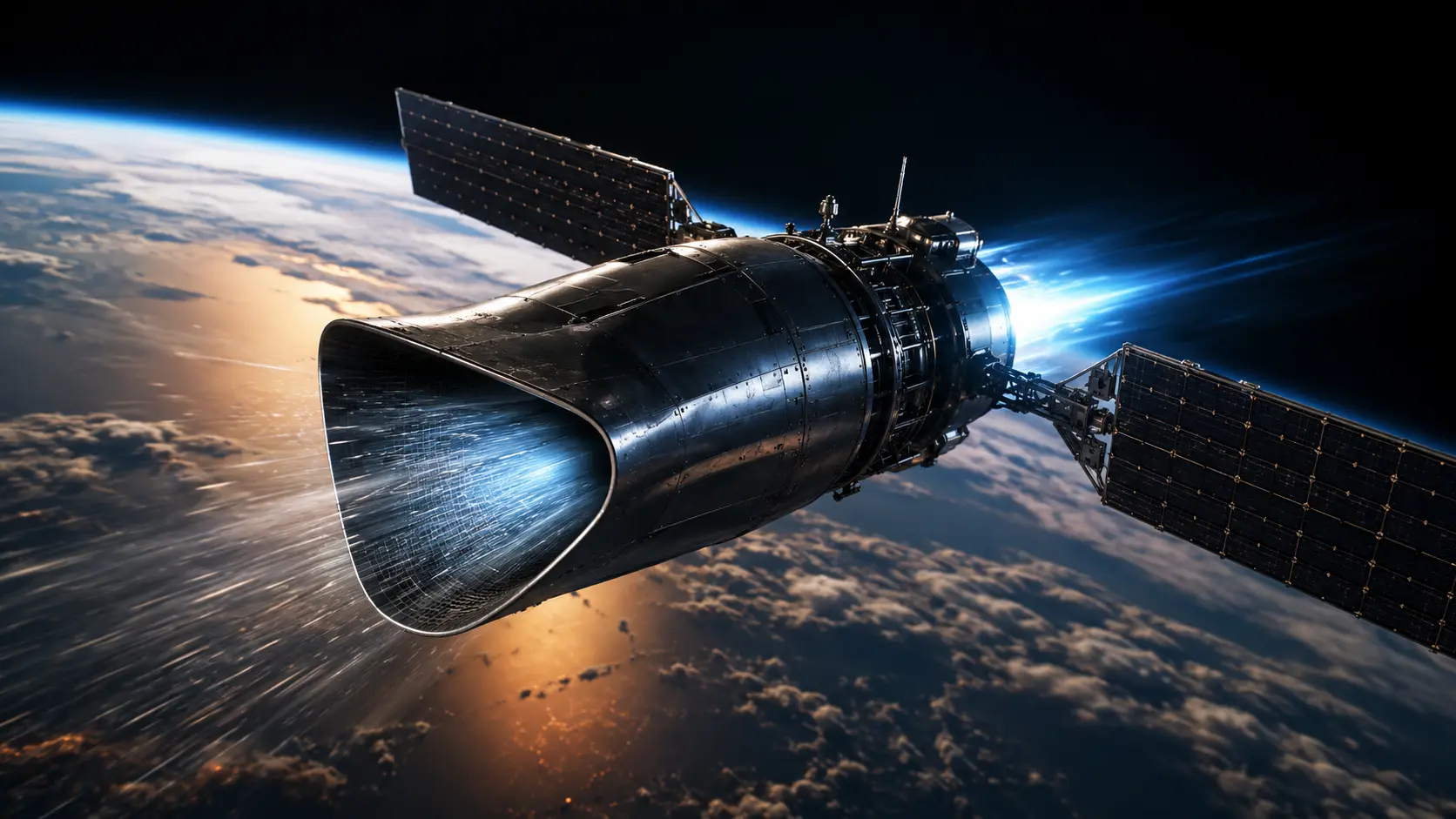

To take the sharpest photograph of the Earth, you have to fly dangerously close to it. But space is not a perfect vacuum. If a satellite flies too low, it smashes into the invisible, outer edges of Earth’s atmosphere. This friction acts like aerodynamic quicksand, dragging the multi-million-dollar machine down until it incinerates in a fiery streak across the sky. For decades, keeping a spy satellite in this low-altitude “death zone” required strapping a massive, heavy tank of propellant to it just to constantly fight the drag. Once the gas ran out, the mission was over.
Today, aerospace engineers have designed a radical alternative to cheating orbital decay: they stopped fighting the atmosphere and started consuming it. By equipping satellites with specialized, funnel-like intakes and electromagnetic thrusters, the next generation of orbital hardware is designed to literally breathe the thin air of the upper atmosphere. Why should you care right now? Because whoever masters this technology secures the ultimate high ground. Flying a satellite closer to the Earth exponentially increases camera resolution and slashes communication latency, kicking off a geopolitical race to populate the lowest, most hostile layer of the cosmos.
What is Very Low Earth Orbit (VLEO)?
Very Low Earth Orbit (VLEO) is the orbital band ranging from 200 to 450 kilometers above Earth. Because it contains trace amounts of atmospheric gases, satellites here experience severe aerodynamic drag. To remain in VLEO, spacecraft require continuous propulsion to prevent rapid orbital decay and atmospheric burn-up.
At a Glance
- Concept: Operating satellites in the transition zone between Earth’s atmosphere and the vacuum of space, utilizing the trace gases as an infinite source of fuel.
- Why it matters: Flying at 250 km instead of 500 km means a satellite’s camera is twice as close to the target. This allows manufacturers to build drastically smaller, cheaper lenses while achieving military-grade resolution.
- Who uses it: Defense agencies (DARPA, Space Development Agency), the European Space Agency (ESA), and commercial Earth Observation (EO) constellation operators.
- Biggest takeaway: ABEP technology completely fundamentally alters satellite economics. By eliminating the need to launch heavy tanks of Xenon or Krypton fuel, launch weights plummet, and the operational lifespan of a VLEO satellite becomes limited only by hardware degradation, not fuel capacity.
In Simple Words
Normally, when you launch a satellite, you want to put it high up in space (like 500 to 1,000 kilometers) where there is no air. Without air, there is no friction. The satellite can turn off its engines and just coast around the Earth for years.
But if you want to take a high-resolution picture of a license plate, 500 kilometers is too far away. You want your satellite to fly at 250 kilometers.
The problem is that at 250 kilometers, there is still a tiny bit of air. Hitting this thin air at 17,000 miles per hour creates drag, which slows the satellite down. To stop from falling back to Earth, the satellite has to constantly fire its thrusters. Historically, this meant the satellite had to carry a giant, heavy tank of gas.
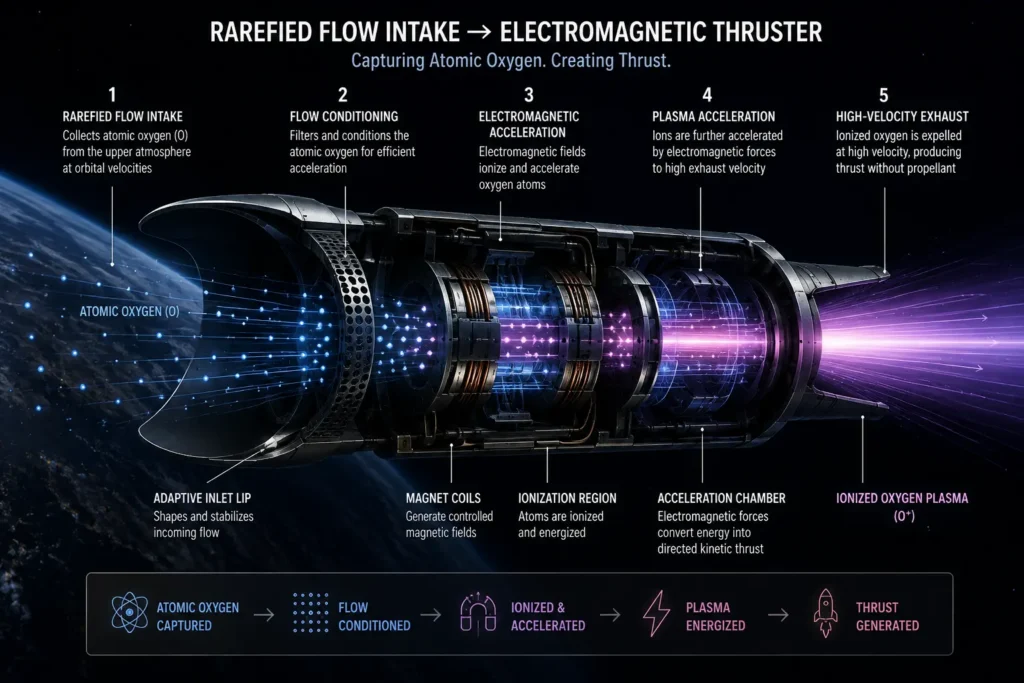
Air-Breathing Electric Propulsion (ABEP) is an engine that solves this. Instead of bringing gas from Earth, the front of the satellite acts like a giant vacuum cleaner. It scoops up the thin air it is crashing into, funnels it into the engine, zaps it with electricity from its solar panels, and shoots it out the back for thrust. The friction that was trying to kill the satellite is now being used as free, infinite fuel to keep it alive.
Why This Matters
The commercial space industry is bottlenecked by the payload capacity of rockets.
To achieve sub-meter optical resolution or ultra-high signal-to-noise ratios for Synthetic Aperture Radar (SAR), traditional satellites require massive, heavy, billion-dollar sensor payloads. However, the laws of physics offer a cheat code: if you cut the distance to the target in half, you can drastically reduce the size and cost of the sensor required to achieve the exact same performance.
For space investors and defense analysts, VLEO represents the commoditization of extreme high-fidelity intelligence. By moving constellations into VLEO, companies can launch swarms of cheap, microwave-sized satellites that outperform school-bus-sized legacy satellites in higher orbits. Furthermore, because VLEO guarantees rapid orbital decay, these constellations automatically solve the space debris crisis—if a VLEO satellite breaks, the atmosphere safely burns it up in a few weeks, leaving the orbital lanes perfectly clean.
The Global Race for VLEO Satellite Technology
The pursuit of ABEP is a highly funded, multinational technology race.
The European Space Agency (ESA) proved the foundational physics in 2019 with a successful laboratory test of an air-breathing thruster inside a vacuum chamber simulating VLEO conditions. Fast forward to the mid-2020s, and the U.S. Defense Advanced Research Projects Agency (DARPA) is actively funding programs to weaponize the VLEO band.
DARPA’s investments are focused on ensuring that the U.S. military can field untrackable, highly maneuverable orbital assets. Because VLEO satellites fly below the traditional orbital tracking belts and can dynamically change their altitude using continuous air-breathing thrust, they represent a highly resilient, survivable architecture in the event of a great power conflict in space.
How Air-Breathing Electric Propulsion (ABEP) Works
Extracting propulsion from an near-vacuum environment requires mastering extreme fluid dynamics and plasma physics. Here is the first-principles breakdown.
1. The Fundamental Problem: The Propellant Mass Fraction
In traditional electric propulsion, satellites use heavy noble gases like Xenon. A satellite might consist of 30% to 50% propellant by weight. In VLEO, the atmospheric drag is so intense that a standard satellite would burn through its Xenon supply in a matter of months. Carrying enough Xenon to survive for five years in VLEO would make the satellite too heavy to launch economically.
2. The Insufficiency of Traditional Aerodynamics
You cannot just put a jet engine on a satellite. Jet engines rely on dense air to combust jet fuel. At 250 kilometers, the air is in a “free molecular flow” regime—meaning the gas molecules are so far apart they rarely collide with each other. Traditional aerodynamic intakes cannot compress this air; the molecules would just bounce off the metal and escape.
3. The Core Mechanism: The Rarefied Flow Intake
The defining component of an ABEP system is the intake. It is an actively cooled, highly polished, funnel-like structure designed specifically for rarefied gas. As the satellite flies at 7.5 km/second, atomic oxygen and nitrogen molecules enter the wide mouth of the intake. The internal geometry acts as a passive compressor, using the sheer velocity of the spacecraft to force the scattered molecules into a dense collection chamber without them bouncing back out.
4. Technical Depth: Ionization and Acceleration
Once the atmospheric gas is compressed in the chamber, the system functions like a standard Hall-effect or gridded ion thruster. Solar panels provide electrical power to an electron emitter. The electrons bombard the trapped oxygen and nitrogen atoms, knocking their electrons loose and turning the gas into a positively charged plasma. Powerful electromagnetic fields then grip this plasma and accelerate it out the back of the engine at tremendous speeds (often exceeding 15,000 meters per second), generating the continuous micro-thrust needed to exactly cancel out the aerodynamic drag.
5. Real-World Consequences: The Drag-Thrust Balance
There is a catch: to power the ionization process, the satellite needs massive solar arrays. But large solar arrays act like sails, creating more aerodynamic drag. Therefore, an ABEP system must be hyper-efficient. The thrust generated from the scooped-up air must be mathematically greater than the drag penalty caused by the solar panels required to run the engine. If the system drops below this efficiency threshold, the satellite will inevitably fall from the sky.
Real-World Applications for VLEO Satellites
The leap from the vacuum chamber to actual orbital deployment is currently underway.
DARPA and Redwire’s SabreSat: To capitalize on VLEO, DARPA awarded millions to Redwire to develop SabreSat, a specialized VLEO spacecraft. The satellite features a deeply aerodynamic, dart-like profile to minimize drag, proving that VLEO satellites require a totally different, sleek form factor compared to the bulky, box-like satellites deployed in standard orbits.
Earth Observation (EO) and SAR Constellations: Commercial companies like Albedo are actively targeting the VLEO regime to offer 10-centimeter optical resolution imagery to the civilian market—a level of detail previously restricted to classified NRO (National Reconnaissance Office) spy satellites. Similarly, Synthetic Aperture Radar (SAR) providers are exploring VLEO because the lower altitude drastically reduces the power required to bounce radar pulses off the Earth’s surface.
Low-Latency Telecommunications: While SpaceX’s Starlink operates in LEO (~550 km), future telecommunication architectures are looking at VLEO (~250 km). Because the signal has half the physical distance to travel, the round-trip latency drops significantly. For high-frequency trading networks or autonomous drone coordination, saving a few milliseconds by lowering the orbital shell provides a massive commercial advantage.
Economic & Strategic Impact
VLEO architecture fundamentally solves the Kessler Syndrome threat.
The greatest existential threat to the $400 billion space economy is space debris. The orbital bands between 500 km and 800 km are becoming dangerously crowded. If two satellites collide in LEO, the resulting shrapnel will orbit the Earth for decades, potentially triggering a chain reaction that renders space impassable.
VLEO is immune to this threat. Because the aerodynamic drag at 250 km is so severe, VLEO is inherently self-cleaning. If an ABEP satellite loses power, gets hit by debris, or reaches the end of its life, it does not become space junk. Without its engine running, the atmosphere instantly grips the dead satellite, dragging it down to safely incinerate in a matter of weeks. For space regulators and insurers, this absolute guarantee of zero long-term orbital debris makes VLEO the most sustainable and financially insurable orbital band.
Advantages
- Infinite Propellant: By utilizing atmospheric gas, the satellite is completely freed from the mass constraints of onboard chemical or noble gas propellant tanks.
- Drastically Smaller Optics: Operating at half the altitude of traditional LEO allows for significantly smaller, lighter, and cheaper camera payloads to achieve equivalent ground resolution.
- Inherent Debris Mitigation: The severe atmospheric drag ensures that any failed or decommissioned hardware automatically de-orbits and burns up within weeks, keeping the orbit clean.
- Lower Radiation Exposure: VLEO sits well below the inner Van Allen radiation belt. The Earth’s magnetic field and upper atmosphere shield the satellites, allowing manufacturers to use cheaper, commercial off-the-shelf (COTS) electronics instead of expensive, radiation-hardened chips.
Limitations
- Atomic Oxygen Erosion: The VLEO atmosphere is dense with highly reactive atomic oxygen (O). Striking this oxygen at 7.5 km/s acts like a microscopic sandblaster, aggressively eroding polymers, solar cell coatings, and the ABEP intake surfaces over time.
- Solar Drag Penalty: ABEP systems require immense electrical power to ionize the atmospheric gases. Generating this power requires large solar arrays, which dramatically increase the aerodynamic drag the thruster must fight against.
- Orbital Station-Keeping: Because the density of the upper atmosphere fluctuates wildly based on solar weather (solar flares cause the atmosphere to puff out and expand), VLEO satellites require constant, dynamic automated thrust adjustments to avoid suddenly crashing during a solar storm.
Common Misconceptions
Misconception: VLEO satellites fly like airplanes in the sky.
Reality: While they experience drag, they do not generate aerodynamic “lift” with wings. They are still orbiting in a near-vacuum via orbital mechanics (falling around the Earth at 17,000 mph); they simply have to constantly use a tiny bit of thrust to offset the friction.
Misconception: The engine burns the air like a jet.
Reality: There is no combustion. At 250 km, there is not enough dense oxygen or fuel to start a fire. The engine uses electricity (from solar panels) to electromagnetically accelerate the air molecules. It is an electrical process, not a chemical fire.
Misconception: If the engine stops for a second, the satellite falls instantly.
Reality: Orbital decay at 250 km is aggressive, but it is not instantaneous. If the ABEP engine shuts down, the satellite will slowly lose altitude over several days or weeks before hitting the denser atmosphere and burning up, giving ground control time to reboot systems.
What Most People Miss
The geopolitical advantage of Unpredictable Maneuverability.
Standard satellites follow highly predictable orbital paths dictated by Kepler’s laws. Adversaries know exactly when a U.S. spy satellite will pass over a sensitive military base, allowing them to hide their activities under a tarp just in time.
What most people miss is that VLEO satellites utilizing continuous ABEP thrust are not bound by strict ballistic trajectories. Because their engine is always firing, they can continuously and subtly alter their altitude and orbital track without worrying about wasting finite fuel reserves. This constant maneuvering makes their exact orbital path incredibly difficult for adversaries to predict, blinding enemy early-warning tracking systems.
Comparison Table
| Feature | Standard LEO (500+ km) | Very Low Earth Orbit (VLEO) (200 – 350 km) |
| Atmospheric Drag | Minimal | Severe |
| Propellant Source | Heavy onboard tanks (Xenon/Hydrazine) | Infinite Atmospheric Intake (ABEP) |
| Optical Resolution | Standard | Ultra-High (Due to proximity) |
| Space Debris Risk | High (Debris orbits for decades) | Zero (Debris burns up in weeks) |
| Radiation Exposure | Moderate to High | Low (Shielded by upper atmosphere) |
| Hardware Form Factor | Boxy, bulky | Sleek, highly aerodynamic |
Case Study
Situation: The European Space Agency (ESA) recognized that unlocking the VLEO band for sustained Earth Observation required validating the physics of an air-breathing thruster. Traditional Hall-effect thrusters degraded rapidly when exposed to atomic oxygen and molecular nitrogen, meaning standard electric propulsion designs would destroy themselves if fed atmospheric gas.
Challenge: Designing an intake and thruster that could collect rarefied gas, ionize it efficiently using solar power, and physically survive the highly corrosive properties of an oxygen plasma exhaust plume.
Solution (The RAM-EP Project): In 2019, ESA partnered with Sitael (an Italian space tech firm) to construct a dual-stage system. They designed a novel passive intake to collect and compress the gas. Crucially, they developed a specialized thruster that utilized magnetic shielding to contain the plasma, ensuring the corrosive atomic oxygen never physically touched the walls of the thruster chamber.
Outcome: Inside a vacuum chamber built to simulate the exact flow and density of the atmosphere at 200 kilometers, the team successfully ignited the thruster using only the simulated atmospheric gas as propellant. The system generated continuous, stable thrust without utilizing a single drop of stored Xenon.
Lessons Learned: The ESA test mathematically proved that the “drag-to-thrust” balance could be conquered. It validated that ABEP is not just theoretically possible, but mechanically viable, initiating a global race among defense contractors to shrink the power requirements and scale the technology for immediate orbital deployment.
Future Outlook
Next 12–24 Months
The launch of Aerodynamic Demonstrators. Through 2026 and 2027, defense agencies and commercial startups will launch the first wave of specialized VLEO testbeds. These satellites will not yet rely fully on ABEP; rather, they will test the aerodynamic stability of dart-shaped, fin-stabilized satellite chassis in the 250 km band, utilizing traditional electric propulsion to measure the exact drag coefficients and atomic oxygen erosion rates in real-time.
Next 3–5 Years
The deployment of Operational ABEP Prototypes. By the end of the decade, the first true Air-Breathing Electric Propulsion satellites will achieve stable, sustained orbit. These pathfinder missions will prove that a satellite can operate indefinitely at 200 km using only solar power and atmospheric drag. The success of these missions will trigger a massive influx of venture capital, as the capability to launch ultra-cheap, high-resolution optics fundamentally undercuts the business models of legacy LEO observation companies.
Next 10 Years
The VLEO Commercial Migration. By the mid-2030s, VLEO will become the default operational band for military intelligence, high-frequency trading communications, and environmental monitoring. Traditional LEO will be viewed as a congested, debris-ridden transit zone. VLEO constellations will operate as self-sustaining, self-cleaning orbital networks, utilizing advanced metamaterials to resist atomic oxygen degradation and providing humanity with an uninterrupted, microscopic real-time view of the Earth’s surface.
Most Likely Scenario
ABEP technology will successfully bridge the gap between aviation and spaceflight. While overcoming the power-to-drag ratio of massive solar panels will require strict aerodynamic compromises, the geopolitical value of flying untouchable, ultra-high-resolution sensors at 200 km is too lucrative to ignore. The commercialization of VLEO will establish a permanent, low-altitude infrastructure layer for the global space economy.
Key Takeaways
- Very Low Earth Orbit (VLEO) is the region of space between 200 and 450 km, where severe atmospheric drag typically causes satellites to quickly fall out of orbit and burn up.
- To survive in VLEO without carrying massive tanks of fuel, satellites are being designed with Air-Breathing Electric Propulsion (ABEP) systems.
- ABEP engines act like vacuums, scooping up the thin atmospheric gases (mostly atomic oxygen), ionizing them with electricity from solar panels, and shooting them out the back for thrust.
- Flying in VLEO allows satellites to use much smaller, cheaper cameras to achieve ultra-high-resolution images, and significantly reduces the latency of communication signals.
- VLEO solves the space debris crisis (Kessler Syndrome); if an ABEP satellite breaks, the atmospheric friction safely pulls it out of orbit and incinerates it within weeks.
- The primary engineering challenges are surviving the highly corrosive nature of atomic oxygen and designing solar arrays that generate enough power without creating too much aerodynamic drag.
Glossary
Air-Breathing Electric Propulsion (ABEP): An advanced thruster technology that captures surrounding atmospheric gas, ionizes it, and accelerates it electromagnetically to generate thrust without onboard propellant tanks.
Atomic Oxygen (O): A highly reactive form of oxygen found in the upper atmosphere, created when solar radiation splits O_2 molecules. It causes severe corrosion to satellite materials.
Kessler Syndrome: A theoretical scenario where the density of space debris in LEO becomes so high that collisions create a cascading chain reaction, rendering spaceflight impossible. VLEO avoids this.
Rarefied Flow: The behavior of gases at extremely low densities (like in VLEO), where molecules are so far apart they rarely collide with each other, requiring specialized aerodynamic intakes to compress them.
Synthetic Aperture Radar (SAR): A type of active data collection where a sensor produces its own energy to illuminate the Earth, creating 3D images through clouds and darkness. Very effective in VLEO.
Very Low Earth Orbit (VLEO): The transitional orbital band located approximately 200 km to 450 km above Earth, characterized by significant aerodynamic drag.
Frequently Asked Questions
Why don’t all satellites just use air-breathing engines?
Because you have to fly very low to find enough “air” to breathe. Most communications and GPS satellites need to be much higher (in LEO or GEO) so they can “see” a larger portion of the Earth at one time. ABEP is only useful for satellites that specifically want to fly extremely close to the ground.
If the engine breaks, will the satellite crash into a city?
No. Satellites re-entering from VLEO are traveling at roughly 17,000 miles per hour. When they hit the thicker parts of the atmosphere, the friction generates intense heat (thousands of degrees), which completely incinerates and vaporizes the satellite long before any pieces can reach the ground.
Can ABEP be used to travel to Mars?
No. Deep space is a true vacuum; there is no atmospheric gas to scoop up and breathe. ABEP is exclusively designed for the transitional boundary layer around planets that have an atmosphere (like Earth or potentially Mars, but only for orbiters dipping into the Martian atmosphere, not for the transit between planets).
What powers the air-breathing engine?
Solar panels. The engine gets its “propellant” (gas) from the atmosphere, but it still needs “power” (electricity) to run the magnetic fields that accelerate the gas. The solar panels collect energy from the sun to run the electrical components of the thruster.
How does atomic oxygen damage the satellite?
Atomic oxygen is highly reactive (think of it like extreme, rapid rusting). When a satellite smashes into atomic oxygen at orbital speeds, the chemical reaction slowly eats away at plastics, thermal blankets, and optical coatings, forcing engineers to use highly specialized, resistant materials for VLEO spacecraft.
Sources
[1] European Space Agency (ESA): World-first firing of air-breathing electric thruster
[2] Defense Advanced Research Projects Agency (DARPA): SABRE Program and VLEO Operations
[3] IEEE Aerospace and Electronic Systems Magazine: Air-Breathing Electric Propulsion: Flight in the Very Low Earth Orbit (2025/2026 Updates)
[4] Redwire Space: Redwire Awarded DARPA Contract for VLEO Satellite Platform
[5] Journal of Spacecraft and Rockets: System Architecture and Intake Design for Air-Breathing Electric Propulsion