Advertisement
)
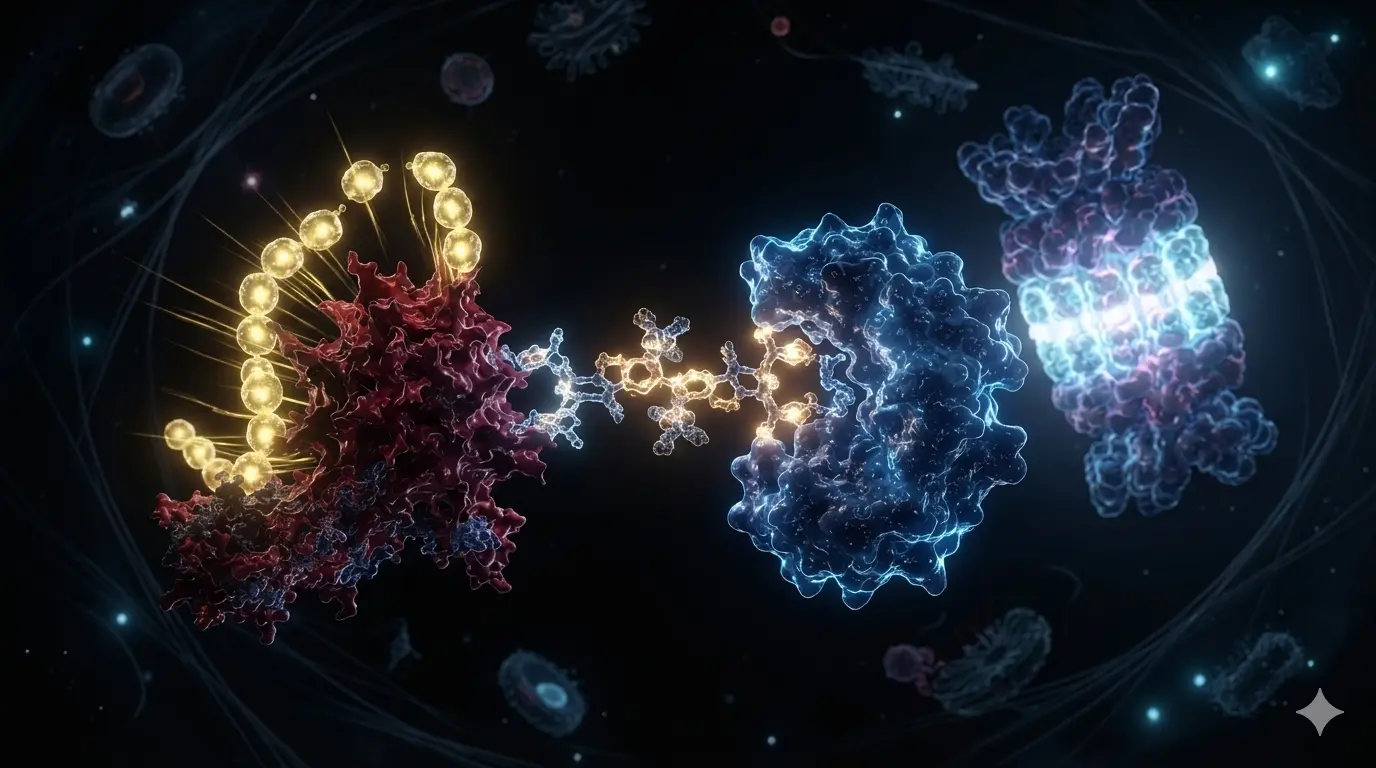

For a century, the pharmaceutical industry has relied on a single, stubborn mechanic: the lock and key. To stop a cancer-causing protein, scientists had to find a microscopic groove on its surface (the lock) and engineer a chemical drug (the key) to fit perfectly inside, jamming the machinery and blocking its function. But what happens if the deadly protein is perfectly smooth? What if there is no lock to jam? For decades, the answer was grim. Nearly 80 percent of the proteins driving human disease lack an accessible active site. The industry labeled them “undruggable,” and patients simply ran out of options.
That paradigm is now obsolete. Instead of trying to block a protein, scientists have figured out how to completely shred it. By leveraging a radical new class of drugs known as Proteolysis Targeting Chimeras (PROTACs) and “molecular glues,” biotechnology has hacked the human body’s own natural garbage disposal network. Why should you care right now? Because this isn’t a theoretical lab experiment—it is an active, multi-billion-dollar clinical pivot that is curing drug-resistant cancers. Targeted Protein Degradation (TPD) completely rewrites the rules of chemistry, allowing us to grab previously untouchable targets by any available edge and drag them directly to the cellular incinerator.
What is Targeted Protein Degradation (PROTACs)?
Targeted Protein Degradation (TPD), specifically via PROTACs (Proteolysis Targeting Chimeras), is a therapeutic strategy that utilizes a two-headed molecule to force a disease-causing protein into contact with an E3 ubiquitin ligase. This interaction tags the target protein for destruction by the cell’s natural waste disposal system, the proteasome.
At a Glance
- Concept: Repurposing the cell’s internal trash-collection mechanism to identify and destroy pathogenic proteins, rather than just temporarily blocking them.
- Why it matters: It unlocks the “undruggable” human proteome. If a cancer protein mutates to eject a traditional drug, a PROTAC can still bind to a different, non-active part of the protein and destroy it anyway.
- Who uses it: Elite biotechnology firms (Arvinas, Kymera Therapeutics, Nurix) partnering with massive pharmaceutical conglomerates (Pfizer, Novartis, Bayer) to replace their aging small-molecule pipelines.
- Biggest takeaway: PROTACs operate as catalysts. A traditional drug molecule blocks one protein and is used up. A single PROTAC molecule can tag a protein for destruction, release it, and then hunt down hundreds of other proteins, achieving massive clinical efficacy at incredibly low doses.
In Simple Words
Imagine a factory with a rogue machine that is constantly pumping out toxic pollution (a cancer protein).
A traditional drug acts like a mechanic trying to jam a wrench into the machine’s gears. If the wrench fits perfectly, the machine stops. But if the machine changes its shape (mutates), the wrench falls out, and the pollution starts again. Worse, the mechanic has to stand there holding the wrench forever to keep the machine broken.
A PROTAC is entirely different. It does not try to jam the gears. Instead, it acts like a sticky tracking beacon.
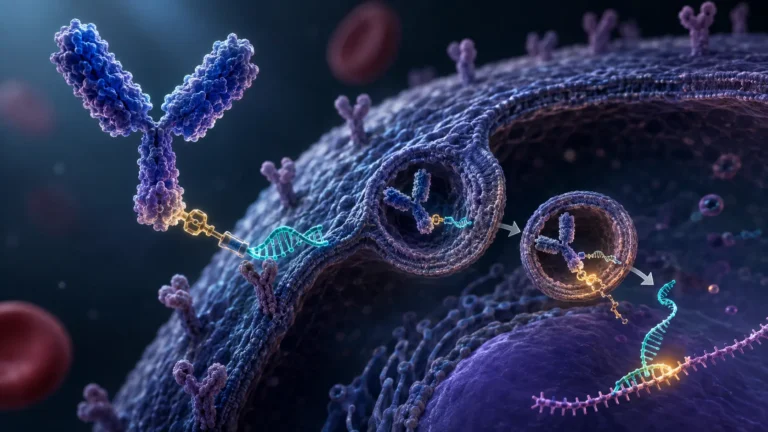
One end of the PROTAC sticks to the rogue machine (anywhere it can grab it), and the other end sticks to the factory’s janitor (a specialized enzyme called an E3 ligase). By gluing the janitor to the machine, the janitor automatically slaps a “TRASH” sticker (ubiquitin) onto the machine.
The factory’s internal garbage truck (the proteasome) sees the sticker, hauls the rogue machine away, and completely shreds it into scrap metal. Meanwhile, the PROTAC detaches, floats away, and finds the next rogue machine to glue to the janitor. It permanently eliminates the problem instead of just pausing it.
Why This Matters
The economic ceiling of traditional small-molecule inhibitors has been reached. When a patient takes a traditional kinase inhibitor for prostate or breast cancer, the tumor often shrinks initially. However, the cancer inevitably mutates the specific active site that the drug targets. The drug stops working, the cancer becomes resistant, and the patient relapses.
For biotech investors and oncologists, Targeted Protein Degradation circumvents this biological arms race. Because a PROTAC doesn’t need to bind to the functional “active site” of a protein to work, it is highly resilient to mutations. By simply dragging the mutated protein to the proteasome, TPD effectively deletes the target from the cell entirely. The multi-billion-dollar licensing deals signed in the mid-2020s reflect a clear industry consensus: degrading proteins will rapidly cannibalize the market share of blocking proteins across oncology, immunology, and neurodegeneration.
The Evolution of PROTACs and Molecular Glues
The concept of hacking the ubiquitin-proteasome system is not entirely new; the multiple myeloma drug Lenalidomide (Revlimid) has acted as a “molecular glue” for years, though its precise degradation mechanism was discovered largely by accident after it was already on the market.
What defines the current PROTAC revolution is intentional, rational engineering. Scientists are no longer hoping to stumble upon a chemical that accidentally degrades a protein. They are actively synthesizing heterobifunctional (two-headed) molecules from scratch, using computational AI to custom-design the chemical “linker” that bridges the target protein to the exact E3 ligase required. This rational design has transitioned TPD from a serendipitous biological anomaly into a highly predictable, repeatable industrial platform.
How Targeted Protein Degradation Works
Forcing a cell to eat its own disease-causing proteins requires master-level molecular choreography. Here is the first-principles breakdown of the degradation cycle.
1. The Fundamental Problem: Occupancy-Driven Pharmacology
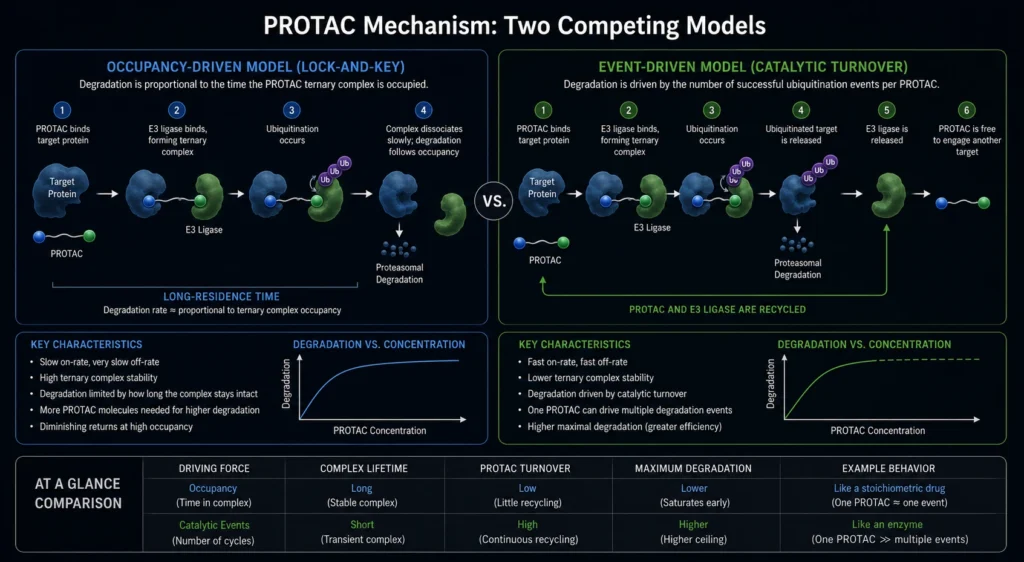
Traditional drugs operate on an “occupancy-driven” model. To suppress a tumor, the drug must achieve high concentrations in the bloodstream so that every single target protein is occupied by a drug molecule at all times. This requires massive, continuous dosing, which inevitably leads to severe systemic toxicity (side effects) as the drug accumulates in healthy organs.
2. The Insufficiency of the “Lock and Key”
If the target protein (like KRAS or MYC, infamous cancer drivers) has a smooth surface without a deep, accessible pocket, a traditional small molecule cannot bind to it tightly enough to block its function. These proteins remained biologically untouchable for decades.
3. The Core Mechanism: The Heterobifunctional Ligand
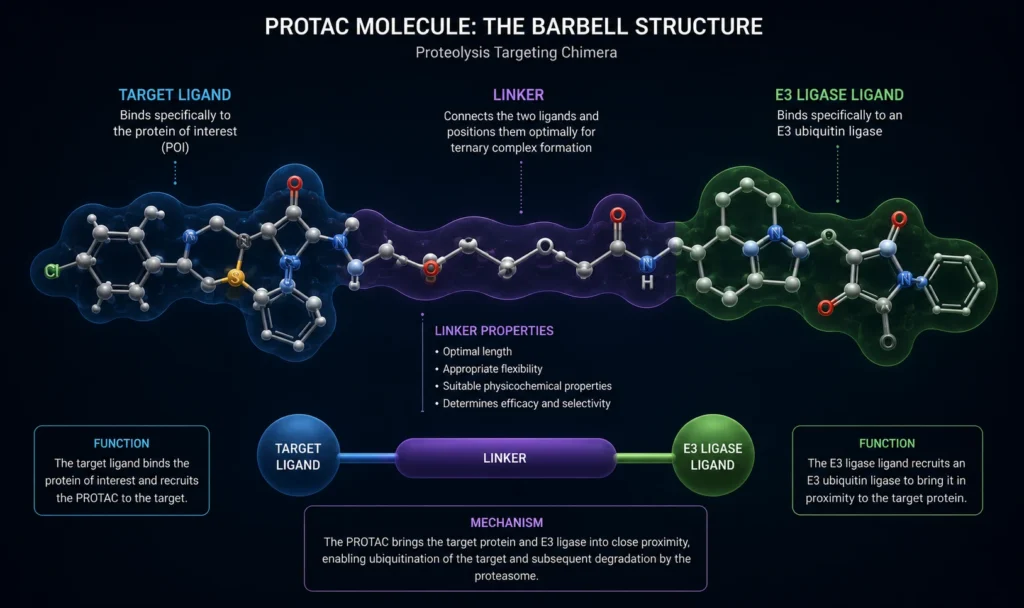
A PROTAC is designed to bypass the need for an active site. It is a single, large molecule with a barbell-like structure:
- Ligand A (The Hook): Designed to bind to any available nook or cranny on the target protein.
- Ligand B (The Recruiter): Designed to bind to a specific E3 ubiquitin ligase naturally present in the human cell (commonly Cereblon or VHL).
- The Linker (The Chain): A flexible chemical chain connecting the two ligands.
4. Technical Depth: Polyubiquitination
When the PROTAC successfully binds to both the target protein and the E3 ligase, it forms a “Ternary Complex.” This brings the E3 ligase into unnatural proximity with the target protein. The E3 ligase reacts by repeatedly attaching small regulatory proteins called ubiquitin onto the target. Once a chain of ubiquitin forms (polyubiquitination), the target protein is chemically marked for death.
5. Real-World Consequences: Catalytic Turnover
The cell’s 26S proteasome (a cylindrical protein-shredding machine) recognizes the ubiquitin chain. It pulls the target protein inside, unfolds it, and chops it into harmless amino acid peptides. Crucially, before the protein is shredded, the PROTAC detaches intact. It exhibits “event-driven pharmacology.” A single PROTAC acts as a catalyst, surviving to bind and destroy hundreds of subsequent proteins. Because of this massive multiplier effect, PROTACs can be administered at incredibly low, non-toxic doses while achieving total target eradication.
Clinical Applications of PROTACs in Oncology
The theoretical elegance of PROTACs is now yielding hard clinical data across the most resilient disease states.
Advanced Prostate and Breast Cancers: The androgen receptor (AR) and estrogen receptor (ER) are primary drivers of prostate and breast cancers, respectively. Traditional therapies try to block these receptors, but the cancer rapidly mutates to ignore the drugs. Arvinas, the pioneer of the PROTAC space, advanced ARV-110 (targeting ER) and ARV-766 (targeting AR) into advanced clinical trials. By completely degrading the mutated receptors rather than fighting them, these PROTACs are successfully shrinking tumors in patients who have exhausted all other available therapies.
Autoimmune and Inflammatory Diseases: TPD is expanding far beyond oncology. Proteins like IRAK4 and STAT3 are master regulators of severe inflammation and autoimmune disorders (like rheumatoid arthritis and lupus). By developing PROTACs that selectively degrade these specific inflammatory hubs, biotech firms are creating targeted immune suppressants that avoid the widespread, dangerous immune suppression caused by legacy steroid treatments.
Targeting the “Undruggable” KRAS Mutation: The KRAS protein was the holy grail of oncology for forty years. It is perfectly smooth, making it nearly impossible for drugs to grip. While specific KRAS-G12C inhibitors were recently developed, they only work on one mutation and tumors quickly build resistance. Companies are now utilizing molecular glues to drag the entire spectrum of KRAS variants to the proteasome, promising a pan-KRAS cancer therapy that leaves the tumor no avenue for mutational escape.
Economic & Strategic Impact
Targeted Protein Degradation represents a systemic replacement cycle for the global small-molecule patent portfolio.
Pharmaceutical giants face a terrifying “patent cliff” in the late 2020s as their blockbuster small-molecule inhibitors lose exclusivity and fall to cheap generic competition. To survive, they must completely replenish their pipelines. TPD offers the ultimate strategic lifeline: you can take a generic, off-patent drug that previously acted as a weak inhibitor, attach a chemical linker and an E3 ligase recruiter to it, and instantly patent a brand-new, vastly more powerful PROTAC.
This intellectual property arbitrage is driving massive M&A (Mergers and Acquisitions) activity. Novartis, Roche, and Bayer are signing billion-dollar “bio-dollar” partnerships (massive milestone-based contracts) with nimble TPD platform companies to access their proprietary linker chemistries and E3 ligase libraries, effectively outsourcing their entire next-generation chemistry R&D.
Advantages
- Drugging the Undruggable: Can destroy proteins that lack traditional binding pockets by latching onto any surface accessible by the PROTAC.
- Catalytic Efficacy (Lower Dosing): Because a single PROTAC molecule destroys hundreds of targets and is not consumed in the process, therapeutic efficacy is achieved at drastically lower, safer doses.
- Overcomes Mutational Resistance: Traditional drugs fail if the protein’s active site changes shape by a single amino acid. PROTACs delete the entire protein, making it exceptionally difficult for tumors to evolve resistance.
- Clears the “Scaffolding” Effect: Some disease proteins cause harm simply by physically blocking other cellular processes (scaffolding), even without active enzymatic function. Inhibitors cannot stop scaffolding; only total degradation can physically clear the blockage.
Limitations
- The “Rule of 5” Violation: Traditional oral drugs are small and lightweight, adhering to Lipinski’s Rule of 5 to ensure they are absorbed through the stomach and into the blood. PROTACs are huge, bulky, Frankenstein molecules. Making them orally bioavailable (a daily pill) is an immense chemical engineering challenge, with many currently requiring intravenous infusions.
- The “Hook Effect”: If the concentration of PROTACs in the cell becomes too high, the system breaks. One PROTAC binds to the target protein, and a different PROTAC binds to the E3 ligase. Because the complex is saturated, the Ternary Complex never forms, and degradation stops completely. Dosing must fall within a precise “Goldilocks” zone.
- E3 Ligase Resistance: While tumors struggle to mutate the target protein against a PROTAC, they can mutate the E3 ligase machinery itself. If a cancer cell downregulates its own Cereblon or VHL ligases, the PROTAC has no janitor to recruit, rendering the drug useless.
Common Misconceptions
Misconception: PROTACs edit the patient’s DNA to stop the protein from being made.
Reality: PROTACs do not interact with DNA or RNA. The cancer cell continues to pump out the toxic protein at the genetic level, but the PROTAC acts like a woodchipper sitting at the end of the assembly line, shredding the protein the second it is manufactured.
Misconception: Molecular Glues and PROTACs are the exact same thing.
Reality: They achieve the same goal, but differently. A PROTAC is a large, two-headed molecule connected by a long chain. A “Molecular Glue” is a tiny, single molecule that lodges itself between the target protein and the E3 ligase, making them sticky enough to clump together. Glues are much smaller and easier to turn into pills, but vastly harder to design from scratch.
Misconception: Degrading proteins will permanently damage healthy cells.
Reality: TPD is highly selective. The PROTAC is engineered to recognize only the mutated or disease-causing variant of the protein. Furthermore, the ubiquitin-proteasome system is a natural, highly regulated part of healthy cell maintenance; PROTACs simply hijack an existing safety system.
What Most People Miss
The strategic race to discover Novel E3 Ligases.
The human body possesses over 600 different E3 ubiquitin ligases. However, almost every PROTAC currently in clinical trials recruits just two of them: Cereblon (CRBN) or Von Hippel-Lindau (VHL).
What most people miss is that Cereblon and VHL are not present in every tissue type. If you want to degrade a toxic protein inside the brain to cure Alzheimer’s, but Cereblon isn’t highly active in the brain, the PROTAC will fail. The multi-billion-dollar frontier of the TPD industry is discovering and mapping the other 598 E3 ligases. The biotech company that discovers an E3 ligase that is only active in liver cells or only active in neurons will possess the ultimate “tissue-specific” delivery mechanism, allowing them to obliterate proteins in one specific organ while leaving the rest of the body completely untouched.
Comparison Table
| Feature | Traditional Small Molecule Inhibitor | Targeted Protein Degradation (PROTAC) |
| Mechanism of Action | Occupies and blocks the active site | Recruits E3 ligase to shred the protein |
| Pharmacology Model | Occupancy-driven (High sustained dose required) | Event-driven (Catalytic, low dose required) |
| Target Requirement | Deep, accessible active binding pocket | Any surface groove (Drugs the “undruggable”) |
| Impact on Protein | Temporarily pauses function | Permanent physical elimination |
| Vulnerability to Mutation | High (Tumors easily mutate the active site) | Low (Deletes the entire mutated protein) |
| Molecular Size | Small (Easily absorbed as an oral pill) | Massive (Bulky, challenging pharmacokinetics) |
Case Study
Situation: Estrogen receptor positive (ER+) breast cancer is historically treated with selective estrogen receptor degraders (SERDs) like fulvestrant. While effective, traditional SERDs are notoriously difficult to dose, require painful intramuscular injections, and struggle to completely eliminate the mutated ER proteins that drive late-stage, metastatic breast cancer.
Challenge: Patients who relapsed had tumors driven by highly aggressive ESR1 mutations. Traditional drugs could no longer block the receptor, leaving patients with advanced disease out of viable, targeted oral treatment options.
Solution (The ARV-471 Pivot): Arvinas developed ARV-471 (vepdegestrant), an oral, heterobifunctional PROTAC. Instead of acting as a traditional SERD, ARV-471 specifically bound the mutated estrogen receptor to an E3 ligase, leveraging the catalytic turnover to violently drag the mutated proteins into the proteasome for total destruction.
Outcome: In extensive clinical trials through the mid-2020s, ARV-471 demonstrated an unprecedented ability to degrade up to 90% of the estrogen receptors in patient tumors. More importantly, it achieved this via a daily oral pill, fundamentally outperforming legacy injectable SERDs and achieving significant clinical benefit in heavily pre-treated, drug-resistant metastatic patients.
Lessons Learned: The case study decisively proved that PROTACs could break the “Rule of 5” and be formulated as successful, orally bioavailable pills. It established TPD not just as a niche tool for rare diseases, but as a direct, superior replacement for the massive global market of traditional oncology inhibitors.
Future Outlook
Next 12–24 Months
The era of Molecular Glue Discovery. While PROTACs proved the concept, their massive size makes formulation difficult. The industry focus is rapidly pivoting to “Molecular Glues.” Historically, glues were discovered by accident. Utilizing generative AI (like AlphaFold 3 and advanced neural networks), companies will begin rationally designing molecular glues from scratch, simulating billions of protein-protein interactions to find tiny, pill-friendly chemicals that trigger degradation without the bulky linker chains of PROTACs.
Next 3–5 Years
The expansion into Extra-Hepatic and CNS TPD. As the library of mapped E3 ligases expands from Cereblon to brain-specific and tissue-specific ligases, the application of TPD will move aggressively into neurodegeneration. PROTACs and glues will be deployed across the Blood-Brain Barrier to directly degrade the Tau tangles and Amyloid-beta plaques responsible for Alzheimer’s, and the mutant Huntingtin proteins driving Huntington’s disease, shifting TPD from an oncology tool into a universal cellular cleanup mechanism.
Next 10 Years
The evolution to Targeted Protein Stabilization (DUBTACs). If you can hack the system to destroy proteins, you can hack the system to save them. The opposite of a PROTAC is a DUBTAC (Deubiquitinase-Targeting Chimera). By the 2030s, scientists will use DUBTACs to recruit enzymes that remove the ubiquitin “trash” stickers from healthy proteins that are being erroneously destroyed by a genetic disease (like Cystic Fibrosis). This will allow biotechnology to precisely edit the human proteome in real-time, both deleting toxic proteins and rescuing essential ones.
Most Likely Scenario
Targeted Protein Degradation will fundamentally cannibalize the traditional small-molecule inhibitor market. By 2030, over half of all new oncology and immunology pipelines initiated by Big Pharma will utilize a degradation modality. The “lock and key” era of pharmacology will be largely relegated to history, replaced entirely by the era of the “molecular woodchipper.”
Key Takeaways
- Targeted Protein Degradation (TPD) uses drugs called PROTACs to destroy disease-causing proteins, replacing traditional drugs that only temporarily block them.
- PROTACs are two-headed molecules: one end grabs the target protein, and the other end grabs an E3 ubiquitin ligase (the cell’s natural janitor).
- The E3 ligase tags the target protein with ubiquitin, signaling the 26S proteasome (the cellular trash can) to permanently shred the protein.
- Because PROTACs don’t need a deep “active site” to bind to, they can destroy the 80% of human proteins that were previously considered entirely “undruggable.”
- PROTACs operate as catalysts—a single molecule can destroy hundreds of target proteins and survive, meaning they require much lower doses than traditional drugs.
- The future of the field involves finding tissue-specific E3 ligases and designing smaller “Molecular Glues” to overcome the bulky size limitations of PROTACs.
Glossary
26S Proteasome: A massive, cylindrical protein complex inside human cells that acts as a garbage disposal, unfolding and shredding unneeded or damaged proteins into harmless amino acids.
E3 Ubiquitin Ligase: An enzyme that flags a protein for destruction by attaching a polyubiquitin chain to it. The human body has over 600 varieties of E3 ligases.
Event-Driven Pharmacology: A drug mechanism where the drug acts as a catalyst to cause a biological event (like destruction) and then releases to repeat the event, requiring vastly lower doses.
Heterobifunctional Ligand: A molecule with two distinct active ends designed to bind two completely different proteins and pull them together. A PROTAC is a heterobifunctional ligand.
Molecular Glue: A much smaller degrader drug that lacks a long chemical linker. It lodges between a target protein and an E3 ligase, altering their surfaces so they stick together and trigger degradation.
Polyubiquitination: The process of attaching a chain of ubiquitin molecules to a target protein, acting as the universal biological “kiss of death” signal for the proteasome.
Frequently Asked Questions
Are PROTACs a type of gene therapy?
No. Gene therapies (like CRISPR) permanently alter your DNA so you stop making a mutated protein entirely. PROTACs don’t touch your DNA. Your body keeps making the mutated protein, but the PROTAC continuously shreds it as soon as it is produced. If you stop taking the PROTAC pill, the mutated proteins will build up again.
If they are so big, how do they get inside the cell?
This is the “Rule of 5” problem. Traditionally, large molecules cannot pass through the fatty membrane of a cell. However, PROTACs act like “chameleons.” They are highly flexible and can fold themselves into tight, greasy balls to slip through the cellular membrane, before unfolding once they are inside the cytoplasm.
Do PROTACs cause more side effects than normal drugs?
Generally, they cause fewer side effects because they are “catalytic.” You can take a drastically smaller dose of a PROTAC than a traditional drug to get the same effect, which prevents the drug from building up to toxic levels in the liver or kidneys.
Why haven’t they cured Alzheimer’s yet?
To cure Alzheimer’s, a drug must cross the highly fortified Blood-Brain Barrier (BBB). Because PROTACs are massive, bulky molecules, it is exceptionally difficult to engineer them to slip through the BBB into the brain.
What happens if the cell runs out of E3 ligase “janitors”?
This is a known limitation. PROTACs rely completely on the cell’s natural machinery. If a cancer cell figures out what the drug is doing, it can simply stop producing the E3 ligase (like Cereblon). Without the janitor, the PROTAC becomes useless, leading to drug resistance.
Sources
[1] Nature Reviews Drug Discovery: Targeted protein degradation: from chemical biology to clinic (2024/2025 Updates)
[2] Journal of Medicinal Chemistry: Molecular Glues and PROTACs: The Next Generation of TPD (2025)
[3] Arvinas: Clinical Data on ARV-471 and the Degradation of the Estrogen Receptor (2026 Briefs)
[4] Dana-Farber Cancer Institute: The Ubiquitin-Proteasome System in Cancer Therapy
[5] Kymera Therapeutics: Targeting the Undruggable Proteome via IRAK4 Degradation