Advertisement
)


If a nation imports vastly more than it exports year after year, standard economic gravity dictates that its currency should collapse and its economy should face ruin. Yet, the United States has run a continuous, multi-trillion-dollar trade deficit for nearly half a century, and its currency remains the undisputed bedrock of global finance. This is not a lucky coincidence; it is a mathematical requirement.
For a country’s currency to be used by the rest of the world to trade oil, wheat, and electronics, that country must flood the globe with its money. The only way to export that much cash is to aggressively buy foreign goods, systematically hollowing out the domestic manufacturing base in exchange for global financial supremacy. Why should you care right now? Because the global economy is beginning to fracture under the weight of this paradox. As the U.S. national debt spirals and geopolitical rivals actively seek to bypass the dollar, the inherent flaw of the global reserve system—first identified in the 1960s—is reaching a breaking point, threatening the stability of international trade and the future of American economic power.
What is The Triffin Dilemma?
The Triffin Dilemma is an economic paradox which states that the country issuing the global reserve currency must run persistent trade deficits to supply the world with liquidity. This forces the issuing country to choose between maintaining global economic stability or protecting its own domestic economic health.
At a Glance
- Concept: A structural conflict of interest. The world needs dollars to trade, but supplying those dollars requires the U.S. to buy more foreign goods than it sells, suppressing domestic factories and growing national debt.
- Why it matters: It explains why the U.S. manufacturing base collapsed while Wall Street boomed. It is the hidden mechanic behind global trade imbalances and the U.S. national debt structure.
- Who uses it: Macroeconomists, central bankers, and foreign exchange (FX) traders use this framework to understand currency valuations, Treasury yields, and systemic liquidity crises.
- Biggest takeaway: The U.S. cannot simultaneously run a massive trade surplus (exporting more goods than it imports) and maintain the dollar as the global reserve currency. If the U.S. stops exporting dollars, global trade freezes.
In Simple Words
Imagine a small island town where everyone decides to use “Dave’s IOUs” instead of normal cash to buy and sell groceries.
For the town’s economy to grow, the townspeople need more of Dave’s IOUs to facilitate larger trades. The only way Dave can give them more IOUs is by constantly buying things from the townspeople and handing out IOUs in return.
Because Dave is buying everything and producing nothing to sell back to them, his personal debt skyrockets. If Dave decides to be financially responsible, stops buying things, and tries to pay off his debt, he stops issuing new IOUs. Suddenly, the town doesn’t have enough money to trade, and the town’s economy crashes.
Dave is trapped. He must either bankrupt himself to keep the town running, or save himself and crash the town. In the global economy, the U.S. Dollar is Dave’s IOU.
Why This Matters
For decades, politicians have promised to “fix the trade deficit” and bring manufacturing jobs back to America. For Macro Economists and Forex Traders, these promises reveal a fundamental misunderstanding of the global monetary system.
The U.S. trade deficit is not purely the result of bad trade deals or cheap foreign labor; it is the physical cost of maintaining the U.S. dollar as the world’s reserve currency. If the U.S. successfully closed its trade deficit and started hoarding dollars domestically, there would be a severe dollar shortage globally. Emerging markets would be unable to service their dollar-denominated debts, and international trade in critical commodities like oil would grind to a halt. Understanding the Triffin Dilemma is the only way to accurately forecast the limits of U.S. protectionist policies and the true drivers of global currency liquidity.
The Bretton Woods Origins of the Triffin Dilemma
The dilemma was named after Belgian-American economist Robert Triffin, who testified before the U.S. Congress in 1960 to warn them of an impending crisis.
At the time, the world operated under the Bretton Woods system, where the U.S. dollar was pegged to gold, and all other currencies were pegged to the dollar. Triffin accurately predicted that as global trade expanded, the world would demand more dollars. To supply those dollars, the U.S. would have to run deficits. Eventually, the amount of U.S. dollars held by foreign nations would vastly exceed the amount of gold held in Fort Knox.
Triffin warned that this would eventually cause a crisis of confidence, triggering a “run on the bank” as foreign nations demanded their gold back. His prediction was flawlessly accurate. In 1971, facing massive gold depletion, President Richard Nixon was forced to end the dollar’s convertibility into gold (the “Nixon Shock”), transitioning the world entirely into the modern fiat currency system.
How the Triffin Dilemma Works: Deficits and Liquidity
Balancing the domestic needs of a sovereign nation against the liquidity demands of a hyper-connected global economy requires a continuous accounting arbitrage. Here is the first-principles breakdown of the mechanics.
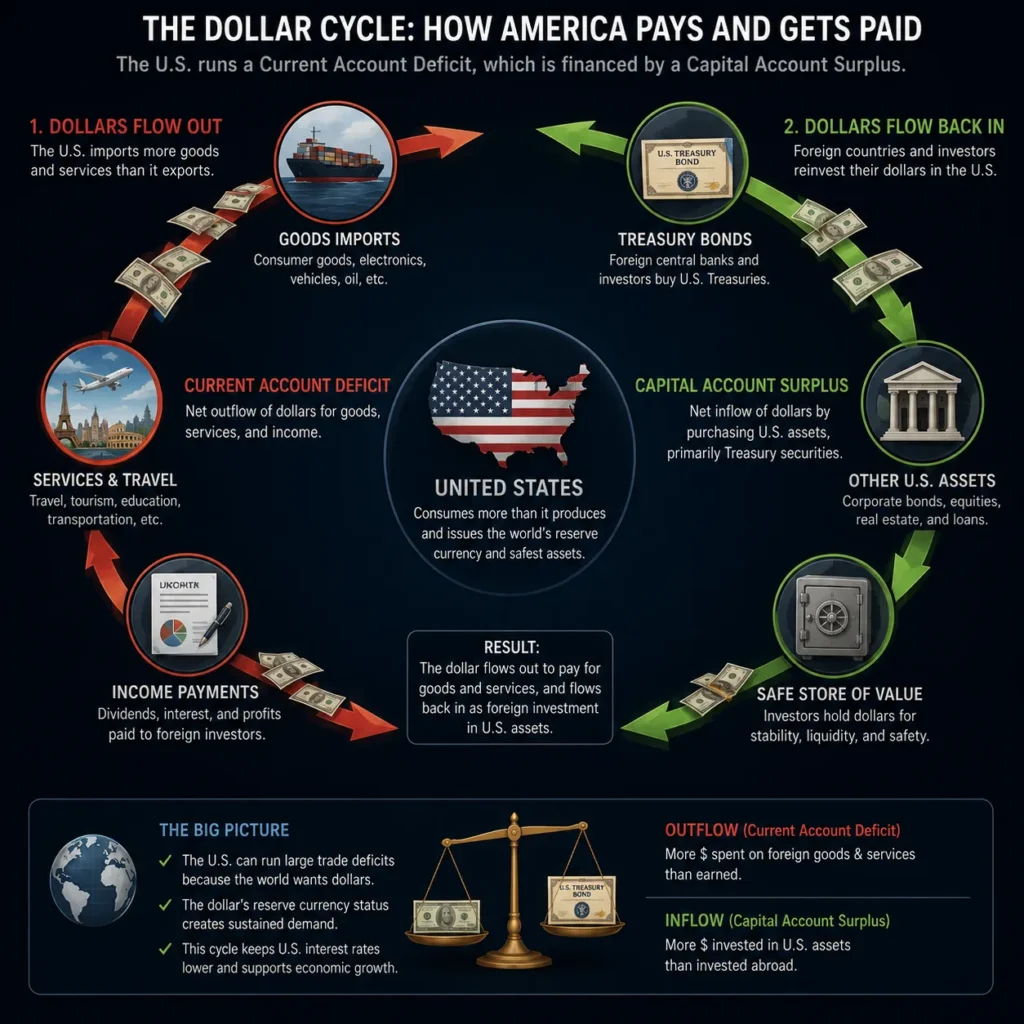
1. The Fundamental Problem: Medium of Exchange
International trade requires a universally accepted medium of exchange. A Japanese electronics manufacturer buying oil from Saudi Arabia does not want to pay in Yen, and the Saudis do not want to hold Yen. They both agree to use U.S. Dollars. Therefore, both nations must acquire dollars to conduct basic commerce.
2. The Insufficiency of Bilateral Trade
The U.S. cannot simply print dollars and give them away. To inject dollars into the foreign market, the U.S. must purchase foreign goods and services. If the U.S. exported exactly as much as it imported, the net flow of dollars would be zero, and global liquidity would stagnate.
3. The Core Mechanism: The Current Account Deficit
To keep the global engine running, the U.S. must run a persistent Current Account Deficit. It must consistently import more foreign goods (cars, electronics, apparel) than it exports. This physically transfers billions of U.S. dollars into the hands of foreign central banks and corporations every day.
4. Technical Depth: The Capital Account Surplus
In macroeconomics, the balance of payments must sum to zero. A current account deficit must be mirrored by a Capital Account Surplus.
When China or Saudi Arabia receives billions of U.S. dollars from selling goods or oil, they do not just lock the physical paper in a vault. They invest those dollars back into the United States by purchasing U.S. financial assets—primarily U.S. Treasury bonds. This creates a massive, artificial demand for U.S. debt.
5. Real-World Consequences: The Exorbitant Privilege
Because foreign nations are forced to buy U.S. Treasuries to store their surplus dollars, U.S. interest rates are pushed artificially low. This grants the U.S. government the “exorbitant privilege” of running massive federal budget deficits and borrowing money at uniquely cheap rates. However, the consequence is the “hollowing out” of the U.S. industrial base, as cheap foreign imports suppress domestic manufacturing, creating deep structural wealth inequality within the U.S.
Global Impacts of the Reserve Currency Paradox
The Triffin Dilemma is the invisible hand driving the architecture of modern global finance.
The Eurodollar Market: Because the world needs dollars to function, foreign banks began holding and lending U.S. dollars outside the regulatory jurisdiction of the Federal Reserve. This offshore pool of liquidity is known as the “Eurodollar” market. It is a massive, opaque shadow banking system that lubricates global trade, but it is entirely dependent on the continuous outflow of dollar liquidity generated by U.S. trade deficits.
Emerging Market Debt Crises: When the U.S. Federal Reserve raises interest rates to fight domestic inflation, it unintentionally triggers global crises. Higher rates attract capital back to the U.S., strengthening the dollar. Because most emerging markets (like Argentina or Turkey) borrow in U.S. dollars, a strong dollar makes their debt exponentially more expensive to repay. The Triffin Dilemma dictates that U.S. domestic monetary policy inherently destabilizes foreign economies.
Petrodollar Recycling: In the 1970s, the U.S. struck an agreement with Saudi Arabia to price all global oil exports in U.S. dollars. This guaranteed a perpetual global demand for the dollar. The oil-producing nations take their massive dollar profits and “recycle” them by buying U.S. Treasuries and military equipment, perfectly illustrating the mechanical loop of the capital account surplus funding U.S. hegemony.
Economic & Strategic Impact
The ultimate strategic consequence of the Triffin Dilemma is the Weaponization of the Dollar.
Because the U.S. controls the ultimate reserve currency, it controls the plumbing of global finance (like the SWIFT messaging system). In recent years, the U.S. has weaponized this privilege, unleashing devastating financial sanctions against adversaries (e.g., freezing the central bank reserves of Russia).
This weaponization has terrified the rest of the world. Global powers realize that holding U.S. dollars is not just an economic choice; it is a profound national security vulnerability. This realization has supercharged the push for “De-dollarization,” as the BRICS+ nations actively attempt to circumvent the structural monopoly the Triffin Dilemma has enforced for 80 years.
Advantages
- The Exorbitant Privilege: The U.S. can print the currency required to buy real, tangible goods from the rest of the world, effectively trading paper for physical wealth.
- Cheap Domestic Borrowing: The guaranteed global demand for U.S. Treasuries suppresses domestic interest rates, allowing the U.S. government to fund massive military and social programs cheaply.
- Geopolitical Leverage: Controlling the world’s reserve currency grants the U.S. unmatched diplomatic and economic coercion capabilities without needing to fire a single kinetic weapon.
Limitations
- Domestic Deindustrialization: Maintaining the necessary trade deficit requires importing massive amounts of foreign goods, destroying domestic manufacturing jobs and creating severe internal political friction.
- Runaway National Debt: The system encourages and enables reckless deficit spending by the U.S. government, as the market penalty for high debt is delayed by foreign central bank purchasing.
- Systemic Fragility: If the world loses faith in the U.S. dollar and stops buying Treasuries, the capital account surplus will vanish. U.S. interest rates will violently spike, causing an immediate, catastrophic domestic debt crisis.
Common Misconceptions
Misconception: The U.S. trade deficit means America is “losing” to other countries.
Reality: The trade deficit is not a scorecard of winners and losers. It is a mechanical necessity for the dollar to remain the global reserve currency. The U.S. gives the world dollars (liquidity), and the world gives the U.S. televisions, cars, and oil.
Misconception: A strong dollar is always good for the U.S. economy.
Reality: A strong dollar makes U.S. exports extremely expensive for the rest of the world to buy, further crushing the domestic manufacturing sector and widening the trade deficit. It benefits consumers buying imports, but punishes domestic producers.
Misconception: The Triffin Dilemma only applied to the Gold Standard.
Reality: While Robert Triffin originally formulated it regarding gold convertibility, the core paradox remains identical in the fiat era. The fundamental conflict between domestic monetary needs and international liquidity requirements is permanent and inescapable for any global reserve issuer.
What Most People Miss
The true challenge of De-dollarization.
Many analysts point to China settling oil trades in Yuan as the death of the dollar. What most people miss is that to replace the U.S. Dollar as the global reserve currency, China would have to subject itself to the Triffin Dilemma.
If the Yuan is to become the global reserve, China must flood the world with Yuan. To do this, China would have to dismantle its export-driven economy and become a massive net importer, running persistent trade deficits. Furthermore, it would have to open its capital account, relinquishing absolute state control over its currency valuation. Because the Chinese Communist Party is entirely reliant on an export-driven economic model and strict capital controls to maintain domestic stability, Beijing is fundamentally unwilling to pay the domestic price required to usurp the dollar’s global hegemony.
Comparison Table
| Feature | Domestic Economy Priority | Global Reserve Priority (Triffin Reality) |
| Trade Balance | Trade Surplus (Export driven) | Persistent Trade Deficit (Import driven) |
| Manufacturing Base | Expanding and robust | Contracting (Outsourced to cheaper labor) |
| Currency Flow | Dollars remain inside the U.S. | Dollars flood international markets |
| Interest Rates | Set purely by domestic inflation/growth | Artificially lowered by foreign Treasury demand |
| Global Liquidity | Severe shortages (Trade freezes) | Abundant (Trade flows smoothly) |
Case Study
Situation: By the late 1960s, the post-WWII Bretton Woods system was buckling. The U.S. was running massive deficits to fund the Vietnam War and the Great Society domestic programs. To supply global liquidity and fund these initiatives, the U.S. exported vast amounts of dollars.
Challenge: The U.S. dollar was legally pegged to gold at $35 an ounce. Foreign nations, particularly France, realized the U.S. had printed far more dollars than it had gold in Fort Knox to back them. Recognizing the exact crisis Robert Triffin had predicted a decade earlier, foreign central banks began aggressively redeeming their paper dollars for physical U.S. gold.
Solution / The Crisis: The U.S. faced total gold depletion. On August 15, 1971, President Richard Nixon unilaterally suspended the direct convertibility of the U.S. dollar to gold. This event, known as the “Nixon Shock,” effectively destroyed the Bretton Woods system.
Outcome: The world was forced onto a purely fiat monetary standard. Because foreign nations could no longer demand gold, they were forced to store their dollar surpluses in U.S. Treasury bonds.
Lessons Learned: The Nixon Shock proved that the Triffin Dilemma is absolute. A nation cannot maintain a hard asset peg while simultaneously acting as the liquidity provider of last resort for the global economy. The event permanently untethered the dollar, establishing the modern dynamic where global trade is financed entirely by U.S. debt expansion.
Future Outlook
Next 12–24 Months
The era of Bilateral Currency Swaps. In the immediate term, the U.S. Dollar will not be replaced, but its monopoly will be chipped away at the margins. Nations like India, Russia, and Brazil will increasingly utilize bilateral currency swaps to settle commodities trades in Rupees, Rubles, or Reals, attempting to bypass the dollar-dominated SWIFT network to insulate their specific trade corridors from U.S. sanctions and exchange rate volatility.
Next 3–5 Years
The scaling of Alternative Settlement Infrastructures (mBridge). The Bank for International Settlements (BIS) is actively piloting Project mBridge, a multi-central bank digital currency (CBDC) platform designed to facilitate real-time, peer-to-peer cross-border payments without relying on U.S. correspondent banks. As this architecture scales, it will slowly erode the transactional dominance of the dollar, shrinking the international demand for dollar liquidity and forcing the U.S. to finance its massive debt at marginally higher interest rates.
Next 10 Years
The Multipolar Currency Paradigm. The absolute hegemony of the dollar will transition into a multipolar reserve system. While the U.S. Treasury market will remain the deepest and safest collateral pool on Earth, the Euro and a highly digitized, state-backed Chinese Yuan will capture larger shares of global central bank reserves. This fragmentation will ease the severity of the Triffin Dilemma for the U.S., reducing the requirement to run extreme trade deficits, but simultaneously stripping Washington of the “exorbitant privilege” that has allowed it to borrow cheaply for decades.
Most Likely Scenario
The Triffin Dilemma guarantees that the U.S. Dollar’s reign as the sole global reserve currency is inherently self-destructive over an extended timeline. However, because no other nation is politically willing to dismantle its own export economy to supply global liquidity, the dollar will remain the dominant pillar of international finance, slowly declining in total market share rather than collapsing abruptly.
Key Takeaways
- The Triffin Dilemma is the economic paradox dictating that the country issuing the global reserve currency must run persistent trade deficits to supply the world with money.
- By running trade deficits, the U.S. imports foreign goods and exports dollars, keeping global trade lubricated but slowly hollowing out the American manufacturing sector.
- The paradox requires a current account deficit (buying goods) to be balanced by a capital account surplus (foreigners taking those dollars and buying U.S. Treasury bonds).
- This dynamic creates an artificial global demand for U.S. debt, keeping American interest rates low and granting the U.S. the “exorbitant privilege” of cheap borrowing.
- Robert Triffin predicted this system would cause a crisis under the gold standard, leading directly to the 1971 “Nixon Shock” where the U.S. severed the dollar’s peg to gold.
- De-dollarization efforts by rivals like China are fundamentally bottlenecked by their unwillingness to run the massive trade deficits required to supply the world with their own currencies.
Glossary
Bretton Woods System: The international monetary framework established in 1944 where global currencies were pegged to the U.S. Dollar, and the U.S. Dollar was pegged to gold. It collapsed in 1971.
Capital Account Surplus: A macroeconomic condition where more investment capital flows into a country (e.g., foreigners buying U.S. stocks and bonds) than flows out.
Current Account Deficit: A macroeconomic condition where a country imports more goods, services, and capital than it exports, effectively sending its currency abroad.
Exorbitant Privilege: A term coined by a French finance minister in the 1960s describing the unique, asymmetric benefits the U.S. receives (like incredibly cheap borrowing) because the world is forced to hold its currency.
Fiat Currency: Money that is not backed by a physical commodity (like gold or silver) but derives its value entirely from government decree and public trust.
Petrodollar Recycling: The global system where oil-producing nations sell oil exclusively in U.S. dollars, and then reinvest those massive dollar profits into U.S. Treasury bonds and Western financial markets.
Sources
[1] International Monetary Fund (IMF): The International Role of the U.S. Dollar and the Triffin Dilemma in the Modern Era (2025 Analysis)
[2] Bank for International Settlements (BIS): Global Liquidity, the Eurodollar Market, and Cross-Border Capital Flows
[3] Federal Reserve Bank of St. Louis: The Exorbitant Privilege and U.S. Macroeconomic Imbalances
[4] Carnegie Endowment for International Peace: De-dollarization, BRICS+, and the Limits of Multipolar Currency Systems (2026 Report)
[5] Council on Foreign Relations: The Nixon Shock and the Evolution of Fiat Hegemony