Advertisement
)


For the past three decades, if an investor wanted to buy the S&P 500, they simply bought a low-cost Exchange-Traded Fund (ETF) or a mutual fund. It was the undisputed cornerstone of modern wealth accumulation. But beneath the surface, the mutual fund structure hides a fatal flaw: you are trapped in a pooled vehicle. You own a slice of a pre-packaged basket, meaning you cannot sell the individual losing stocks inside that basket for your own tax benefit, and you cannot customize the holdings to align with your personal ethics or concentrated corporate stock options.
The era of the pre-packaged fund is ending. Wall Street has weaponized software to deconstruct the ETF. Why should you care right now? Because what was once a bespoke tax loophole reserved exclusively for billionaires with $50 million accounts is now available to the mass affluent. By combining zero-commission trading, fractional shares, and relentless automated algorithms, “Direct Indexing” allows you to build, manage, and instantly tax-optimize your own personalized stock market. It is triggering a massive migration of capital away from legacy asset managers and toward wealth-tech platforms, fundamentally changing who controls the plumbing of global retail finance.
What is Direct Indexing?
Direct indexing is a personalized investment strategy where an individual purchases the underlying stocks of a benchmark index directly within a separately managed account, rather than buying a pooled mutual fund or ETF.This approach replicates the index’s performance while utilizing automation to enable individual security-level tax-loss harvesting, navigate wash-sale rules, and allow for deep portfolio customization.
At a Glance
- Concept: Buying the 500 stocks in the S&P 500 individually, rather than buying one share of an S&P 500 ETF.
- Why it matters: If the market is up 10%, but 100 individual stocks within the index are down, direct indexing allows you to sell the losers to lower your taxes, while still matching the overall 10% gain.
- Who uses it: High-net-worth investors, family offices, and increasingly, retail investors accessing wealth-tech platforms.
- Biggest takeaway:Direct indexing is projected to surpass $800 billion in assets under management (AUM) by 2026, growing faster than ETFs or mutual funds by automating complex daily tax strategies.
In Simple Words
Imagine you want to buy a pre-made fruit basket. An ETF is the pre-made basket. It’s cheap, convenient, and you get a mix of apples, bananas, and grapes. But if you are allergic to grapes, or if the bananas go bad, you can’t take them out. You are stuck with the whole basket.
Direct Indexing means the grocery store uses a robot to automatically buy you the exact same mix of individual fruits, but places them loose in your cart. Now, if the bananas go bad, you can throw them away and claim a refund, while keeping the rest of the fruit. If you decide you don’t want grapes, the robot never buys them in the first place, but perfectly replaces them with extra apples so your cart stays full. It gives you the exact same market performance as the pre-made basket, but with total control over every single item.
Why This Matters
For Wealth Managers and Institutional LPs, direct indexing is the ultimate differentiator. The traditional “60/40” mutual fund portfolio has become a commoditized, race-to-the-bottom business with management fees approaching zero.
Direct indexing shifts the value proposition from asset allocation to tax alpha. By utilizing software that generates an extra 100 to 200 basis points (1% to 2%) in after-tax returns annually, wealth managers can mathematically justify their advisory fees. It transitions the advisor from someone who simply picks funds into an indispensable tax-optimization engineer.
The Evolution of Direct Indexing Technology
The evolution of direct indexing is a story of computing power matching financial regulation. Pioneered in the 1990s by firms like Parametric for the ultra-wealthy, the strategy was historically barred from normal investors because buying 500 separate stocks incurred massive trading commissions.
The technological breakthrough of the 2020s—specifically the total elimination of trading commissions and the invention of fractional share routing—democratized the architecture. A retail investor can now execute a 500-stock portfolio rebalance with $5,000, triggering an industry consolidation where Wall Street titans (Morgan Stanley acquiring Parametric, BlackRock acquiring Aperio) spent billions to secure direct indexing software algorithms.
How Direct Indexing Works: Tax-Loss Harvesting
Bypassing the ETF wrapper requires ruthless, automated trade execution. Here is the first-principles breakdown of the architecture.
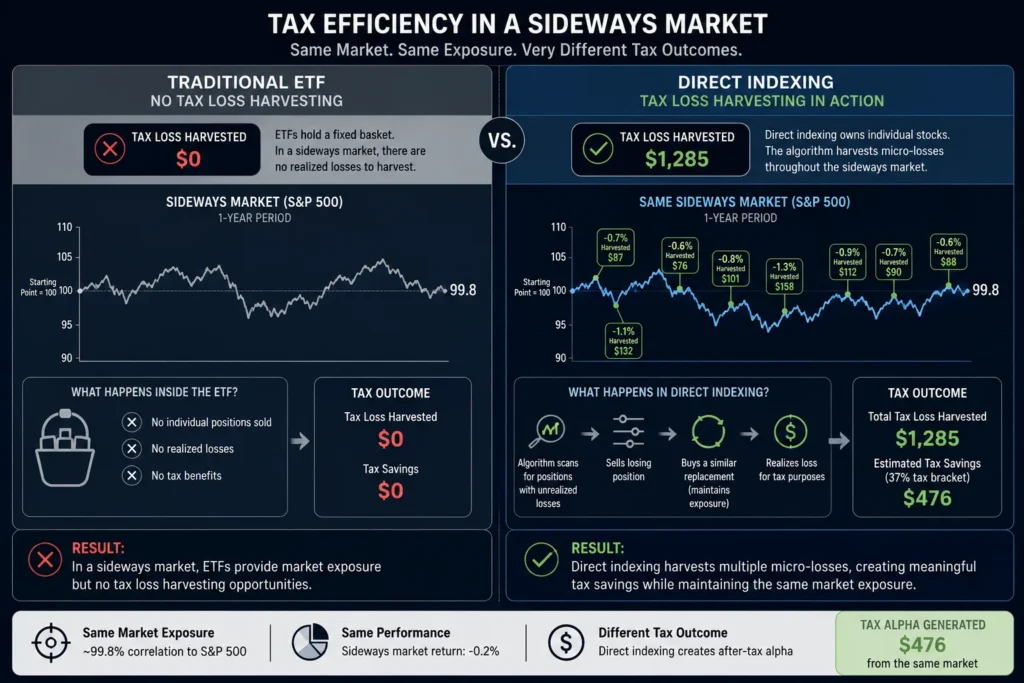
1. The Fundamental Problem: Pooled Tax Inefficiency
When you own an ETF, you only realize a capital loss if the entire ETF drops in value. However, equity markets are volatile; even in a year where the S&P 500 finishes up 20%, roughly one-third of its underlying companies might finish the year in the red. The ETF wrapper traps these individual losses, preventing the investor from claiming them.
2. The Core Mechanism: Security-Level Ownership
Direct indexing places the individual index constituents directly into the investor’s Separately Managed Account (SMA). The software connects to the brokerage via API and executes hundreds of micro-trades to perfectly replicate the mathematical weighting of the target index.
3. Technical Depth: Automated Tax-Loss Harvesting (TLH)
The true engine of direct indexing is its TLH algorithm. The software scans the investor’s portfolio daily.If a specific stock (e.g., Ford) drops below its cost basis, the algorithm instantly sells it, capturing the capital loss to offset the investor’s capital gains elsewhere.
4. The Wash-Sale Evasion Algorithm
If the algorithm sells Ford for a loss, it cannot buy Ford back for 30 days, or the IRS “wash-sale rule” will invalidate the tax deduction. However, the portfolio must still track the index. The software solves this by instantly buying a highly correlated replacement stock (e.g., General Motors) to maintain the exact sector weighting and risk profile. After 31 days, the software smoothly swaps the positions back.
5. Real-World Consequences: Generating Tax Alpha
Because the algorithm runs autonomously every day—harvesting micro-losses during daily market dips—it generates a compounding reservoir of tax credits. This “tax alpha” drastically outperforms traditional end-of-year manual tax harvesting, mathematically boosting the investor’s after-tax wealth accumulation by up to 2% annually.
Wealth Management Applications for Direct Indexing
The architecture of direct indexing solves highly complex financial constraints that standard funds cannot address.
Concentrated Stock Unwinding: Executives who receive massive compensation in company stock face a dangerous lack of diversification and a massive capital gains tax bill if they sell. Direct indexing algorithms can ingest this concentrated position and build a “completion portfolio” around it. The software systematically harvests losses from the broader index to smoothly offset the tax hit of slowly selling off the executive’s concentrated stock over a multi-year timeline.
Hyper-Personalized ESG Filtering: Traditional Environmental, Social, and Governance (ESG) ETFs are rigid; an investor must accept the fund manager’s specific definition of “ethical.” Direct indexing allows the investor to start with a broad index and simply delete the stocks they personally object to (e.g., weapons, fossil fuels, or specific labor practices). The algorithm automatically reweights the remaining stocks to ensure the portfolio still closely tracks the benchmark’s performance without violating the investor’s personal ethics.
Planned Charitable Giving: When wealthy clients donate to charity, donating highly appreciated individual stocks is vastly more tax-efficient than donating cash. Direct indexing allows an advisor to pinpoint the specific stocks in the customized portfolio with the highest unrealized gains, donate them directly, and replace them with cash, resetting the cost basis and opening up fresh tax-loss harvesting opportunities for the future.
Economic & Strategic Impact
The rise of direct indexing threatens the trillion-dollar hegemony of the traditional Asset Manager.
Historically, companies like Vanguard and State Street held ultimate power because they manufactured the physical ETFs. With direct indexing, the power shifts to the Wealth-Tech Platforms (the software providers) and the Wealth Managers. If an investor can hit a button to autonomously buy the S&P 500 stocks directly, they no longer need to pay an expense ratio to a pooled fund provider.
As Cerulli Associates projects direct indexing to top $800 billion by 2026, the legacy asset management industry is being forced into a radical pivot. To survive, asset managers must transition from selling pre-packaged products to licensing their software algorithms directly to retail brokerage platforms.
Advantages
- Generates Tax Alpha:Daily, automated tax-loss harvesting at the individual stock level yields significantly higher after-tax returns than passive ETF holding.
- Ultimate Customization: Investors can mathematically exclude specific sectors, tilt toward ESG values, or restrict individual tickers to avoid overlapping with outside employer stock.
- Direct Proxy Voting:Because the investor holds the physical shares in their own name (unlike an ETF), they retain the legal right to cast shareholder votes directly on corporate governance issues.
Limitations
- High Computational Complexity: The strategy generates thousands of micro-trades and massive, complex 1099 tax forms, requiring robust software and sophisticated CPA coordination to manage correctly at tax time.
- Tracking Error Risk:The more an investor customizes the index (by removing stocks for ESG reasons or harvesting aggressive losses), the more the portfolio’s performance will randomly deviate from the actual benchmark (tracking error).
- Fee Drag for Small Accounts: While trading commissions are zero, the software and wrap fees for a direct indexing platform can range from 0.15% to 0.30%, making the baseline cost inherently more expensive than holding a near-zero-fee Vanguard ETF.
Common Misconceptions
Misconception: Direct indexing is only for billionaires.
Reality: While historically true, the advent of fractional shares allows algorithms to purchase 1/1000th of an Amazon share, bringing the minimum account size for direct indexing down from $5 million to as little as $5,000 on modern retail platforms.
Misconception: It is an active trading strategy designed to beat the market.
Reality: Direct indexing is fundamentally a passive strategy. The primary objective is to exactly match the pre-tax performance of the index, relying entirely on tax savings to generate the ultimate financial outperformance.
Misconception: It works best in a booming bull market.
Reality: Tax-loss harvesting requires volatility. The strategy actually harvests the most tax alpha during choppy, unpredictable markets where individual stocks frequently dip below their cost basis, making it a powerful defensive hedge against market turbulence.
What Most People Miss
The algorithmic transition toward Custom Indexing.
Direct indexing simply replicates a known benchmark. What most analysts miss is the evolution into Custom Indexing—where the investor does not just track the S&P 500, but mathematically engineers their own proprietary index.
Combining direct indexing infrastructure with factor-based investing, an algorithm can create an index that screens for low-carbon intensity, tilts 15% toward value stocks, explicitly excludes the tech sector, and automatically rebalances quarterly. This effectively democratizes quantitative hedge fund strategies, allowing regular investors to build bespoke, institutional-grade portfolios at the push of a button.
Comparison Table
| Feature | Mutual Funds | Exchange-Traded Funds (ETFs) | Direct Indexing |
| Asset Ownership | Pooled (Fund owns the stock) | Pooled (Fund owns the stock) | Direct (Investor owns the stock) |
| Tax-Loss Harvesting | At the fund level only | At the fund level only | Daily, at the individual security level |
| Customization | Zero | Zero | Infinite (Exclude/tilt specific stocks) |
| Trading Mechanics | Priced once at end-of-day | Traded continuously | Algorithmic micro-trades & fractional shares |
| Proxy Voting Rights | Fund manager votes | Fund manager votes | Investor retains direct voting rights |
Case Study
Situation: A senior technology executive with a $2 million portfolio had $1.5 million locked in highly appreciated, concentrated employer stock. They wanted to diversify into the broader S&P 500, but selling the employer stock would trigger an immediate, massive capital gains tax liability.
Challenge: Moving the assets into a standard ETF would provide diversification but offered zero tax relief for the concentrated stock sale.
Solution (The Completion Portfolio): The executive’s wealth manager deployed a Direct Indexing algorithm. The software ingested the employer stock and built a customized 499-stock S&P 500 index around it, deliberately excluding the employer’s sector to prevent dangerous double-exposure.
Outcome: Over the next three years, the algorithm scanned the 499 stocks daily, automatically selling the losers and banking the tax losses. The wealth manager used these continuous tax losses to perfectly offset the deliberate, piecemeal sale of the executive’s concentrated stock.
Lessons Learned: The deployment proved that direct indexing is not just a passive investment vehicle; it is an active tax-transition engine. By isolating losses at the security level, the executive successfully diversified their net worth while systematically erasing what would have been a six-figure IRS tax penalty.
Future Outlook
Next 12–24 Months
The era of Retail Democratization. Throughout 2026, as Cerulli Associates tracks AUM blowing past the $800 billion mark, direct indexing will become a standard dashboard feature on retail brokerage apps. Robo-advisors will deploy simplified, one-click tax-loss harvesting interfaces, forcing legacy mutual fund providers to bleed assets as younger investors demand the tax alpha previously reserved for the ultra-wealthy.
Next 3–5 Years
The scaling of AI-Driven Predictive Harvesting. Current TLH algorithms are reactive—they sell when a stock drops. By 2030, direct indexing engines will integrate machine learning to become predictive. Algorithms will analyze options markets and macroeconomic indicators to preemptively trigger wash-sale swaps hours before a highly probable sector drawdown occurs, optimizing the timing of the tax loss to maximize the harvest yield.
Next 10 Years
The Death of the Mutual Fund Wrapper. By the mid-2030s, the concept of paying a fee to sit inside a rigid, pooled mutual fund will be obsolete for taxable accounts. The global wealth management infrastructure will migrate entirely to an API-driven, tokenized security framework. Investors will carry their hyper-personalized, tax-optimized algorithmic indexes across different financial institutions seamlessly, establishing custom indexing as the undisputed baseline of capital markets architecture.
Most Likely Scenario
Direct indexing is executing a classic technological disruption against the ETF and mutual fund complex. By replacing the legal structure of a fund with the raw computational power of a daily sorting algorithm, Wall Street has fundamentally separated the intellectual property of an index from the physical product. The wealth managers who master this algorithmic tax plumbing will thrive, while passive asset managers who fail to adapt will be rendered obsolete.
Key Takeaways
- Direct indexing replaces traditional ETFs by using software to directly buy the individual stocks that make up a market benchmark inside a personalized account.
- The strategy utilizes automated tax-loss harvesting (TLH) algorithms to scan the portfolio daily, selling losing stocks to generate a “tax alpha” that boosts after-tax returns by 1% to 2% annually.
- To avoid the IRS wash-sale rule, the software instantly repurchases highly correlated replacement stocks, ensuring the portfolio’s performance perfectly mirrors the index.
- The strategy has been democratized by zero-commission trading and fractional shares, opening the market to retail investors and driving a projected $800 billion+ in AUM by 2026.
- Direct indexing allows infinite customization; investors can apply strict ESG filters or exclude specific companies without sacrificing broad market exposure.
- It poses an existential threat to legacy mutual fund providers, shifting the balance of power toward wealth-tech software platforms and personalized advisory services.
Glossary
Cost Basis: The original value of an asset for tax purposes. When an asset drops below this value, selling it generates a capital loss.
Custom Indexing: An evolution of direct indexing where the investor goes beyond tracking a standard benchmark and mathematically designs their own proprietary index rules based on specific factors.
Fractional Shares: A slice of a single equity share. It allows algorithms to precisely balance a 500-stock portfolio even if the investor only has a few thousand dollars.
Separately Managed Account (SMA): A private portfolio of individual securities managed directly on behalf of a specific investor, completely distinct from a pooled mutual fund.
Tax Alpha: The additional financial outperformance generated specifically by minimizing tax liabilities, rather than by picking winning stocks.
Wash-Sale Rule: An IRS regulation preventing an investor from claiming a tax loss if they sell a stock and buy a “substantially identical” stock within 30 days.
Sources
Cerulli Associates: Cerulli Associates Projects Direct Indexing Assets to Top $800 Billion by 2026 While Outpacing Growth of ETFs, Mutual Funds, and SMAs
Cerulli Associates: Differentiation in a Competitive Marketplace
Natixis Investment Managers: Tax loss harvesting: What it is and how to explain it to clients
Vanguard for Advisors: What Is Direct Indexing?
Morgan Stanley: Direct Indexing: What It Is and Its Benefits
TSG Invest: Custom Indexing 2026: The Smart Investor’s Guide
Index One: The Ultimate Guide to Direct Indexing