Advertisement
)


Imagine a Category 5 hurricane obliterates a massive corporate refinery on the Gulf Coast. The physical damage is $2 billion. The company’s stock crashes 40% overnight. Normally, the corporation would face an existential liquidity crisis: traditional insurance adjusters take years to pay out, and banks refuse to lend money to a half-destroyed business at favorable rates. But instead of panicking, the CEO executes a hidden Wall Street contract. Instantly, a syndicate of hedge funds is legally forced to buy $500 million worth of the company’s newly minted stock at yesterday’s pre-crash price. The company generates half a billion dollars in cash out of thin air within 48 hours, entirely bypassing the insurance industry.
Why should you care right now? Because as extreme weather events accelerate, traditional commercial property insurance is becoming prohibitively expensive or entirely unavailable. To survive the climate crisis, massive corporations are turning to “Catastrophe Equity Puts” (CatEPuts). By treating natural disasters as algorithmic triggers, businesses are transferring the existential risk of climate change directly to the global capital markets. Understanding this invisible financial plumbing is essential to grasping how the world’s largest companies plan to survive the physical realities of the 21st century.
What are Catastrophe Equity Puts (CatEPuts)?
Catastrophe Equity Puts (CatEPuts) are contingent capital contracts that give a corporation the right, but not the obligation, to issue and sell new equity shares to investors at a pre-agreed price if a specific catastrophic event occurs. They provide guaranteed, immediate liquidity to companies following devastating natural disasters.
At a Glance
- Concept: Buying a financial insurance policy where the payout isn’t a check from an insurer, but a legal guarantee that investors will buy your company’s stock.
- Why it matters: Post-disaster, a company’s stock price craters and borrowing costs skyrocket. CatEPuts lock in financing terms before the disaster happens, guaranteeing access to cheap capital during the worst possible moment.
- Who uses it: Mega-cap energy firms, Real Estate Investment Trusts (REITs), and primary insurance companies acting as sponsors to protect their balance sheets from ruinous claims.
- Biggest takeaway:The payout is typically driven by “parametric triggers”—like a hurricane reaching 150 mph—rather than waiting for an insurance adjuster to count the actual financial damage, allowing funds to clear in days rather than years.
In Simple Words
Imagine you own a house, but you live in a hurricane zone. You know that if a storm destroys the house, its value will drop from $500,000 to $100,000, and you won’t have the cash to rebuild it.
Instead of buying standard insurance, you sign a contract with a wealthy investor today. You pay the investor a small annual fee. In exchange, the investor makes a legally binding promise: If a Category 4 hurricane hits my town, I have the right to sell you 20% of my property for $100,000, no matter how badly damaged the house is.
When the storm hits, the house’s value crashes. You exercise your right (the “Put” option). The investor is forced to buy a piece of your damaged house at the high, pre-agreed price. You instantly receive $100,000 in cash to start rebuilding the very next day. The investor takes the loss, and you survive the storm. In the corporate world, instead of selling a piece of a house, the company sells newly created shares of its own stock.
Why This Matters
For Corporate Risk Officers and Macro Analysts, CatEPuts solve the “post-event financing gap.”
When a catastrophe strikes, an affected corporation becomes highly toxic to lenders. Debt markets freeze, and issuing new equity on the open market is financial suicide because the stock price has collapsed (meaning the company has to issue a massive, highly dilutive number of shares just to raise a small amount of cash). CatEPuts preempt this doom loop. By legally pre-selling equity to capital markets before the disaster, the corporation secures an algorithmic lifeline. It mathematically guarantees that the company will remain solvent, preserving its credit rating and operational continuity when competitors are forced into bankruptcy.
The Evolution of Insurance-Linked Securities (ILS)
CatEPuts belong to a broader category of Insurance-Linked Securities (ILS) and Alternative Risk Transfer (ART) mechanisms,.
In the 1990s and 2000s, the financial industry invented Catastrophe Bonds (Cat Bonds) to help insurance companies transfer risk to hedge funds. But a Cat Bond is a debt instrument; the issuer receives cash upfront and hopes they don’t have to pay it back. A CatEPut is an equity derivative. It fundamentally merges corporate finance with meteorology. It shifts the burden of climate change away from the highly constrained, regulated balance sheets of insurance companies and directly onto the $100 trillion global capital markets, which possess the infinite depth required to absorb catastrophic meteorological shocks.
How Catastrophe Equity Puts (CatEPuts) Work
Creating an airtight legal mechanism that forces investors to buy crashing stock requires rigorous financial structuring. Here is the first-principles breakdown of the architecture.
1. The Fundamental Problem: Distressed Dilution
If a company’s stock trades at $100, raising $10 million requires issuing 100,000 shares. If a hurricane destroys their factory and the stock crashes to $50, raising that same $10 million now requires issuing 200,000 shares. This destroys existing shareholder value through massive, distressed dilution.
2. The Insufficiency of Traditional Reinsurance
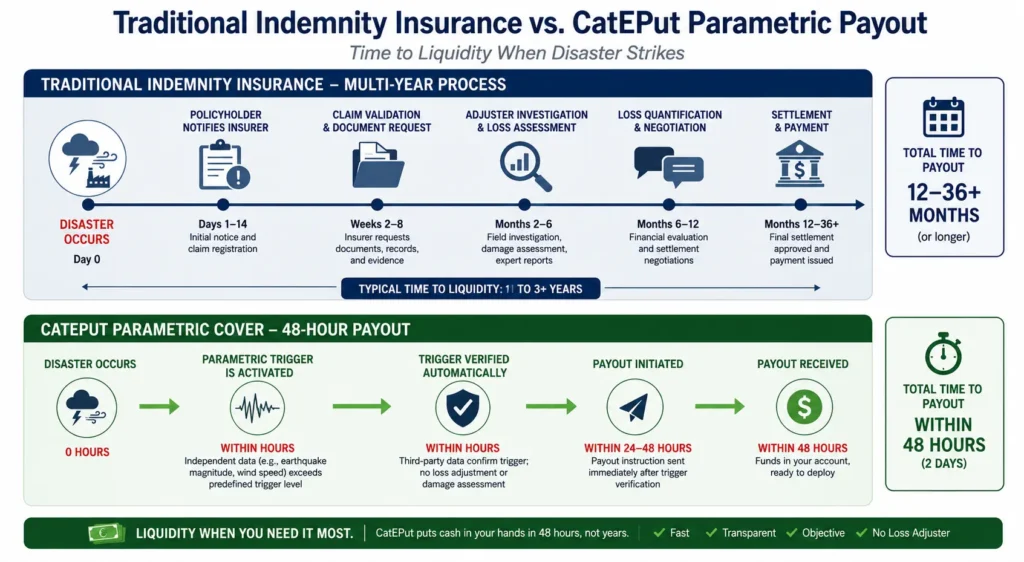
Corporate insurance has strict limits, deductibles, and exclusions. More importantly, settling a multi-billion-dollar commercial claim requires armies of loss adjusters and forensic accountants, tying up the cash in litigation for years when the corporation needs liquidity tomorrow to rebuild.
3. The Core Mechanism: The Put Option
The corporation (the sponsor) sets up a contingent capital facility and pays a premium (a commitment fee) to a syndicate of investors. This fee buys the sponsor a “Put Option”—the right to sell a predetermined number of new shares to the investors at a fixed “Strike Price” over a multi-year term.
4. Technical Depth: The Parametric Trigger
The option cannot be exercised arbitrarily; it is tied to a trigger event.While some use indemnity triggers (actual financial loss), the most advanced CatEPuts use Parametric Triggers. The contract defines exact physical parameters, such as:
- Event: Hurricane.
- Parameter: Sustained Category 4 wind speeds (≥ 130 mph).
- Location: Passing within a 50-mile radius of a specific GPS coordinate (the factory).If a third-party agency (like the National Hurricane Center) verifies this data, the trigger is pulled automatically.
5. Real-World Consequences: The Capital Injection
Once triggered, the sponsor exercises the Put. Even if the open-market stock price has crashed to $50, the investors are legally forced to purchase the new shares at the pre-agreed Strike Price (e.g., $90). The corporation receives an immediate, massive cash injection with minimal share dilution, and the capital market investors absorb the equity loss.
Corporate Applications for Contingent Capital
While historically dominated by the insurance sector, CatEPuts are evolving into broad corporate survival tools.
Primary Insurer Capital Buffers: Insurance companies are the most prolific users of CatEPuts. If a massive earthquake hits California, a primary insurer must pay out billions in claims, rapidly depleting their capital reserves and threatening regulatory insolvency. A CatEPut guarantees that the insurer can instantly refill its capital reserves by forcing Wall Street to buy its equity, preventing a downgrade by credit rating agencies.
Utility and Grid Operators: Power companies operating in wildfire or hurricane zones (like California or Florida) face immense liability and physical damage risks. If a utility’s equipment sparks a catastrophic fire, its stock price plummets. By securing a CatEPut tied to wildfire parametric triggers, the utility ensures it has the immediate cash on hand to repair the grid and handle liabilities without turning to predatory distressed-debt lenders.
Global Logistics and Port Operators: A Category 5 typhoon striking a major Asian shipping hub halts billions of dollars in trade. Port operators use contingent capital facilities to guarantee liquidity to rebuild cranes and dredging equipment instantly, minimizing the length of the supply chain disruption and outcompeting rival ports that lack immediate recovery funding.
Economic & Strategic Impact
The core friction in the CatEPut market is the calculation of Basis Risk.
Basis risk is the danger that a catastrophe destroys the company, but the mathematical trigger is not met. For example, a hurricane destroys the factory with catastrophic flooding, but the CatEPut contract was strictly triggered by wind speed, which peaked just below the Category 4 threshold. The company is destroyed, but the contract pays nothing.
For ESG investors and corporate treasurers, eliminating basis risk is an intense algorithmic challenge. Modern contracts are mitigating this through “Catastrophe Modeling”—using supercomputers to simulate tens of thousands of disaster permutations to ensure the contract’s trigger aligns perfectly with the actual physical vulnerabilities of the corporate asset. The precision of these models directly dictates the premium the corporation must pay to Wall Street.
Advantages
- Guaranteed Liquidity: Provides an absolute, legally binding source of cash at the exact moment traditional debt and equity markets freeze.
- Speed of Execution: Parametric triggers eliminate the need for insurance claims adjusters. Payouts are executed via algorithmic validation, allowing capital to clear in a matter of days.
- Preserves Shareholder Value: By locking in a pre-disaster strike price, the corporation avoids the ruinous equity dilution associated with issuing stock after a catastrophic market crash.
Limitations
- Basis Risk: If the disaster causes massive financial damage but fails to precisely hit the contract’s parametric physical threshold, the corporation receives zero capital.
- Expensive Commitment Fees: The corporation must pay Wall Street investors a heavy annual premium just to keep the option open, creating a constant drag on the company’s balance sheet even if a disaster never strikes.
- Counterparty Credit Risk: In a true global meltdown, the hedge funds or institutional investors who sold the Put option might go bankrupt themselves, leaving them unable to purchase the equity when the corporation finally pulls the trigger.
Common Misconceptions
Misconception: A CatEPut is just another name for a Catastrophe Bond.
Reality: They are structurally opposite. In a Cat Bond, the corporation receives the investors’ money upfront and doesn’t have to pay it back if a disaster hits. In a CatEPut, no money changes hands upfront (except the fee); the corporation only receives the cash after the disaster hits, in exchange for giving the investors company stock.
Misconception: Only insurance companies can use them.
Reality: While insurers invented the mechanism to protect their own reserves, any publicly traded corporation with severe exposure to natural disasters (energy, agriculture, real estate) can structure a CatEPut.
Misconception: The investors are just gambling blindly.
Reality: Investors in CatEPuts use highly advanced stochastic catastrophe models provided by firms like AIR Worldwide or RMS. They mathematically calculate the exact probability of the event occurring (e.g., a 1% annual chance) and demand a premium that statistically compensates them for that exact risk profile.
What Most People Miss
The strategic use of Tiered Triggers and Blended Facilities.
Most observers assume a CatEPut is a binary switch—it either pays out $500 million or nothing. What most miss is that sophisticated corporate risk officers layer these derivatives into “stepped” or “tiered” facilities.
A corporation might structure a contract where a Category 3 hurricane forces the investors to buy $100 million in stock, a Category 4 forces the purchase of $300 million, and a Category 5 forces the purchase of the full $500 million. By blending the severity of the trigger with the volume of the equity issuance, the corporation perfectly matches its capital injection to the escalating severity of the damage, heavily optimizing the premium costs paid to Wall Street.
Comparison Table
| Feature | Traditional Property Insurance | Catastrophe Bonds (Cat Bonds) | Catastrophe Equity Puts (CatEPuts) |
| Capital Source | Insurance/Reinsurance Companies | Capital Markets (Hedge/Pension Funds) | Capital Markets (Hedge/Pension Funds) |
| Financial Mechanism | Indemnified payout after loss | Forgiveness of debt principal | Forced purchase of new equity shares |
| Payout Speed | Slow (Months to Years of auditing) | Fast (Days via Parametric Trigger) | Fast (Days via Parametric Trigger) |
| Balance Sheet Impact | No direct dilution | Debt is wiped out (Gain) | Equity Dilution (but at optimal pricing) |
| Corporate Cost | Monthly/Annual Premium | High interest (coupon) payments | Annual commitment fee (Option Premium) |
Case Study
Situation: A leading global reinsurance company, which underwrites primary insurers in high-risk coastal zones, faced severe capital constraints. As climate change accelerated, the frequency of massive Atlantic hurricanes threatened to drain the reinsurer’s capital reserves, which would trigger a catastrophic credit rating downgrade.
Challenge: The reinsurer needed a way to instantly replenish its capital buffer if a massive storm struck, without relying on the highly volatile post-disaster debt markets or suffering extreme stock dilution.
Solution (The Contingent Capital Facility): The reinsurer worked with investment banks to structure a massive Catastrophe Equity Put. They paid a premium to a syndicate of institutional investors for the right to issue up to $400 million in convertible preference shares at a pre-agreed strike price. The contract was tied to a dual trigger: it required a major industry-wide hurricane loss (an Industry Index trigger) and a specific drop in the reinsurer’s capital reserves.
Outcome: When a historic storm cycle battered the coast, the industry loss index breached the threshold, and the reinsurer’s capital dipped. The CatEPut was automatically executed. Wall Street investors were legally obligated to purchase $400 million of the newly issued shares.
Lessons Learned: The transaction proved the absolute superiority of contingent capital. The reinsurer secured massive, instantaneous liquidity at a favorable, pre-negotiated price, preventing a credit downgrade and allowing them to continue writing new, highly profitable insurance policies in the immediate, capacity-starved aftermath of the storm.
Future Outlook
Next 12–24 Months
The era of Parametric Refinement and Corporate Expansion. As commercial insurance premiums for climate risks continue to skyrocket, non-financial Fortune 500 companies will aggressively enter the ILS market. In the short term, we will see agricultural conglomerates and tech hyperscalers (protecting multi-billion-dollar data centers from flood risks) structure their first bespoke CatEPuts, heavily utilizing advanced satellite and IoT sensor data to create flawless, indisputable parametric triggers.
Next 3–5 Years
The scaling of ESG-Linked Contingent Capital. By the end of the decade, CatEPuts will merge with green finance. Corporations will structure “Resilience Puts” where the strike price or the commitment fee is mathematically tied to the company’s carbon reduction efforts or infrastructure hardening. If a utility buries its power lines to prevent wildfires, the premium it pays to Wall Street for its CatEPut will automatically decrease, perfectly aligning corporate sustainability efforts with capital market incentives.
Next 10 Years
The Automated Algorithmic Execution Mesh. By the mid-2030s, the entire CatEPut lifecycle will execute autonomously on permissioned blockchain ledgers. When a hurricane strikes, a decentralized oracle (linked to the National Weather Service) will verify the wind speed. Smart contracts will automatically trigger the Put option, executing the stock issuance, routing the digital shares to the investors, and transferring the cash into the corporation’s treasury account in milliseconds. The survival of global corporations will be governed entirely by the intersection of algorithmic meteorology and automated capital markets.
Most Likely Scenario
Catastrophe Equity Puts are evolving from a niche reinsurance mechanism into a mandatory corporate survival tool. As climate volatility makes traditional insurance mathematically unviable for mega-disasters, the ability to instantly weaponize a company’s equity to secure emergency survival cash will separate the corporations that recover from the corporations that go bankrupt.
Key Takeaways
- Catastrophe Equity Puts (CatEPuts) give corporations the right to force investors to buy their stock at a predetermined price if a natural disaster strikes.
- They provide instant, guaranteed cash to a company exactly when they need it most—when their factories are destroyed and traditional banks refuse to lend to them.
- The system heavily relies on “Parametric Triggers” (e.g., a Category 4 hurricane hitting a specific GPS coordinate), allowing payouts to clear in days without waiting for insurance adjusters.
- By locking in a “Strike Price” before the disaster, CatEPuts protect existing shareholders from the massive dilution of issuing stock after a catastrophic market crash.
- The primary risk is “Basis Risk”—the danger that a disaster destroys the company, but the exact mathematical parameters of the contract aren’t met, resulting in zero payout.
- As traditional insurance drops coverage for extreme climate events, non-financial corporations (like utilities and tech companies) are adopting CatEPuts to transfer their climate risk directly to Wall Street.
Glossary
Basis Risk: The risk that the payout of a parametric insurance contract does not perfectly match the actual financial loss suffered by the corporation.
Catastrophe Bond (Cat Bond): A high-yield debt instrument where investors lose their principal if a specific natural disaster occurs. It is the debt-equivalent of a CatEPut,.
Contingent Capital: A financial arrangement that guarantees a company access to capital (usually debt or equity) in the future, provided a specific triggering event occurs.
Indemnity Trigger: A contract trigger based on the actual, audited financial losses a company suffers (slow and complex).
Parametric Trigger: A contract trigger based purely on objective, measurable physical data (e.g., wind speed, earthquake magnitude), allowing for instant payouts,.
Strike Price: The pre-negotiated, fixed price at which the investors are legally forced to buy the corporation’s stock if the CatEPut is triggered.
Sources
Artemis.bm: Catastrophe Equity Put (CatEPut) – Glossary
Global Risk Institute: CAT Bond – Premium Spreads
Stable Money: What Are Catastrophe Bonds? Meaning, Working & Risks Explained
National Association of Insurance Commissioners (NAIC): Insurance-Linked Securities Primer
Artemis.bm: What is parametric insurance