Advertisement
)

When a heavily indebted corporation runs out of cash to pay its lenders, the ruthless laws of capitalism dictate an immediate default. Assets are liquidated, equity is wiped out, and Wall Street absorbs a massive loss. But what if the corporation could simply print its own IOUs and hand them to the bank instead of paying cash? And what if the bank, terrified of admitting to its own investors that the loan had failed, happily accepted those IOUs as if they were real money?
This is the hidden alchemy of shadow banking. As global interest rates surged, the private equity industry faced an existential crisis: thousands of companies bought with cheap debt could no longer afford their monthly interest bills. Why should you care right now? Because to prevent a historic wave of corporate bankruptcies, Wall Street deployed “Payment-in-Kind” (PIK) debt at an unprecedented scale. By allowing companies to pay their debt with more debt, lenders are artificially keeping “zombie” companies alive. Understanding this invisible leverage is the only way to recognize the massive, compounding time bomb currently ticking beneath the $2 trillion private credit market.
What is Payment-in-Kind (PIK) Debt?
Payment-in-Kind (PIK) debt is a financial instrument that allows a borrower to pay interest expenses with additional debt rather than cash. Instead of making regular cash payments, the accrued interest is added to the principal loan balance, compounding the total amount owed until the debt matures.
At a Glance
- Concept: A loan where you don’t have to make monthly cash payments. Instead, the bank just adds the interest to your total bill, and you promise to pay the massive, compounded sum at the very end.
- Why it matters: It prevents immediate bankruptcy for companies that are bleeding cash. However, because the interest compounds on top of the new, larger principal, the debt load grows exponentially.
- Who uses it: Private Equity (PE) firms, distressed corporations, direct lenders, and Collateralized Loan Obligations (CLOs).
- Biggest takeaway: PIK creates “phantom income” for lenders. The private credit fund records the PIK interest as revenue on its balance sheet—making its returns look fantastic—even though zero actual cash changed hands.
In Simple Words
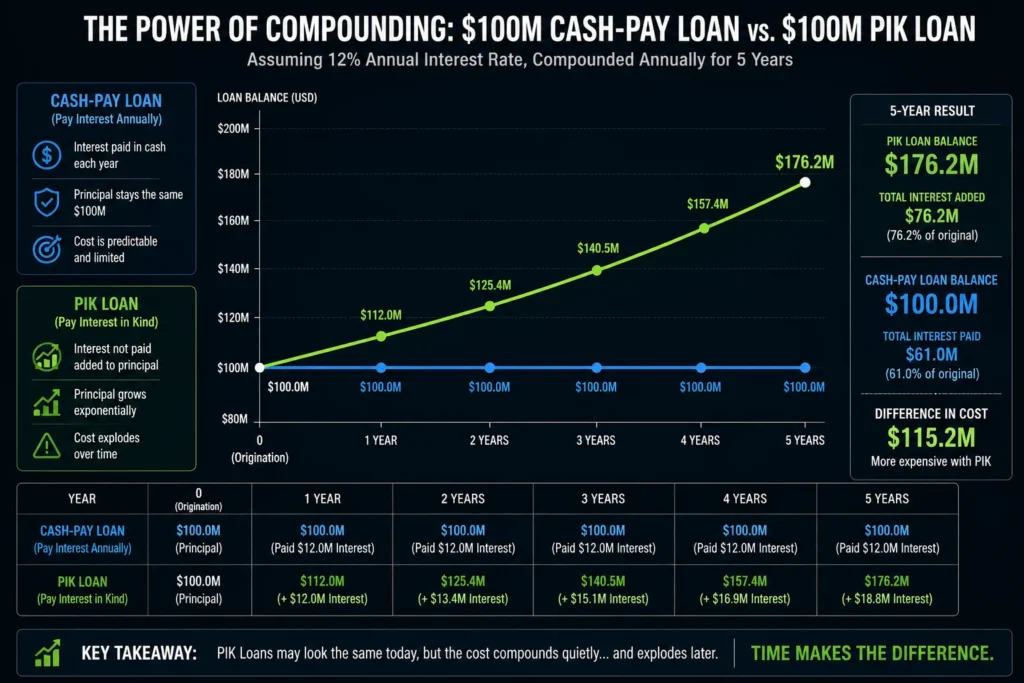
Imagine you have a $100,000 credit card bill with a 10% interest rate. You owe $10,000 in interest this year, but you lost your job and have no cash. Normally, you default.
A Payment-in-Kind (PIK) arrangement is like calling the credit card company and saying, “I can’t pay the $10,000 in cash. Just add it to my total bill.” The credit card company agrees, but they penalize you by charging a higher 12% rate for this privilege.
At the end of the year, you paid $0 in cash, but your new balance is $112,000.
The next year, you do it again. Now you are paying 12% interest on $112,000.
You have successfully survived without spending a dime of cash today, but your debt is quietly mutating into a monster that will eventually be impossible to pay off. In the financial world, private equity firms use this exact maneuver to buy time for their struggling companies, hoping the economy improves before the final bill comes due.
Why This Matters
For Private Credit Analysts and Institutional LPs, the explosion of PIK debt is severely distorting the reality of corporate health.
Historically, default rates were the ultimate metric of credit risk. Today, default rates are artificially suppressed. When a private credit fund realizes a portfolio company cannot pay its interest, they execute an “amend and extend” maneuver, converting the cash-pay loan into a PIK loan. Because the company is now “paying” in PIK, it is not technically in default. This allows the private credit fund to report flawless performance metrics to their pension fund investors, hiding the deep operational distress rotting inside their portfolios.
The Role of PIK Debt in Leveraged Buyouts (LBOs)
PIK debt is the ultimate tool of financial engineering, traditionally reserved for the most aggressive forms of corporate financing: Leveraged Buyouts (LBOs) and Dividend Recapitalizations.
When a private equity firm buys a company, they load it with debt. If they want to extract cash from the company to pay themselves a massive dividend (a dividend recap), they might issue PIK notes. This allows the PE firm to extract hundreds of millions in cash immediately, saddling the company with enormous debt, but without immediately draining the company’s daily operating cash to service that debt. It is a high-wire act of maximizing leverage while artificially protecting short-term liquidity.
How Payment-in-Kind (PIK) Debt Works
Transforming a cash liability into a compounding structural risk requires precise contractual mechanics. Here is the first-principles breakdown of the architecture.
1. The Fundamental Problem: The Cash Flow Sweep
In standard corporate debt, the borrower must pay quarterly cash interest. If the macroeconomic environment tightens—interest rates rise or revenues fall—the company’s Free Cash Flow (FCF) may drop below its debt service requirements. A single missed cash payment triggers a cross-default, immediately handing control of the company to the creditors.
2. The Insufficiency of Standard Restructuring
Filing for Chapter 11 bankruptcy destroys the Private Equity sponsor’s equity value completely. Asking lenders for a standard cash-forbearance is often rejected because it forces the lenders to officially mark the loan as “impaired,” triggering massive regulatory and accounting headaches for the banks.
3. The Core Mechanism: Capitalizing the Interest
The PIK provision solves this by contractually allowing the borrower to “capitalize” the interest. If the interest due is $10 million, the borrower issues $10 million in new debt notes to the lender. The principal balance mathematically grows.
Principal(Final) = Principal(Initial) × (1 + r_PIK)^t
Because the lender takes on higher risk by not receiving cash, PIK interest rates are typically 100 to 300 basis points (1% to 3%) higher than standard cash-pay rates.
4. Technical Depth: Toggle Notes
Sophisticated PE sponsors rarely use pure PIK. They use PIK Toggle Notes. This contract gives the borrower the ultimate optionality. At each quarterly payment date, the borrower can “toggle” the switch: pay 8% in cash, or flip the switch and pay 10% in PIK. Some structures even allow partial toggles (e.g., pay 4% in cash, 6% in PIK). This allows the CFO to perfectly micro-manage the company’s treasury based on real-time macroeconomic shocks.
5. Real-World Consequences: Holdco PIK Subordination
To protect the operating company (OpCo) from going bankrupt, Wall Street invented “Holdco PIK.” A shell Holding Company (HoldCo) is created purely to own the shares of the OpCo. The HoldCo issues the PIK debt. Because the HoldCo has no actual operations or cash, it relies entirely on dividends from the OpCo to pay the debt. If the debt balloons out of control, the HoldCo can go bankrupt, but the OpCo (where the actual factories and employees are) remains legally untouched and insulated from the carnage.
Real-World Deployments of PIK in Private Credit
The deployment of PIK debt is pervasive in the deepest, most opaque corners of institutional finance.
Private Credit “Amend and Extend”: In 2023 and 2024, as the Federal Reserve maintained elevated interest rates, hundreds of middle-market companies backed by private equity began choking on their floating-rate debt. Direct lenders (like Apollo, Ares, and Blackstone) aggressively deployed PIK amendments. Instead of foreclosing on the businesses, they simply flipped the interest to PIK, extended the loan’s maturity date by three years, and allowed the PE sponsor to keep control, entirely masking the systemic distress.
Distressed Dividend Recapitalizations: A private equity firm buys a software company for $1 billion. Three years later, the PE firm wants to return cash to its own investors, but the company hasn’t grown enough to be sold. The PE firm forces the company to issue $300 million in Holdco PIK notes. The PE firm takes the $300 million cash as a dividend payout for itself, while the software company is left to deal with the compounding PIK debt.
CLO Stress Mitigation: Collateralized Loan Obligations (CLOs) are massive bundles of corporate loans sold to institutional investors. CLOs have strict rules: if too many companies in the bundle default, the CLO cash flows freeze, and investors lose money. To prevent these defaults, CLO managers actively negotiate to convert struggling loans into PIK debt, technically keeping the loans “performing” and preventing the CLO from tripping its fatal failure thresholds.
Economic & Strategic Impact
The ultimate friction in the PIK market is the illusion of Phantom Income and Tax Liability.
For the private credit funds providing the loan, PIK creates a terrifying accounting reality. According to Generally Accepted Accounting Principles (GAAP) and the IRS, PIK interest counts as taxable revenue in the year it accrues.
This means a private credit fund must report $10 million in revenue and demand that its Limited Partners (LPs) pay taxes on that income, even though the fund received zero actual cash. To prevent a revolt from LPs who are being taxed on “phantom” money, private credit funds are desperately relying on the hope that these compounding IOUs will ultimately be paid out in full when the company is eventually sold. If the zombie company ultimately defaults, the LPs have paid taxes on revenue that never actually existed.
Advantages
- Bankruptcy Evasion: Provides the ultimate, immediate liquidity relief for a distressed company, allowing it to survive macroeconomic shocks or temporary operational crises without draining cash reserves.
- Sponsor Equity Preservation: Prevents lenders from seizing the company, giving the Private Equity sponsor time to turn the business around or wait for a more favorable M&A market to sell the asset.
- Higher Nominal Yields: Because lenders take on higher risk by deferring cash, they secure mathematically superior interest rates (often 12% to 15%+), inflating the internal rate of return (IRR) of their credit portfolios on paper.
Limitations
- Exponential Capitalization (The PIK Wall): Because interest is charged on top of previous interest, the total debt load grows exponentially. When the loan matures, the company must refinance a principal balance that is often 50% larger than the original loan, creating a massive “maturity wall” that is mathematically impossible to clear if the company hasn’t doubled in size.
- Original Issue Discount (OID) Complexity: The IRS aggressively regulates PIK instruments under Original Issue Discount rules. If the PIK interest exceeds certain thresholds, the company may lose its ability to legally deduct the interest expense on its corporate taxes, destroying the tax-shield benefit of the debt.
- Loss of Creditor Control: For lenders, accepting PIK means surrendering leverage. If they forced a default, they could dictate terms. By accepting PIK, they allow a distressed management team to continue burning value while the lender’s exposure only grows larger.
Common Misconceptions
Misconception: PIK means the company never has to pay the interest.
Reality: PIK is a delay, not a forgiveness. The interest is permanently added to the principal. Every dollar of deferred interest today becomes a dollar of principal that must eventually be repaid, with compounding interest stacked on top of it.
Misconception: PIK debt is illegal or highly regulated.
Reality: It is a perfectly legal, standard contractual feature in high-yield and private credit markets. While regulated by complex tax codes (like AHYDO – Applicable High Yield Discount Obligation rules), it is the premier legal mechanism for restructuring distressed leverage.
Misconception: Only failing companies use PIK debt.
Reality: Highly successful, hyper-growth startups also use PIK. A rapidly growing tech company might choose to issue PIK debt instead of standard debt so they can reinvest 100% of their operational cash flow into expanding the business, rather than handing it to a bank every month.
What Most People Miss
The systemic threat of Net Asset Value (NAV) Loans intersecting with PIK.
When a private equity fund’s companies start choking on debt, the PE firm doesn’t just use PIK at the company level. What most analysts miss is the rise of NAV Lending.
A PE firm will go to a specialized bank and take out a massive loan against the value of its entire portfolio of companies (a NAV loan). The PE firm often structures this NAV loan as PIK debt. The PE firm then takes this borrowed cash and injects it into their distressed companies to help them pay off their standard loans. This creates a terrifying, invisible tower of systemic risk: PIK debt piled on top of a holding company, piled on top of PIK debt at the portfolio level, completely disguising the fact that the underlying businesses are fundamentally insolvent.
Comparison Table
| Feature | Standard Cash-Pay Debt | Pure PIK Debt | PIK Toggle Note |
| Cash Outflow | Mandatory quarterly payments | Zero until maturity | Optional (Borrower decides) |
| Principal Balance | Remains constant (or amortizes) | Grows exponentially | Grows only if toggled |
| Interest Rate | Baseline (e.g., 8%) | High Premium (e.g., 12%) | Dynamic (e.g., 8% Cash / 10% PIK) |
| Lender Risk | Standard Default Risk | Extreme (Phantom Income) | High |
| Tax Treatment | Standard interest deduction | Complex (OID / AHYDO rules) | Variable based on usage |
Case Study
Situation: A leading private equity sponsor acquired a massive enterprise software company in 2021 via an LBO, utilizing $2 billion in floating-rate senior secured debt. When the Federal Reserve hiked interest rates by 500 basis points in 2022-2023, the software company’s annual interest expense skyrocketed, completely consuming its free cash flow and pushing it toward an imminent cash default.
Challenge: The PE sponsor needed to prevent a default to retain control of the asset, but the underlying software company could not organically generate the cash required to service the new, exorbitant floating-rate debt.
Solution (The PIK Amendment): The PE sponsor approached the syndicate of private credit direct lenders holding the debt. Instead of forcing a bankruptcy, the lenders agreed to an aggressive restructuring. They amended the credit agreement, converting 50% of the mandatory cash interest into PIK interest for the next 24 months, while increasing the total interest rate by 200 basis points to compensate for the risk.
Outcome: The software company experienced immediate liquidity relief, saving tens of millions in cash per quarter and successfully avoiding default. However, the private credit lenders were forced to recognize massive amounts of non-cash phantom income. By the end of the 24-month period, the software company’s principal debt load had bloated from $2.0 billion to $2.3 billion, creating a massive, highly dangerous refinancing wall scheduled for 2027.
Lessons Learned: The maneuver validated that PIK is the ultimate “extend and pretend” mechanism of shadow banking. It brilliantly kicks the can down the road, saving the immediate equity value of the PE sponsor, but perfectly sets the stage for a much larger, systemic macroeconomic reckoning if the underlying business fails to double in enterprise value by maturity.
Future Outlook
Next 12–24 Months
The era of AHYDO Tax Reckonings. As the aggressive PIK amendments executed in 2023 and 2024 age, they will trigger the IRS’s Applicable High Yield Discount Obligation (AHYDO) “catch-up” rules. If a PIK loan is outstanding for more than five years, the tax code forces the borrower to make a mandatory “catch-up” cash payment to the lender to cover the deferred taxes. Over the next two years, hundreds of distressed companies that utilized PIK to survive will suddenly face massive, unexpected cash calls mandated by the IRS, triggering a secondary wave of liquidity crises.
Next 3–5 Years
The scaling of Distressed Debt Exchanges (DDEs). The “PIK Wall” will hit. Companies that deferred cash payments for years will face maturity dates with principal balances 30% to 50% larger than their initial loans. Because interest rates may remain structurally higher than the 2010s, refinancing these bloated principals will be mathematically impossible. The market will see a historic surge in Distressed Debt Exchanges, where private credit lenders are forced to legally convert their massive, compounded PIK IOUs into direct equity ownership of the companies, essentially seizing the assets from the private equity sponsors.
Next 10 Years
The Regulatory Crackdown on Private Credit Transparency. By the mid-2030s, the systemic use of PIK to mask default rates will invite severe regulatory intervention. The SEC and global financial regulators will target the opacity of the $2 trillion private credit market, enforcing strict, standardized reporting of “cash-pay vs. PIK” ratios in institutional portfolios. Pension funds and LPs will demand structural reforms, punishing fund managers who rely on phantom income to inflate their Net Asset Value (NAV) metrics, fundamentally altering the high-leverage playbook of global private equity.
Most Likely Scenario
Payment-in-Kind debt is the financial equivalent of pain medication; it is highly effective at stabilizing acute trauma, but lethal if used as a long-term cure. While PIK successfully prevented a massive wave of corporate bankruptcies during the rate hikes of the 2020s, it mathematically guaranteed that the eventual reckoning will be exponentially larger. The shadow banking sector will spend the next decade attempting to slowly defuse the compounding debt bombs they have quietly buried on their own balance sheets.
Key Takeaways
- Payment-in-Kind (PIK) debt allows a company to skip paying cash interest. Instead, the unpaid interest is added to the total loan balance, compounding over time.
- It is the premier tool used by Private Equity and private credit funds to prevent distressed “zombie” companies from defaulting during high-interest-rate environments.
- PIK Toggle Notes give the CFO the ability to flip a switch every quarter, choosing to pay either lower interest in cash or higher interest in PIK IOUs based on current liquidity.
- Holdco PIK structures isolate the massive, compounding debt in a shell company, protecting the actual operating business from immediate bankruptcy.
- For the lenders, PIK creates dangerous “phantom income.” The lender must record the interest as revenue and pay taxes on it, even though they received zero actual cash.
- While PIK avoids immediate disaster, it creates a massive “Maturity Wall.” The company must eventually refinance a principal balance that has grown exponentially larger than the original loan.
Glossary
AHYDO (Applicable High Yield Discount Obligation): A complex IRS tax rule designed to penalize aggressive PIK debt. If a PIK loan lasts over 5 years, it forces the borrower to make a mandatory “catch-up” cash payment to the lender.
CLO (Collateralized Loan Obligation): A massive bundle of corporate loans packaged together and sold to investors. CLO managers frequently use PIK amendments to prevent individual loans inside the bundle from officially defaulting.
Dividend Recapitalization: A strategy where a private equity firm forces a company they own to take on massive new debt, and then uses that borrowed cash to pay themselves a special dividend.
Free Cash Flow (FCF): The cash a company generates after accounting for cash outflows to support operations and maintain its capital assets. If FCF drops below debt service costs, PIK is deployed.
Holdco PIK: PIK debt issued by a holding company rather than the operating company, ensuring the debt is structurally subordinated and less likely to trigger operational bankruptcy.
Phantom Income: Income that is legally recognized and taxed by the IRS, but has not actually been received in cash. PIK interest is the ultimate generator of phantom income for lenders.
Sources
S&P Global Market Intelligence: Private Credit’s ‘Extend and Pretend’ Era Under Scrutiny
Oaktree Capital: Understanding the Mechanics and Risks of PIK Debt
PitchBook / LCD: Leveraged Loan Market – The Rise of PIK Toggle Notes
Securities and Exchange Commission (SEC): Private Fund Adviser Rules and Phantom Income Transparency
Corporate Finance Institute (CFI): Payment in Kind (PIK) – Overview and Examples