Advertisement
)
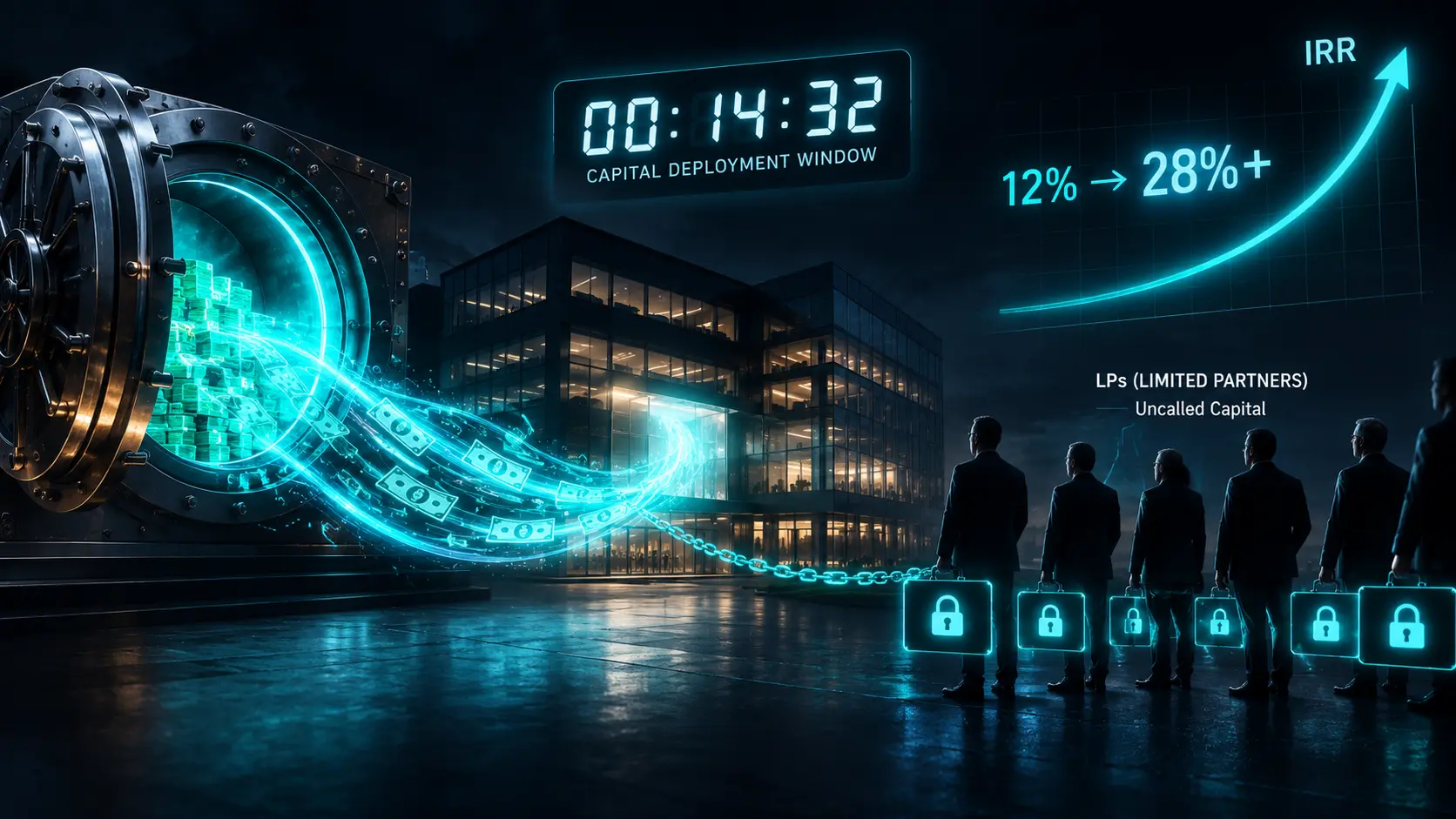

Imagine a Wall Street billionaire acquires a massive software company for $2 billion. The headline reads that their Private Equity firm successfully funded the buyout. What the headline doesn’t mention is that the firm did not use a single dollar of its investors’ cash to make the purchase. Instead, they bought the company using a colossal, specialized credit card issued by a global bank. The Private Equity firm will wait one or two years before finally asking its investors to pay the bill. By officially delaying the moment the investors’ cash enters the investment, the firm mathematically engineers a much higher annualized return on paper, allowing the fund managers to collect exorbitant performance fees for generating what is largely a spreadsheet illusion.
Why should you care right now? Because this hidden financial plumbing, known as a Subscription Credit Facility, has quietly ballooned into a $1 trillion shadow market. It is the lifeblood of modern private capital. But as global interest rates surged throughout the 2020s, the cost of carrying these massive “credit card” balances skyrocketed. The strategy that once seamlessly smoothed cash flows and inflated returns is now squeezing institutional pension funds, threatening to trigger a cascading liquidity crisis across the world’s most opaque asset class. To understand the true health of the private markets, you must look past the companies they own and examine the hidden leverage funding the funds themselves.
What are Subscription Credit Facilities?
Subscription credit facilities (or sublines) are revolving bank loans granted to private investment funds. They are secured by the uncalled capital commitments of the fund’s Limited Partners (LPs). By utilizing these lines, General Partners (GPs) can immediately finance asset acquisitions without issuing immediate capital calls, simplifying administration while artificially inflating time-weighted performance metrics like the Internal Rate of Return (IRR).
At a Glance
- Concept: A massive bank loan given to a Private Equity fund, guaranteed not by the fund’s assets, but by the legal promises of its wealthy investors to eventually provide cash.
- Why it matters: It artificially boosts the fund’s Internal Rate of Return (IRR). If the fund buys a company with a bank loan and waits two years to ask the investors for cash, the investors’ “time in the market” shrinks, making their annualized return look exponentially higher.
- Who uses it: Nearly every major Private Equity, Venture Capital, and Private Credit fund in existence, facilitated by tier-1 global investment banks.
- Biggest takeaway: The fund’s investors (LPs) end up paying for everything. They pay management fees on their committed capital, and they also indirectly pay the massive bank interest on the subscription line, reducing their actual total dollar profit (MOIC).
In Simple Words
Imagine you and ten friends agree to start an investment club. You all sign a legal contract promising to contribute $100,000 each whenever the club’s manager finds a good business to buy.
A month later, the manager finds a great business. Instead of calling all ten friends and demanding the $100,000 immediately (which is annoying and requires everyone to wire money by Friday), the manager goes to a bank. The manager shows the bank the signed contracts. The bank says, “These people are very rich and legally bound to pay. We will loan you the $1 million right now to buy the business.”
The manager buys the business. Two years later, the business is thriving. Now, the manager finally calls you and asks for your $100,000 to pay off the bank. Because you only had your money “at risk” in the club for a few months before the business was sold for a profit, your annualized percentage return looks like a genius-level 50% a year. In reality, the manager just used a bank’s money to do the heavy lifting, and the interest paid to the bank quietly ate into your total cash profit.
Why This Matters
For Institutional LPs (Pension Funds, Endowments) and Credit Analysts, the abuse of subscription lines is a transparency crisis.
LPs allocate billions to Private Equity (PE) because PE promises higher Internal Rates of Return (IRR) than the public stock market. However, if a PE fund reports a 22% IRR, the LP must know whether that return was generated by brilliant operational improvements (actually making the acquired companies better) or simply by delaying the capital call for 18 months via a subline. Furthermore, because subline interest is paid out of the fund’s total returns, LPs are inadvertently funding the very financial trick used to trigger the General Partner’s “carried interest” performance bonuses earlier than mathematically justified.
The Evolution of Private Equity Sublines
Historically, the private equity model was simple: find a target, issue a capital call, wait 15 days for the cash to arrive, and close the deal.
The subline was invented in the 1990s purely as a 30-day “administrative bridge.” It prevented GPs from sending LPs dozens of tiny, annoying capital calls every time the fund needed to pay legal fees or close a minor add-on acquisition.
By the late 2010s, the zero-interest-rate environment mutated the subline. Because borrowing from banks was nearly free, GPs realized they could hold these loans for 365 days or more. The subline transitioned from an administrative convenience into structural, systemic fund-level leverage, creating a $1 trillion market heavily concentrated among a few elite, systemically important mega-banks.
How Sublines Cause IRR Manipulation
Engineering an artificial IRR bump without acquiring toxic corporate debt requires exploiting the pristine credit ratings of pension funds. Here is the first-principles breakdown of the architecture.
1. The Fundamental Problem: Cash Drag
Private Equity performance is universally judged by IRR, which is heavily penalized by time. If an LP wires cash to a fund, and that cash sits in a checking account for 60 days while lawyers finalize an acquisition, the “clock” has started. Earning zero percent interest for 60 days severely drags down the final IRR calculation.
2. The Core Mechanism: The Uncalled Commitment
When an LP commits $100 million to a fund, they don’t wire it all at once. It is “uncalled capital.” The subline is a revolving credit facility secured exclusively by the right to call that capital. The bank fundamentally does not care what companies the GP is buying; the bank only cares that the California Public Employees’ Retirement System (CalPERS) has signed a legally binding contract to provide cash when requested.
3. Technical Depth: The Borrowing Base
Banks do not lend 1-to-1. They calculate a “Borrowing Base” using strict advance rates.
If a sovereign wealth fund (AAA credit rating) pledges $100M, the bank might lend $90M against it. If a high-net-worth individual family office pledges $100M, the bank might only lend $50M against it. The sum of these advance rates dictates the maximum size of the subline.
4. The Mathematical Distortion: IRR vs. MOIC
Let’s examine the math.
Without a Subline: LP gives $100M on Day 1. Fund returns $150M at Year 5.
Multiple on Invested Capital (MOIC) = 1.5x.
IRR = 8.4%.
With a 1-Year Subline: Bank funds the $100M on Day 1. LP is finally called for the cash at Year 1. The fund pays $5M in bank interest. Fund returns $145M at Year 5.
The LP’s cash was only in the fund for 4 years (Year 1 to Year 5).
MOIC drops to 1.45x (due to the interest cost).
IRR artificially spikes to 9.7% because the time denominator ($t$) shrank.
5. Real-World Consequences: The Hurdle Rate Trigger
Most PE funds must clear an 8% “Hurdle Rate” (preferred return) before the GP can start taking their 20% performance fee (carried interest). By using a subline to artificially bump the IRR from 8.4% to 9.7%, the GP effortlessly clears the hurdle, unlocking tens of millions of dollars in personal bonuses at the direct expense of the LP’s total cash multiple.
Asset Classes Using Capital Call Facilities
Sublines have evolved into highly bespoke tools deployed across the entire spectrum of alternative assets.
Real Estate Bridging and Development: Real estate funds require massive, immediate cash injections to close on properties or fund construction milestones. Waiting for 50 different LPs to wire cash delays escrow. Sublines allow real estate GPs to act as all-cash buyers, instantly drawing down on the facility to secure competitive properties and smoothing out the chaotic, fragmented cash flows of physical construction.
Distressed Debt and Special Situations: When a credit fund identifies a distressed company on the verge of bankruptcy, they must buy the debt within hours to secure a controlling position. Sublines provide the immediate liquidity required to execute these lightning-fast distressed trades without telegraphing their moves to the broader market by initiating a highly visible, public capital call.
Fund-of-Funds (FoF) Management: A Fund-of-Funds invests in dozens of other Private Equity funds. Because each underlying PE fund issues capital calls randomly, the FoF manager would constantly have to call their own investors for erratic amounts of cash. A massive subline acts as a shock absorber. The FoF pays the random capital calls using the bank’s money, and then issues a single, consolidated, predictable capital call to its own LPs twice a year.
Economic & Strategic Impact
The true danger of the subline market was exposed during the 2023-2024 Interest Rate Shock.
When the Federal Reserve held rates at 0%, subline interest was negligible (roughly 2%). GPs could hold sublines for two years, dramatically boosting IRR while barely hurting the MOIC.
When SOFR (the Secured Overnight Financing Rate) spiked, the cost of sublines exploded to 7% or 8%. Suddenly, the interest eating into the LP’s profits became staggering. To stop the bleeding, GPs were forced to rapidly pay down these credit facilities. This triggered an avalanche of sudden, massive capital calls to LPs (pension funds). LPs were caught off guard, forced to sell off their liquid public stocks in a down market just to generate the cash needed to honor these sudden capital calls, sparking severe, localized liquidity crunches across institutional portfolios.
Advantages
- Administrative Efficiency: Reduces the frequency of capital calls from dozens of erratic, tiny requests per year down to one or two predictable, consolidated cash transfers.
- Deal Execution Speed: Provides the GP with guaranteed, immediate liquidity, allowing them to outbid competitors and close acquisitions in days rather than weeks.
- Prevents Cash Drag: Ensures that LP capital is not called until it is immediately ready to be deployed, maximizing the efficiency of the capital actually at risk.
Limitations
- IRR Distortion: Masks true operational performance. LPs cannot easily compare two funds if one achieved a 20% IRR through brilliant management, and the other achieved it solely by aggressively holding a subline for 24 months.
- Systemic Contagion Risk: Creates an interconnected web of liability. If a major pension fund goes bankrupt and defaults on its capital call, the bank seizes the subline, instantly freezing the Private Equity fund’s ability to operate and threatening the survival of its portfolio companies.
- The ILPA Friction: The Institutional Limited Partners Association (ILPA) has grown highly critical of sublines, pushing for strict 180-day limits on how long GPs can delay capital calls, leading to tense, hostile negotiations during fund formation.
Common Misconceptions
Misconception: Sublines are loans taken out by the companies the PE firm buys.
Reality: The companies take out standard LBO debt. The subline is a completely separate loan taken out at the fund level, resting entirely on top of the LPs’ promises to pay. This creates dual-layer leverage.
Misconception: Banks take heavy risks by lending to these funds.
Reality: Sublines are considered some of the safest loans on Wall Street. The default rate is virtually zero. Because the collateral is backed by sovereign wealth funds and massive state pensions, banks treat them as near-cash equivalents, which is why they offer massive multi-billion-dollar facilities.
Misconception: LPs hate sublines entirely.
Reality: LPs actually like the administrative ease of not having to wire cash every two weeks. What they hate is the abuse of sublines—when GPs hold them for years specifically to manipulate the IRR hurdle rates and trigger unearned performance fees.
What Most People Miss
The critical distinction between Subscription Lines and NAV Loans.
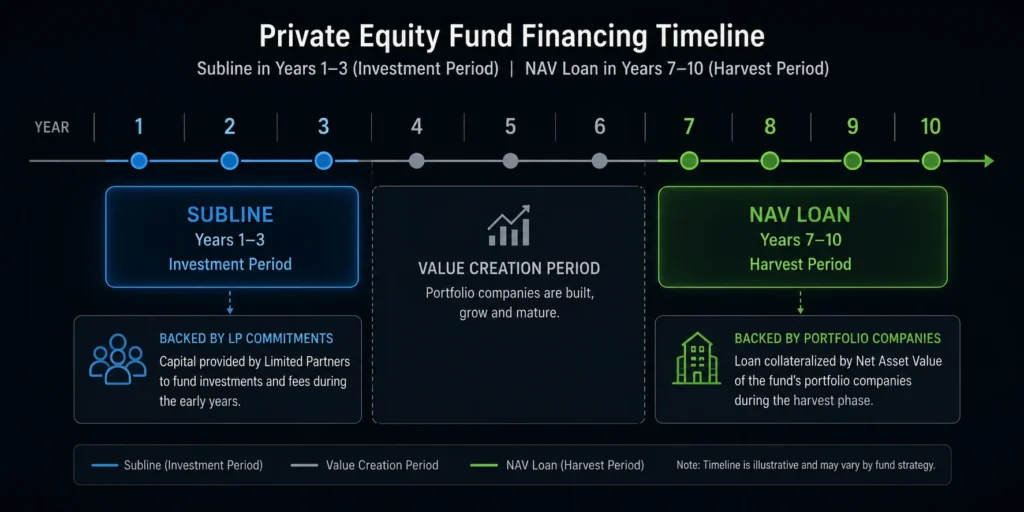
Sublines are “capital call facilities.” They are used at the beginning of a fund’s life, secured by the money LPs haven’t paid yet.
What most analysts miss is the explosive rise of Net Asset Value (NAV) Loans. A NAV loan is used at the end of a fund’s life. When the LPs have paid all their money, but the fund is struggling to sell its companies, the GP goes to a bank and borrows money against the paper value of the unsold portfolio companies. NAV loans are vastly more dangerous than sublines. While a subline is backed by the rock-solid credit of a pension fund, a NAV loan is backed by highly illiquid, struggling companies in a frozen M&A market. Confusing the two obscures the true risk profile of modern private capital.
Comparison Table
| Feature | No Subline (Direct Call) | Subscription Credit Facility (Subline) | Net Asset Value (NAV) Loan |
| Stage of Fund Life | Anytime | Early Stage (Investment Period) | Late Stage (Harvest Period) |
| Collateral | None | Uncalled LP Capital Promises | Existing Portfolio Companies |
| Primary Purpose | Normal operations | Deal speed & IRR enhancement | Liquidity & Artificial distributions |
| Impact on IRR | Neutral | Inflates IRR significantly | Highly variable / Distortive |
| Risk Profile for Banks | N/A | Extremely Low (Near zero default) | Moderate to High |
Case Study
Situation: A top-tier Private Equity mega-fund launched its flagship buyout vehicle in 2021, targeting a 20% net IRR to trigger its carried interest bonuses. During the first two years of the investment period, the GP heavily utilized a massive $3 billion subscription credit facility to fund a dozen acquisitions, deliberately delaying all capital calls to its institutional investors.
Challenge: In 2023, the Federal Reserve executed its most aggressive rate-hiking cycle in four decades. The interest rate on the $3 billion subline—tied to floating benchmark rates—surged from roughly 2.5% to over 7.5%. The interest expense alone began consuming tens of millions of dollars of the fund’s potential profits every month, actively destroying the fund’s Total Value to Paid-In (TVPI) capital multiple.
Solution & Outcome: To stop the hemorrhaging MOIC, the GP abruptly called $3 billion in capital from its LPs simultaneously to pay down the subline. The LPs, experiencing a severe “denominator effect” due to falling public equities, were forced to scramble for liquidity. While the GP successfully secured its mathematically inflated IRR (because the cash was officially “called” at the last possible minute), the LPs suffered the dual blow of absorbing the massive interest costs and facing a chaotic liquidity crisis.
Lessons Learned: The event fundamentally altered LP-GP relations. Institutional investors realized that while sublines enhance paper returns in a zero-interest-rate environment, they act as toxic margin loans in a rising-rate environment. In response, LPs began aggressively dictating terms in new Limited Partnership Agreements (LPAs), strictly capping subline durations to 90 or 180 days and forcing GPs to report “unlevered IRR” metrics alongside their artificially leveraged figures.
Future Outlook
Next 12–24 Months
The era of Unlevered Transparency and ILPA Mandates. Following the rate shock, the Institutional Limited Partners Association (ILPA) will secure widespread adoption of strict transparency guidelines. Throughout 2026, it will become standard industry practice for GPs to report two separate performance metrics: Levered IRR (with the subline) and Unlevered IRR (as if cash was called on Day 1). Funds that refuse to provide this dual-track accounting will face severe headwinds in raising capital, as LPs refuse to pay performance fees on pure financial engineering.
Next 3–5 Years
The scaling of Non-Bank Subline Providers. Historically, sublines were the exclusive domain of massive global commercial banks (like JPMorgan, Citi, and Wells Fargo). However, as Basel III Endgame regulations enforce stricter capital requirements on commercial banks, their ability to hold massive, undrawn credit lines will be constrained. This regulatory squeeze will trigger the rise of private credit and insurance companies stepping in to provide sublines directly to PE funds, blurring the lines as the shadow banking sector begins lending directly to itself.
Next 10 Years
The Tokenization of LP Commitments. By the 2030s, the archaic, paper-based legal architecture of the capital call will be digitized. LP commitments will be tokenized on permissioned blockchain ledgers. Rather than relying on slow, syndicated bank facilities to bridge 30-day gaps, GPs will use these smart-contract tokens as instant, programmable collateral, executing micro-borrowing in decentralized liquidity pools. This will eliminate the massive banking friction currently inherent in fund finance, enabling perfectly synchronized, second-by-second capital deployment across the global private markets.
Most Likely Scenario
The Subscription Credit Facility is a permanent fixture of modern finance; the administrative convenience is too valuable to abandon. However, its era as a stealthy, unregulated IRR-manipulation tool is over. Constrained by higher baseline interest rates and militant LP oversight, sublines will regress to their original purpose: short-term bridges. The Private Equity industry will be forced to return to its roots, generating returns through actual corporate turnarounds rather than balance sheet arbitrage.
Key Takeaways
- Subscription Credit Facilities (sublines) are massive bank loans used by Private Equity funds to buy companies without immediately asking their investors for cash.
- The loans are completely safe for banks because the collateral is not a risky company; the collateral is the legally binding promise of wealthy investors (like pension funds) to pay the bill eventually.
- By delaying the moment investors wire their cash, the fund shrinks the timeline of the investment. This mathematical trick artificially inflates the fund’s Internal Rate of Return (IRR).
- GPs use this inflated IRR to easily clear their “hurdle rates” and unlock massive personal performance bonuses (carried interest) earlier than they otherwise would.
- The interest paid to the bank on the subline is paid out of the fund’s profits. Therefore, investors get a higher percentage return on paper, but walk away with less total cash in their pockets (lower MOIC).
- As interest rates skyrocketed, the cost of maintaining these sublines became ruinous, forcing GPs to suddenly demand billions in cash from investors, triggering severe liquidity crunches.
Glossary
Borrowing Base: The mathematical formula a bank uses to decide how much money to lend a fund. It is based on the creditworthiness of the investors; a AAA-rated pension fund allows the GP to borrow more money than a high-net-worth individual.
Capital Call (Drawdown): The formal, legal request from a General Partner (GP) demanding that the Limited Partners (LPs) wire the cash they promised to the fund.
Carried Interest: The performance bonus paid to the Private Equity managers (usually 20% of the profits), triggered only after the fund achieves a specific IRR.
Denominator Effect: A crisis where an investor’s public stocks lose value, making their private equity holdings mathematically look like too large a percentage of their overall portfolio, forcing them to stop investing in private markets.
Internal Rate of Return (IRR): A time-weighted metric used to judge private equity performance. Because it is highly sensitive to time, delaying a capital call via a subline artificially inflates the number.
Multiple on Invested Capital (MOIC): A simple metric showing total cash returned divided by total cash invested (e.g., investing $10 and getting back $20 is a 2.0x MOIC). Unlike IRR, it cannot be manipulated by time.
Sources
Institutional Limited Partners Association (ILPA): Subscription Lines of Credit and Aligning Interests
PitchBook: The impact of subscription lines of credit on private equity performance
Oaktree Capital: The Rise of Subscription Lines in Private Equity
Federal Reserve Board: Financial Stability Report – Vulnerabilities in Private Credit
S&P Global Ratings: Fund Finance: Subscription Lines and NAV Loans