Advertisement
)


The greatest breakthrough in modern oncology is Radioligand Therapy (RLT). Instead of flooding the entire body with toxic chemotherapy or burning tissue with external radiation beams, RLT acts like a smart bomb. Scientists attach a radioactive isotope to a homing molecule that physically hunts down cancer cells, latches onto them, and detonates. The current gold standard for this payload is Lutetium-177. It has saved thousands of lives, particularly in late-stage prostate cancer. But it has a fatal flaw: its radioactive blast radius is too large. Lutetium’s beta particles travel millimeters through tissue, perfectly wiping out large tumor masses, but frequently passing straight through tiny, single cancer cells without killing them. The cancer survives, hides, and inevitably returns.
Why should you care right now? Because nuclear physicists and biotech firms are actively replacing Lutetium with a heavier, more destructive element: Terbium-161. While chemically identical to Lutetium, Terbium-161 possesses a distinct nuclear decay profile. When it detonates, it fires a dense, microscopic shotgun blast of “Auger electrons” that travel less than the width of a single cell. This hyper-localized radiation completely shreds the DNA of micro-metastases while leaving the healthy cells next door completely untouched. Slated for commercial scaling by 2026, Terbium-161 is poised to upgrade the world’s most successful targeted radiation therapy from a blunt instrument into a microscopic sniper rifle.
What is Terbium-161 (Tb-161)?
Terbium-161 is an emerging, highly destructive radioactive isotope used in targeted cancer therapy. While it emits medium-range beta particles similar to traditional isotopes, it uniquely co-emits a dense cascade of ultra-short-range Auger electrons. This localized radiation perfectly eradicates individual, microscopic cancer cells and micro-metastases without damaging adjacent healthy tissue.
At a Glance
- Concept: Upgrading the radioactive payload of targeted cancer drugs to hit smaller targets.
- Why it matters: Current therapies miss microscopic cancer cells because the radiation travels too far. Terbium-161’s radiation stops inside the exact cell it touches, ensuring single-cell destruction.
- Who uses it: Advanced radiopharmaceutical biotechs (e.g., Novartis, Point Biopharma), nuclear reactor operators, and specialized isotope manufacturers like Rocket Isotopes and TerThera.
- Biggest takeaway: Because Terbium and Lutetium are chemically identical (both are Lanthanides), drug companies do not have to invent new targeting molecules. They can simply pop the Lutetium out of their existing billion-dollar drugs and drop Terbium-161 in.
In Simple Words
Imagine a sniper trying to eliminate an enemy hiding inside a crowded apartment building.
Current radioligand therapy uses Lutetium-177. Lutetium is like a grenade. When the sniper throws it into the room, it destroys the enemy, but the blast radius is wide enough that it might blow out the walls and damage the innocent people in the next room. Furthermore, if the enemy is very small (like a single wandering cancer cell), the grenade shrapnel might fly right past them without doing fatal damage.
Terbium-161 is different. It still has the grenade blast, but it also fires a microscopic, point-blank shotgun blast (Auger electrons) that travels only an inch. When the drug latches onto the cancer cell, the Auger electrons tear the cell’s DNA to shreds from the inside out. The radiation stops exactly at the cell wall. The enemy is vaporized, but the innocent cell sitting directly next door doesn’t even feel a breeze.
Why This Matters
For Biotech Investors, Oncologists, and Pharma Execs, Terbium-161 solves the Micro-Metastatic Relapse Trap.
Radioligand therapies like Novartis’s Pluvicto (Lu-177-PSMA-617) generate billions in revenue by effectively shrinking massive, late-stage prostate tumors. But oncology’s ultimate goal is curative, early-stage intervention. If an oncologist administers Lutetium-177 early, when the cancer is just beginning to spread as microscopic clusters of cells in the bloodstream or bone marrow, the Lutetium fails. Its beta particles travel up to 2 millimeters. If the cancer cluster is only 0.1 millimeters wide, most of the radioactive energy deposits uselessly in the surrounding healthy tissue (causing bone marrow toxicity) rather than in the tumor.
Terbium-161 fixes the physics. Because Auger electrons travel fractions of a micrometer, 100% of their destructive energy is deposited directly into the microscopic cell they attach to. For pharmaceutical companies, dropping Tb-161 into existing ligand pipelines unlocks the ability to move targeted radiation therapy from a “last resort” for dying patients into a frontline, curative treatment for early-stage disease.
Micro-Insight: The value of a medical isotope is determined by its “Linear Energy Transfer” (LET). You don’t just want radiation; you want radiation that stops exactly where you tell it to.
The Shift to Isotope-Matched Oncology
We are witnessing the Isotopic Optimization of Oncology.
For the last decade, biotech innovation was entirely focused on the “Ligand” half of Radioligand Therapy—inventing better homing molecules to find the cancer. The radioactive payload was largely an afterthought. With the rise of Alpha emitters (Actinium-225) and Auger emitters (Terbium-161), the industry has realized that the payload physics dictate the clinical outcome. We are now entering an era of “Isotope Matching,” where oncologists will select specific radiation ranges based strictly on the geometric size of the patient’s tumor.
How Terbium-161 (Tb-161) Works
Understanding why Terbium-161 is deadlier than Lutetium-177 requires looking at the sub-atomic physics of radioactive decay. Here is the first-principles breakdown of the architecture.
1. The Fundamental Problem: Beta Particle “Crossfire”
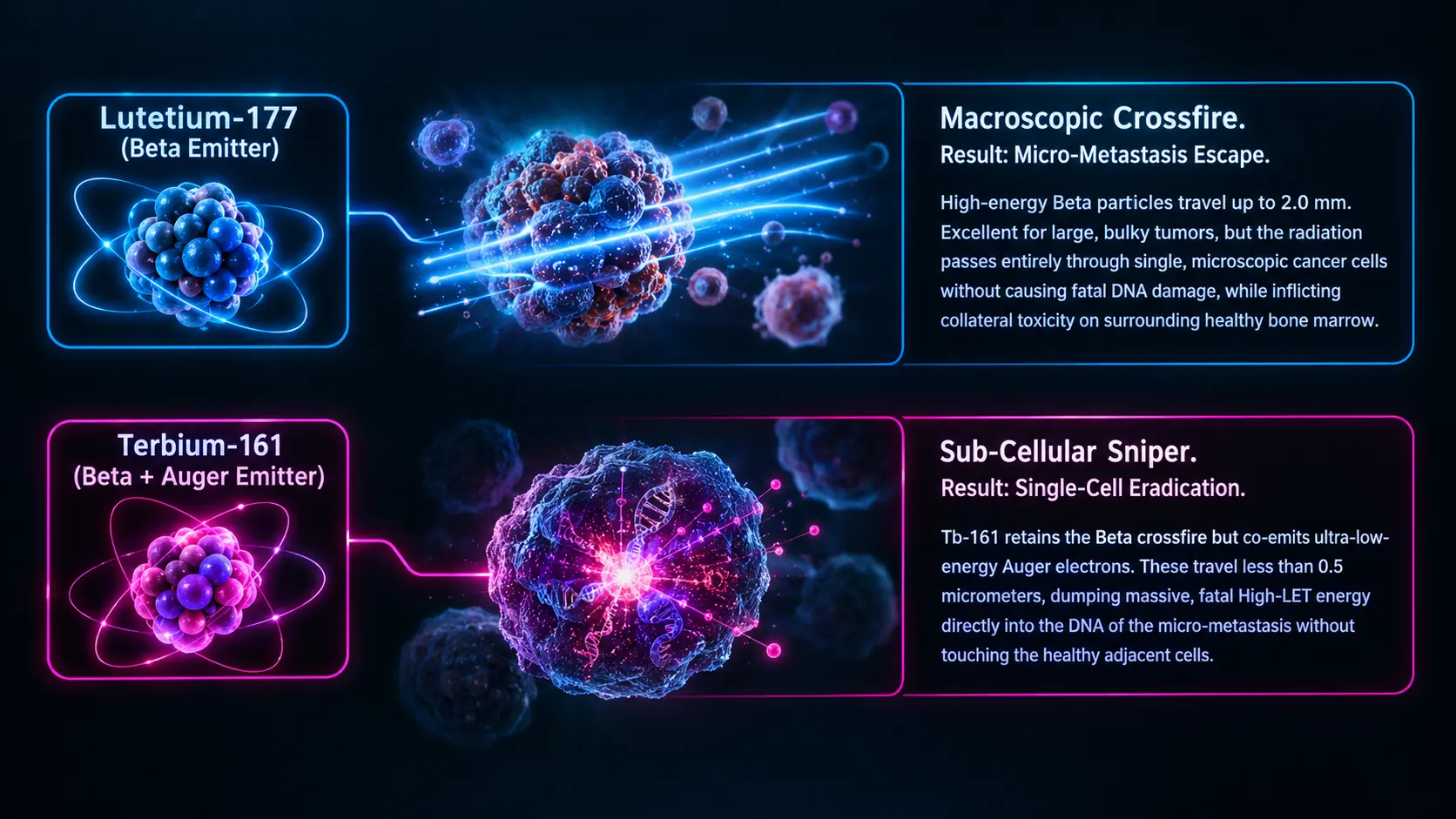
When Lutetium-177 decays, it emits Beta particles (high-speed electrons). These particles have high kinetic energy, causing them to travel up to 2 millimeters through human tissue before stopping. This creates a “crossfire effect”—if a tumor is a large ball of cells, the beta particles fire through the ball, hitting multiple cancer cells at once. But if the target is a single cell, the fast-moving beta particle zips right through it, often doing minimal damage to the DNA, and deposits its energy in the healthy tissue behind it.
2. The Core Mechanism: The Auger Effect
Terbium-161 also emits beta particles, meaning it retains the crossfire capability for large tumors. But as its nucleus decays, it also undergoes a phenomenon called internal conversion. This process disturbs the inner electron shells of the Terbium atom. To restabilize, the atom violently ejects a cascade of ultra-low-energy electrons from its outer shells. These are Auger electrons.
3. Technical Depth: Nanometer Track Structure
Because Auger electrons have incredibly low energy (often less than 1 keV), they cannot travel far. Their maximum range in human tissue is typically between 2 to 500 nanometers (the width of a single DNA strand to a single cell).
Because they dump all of their energy in such a microscopic distance, they possess extremely high Linear Energy Transfer (LET). If the Terbium-161 atom is attached to the surface of a cancer cell, or internalized into its nucleus, the Auger cascade effectively acts like a microscopic chainsaw, causing fatal double-strand DNA breaks that the cancer cell cannot repair.
4. Technical Depth: Lanthanide Chemical Equivalence
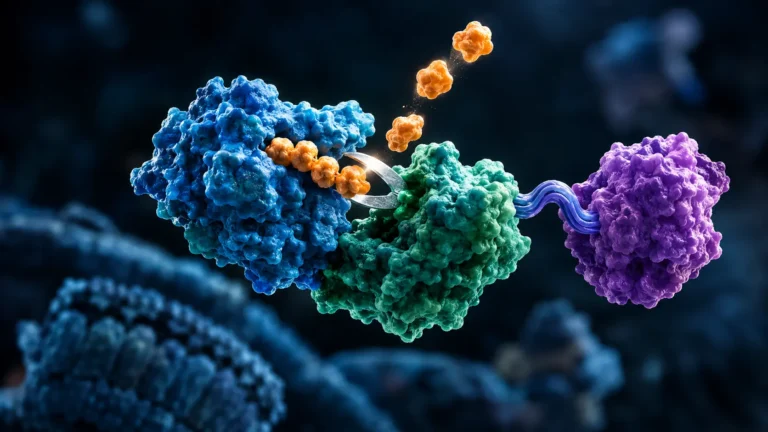
Why is Terbium specifically the chosen upgrade? Because Terbium (Element 65) and Lutetium (Element 71) are both Lanthanides. They possess almost identical chemical properties. If a pharmaceutical company has spent $500 million FDA-clearing a targeting molecule (like a PSMA binder or a somatostatin analog) designed to hold a Lutetium atom, they do not have to redesign the molecule. The chemical “claw” (chelator) that holds Lutetium holds Terbium equally well.
5. Real-World Consequences: Micro-Metastatic Eradication
By hot-swapping Lutetium for Terbium-161, oncologists get a dual-action weapon. The beta emissions handle the large, bulky tumor masses via crossfire, while the Auger emissions act as a localized cleanup crew, instantly executing any single cancer cells floating in the bloodstream or hiding in the bone marrow, preventing the disease from metastasizing.
Radioligand Therapy Simulator: Lu-177 vs. Tb-161
Evaluating Beta Particle Crossfire vs. High-LET Auger Electron Nano-Targeting
Tumor Target Diameter
20 µm (Micro-Metastasis)
Isotope Payload
Lutetium-177 (Beta Only)
Terbium-161 (Beta + Auger)
Tumor DNA Double-Strand Breaks
18.4%
Healthy Collateral Toxicity
71.2%
Effective Local LET Density
0.2 keV/µm
Cellular Track Structure & Radiation Deposition
TARGET ACQUIRED
Therapeutic Index: Tumor Kill Rate vs. Collateral Damage
Real-World Applications
Terbium-161 is aggressively moving from academic nuclear physics reactors into late-stage clinical oncology trials.
The Swiss REALITY Trial: In late 2024 and 2025, the University Hospital Basel in Switzerland initiated the first-in-human clinical trials comparing 161Tb-DOTATOC directly against the standard 177Lu-DOTATOC for neuroendocrine tumors. Early preclinical models demonstrated that Tb-161 outperformed Lu-177, significantly extending survival in mice with micro-metastatic disease. The human trial data is heavily anticipated as the definitive proof-of-concept that Auger electrons translate to superior progression-free survival in patients.
Prostate Cancer (PSMA) Upgrades: Prostate-Specific Membrane Antigen (PSMA) is the most lucrative target in radioligand therapy. Several biotechs are actively radiolabeling existing PSMA-617 and PSMA-I&T molecules with Terbium-161. Because prostate cancer frequently metastasizes into the bone marrow as tiny cellular clusters, standard Lutetium therapy often causes heavy bone marrow suppression (toxicity) while failing to clear the micro-clusters. Tb-161’s Auger cascade keeps the radiation localized precisely to the PSMA-expressing cells, sparing the delicate stem cells in the surrounding bone marrow.
Theranostic Imaging Capability: Terbium is unique; it is known as the “Swiss Army Knife” of nuclear medicine. While Tb-161 destroys tissue, it also emits low-energy gamma rays and X-rays as a byproduct of its decay. This means a patient injected with Tb-161 can be placed in a standard SPECT camera, and the oncologist can physically see exactly where the drug went in real-time, mapping the tumors visually while simultaneously destroying them.
Economic & Strategic Impact
The core strategic consequence of Terbium-161 is the Upheaval of the Isotope Supply Chain.
Lutetium-177 is produced smoothly today because its raw precursor material (Ytterbium-176) is relatively abundant, and nuclear reactors are optimized for it. Terbium-161 is manufactured by placing highly enriched Gadolinium-160 (160Gd) targets inside a nuclear reactor and bombarding them with neutrons.
The global supply of enriched Gadolinium-160 is severely constrained. Furthermore, separating the newly created radioactive Terbium from the unreacted Gadolinium target requires incredibly complex, GMP-compliant radiochemistry that few facilities on Earth possess. Companies like Rocket Isotopes and TerThera are investing hundreds of millions of dollars into scaling commercial radiochemical separation lines. Whoever controls the reliable output of GMP-grade Terbium-161 by 2026 will command immense pricing power over the massive pharmaceutical companies desperate to upgrade their oncology portfolios.
Clinical Advantages of Terbium-161
- Micro-Metastatic Eradication: Auger electrons deposit massive destructive energy over microscopic distances, ensuring single-cell death.
- Dual-Action Physics: By emitting both Beta particles and Auger electrons, Tb-161 effectively treats both large, bulky tumors and tiny, invisible metastases simultaneously.
- Plug-and-Play Chemistry: Fits perfectly into the exact same chemical chelators (like DOTA) already FDA-approved for Lutetium therapies, saving biotechs years of R&D.
- In-Vivo Imaging: Emits gamma rays during decay, allowing doctors to image the patient and visually confirm the drug hit the tumor using standard SPECT cameras.
Limitations of Tb-161 Radioligand Therapy
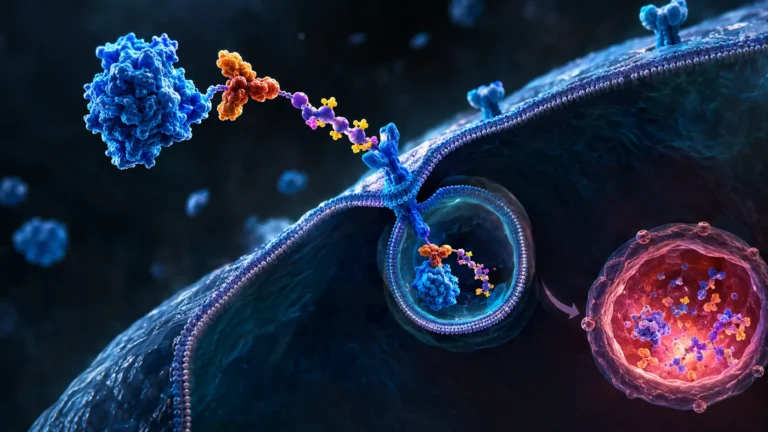
- Cellular Internalization Required: Auger electrons have such a short range that if the drug merely sticks to the outside of the cancer cell, the radiation might not reach the DNA in the nucleus. The targeting molecule must be actively “swallowed” (internalized) by the cancer cell for maximum lethality.
- Gadolinium-160 Bottleneck: Scaling global production is entirely dependent on securing a massive, consistent supply of enriched 160Gd targets, which are difficult and expensive to refine.
- Radiochemical Separation CapEx: The chemical process required to separate radioactive Terbium from the Gadolinium target is intensely complex, requiring specialized “hot cells” and heavily shielded nuclear pharmacies.
Takeaway: The biology and physics of Terbium-161 are flawless. The sole barrier to replacing Lutetium entirely is industrial physics—building enough nuclear reactors and hot cells to supply the global oncology market.
Common Misconceptions
Misconception: Terbium-161 is an Alpha emitter, like Actinium-225.
Reality: Alpha particles (Actinium) are massive, heavy helium nuclei that act like cannonballs. Terbium-161 emits Beta particles and Auger electrons. Auger electrons are incredibly short-range and highly lethal, but they do not cause the severe, irreversible salivary gland toxicity often seen in heavy Alpha therapies.
Misconception: You need new hospitals to deliver it.
Reality: Because Tb-161 has a similar half-life (6.9 days) and identical chemical handling to Lutetium-177, it can be shipped globally and injected by the exact same nuclear medicine physicians using the exact same shielding protocols.
Misconception: The radiation stays in the patient’s body forever.
Reality: The 6.9-day half-life means the radioactivity decays relatively quickly. What isn’t absorbed by the tumors is excreted safely through the patient’s urine within the first 48 hours.
What Most People Miss
The disruptive capability of The Quadruple Terbium Family.
While Terbium-161 is the therapeutic workhorse, it is part of a unique family of four isotopes, often called the “Swiss Army Knife” of nuclear medicine.
If an oncologist wants to image a patient perfectly using a high-resolution PET scan, they can use Terbium-152. If they want to use an Alpha emitter to destroy a massive, resistant tumor, they can use Terbium-149. If they want Auger electrons for micro-metastases, they use Terbium-161.
Because all four are the exact same chemical element, the body processes them identically. An oncologist can use Tb-152 to map the cancer, immediately switch to Tb-161 to treat it, and know with absolute mathematical certainty that the therapeutic drug is going to the exact same location as the imaging drug. No other element on the periodic table offers this perfect diagnostic-therapeutic matching.
Comparison Table
| Metric | Lutetium-177 (177Lu) | Terbium-161 (161Tb) | Actinium-225 (225Ac) |
| Primary Emission | Beta (β-)) particles | Beta (β-)) + Auger electrons | Alpha (α) particles |
| Max Tissue Range | ~2.0 mm (Crossfire) | ~2.0 mm + <0.5 µm (Sub-cellular) | ~0.08 mm (Cannonball) |
| Target Efficacy | Excellent for large tumors | Excellent for both large tumors & single cells | Excellent for resistant tumors |
| Chemistry / Chelator | DOTA | DOTA (Chemically identical to Lu) | Macropa / DOTA (Complex) |
| Production Scale | High (Commercialized) | Emerging (Scaling by 2026) | Severely Constrained |
Future Outlook
Next 12–24 Months
The era of Clinical Validation and Head-to-Head Superiority. Through 2027, the focus is purely on the Phase I/II clinical trial data out of Europe and the US. Pharmaceutical companies will rigorously compare Tb-161-PSMA against Lu-177-PSMA. The primary metric for success will be progression-free survival and a marked decrease in bone marrow toxicity. Positive data will trigger a massive surge of venture capital into specialized isotope manufacturing facilities.
Next 3–5 Years
The scaling of Commercial Gadolinium Supply Chains. By 2030, the global isotope industry will transition from boutique academic production to heavy industrial scale. Companies like TerThera will finalize automated, GMP-compliant radiochemical separation lines capable of processing massive volumes of irradiated Gadolinium-160. This infrastructural build-out will drop the cost per dose of Tb-161, making it financially viable for pharmaceutical giants like Novartis to officially switch their flagship pipelines over to the new isotope.
Next 10 Years
The Frontline Curative Standard. By the mid-2030s, Terbium-161 will supersede Lutetium-177 as the default payload for radioligand therapy. Because Auger electrons excel at destroying micro-metastases, oncologists will no longer wait for a patient’s prostate or neuroendocrine cancer to reach late-stage metastasis before using radiation. Tb-161 will be administered as a frontline, adjuvant therapy immediately after surgery to hunt down and vaporize any rogue, circulating cancer cells, effectively curing the patient before the cancer has a chance to hide.
Most Likely Scenario
The physical limitations of Beta-only radioligand therapy have been reached; you cannot cure a patient if the radiation passes right through the smallest cancer cells. Terbium-161 represents the inevitable physics upgrade. By combining the wide-area damage of Beta particles with the microscopic precision of Auger electrons, Tb-161 perfectly matches the biological geometry of cancer metastasis. While the supply chain scaling of Gadolinium-160 presents a temporary mechanical bottleneck, the sheer clinical superiority of Auger therapy guarantees that Tb-161 will dominate the next decade of nuclear medicine.
Key Takeaways
- Traditional Lutetium-177 radioligand therapy emits Beta particles that travel too far, missing microscopic cancer cells and causing collateral damage to healthy tissue.
- Terbium-161 emits both Beta particles and ultra-short-range Auger electrons. Auger electrons travel less than the width of a single cell, depositing massive destructive energy directly into the DNA.
- Because Terbium acts like a microscopic sniper round, it is highly effective at destroying single circulating cancer cells and micro-metastases that traditional radiation therapies fail to kill.
- Terbium is chemically identical to Lutetium. Pharmaceutical companies can upgrade their existing, FDA-approved targeting drugs simply by swapping the isotope, saving years of R&D.
- The primary bottleneck to commercialization is scaling the nuclear reactors and radiochemical facilities required to process enriched Gadolinium-160 into medical-grade Terbium-161.
Glossary
Auger Electron: A very low-energy electron ejected from an atom to restabilize it. It travels an incredibly short distance (nanometers) but causes massive, localized damage.
Beta Particle: A high-energy, high-speed electron emitted during radioactive decay. It travels millimeters through tissue, causing the “crossfire effect” useful for large tumors.
Chelator: The chemical “claw” on a targeting molecule that physically grabs and holds the radioactive isotope securely so it can be delivered to the cancer cell.
Linear Energy Transfer (LET): A physics measurement of how much energy a radioactive particle dumps into the surrounding tissue as it travels. High LET (like Auger electrons) means massive damage over a tiny distance.
Micro-Metastasis: A microscopic cluster of cancer cells that has broken off from the main tumor and hidden elsewhere in the body. They are too small to be seen on standard scans.
Radioligand Therapy (RLT): A targeted cancer treatment that links a radioactive isotope (the payload) to a homing molecule (the ligand) designed to seek out and attach specifically to cancer cells.
Sources
European Journal of Nuclear Medicine and Molecular Imaging: Terbium-161 for radioligand therapy in cancer: superior efficacy to Lutetium-177
Paul Scherrer Institute (PSI): Development and Preclinical Evaluation of Tb-161 Radiopharmaceuticals
TerThera: Scaling GMP Production of Highly Pure Terbium-161
Journal of Nuclear Medicine (JNM): Auger Electron Emitters for Targeted Radionuclide Therapy
University Hospital Basel: The REALITY Trial: 161Tb-DOTATOC vs 177Lu-DOTATOC