Advertisement
)

AT A GLANCE
- Concept: Digital Fractionalization: Smart contracts divide massive illiquid assets into billions of tradable microscopic ownership shares.
- Concept: The Oracle Problem: Blockchains cannot naturally see real-world prices; they require decentralized oracles to feed them external market data.
- Concept: Automated Market Makers: Mathematical algorithms continuously adjust token prices based on localized supply and demand without human intervention.
- Concept: Compliance Embedding: Identity protocols hardcode strict regulatory requirements directly into the digital asset, preventing illegal cross-border transfers.
HOW IT WORKS
Traditional institutional assets—such as a $500 million commercial skyscraper or a private corporate debt facility—are inherently illiquid. Selling a fraction of a skyscraper to raise capital requires months of legal underwriting, massive broker fees, and a highly limited pool of accredited institutional buyers.
Tokenization fundamentally digitizes this ownership structure. Asset managers place the legal title of the physical asset into a bankruptcy-remote Special Purpose Vehicle (SPV). They then deploy a smart contract on a public blockchain, such as Ethereum or Polygon, which mints millions of digital tokens. Each token represents a strict, legally binding fraction of the underlying SPV.
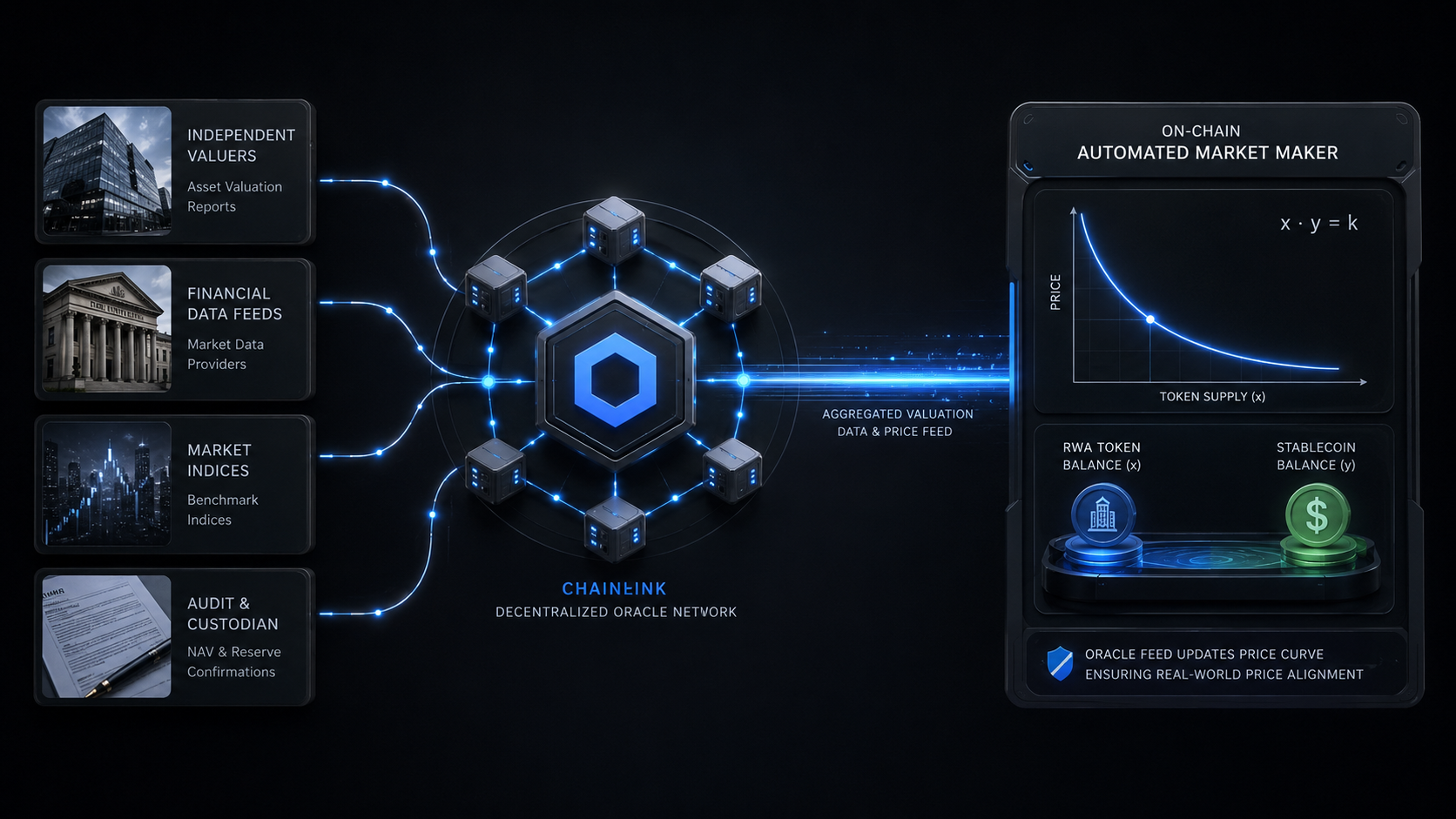
To trade these tokens efficiently, the market relies on Automated Market Makers (AMMs). Unlike traditional stock exchanges that match specific buyers to specific sellers through a centralized order book, an AMM utilizes a liquidity pool and a deterministic mathematical algorithm. The standard constant product formula dictates the price:
$$x \cdot y = k$$
Where x represents the total supply of the tokenized real-world asset (RWA) in the pool, y represents the supply of the stablecoin used for purchase, and k is a constant value. When a trader buys the RWA token, they remove x and add y. The algorithm instantly and automatically raises the price of the remaining RWA tokens to maintain the constant k.
This algorithm presents a severe vulnerability when pricing real-world assets. The blockchain is entirely blind to external reality. If the physical skyscraper burns down, the AMM mathematically will not lower the token price until traders actively begin selling it.
To bridge this gap, the smart contract relies on decentralized oracle networks, like Chainlink. These oracles continuously scrape off-chain valuation data from independent auditors and traditional financial feeds. They aggregate this data and broadcast the consensus price directly onto the blockchain, forcing the AMM to dynamically recalibrate its internal pricing curve to match external, real-world reality.
WHY IT MATTERS NOW
The global financial system currently operates on disconnected, localized settlement rails that take days to clear standard transactions. The tokenization of real-world assets represents the largest single infrastructure upgrade to global capital markets since the transition from paper certificates to electronic databases in the 1970s.
Major institutional players recognize this fundamental shift in liquidity economics. BlackRock, the world’s largest asset manager, recently partnered with the tokenization firm Securitize to launch BUIDL, a tokenized fund backed entirely by US Treasury bills. This fund operates directly on the Ethereum blockchain, allowing investors to earn continuous, off-chain sovereign yield while utilizing the token as immediate, on-chain collateral for decentralized lending protocols.
This architecture unlocks billions of dollars of previously trapped capital. A mid-sized agricultural firm in Brazil can tokenize its future harvest receivables into a digital debt pool. An algorithmic trading firm in Singapore can instantly purchase a fraction of that debt, providing immediate liquidity to the farmer while capturing a guaranteed yield. The blockchain settles the transaction, verifying compliance and transferring the funds in less than twelve seconds.
This absolute speed forces traditional commercial banks into an existential crisis. If corporate borrowers can issue tokenized debt directly to global liquidity pools, they bypass the lucrative underwriting and syndication fees that sustain legacy investment banking divisions.
WHAT MOST PEOPLE MISS
Crypto enthusiasts frequently champion tokenization as the ultimate democratization of finance, assuming retail investors will soon day-trade fractions of the Mona Lisa. They completely miss the strict, algorithmic regulatory enforcement explicitly designed to prevent retail participation.
Institutional tokenization relies heavily on the ERC-3643 standard, an identity-first smart contract architecture. The smart contract itself acts as a robotic compliance officer. Before a tokenized asset can move between two digital wallets, the contract pings an off-chain identity registry to verify the Know Your Customer (KYC) and Anti-Money Laundering (AML) status of the receiver. If the receiving wallet lacks the cryptographic proof of being an accredited institutional investor, the smart contract mathematically rejects the transfer. The asset remains completely frozen, proving that public blockchains can enforce private, sovereign financial regulations with absolute, unforgiving mathematical certainty.
THE TRAJECTORY
Next 12–36 Months: Global clearinghouses will standardize cross-chain interoperability protocols. This will allow tokenized US Treasuries minted on the Ethereum network to seamlessly act as margin collateral for synthetic derivatives trading on competing high-speed networks like Solana, vastly improving global capital efficiency.
Next Five Years: The integration of Zero-Knowledge (ZK) proofs will solve the institutional privacy dilemma. Asset managers will utilize ZK-rollups to cryptographically prove they possess the required liquidity to settle massive block trades on a public ledger, without revealing the specific assets they hold or the identities of their clients to competing trading firms.
Next Ten Years: The physical and digital definitions of an asset will merge completely. Municipal governments will issue fully programmatic bonds where the smart contract automatically sweeps localized tax revenues from civic digital wallets and instantly distributes the yield to global token holders, entirely automating sovereign debt servicing.
What Could Go Wrong: The oracle latency window remains a critical vulnerability. If extreme market volatility causes a traditional asset class to crash, but network congestion delays the oracle from updating the on-chain price feed for just a few minutes, high-frequency arbitrage bots will ruthlessly drain the automated market maker of all its stablecoin reserves, leaving institutional liquidity providers with massive, instantaneous losses.
Most Likely Outcome: The tokenization of real-world assets will systematically replace the legacy Swift and DTCC settlement architectures. While highly speculative retail crypto tokens will fade into obscurity, the underlying blockchain rails will quietly become the mandatory, invisible plumbing for all global institutional finance.
KEY TERMS
- Tokenization: The process of converting legal ownership rights of a physical or traditional financial asset into a digital token on a blockchain.
- Automated Market Maker (AMM): A decentralized exchange protocol that relies on mathematical formulas to price assets continuously, rather than matching buyers and sellers through a traditional order book.
- Decentralized Oracle: A secure, third-party network that reliably feeds external, real-world data (such as off-chain asset prices) directly into blockchain smart contracts.
- ERC-3643: A specific Ethereum token standard designed for security tokens, embedding strict identity verification and regulatory compliance directly into the asset’s transfer logic.
- Special Purpose Vehicle (SPV): A subsidiary company legally created to isolate financial risk, typically holding the physical title to the asset being tokenized on the blockchain.
SOURCES
- Bank for International Settlements (BIS) — The Tokenisation Continuum and Global Financial Infrastructure
- BlackRock — Institutional Digital Asset Strategy and Tokenized Treasury Funds
- Chainlink Labs — Oracle Architecture for Real-World Asset (RWA) Pricing and Cross-Chain Interoperability
- World Economic Forum (WEF) — The Future of Global Capital Markets and Asset Tokenization