Advertisement
)

AT A GLANCE
- Concept: Floating Microgrids: A modern container ship is essentially a floating steel city that requires up to 15 megawatts of continuous electricity just to keep its internal lights on and cargo cold.
- Concept: The Diesel Penalty: Historically, ships idling in port burned bunker fuel constantly to generate this power, poisoning the local coastal air quality.
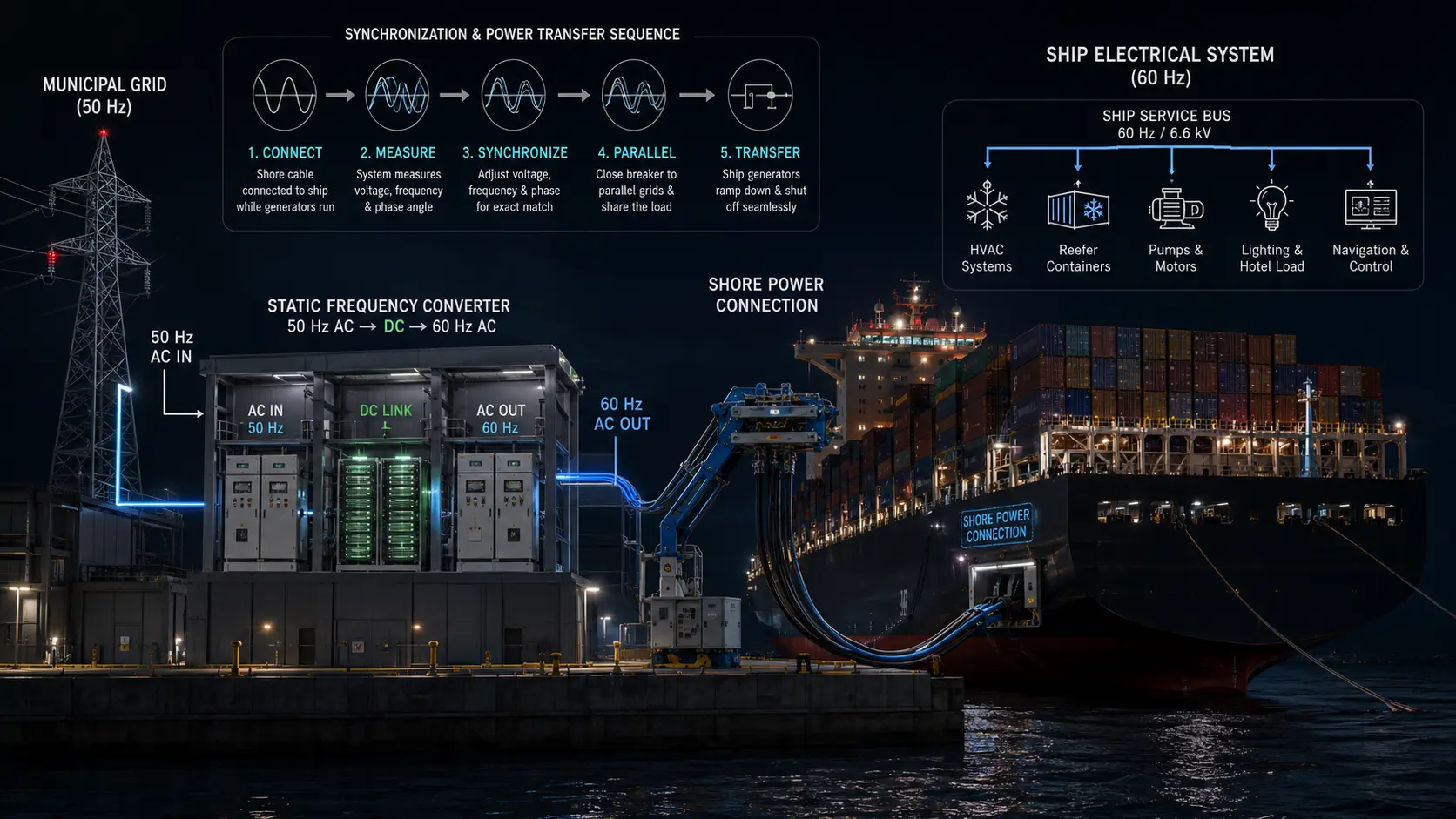
- Concept: Frequency Mismatch: Ships often generate power at 60 Hertz, while many global ports operate their municipal grids at 50 Hertz, preventing a simple plug-and-play connection.
- Concept: Seamless Transfer: Engineers must mathematically synchronize the phase, voltage, and frequency of the shore power with the ship’s generators before shutting the engines down, preventing catastrophic electrical arcing.
HOW IT WORKS
When a 20,000-TEU ultra-large container vessel docks at a major terminal like the Port of Los Angeles, it does not simply turn off. It must continuously run thousands of refrigerated containers (reefers), power the ship’s massive ballast water pumps, and maintain the complex navigation and hotel systems for the crew. To sustain this hotel load, a docked ship historically ran auxiliary diesel engines, burning thousands of gallons of heavy marine fuel directly adjacent to dense urban populations.
Cold ironing, or Alternative Maritime Power (AMP), attempts to replace these localized diesel emissions with clean electrons drawn directly from the terrestrial power grid. However, you cannot simply plug a ship the size of the Empire State Building into a municipal wall socket. The vessel is a massive, independent electrical island operating on an entirely different set of physical parameters than the host city.
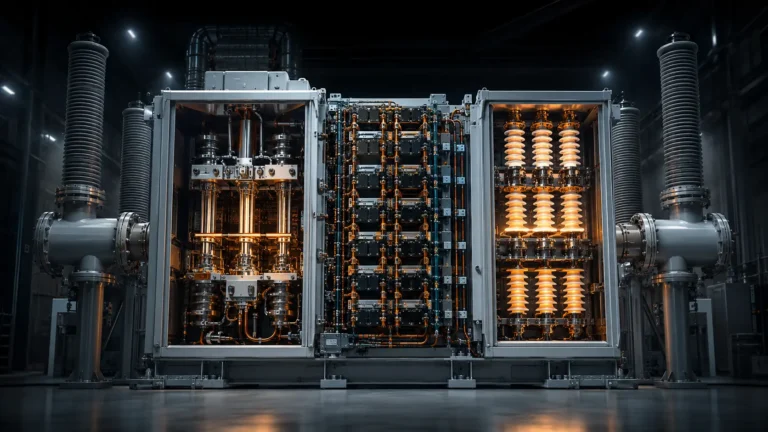
The primary engineering hurdle is frequency matching. The global marine shipping fleet is highly standardized around a 60 Hertz (Hz) operating frequency. However, massive swaths of the global terrestrial grid, particularly in Europe and Asia, operate strictly at 50 Hz. To bridge this gap, ports must construct massive static frequency converters. These substations take the 50 Hz alternating current (AC) from the city, convert it entirely into direct current (DC) to strip away the frequency, and then invert it back into a perfect 60 Hz AC wave that the ship can digest.
The actual connection process is an exercise in extreme phase synchronization. The shore power cannot be engaged while the ship’s engines are off; the power draw would be too sudden, tripping the ship’s breakers. Instead, the heavy shore-power cables are connected while the ship’s diesel generators are still running. Sophisticated switchgear mathematically measures the sine wave of the ship’s generator and the sine wave of the shore grid. Only when the voltage, frequency, and phase angle of both systems perfectly align does the system close the main breaker. The two grids briefly parallel, sharing the load, before the ship’s engineer safely kills the diesel engines, completing the seamless transfer to cold iron.
WHY IT MATTERS NOW
Global maritime shipping is currently undergoing a brutal, highly regulated decarbonization mandate enforced by the International Maritime Organization (IMO). While the industry tests experimental alternative fuels like green methanol or ammonia for deep-ocean transit, the immediate regulatory target is the air quality surrounding coastal mega-cities.
The emissions profile of an idling cargo ship is staggering. A single large cruise ship running its diesel generators at the dock for ten hours produces roughly the same amount of localized particulate matter and nitrogen oxides (NOx) as thousands of heavy-duty diesel trucks driving continuously. Environmental regulations in California and the European Union now legally mandate that certain classes of vessels must plug into shore power upon arrival, effectively banning localized diesel idling.
This regulatory hammer instantly shifts the logistical burden from the shipping companies to the physical infrastructure of the port cities. Equipping a single terminal berth with the high-voltage vaults, frequency converters, and heavy-duty cable management systems required for cold ironing costs upwards of twenty million dollars.
More critically, it demands massive localized power. If four massive container ships dock simultaneously at a terminal and plug in, they create an immediate, localized 40-to-60 megawatt spike in electrical demand. For older coastal cities with aging, congested transmission infrastructure, this sudden load can severely destabilize the local municipal grid, forcing utilities to execute multi-billion-dollar high-voltage substation upgrades simply to prevent the port from browning out the adjacent neighborhoods.
WHAT MOST PEOPLE MISS
Environmental advocates view cold ironing as a pure, zero-emission solution. They completely miss the reality of the thermodynamic energy mix powering the local grid.
Plugging a ship into the wall only eliminates emissions if the electricity behind the wall is clean. If a major port in Southeast Asia implements cold ironing, but the host city relies entirely on a legacy coal-fired power plant to generate its municipal electricity, the emissions are not eliminated; they are merely displaced. The carbon dioxide is simply vented out of a smokestack twenty miles inland rather than the ship’s funnel at the dock. The true environmental value of cold ironing is entirely dependent on the parallel deployment of utility-scale wind, solar, or nuclear generation on the host grid.
THE TRAJECTORY
Next 12–36 Months: Major international ports will finalize the implementation of standardized high-voltage connection protocols (IEC 80005). This standard ensures that a Maersk container ship built in South Korea can safely interface with the proprietary switchgear at the Port of Long Beach without requiring custom, dangerous manual cable splicing by the dockworkers.
Next Five Years: Ports will integrate massive, localized battery energy storage systems (BESS) directly alongside the shore power vaults. These batteries will trickle-charge from the municipal grid overnight when electricity is cheap. When a massive ship plugs in during the day, the battery will discharge, buffering the sudden 15-megawatt draw and protecting the local city grid from violent frequency voltage sags.
Next Ten Years: Cold ironing infrastructure will transition into bi-directional energy nodes. As commercial shipping heavily adopts hybrid-electric or pure-battery propulsion for short-sea routes, the ships will not just draw power. During peak municipal demand events, docked ships will act as massive floating batteries, discharging power back into the city grid to prevent localized blackouts, creating a highly lucrative secondary revenue stream for the shipping operators.
What Could Go Wrong: The physical connection point is highly vulnerable. Massive, high-voltage cables must hang loosely between the concrete dock and the floating steel ship. If the automated cable management system fails to spool the slack correctly during a severe tidal shift or an unexpected tsunami swell, the heavy cables can snap under extreme tension. This would trigger a massive, lethal electrical arc fault, instantly sparking a catastrophic fire directly adjacent to millions of gallons of flammable marine fuel.
Most Likely Outcome: Cold ironing will become the absolute legal prerequisite for accessing any major port in the developed world. The physical capability of a city’s electrical grid to securely export megawatts of stable, frequency-matched power directly to the waterfront will supersede deepwater dredging as the primary competitive advantage of global maritime logistics hubs.
KEY TERMS
- Cold Ironing: The maritime industry term for providing shore-based electrical power to a ship at berth, allowing its main and auxiliary diesel engines to be completely shut down.
- Static Frequency Converter: A massive electrical substation that alters the alternating current (AC) frequency of the power grid (e.g., from 50 Hz to 60 Hz) to safely match the specific requirements of the ship.
- Hotel Load: The continuous electrical demand required to sustain the crew and the cargo while a ship is docked, powering lighting, ventilation, and refrigerated containers.
- Phase Synchronization: The highly precise electrical process of perfectly aligning the voltage waveforms of the ship’s generator and the shore grid before closing the connection breaker to prevent an explosive short circuit.
- International Maritime Organization (IMO): The specialized agency of the United Nations responsible for regulating shipping, specifically concerning safety, security, and the prevention of marine and atmospheric pollution.
SOURCES
- International Electrotechnical Commission (IEC) — High Voltage Shore Connection (HVSC) Systems Standardization (IEC 80005)
- California Air Resources Board (CARB) — At-Berth Ocean-Going Vessels Regulation and Emissions Compliance
- Port of Los Angeles — Alternative Maritime Power (AMP) Infrastructure and Grid Integration
- Journal of Marine Engineering & Technology — Thermodynamic and Electrical Challenges of Synchronizing Marine Microgrids