Advertisement
)


Public markets are shrinking. Companies are staying private longer, delaying IPOs, and generating their most explosive growth away from the public eye. But for forty years, the greatest wealth-generating engine on Wall Street—the private market—has been surrounded by an impenetrable structural moat. To get in, you needed $5 million and the willingness to lock your money in a vault for ten to twelve years without touching it. This meant 99 percent of the global population was legally and mechanically locked out of the private markets.
Why should you care right now? Because Wall Street’s mega-firms have run out of institutional pension money to fuel their growth, and they are now aggressively targeting your retirement account. To unlock the $80 trillion held by individual global investors, firms like Blackstone, Apollo, and KKR have engineered a radical structural pivot: the “Evergreen” or “Semi-Liquid” fund. These funds rewrite the rules of private investing, allowing retail wealth to buy into private equity and private credit with the ability to cash out monthly or quarterly. But this unprecedented democratization of alternative assets hides a profound mechanical risk, and understanding how these funds trap money is the key to surviving the new era of retail finance.
What are Evergreen Funds (Semi-Liquids)?
Evergreen funds are open-ended, semi-liquid investment vehicles that continuously accept new capital and allow investors to redeem shares at regular intervals, such as monthly or quarterly. They democratize access to private markets, enabling retail and high-net-worth investors to hold illiquid assets like private equity without traditional ten-year lockup periods.
At a Glance
- Concept: A fund structure that blends the high returns of private, illiquid assets with the continuous subscription and periodic withdrawal features of a traditional mutual fund.
- Why it matters: Institutional capital (pensions, endowments) is heavily saturated in private markets. To continue growing their Assets Under Management (AUM), alternative asset managers must tap into the mass-affluent and high-net-worth retail channels.
- Who uses it: Mega-cap alternative asset managers (Blackstone, Ares, KKR), wealth management advisors, and retail investors seeking private market yields.
- Biggest takeaway: The liquidity is conditional. Semi-liquid funds enforce strict “redemption gates” (typically 5% per quarter). In a market panic, if too many investors ask for their money back at once, the fund legally locks the doors, turning your “liquid” investment into a highly illiquid one overnight.
In Simple Words
Imagine you want to invest in a massive, privately owned apartment complex.
In the old days, you had to join a Closed-End Fund. You would give a private equity firm your money, they would lock it up, buy the building, hold it for ten years, sell it, and finally hand you your profits a decade later. If you needed your money in year three to pay for a medical emergency, you were out of luck.
An Evergreen Fund changes the rules. It operates like a continuous pool of money that never closes. You can buy shares into the apartment complex today. Next month, if you want out, you can sell your shares back to the fund at their current value.
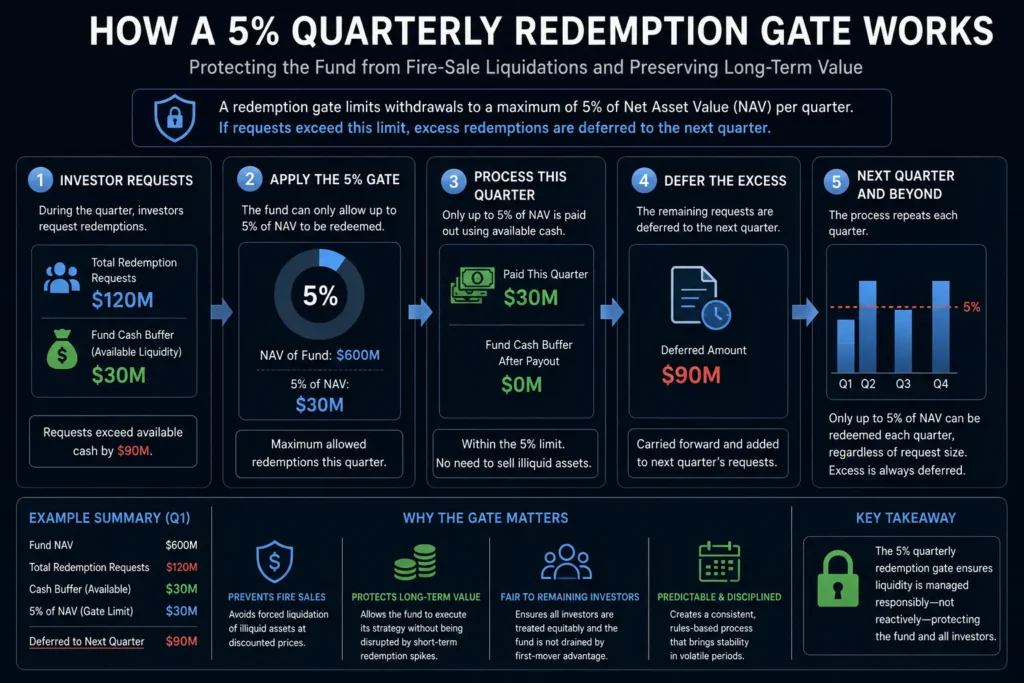
But there is a catch. Buildings are hard to sell. If every investor suddenly panics and asks for their money back on the same day, the fund cannot sell the apartment complex overnight to pay them. To prevent this, Evergreen funds have a “gate.” The fund promises to give money back, but only up to 5 percent of the total fund per quarter. If you are the last person in line during a panic, the gate drops, and you cannot get your cash until the next quarter, or the quarter after that.
Why This Matters
The pivot to retail wealth is the defining strategic shift of the alternative asset management industry in the 2020s.
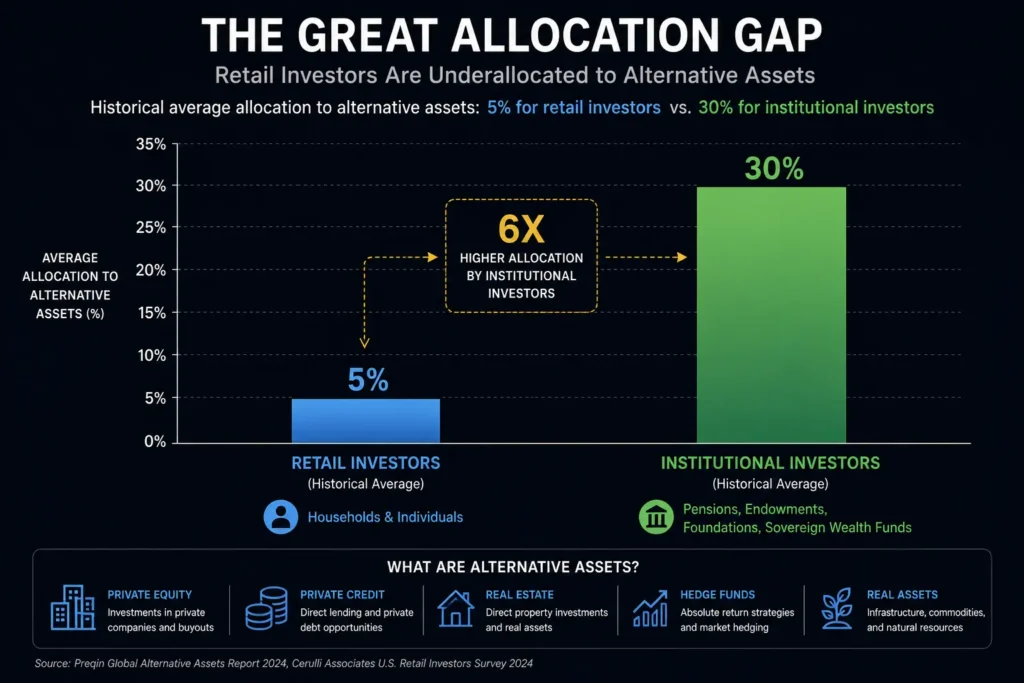
Bain & Company estimates that individuals hold roughly 50 percent of global wealth, but allocate only 5 percent of it to alternative investments. Conversely, institutions hold the other 50 percent of wealth, but allocate roughly 30 percent to alternatives. The mathematical imperative for firms like KKR and Apollo is obvious: they must close that gap.
For the retail investor and the wealth manager, this unlocks institutional-grade private credit, real estate, and private equity yields that historically outperformed public markets. However, the introduction of retail capital into private markets creates a severe behavioral mismatch. Institutional investors understand that private assets take time to mature and do not panic during market dips. Retail investors are accustomed to the instant liquidity of Robinhood and public stock exchanges. When a recession hits, the structural resilience of these semi-liquid vehicles will face an unprecedented stress test from retail panic.
The Rise of Semi-Liquid Funds and ELTIFs
The rise of the Evergreen fund is heavily supported by global regulatory shifts explicitly designed to democratize private capital.
In the United States, this takes the form of non-traded Business Development Companies (BDCs) and Interval Funds. In Europe, regulators recently overhauled the European Long-Term Investment Fund (ELTIF 2.0) framework, drastically lowering the minimum investment thresholds and removing strict diversification rules to make it easier for retail European wealth to buy private assets. The UK followed suit with the Long-Term Asset Fund (LTAF).
This synchronized global regulatory easing is triggering a gold rush. Every major wirehouse (Morgan Stanley, UBS, Merrill Lynch) is currently upgrading its technological infrastructure and re-training its financial advisors to distribute these complex, semi-liquid products to their high-net-worth clients at massive scale.
How Evergreen Funds Work: Redemption Gates
Bridging the gap between an illiquid asset (a private company) and a liquid liability (a retail investor wanting cash) requires precise financial engineering. Here is the first-principles breakdown.
1. The Fundamental Problem: The Illiquidity Premium
Private equity generates high returns specifically because the assets are illiquid. Managers can buy a struggling company, take it private, spend five years fixing it out of the public eye, and sell it for a massive profit. If investors could pull their capital out at any time, the manager would be forced to sell the company prematurely to generate cash, destroying the investment strategy.
2. The Insufficiency of Mutual Funds
Traditional mutual funds and ETFs solve for liquidity by only holding publicly traded stocks and bonds, which can be sold in milliseconds on a stock exchange. By law (such as the US Investment Company Act of 1940), standard open-end mutual funds are severely restricted from holding illiquid private assets because they must guarantee daily liquidity to their investors.
3. The Core Mechanism: The Semi-Liquid Structure
Evergreen funds solve this by shifting from daily liquidity to periodic liquidity. The fund continually accepts new subscriptions (cash in) on a monthly basis. They use this incoming cash to buy private assets. They calculate the exact value of the portfolio every month (the Net Asset Value, or NAV). If an investor wants to leave, they redeem their shares at that specific monthly NAV.
4. Technical Depth: The Cash Buffer and The Gate
To facilitate redemptions without selling the underlying private companies, Evergreen funds maintain a “cash buffer” (typically 10 to 15 percent of the fund is kept in highly liquid public bonds or cash equivalents). However, if redemption requests exceed the cash buffer, the fund deploys the Redemption Gate. The legal prospectus of the fund limits total redemptions to a hard cap—usually 2 percent of the fund’s NAV per month, or 5 percent per quarter. Once the cap is hit, all remaining redemption requests are denied and rolled over to the next period.
5. Real-World Consequences: The Mark-to-Model Lag
Because private companies do not trade on a stock market, their value (the NAV) is calculated by accountants using valuation models (Mark-to-Model), rather than live market prices (Mark-to-Market). This creates a “valuation lag.” When public stock markets crash by 20 percent in a week, the NAV of a private Evergreen fund might remain artificially stable for months before the accountants finally mark it down. Savvy institutional investors often try to exploit this lag by redeeming their shares before the markdown occurs, forcing retail investors who stay in the fund to absorb the eventual losses.
Types of Evergreen Funds: BDCs and REITs
The Evergreen structure is being aggressively deployed across three primary asset classes.
Private Credit (Non-Traded BDCs): The most successful iteration of the Evergreen model. Private credit funds (like Blackstone’s BCRED or Ares’ ASIF) lend money directly to middle-market companies at high, floating interest rates. Because the loans generate consistent monthly cash flow (interest payments), it is mathematically easier for the fund to generate the cash required to satisfy retail investor redemptions without needing to sell the underlying loans.
Private Real Estate (Non-Traded REITs): Mega-funds like Blackstone Real Estate Income Trust (BREIT) use the Evergreen structure to buy logistics warehouses, data centers, and multi-family housing. Retail investors receive monthly dividend yields from the rental income. However, because selling a warehouse takes months, these funds are highly reliant on the 5% quarterly redemption gates to protect the portfolio during real estate downturns.
Private Equity (ELTIFs / Interval Funds): The most difficult asset class to force into a semi-liquid structure. Private equity involves buying whole companies. Because these assets generate very little immediate cash flow and take years to sell, PE Evergreen funds must carry significantly larger, return-dragging cash buffers to honor redemptions, making them structurally less efficient than traditional closed-end 10-year PE funds.
Economic & Strategic Impact
The democratization of private markets fundamentally alters the revenue quality of alternative asset managers.
Historically, private equity firms had to constantly fundraise. They would raise “Fund I,” deploy the capital, sell the assets, return the money, and immediately have to spend months flying around the world to convince clients to invest in “Fund II.”
Evergreen funds are Permanent Capital Vehicles. Because the fund never closes and continually accepts new subscriptions, the asset manager secures a permanent, compounding base of Assets Under Management (AUM). This generates highly predictable, compounding management fees that never roll off. As a result, the public stock valuations of firms like Apollo, KKR, and Blackstone have soared, as Wall Street heavily rewards the stability and endless scale of the retail-driven Evergreen fee stream.
Advantages
- Retail Accessibility: Lowers minimum investment thresholds from $5 million to as little as $10,000 to $50,000, allowing HNW individuals to finally diversify away from the 60/40 public stock and bond portfolio.
- Immediate Deployment: In traditional closed-end funds, investors commit capital that is slowly “called” over years, creating “cash drag.” In Evergreen funds, capital is fully deployed on day one at the current NAV.
- Tax Efficiency and Compounding: Investors can elect to automatically reinvest their distributions and dividends directly back into the fund, compounding their private market returns tax-efficiently over time.
Limitations
- The Liquidity Illusion: The most severe risk. Retail investors often fail to read the fine print, treating semi-liquid funds like standard bank accounts. When the market turns and the 5% gate drops, their capital is legally trapped.
- Cash Drag: To honor redemptions, the manager must keep 10 to 15 percent of the fund in cash or low-yielding public bonds. This cash buffer dilutes the overall performance of the fund compared to a traditional, fully-invested closed-end private equity fund.
- Upfront and Ongoing Fees: Evergreen products often carry heavy distribution fees (to pay the wealth advisors selling them), alongside standard management fees (1.25%) and performance fees (12.5% of profits), which heavily eat into the retail investor’s net return.
Common Misconceptions
Misconception: Evergreen funds guarantee you can get your money out every month.
Reality: They offer the ability to redeem monthly, but they absolutely do not guarantee it. If total redemption requests exceed the pre-defined limit (usually 2% to 5%), the fund will aggressively enforce the gate and halt withdrawals to protect the underlying assets.
Misconception: Private markets are less volatile because their prices don’t drop during a crash.
Reality: The assets are just as volatile; you simply cannot see it. Because private assets are not traded publicly, they are “Marked-to-Model.” The price looks incredibly stable on a chart because the accountants only update the valuation metrics quarterly, artificially masking the true volatility of the underlying business.
Misconception: Only institutional giants can manage Evergreen funds.
Reality: While giants pioneered them, mid-market boutique firms are aggressively launching Interval Funds. However, smaller funds carry higher systemic risk; they lack the massive balance sheets of a Blackstone or KKR to artificially prop up a cash buffer during a severe liquidity crisis.
What Most People Miss
The conflict of interest in Wealth Advisor Incentives.
The explosion of Evergreen funds is not purely driven by consumer demand; it is driven by distribution economics. Wealth management advisors (brokers) at major banks are heavily incentivized to sell these products.
Traditional public index funds (like an S&P 500 ETF) charge near-zero fees, leaving very little commission for the wealth advisor. Evergreen semi-liquid funds often carry front-end load fees, distribution fees, and ongoing servicing fees. Wall Street is eagerly pivoting to retail private markets because it restores the lucrative, high-margin fee structures that were destroyed by the rise of Vanguard and passive index investing in the 2010s.
Comparison Table
| Feature | Traditional Mutual Fund | Evergreen (Semi-Liquid) Fund | Closed-End Private Equity Fund |
| Asset Type | Publicly traded stocks/bonds | Private credit, real estate, PE | Private equity, distressed debt |
| Liquidity | Daily (Guaranteed) | Monthly/Quarterly (Capped/Gated) | None (10 to 12-year lockup) |
| Target Audience | Retail (Mass market) | HNW Retail & Wealth Channels | Institutional (Pensions, Endowments) |
| Valuation Method | Mark-to-Market (Live) | Mark-to-Model (Monthly NAV) | Mark-to-Model (Quarterly) |
| Capital Deployment | Immediate | Immediate | Capital Called over 3-5 years |
Case Study
Situation: Launched in 2017, the Blackstone Real Estate Income Trust (BREIT) became the crown jewel of the semi-liquid industry, raising over $70 billion from retail investors by purchasing high-quality warehouses and apartment buildings.
Challenge: In late 2022, global interest rates spiked. Asian markets panicked, and a wave of foreign retail investors simultaneously requested to pull their money out of BREIT. However, real estate is an inherently illiquid asset; Blackstone could not immediately sell billions of dollars worth of warehouses to generate cash without taking massive, devastating losses.
Solution (Dropping the Gate): In November 2022, redemption requests exceeded BREIT’s structural limit (2% of NAV per month, or 5% per quarter). Blackstone did exactly what the legal prospectus mandated: they dropped the gate. They honored redemptions up to the 5% limit and denied the rest, freezing billions of dollars of retail capital.
Outcome: The media and retail investors panicked, viewing the frozen redemptions as a sign of imminent collapse. In reality, the gate functioned flawlessly as a shield. By locking the capital, Blackstone avoided a fire sale, slowly sold a few assets at a premium over the next year to rebuild the cash buffer, and eventually cleared the backlog of redemption requests by early 2024 with the fund’s overall performance intact.
Lessons Learned: The BREIT saga permanently validated the mechanics of the Evergreen fund. It proved that the gating mechanism works to protect the underlying portfolio. However, it also highlighted a massive educational deficit: retail investors did not understand what they bought, proving that the “liquidity illusion” remains the greatest friction point in the democratization of private markets.
Future Outlook
Next 12–24 Months
The proliferation of ELTIF 2.0 and LTAFs. Following regulatory approvals in Europe and the UK, we will witness an aggressive land grab as US-based mega-managers launch specialized European semi-liquid vehicles. The wealth management channels across Zurich, London, and Frankfurt will be flooded with new private credit and infrastructure Evergreen products, heavily accelerating the shift of European retail capital out of negative-yielding legacy bonds and into global private markets.
Next 3–5 Years
The evolution of the Secondary Market for Semi-Liquids. As more retail capital gets trapped behind periodic redemption gates, a robust secondary market will emerge. Specialized institutional buyers will offer to buy retail investors’ locked-up Evergreen shares for immediate cash, but at a steep 15 to 20 percent discount to the official NAV. This will create a highly lucrative arbitrage opportunity for institutional distress funds feeding off retail impatience.
Next 10 Years
The Tokenization of Private Assets. The ultimate solution to the semi-liquid mismatch is blockchain tokenization. By the 2030s, Evergreen funds will transition into tokenized digital assets traded on regulated, decentralized financial (DeFi) exchanges. Instead of relying on the fund manager to process a monthly redemption through a cash buffer, retail investors will simply sell their digital private equity tokens peer-to-peer on a blockchain ledger, achieving true, instantaneous secondary liquidity for historically illiquid alternative assets.
Most Likely Scenario
Evergreen funds will become the standard, default allocation for the alternative investment sleeve of every high-net-worth portfolio, entirely replacing traditional 60/40 models with a 50/30/20 (Public Equity/Public Debt/Private Evergreen) split. While a future macroeconomic crisis will inevitably trigger widespread redemption gates and retail outrage, the structural design of the funds will survive, cementing private markets as a permanent fixture of retail wealth management.
Key Takeaways
- Evergreen (Semi-Liquid) funds allow retail investors to access high-yielding private markets without the traditional 10-year lockups required by institutional closed-end funds.
- The funds bridge the liquidity gap by maintaining a continuous subscription model, pricing shares monthly via a Net Asset Value (NAV), and keeping a 10–15% cash buffer.
- Liquidity is highly conditional. To protect the illiquid underlying assets (like real estate or private loans) from a “bank run,” funds cap redemptions—typically at 5% per quarter.
- This structure heavily benefits Alternative Asset Managers (like Blackstone and KKR) by providing a permanent, non-expiring base of fee-generating Assets Under Management (AUM).
- The fundamental risk is the “Liquidity Illusion.” Retail investors expect mutual-fund-like daily liquidity and often panic when the structural gates are enforced during a market downturn.
- Global regulatory frameworks, specifically Interval Funds and BDCs in the US, and ELTIFs/LTAFs in Europe, are the primary vehicles driving this multi-trillion-dollar wealth pivot.
Glossary
Business Development Company (BDC): A specific type of US investment vehicle designed to invest in small and mid-sized businesses, heavily utilized by asset managers to offer private credit to retail investors.
Cash Drag: The reduction in a fund’s overall return caused by holding a portion of its assets in low-yielding cash or public bonds to satisfy potential investor redemptions.
ELTIF (European Long-Term Investment Fund): A European regulatory framework redesigned in 2024 (ELTIF 2.0) to make it easier for European retail investors to allocate capital to long-term, illiquid private assets.
Interval Fund: A type of US mutual fund that periodically offers to buy back a stated portion of its shares from investors (e.g., 5% every quarter), commonly used for Evergreen private equity.
Net Asset Value (NAV): The total value of an investment fund’s assets minus its liabilities. In Evergreen funds, this is calculated monthly by accountants to determine the price at which investors buy in or cash out.
Redemption Gate: A structural, legal limit embedded in a semi-liquid fund’s prospectus that caps the total amount of money investors can withdraw during a specific time period to prevent a fire sale of assets.
Frequently Asked Questions
Are Evergreen funds the same thing as a Mutual Fund?
No. While they both pool money from many investors, standard mutual funds only buy public stocks and bonds, guaranteeing you can get your cash back any day the market is open. Evergreen funds buy private, illiquid assets and only allow you to ask for your money back on specific dates, subject to strict limits.
What happens if I try to withdraw my money and the “gate” is down?
Your request will be partially filled or completely denied for that month/quarter. Your money remains invested in the fund, subject to market gains or losses, and you must re-submit your withdrawal request in the next redemption window, waiting in line with everyone else.
Why is Wall Street pushing these products to normal people now?
Institutional investors (like pension funds) already have as much private equity as they can handle. To keep their companies growing, massive asset managers must find new sources of capital. The retail wealth market holds roughly $80 trillion globally, making it the last great untapped frontier for alternative investments.
Are the valuations of the private assets inside the fund accurate?
They are accurate based on accounting models (Mark-to-Model), but they lag behind reality. If the public stock market crashes on a Tuesday, an Evergreen fund’s NAV won’t drop on Wednesday. It might take three to six months for the accountants to officially mark down the value of the private companies held in the portfolio.
Do I pay higher fees for an Evergreen fund?
Generally, yes. Because they are complex to manage and require extensive retail distribution networks (paying the financial advisor who sells it to you), they often carry upfront load fees, ongoing management fees, and performance fees that are significantly higher than passive public index funds.
Sources
[1] Bain & Company: Global Private Equity Report 2025/2026 – The Retail Wealth Pivot
[2] Preqin: The Rise of Semi-Liquid and Evergreen Structures in Private Markets (2026 Analysis)
[3] Financial Times: BREIT, Redemption Gates, and the Stress Test of Retail Private Markets
[4] European Securities and Markets Authority (ESMA): ELTIF 2.0 Regulatory Framework Guidelines (2025)
[5] Blackstone: Understanding Semi-Liquid Alternative Investments (Investor Education Series)