Advertisement
)

At a Glance
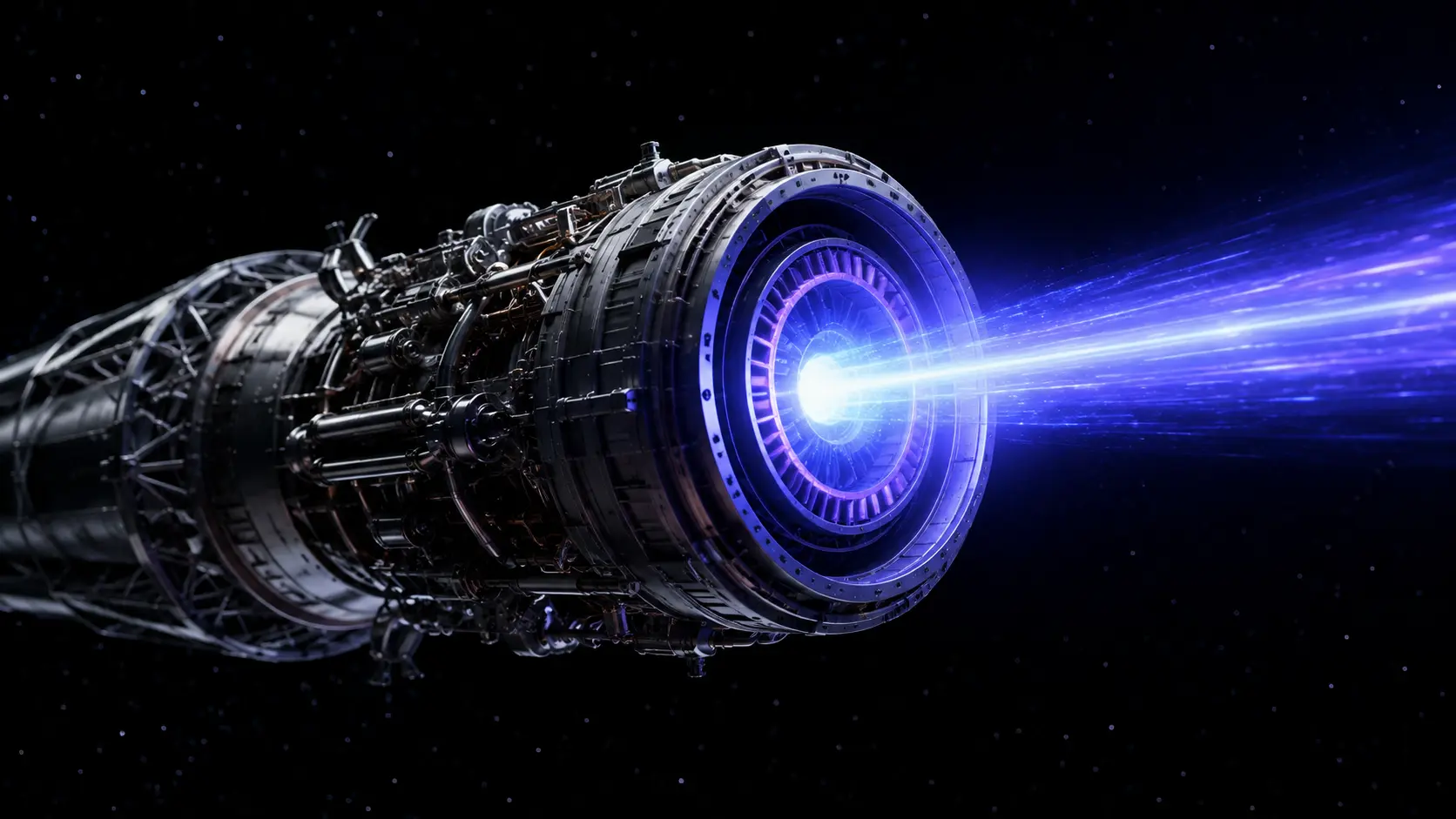
- Concept: Pumping cryogenic liquid hydrogen through a nuclear reactor core to generate extreme heat and thrust without requiring an oxidizer or chemical combustion.
- Why it matters: Chemical rockets have reached the absolute limits of their physical chemistry. Reaching Mars with human crews takes up to nine months using chemical fuel, exposing astronauts to lethal cosmic radiation. NTP cuts that transit time in half.
- Who uses it: NASA, the Defense Advanced Research Projects Agency (DARPA), and prime aerospace contractors like Lockheed Martin and BWXT.
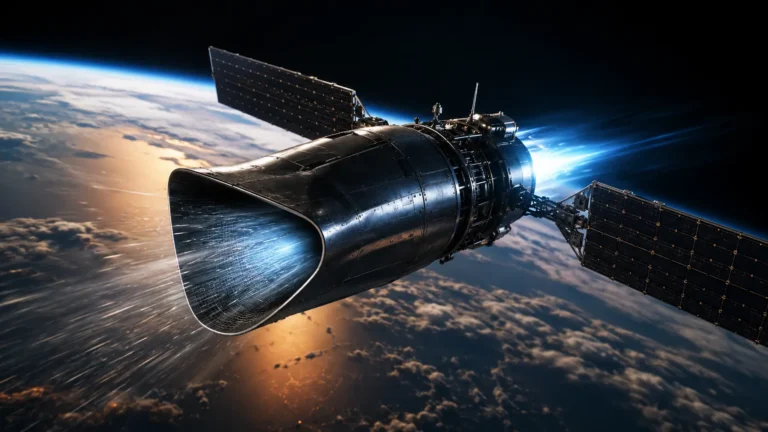
- Biggest takeaway: The strategic value of NTP is not just speed; it is maneuverability. Current satellites operate on ballistic “launch and drift” trajectories because they cannot carry enough chemical fuel to change course. NTP unlocks the ability to actively patrol, stop, and maneuver freely in the vast space between Earth and the Moon.
In Simple Words
A traditional chemical rocket works like a controlled explosion. You mix a fuel (like liquid hydrogen) with an oxidizer (like liquid oxygen), ignite them, and the resulting massive fire blasts out the back to push the rocket forward. This requires carrying millions of pounds of heavy, volatile liquid. Because the fuel is so heavy, the rocket burns almost all of it just getting into orbit, leaving very little energy to actually travel anywhere else.
A Nuclear Thermal Propulsion (NTP) rocket does not use fire.
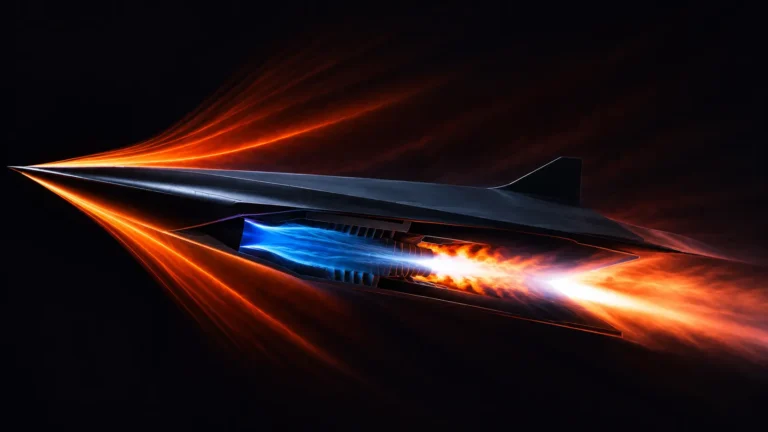
Instead of burning fuel, it uses a small, highly advanced nuclear reactor to create immense, clean heat. The rocket carries only one liquid: super-cold hydrogen. The hydrogen is pumped directly into the hot nuclear reactor. The intense heat causes the hydrogen gas to violently expand and shoot out of the rocket’s nozzle at blinding speeds.
Because hydrogen is the lightest element in the universe, it can be pushed out the back of the rocket much faster than the heavy exhaust gases created by a chemical explosion. This makes the nuclear engine twice as fuel-efficient. You can carry half the fuel to go the same distance, or use the same amount of fuel to travel twice as fast.
Why This Matters
Control of the “cislunar” domain—the vast area of space between Earth and the Moon—is the next major geopolitical theater.
Currently, if an adversarial satellite changes its orbit to spy on or threaten a U.S. national security satellite, the U.S. satellite struggles to evade it. Chemical thrusters run out of fuel after a few orbital changes. The military requires “Space Domain Awareness” and the ability to maneuver freely without constantly worrying about an empty fuel tank.
For deep space exploration, the stakes are biological. NASA intends to send humans to Mars by the late 2030s. A chemical rocket takes roughly seven to nine months to reach Mars. During that transit, astronauts are bombarded by deep-space galactic cosmic rays (GCRs) and solar radiation, drastically increasing their risk of cancer and neurological degradation. The only defense against this radiation is speed. By utilizing NTP to accelerate the spacecraft, transit times drop to as little as 45 days, mitigating the biological risks of deep space travel and ensuring the crew arrives physically capable of executing a planetary mission.
The Big Picture
The idea of a nuclear rocket is not new. During the Cold War, the U.S. government spent billions on Project NERVA (Nuclear Engine for Rocket Vehicle Application). In the 1960s, NERVA successfully built and fired multiple nuclear rocket engines in the Nevada desert.
The program was highly successful technically, but it was canceled in 1973 due to budget cuts, the end of the Apollo era, and growing public fear of nuclear technology.
The resurrection of NTP today is driven by materials science. The reactors designed in the 1960s used highly enriched, weapons-grade uranium (HEU), which is a massive geopolitical proliferation risk. Today, the aerospace industry is leveraging High-Assay Low-Enriched Uranium (HALEU) and advanced TRISO (TRi-structural ISOtropic) or cermet (ceramic-metal) fuels. These new materials allow the reactor to reach staggering temperatures without melting and without utilizing weapons-grade material, definitively transitioning NTP from a Cold War relic into a modern, deployable technology.
HOW NUCLEAR THERMAL PROPULSION WORKS
Extracting thrust from a nuclear reactor requires operating at the absolute extremes of thermodynamics and fluid mechanics.
1. The Fundamental Problem: The Rocket Equation
Space travel is dictated by the Tsiolkovsky rocket equation, which states that to carry more mass, you need more fuel, but adding more fuel adds more mass, requiring even more fuel. The ultimate metric of rocket efficiency is Specific Impulse (Isp)—measured in seconds, it defines how much thrust you get from a given amount of fuel. Chemical rockets hit a hard physical ceiling of around 450 seconds of Isp.
2. The Insufficiency of Chemical Combustion
Chemical rockets must carry an oxidizer (oxygen) to burn their fuel in the vacuum of space. Oxygen is extremely heavy. When hydrogen and oxygen burn, the exhaust is essentially superheated water vapor (H₂O). Because a water molecule is relatively heavy, it moves relatively slowly out of the nozzle. To increase Isp, you must eject the lightest possible particles at the highest possible velocity.
3. The Core Mechanism: Fission Heating
NTP deletes the heavy oxygen entirely. The engine consists of a compact nuclear fission core. A turbopump pulls cryogenic liquid hydrogen (LH₂) from a storage tank at -253 degrees Celsius (-423°F) and pumps it directly through microscopic cooling channels inside the uranium reactor core.
4. Technical Depth: HALEU and Thermal Extremes
The reactor core utilizes HALEU (enriched up to 19.75% U-235) to generate immense heat. In a fraction of a second, the liquid hydrogen absorbs this heat, instantly phase-changing into a highly pressurized gas approaching 2,700 degrees Celsius. Because pure hydrogen (H₂) is structurally the lightest molecule in the universe, this immense thermal energy accelerates the gas to phenomenal speeds. It exits the convergent-divergent nozzle at over 9,000 meters per second, generating an Isp of 900 seconds—exactly double the maximum efficiency of a chemical rocket.
5. Real-World Consequences: Materials and Embrittlement
The engineering bottleneck is the reactor core’s survival. Hot hydrogen is incredibly corrosive and causes “hydrogen embrittlement,” degrading the metallic structure of the engine. The fuel elements must withstand extreme thermal shock—going from absolute cryogenic zero to 2,700°C instantly—without fracturing, melting, or releasing radioactive fission products into the hydrogen exhaust stream. This requires the use of exotic refractory metals (like molybdenum or tungsten) and advanced ceramic-metallic matrices (cermets) that were un-manufacturable until the 2020s.
Real-World Applications
NTP is the foundational infrastructure for the “Space Economy.”
Agile Cislunar Defense: The Department of Defense cannot allow adversarial assets to dominate the space between Earth and the Moon. Satellites equipped with NTP can perform drastic orbital inclination changes. A military asset could intercept a foreign satellite in Geosynchronous Equatorial Orbit (GEO), inspect it, and rapidly maneuver back to a safe orbit—a physical impossibility for a chemical satellite.
Crewed Mars Missions: NASA’s architectural roadmap for Mars relies entirely on nuclear propulsion. An NTP “tug” vehicle would be assembled in Earth orbit. The crew module would dock with the tug, the reactor would ignite, and the crew would be aggressively accelerated toward Mars, vastly reducing required life-support supplies and cosmic radiation exposure.
Heavy Cargo Logistics: Establishing a permanent base on the Moon requires moving thousands of tons of steel, habitats, and rovers from Earth orbit to Lunar orbit. NTP operates as an ultra-efficient, reusable deep-space cargo truck. The nuclear tug can haul massive payloads to the Moon, leave them there, and use a fraction of its fuel to return to Earth orbit to pick up the next shipment.
Economic & Strategic Impact
The development of NTP introduces a lucrative new sector to the aerospace defense industrial base: Space Nuclear Infrastructure.
For decades, the space industry was dominated by launch providers (SpaceX, ULA) focused purely on getting objects off the ground. The advent of NTP shifts capital toward “in-space logistics.” Because NTP engines have very low thrust-to-weight ratios compared to chemical rockets, an NTP rocket cannot lift off from the Earth’s surface. It must be launched into orbit by a chemical rocket (like SpaceX’s Starship) while turned off, and only activated in the vacuum of space.
This creates a split supply chain. Companies like BWXT, X-energy, and General Atomics are securing massive government contracts to design the specialized micro-reactors, fundamentally merging the heavily regulated nuclear energy sector with the agile commercial space sector. For investors, the companies that successfully navigate both Department of Energy (DOE) nuclear regulations and NASA spaceflight standards will secure an impenetrable monopoly over the next generation of deep space propulsion.
Advantages
- Double the Efficiency: Achieves a Specific Impulse (Isp) of 900 seconds, cutting propellant mass requirements in half compared to the best chemical engines.
- Rapid Transit Times: Reduces Earth-to-Mars transit times from 7–9 months down to 45–90 days, safeguarding astronaut health.
- High Thrust and High Efficiency: Unlike Nuclear Electric Propulsion (NEP) which is efficient but incredibly weak, NTP provides thousands of pounds of immediate thrust, allowing for rapid, high-G orbital maneuvers.
- Launch Safety: The reactor is launched “cold.” There is highly radioactive fission occurring during launch, meaning if the chemical launch rocket explodes in the Earth’s atmosphere, it scatters relatively inert uranium, not highly radioactive waste.
Limitations
- Hydrogen Boil-Off: Liquid hydrogen must be kept at absolute cryogenic temperatures (-253°C). In the vacuum of space, the sun’s heat slowly boils the hydrogen away. Storing LH2 for months in a spacecraft without it evaporating before the engine is fired remains a massive cryogenic engineering challenge.
- Earth Launch Inability: NTP cannot generate enough thrust to overcome Earth’s gravity. It is strictly an “in-space” engine, requiring traditional chemical rockets to act as ferries.
- Testing Restrictions: Due to environmental treaties and radiation fears, engineers cannot conduct open-air test firings of nuclear rockets on Earth like they did in the 1960s. All testing must be done via complex computer simulations or expensive, specialized sub-surface containment facilities.
Common Misconceptions
Misconception: The rocket’s exhaust is highly radioactive.
Reality: The exhaust is simply hot, expanding hydrogen gas. Because the radioactive uranium is permanently locked inside the ceramic fuel elements in the core, the hydrogen passes over the fuel, absorbs the heat, and exits clean. It does not spew nuclear fallout into space.
Misconception: If the rocket crashes on launch, a nuclear explosion will happen.
Reality: A nuclear reactor cannot detonate like a nuclear bomb under any circumstances; the physics are completely different. Furthermore, the reactor is not turned “on” until it safely reaches deep orbit. If the launch vehicle explodes on the launchpad, the reactor core will simply fall into the ocean as a highly resilient, inert piece of metal.
Misconception: Nuclear Electric Propulsion (NEP) and Nuclear Thermal Propulsion (NTP) are the same thing.
Reality: They are entirely different. NTP uses a reactor to directly heat a gas and shoot it out the back (High Thrust / High Efficiency). NEP uses a reactor to generate electricity, which powers an ion thruster (Extremely Low Thrust / Extremely High Efficiency). NEP takes years to slowly accelerate, making it useless for agile military maneuvers but excellent for deep-space uncrewed probes.
What Most People Miss
The ultimate endgame of deep space propulsion is the Bimodal Nuclear Reactor.
Current designs require a nuclear reactor to generate thrust, but the spacecraft still needs solar panels to run its computers and life support systems. A Bimodal NTP system solves this by acting as a two-in-one machine. When the spacecraft needs to move, the reactor heats hydrogen for thrust. Once the spacecraft arrives at its destination, the reactor switches modes, routing its heat to a closed-loop turbine to generate megawatts of continuous electrical power for the crew habitat, radar systems, or directed-energy weapons, completely eliminating the need for fragile solar panels.
Comparison Table
| Feature | Chemical Propulsion (Liquid O2 / H2) | Nuclear Electric Propulsion (NEP / Ion) | Nuclear Thermal Propulsion (NTP) |
| Power Source | Chemical Combustion | Nuclear Reactor generating electricity | Nuclear Reactor directly heating gas |
| Propellant | Fuel + Oxidizer (Heavy) | Xenon or Argon gas | Pure Liquid Hydrogen (LH₂) |
| Specific Impulse (Isp) | ~450 seconds (Low) | ~3,000 to 10,000 seconds (Extreme) | ~900 seconds (High) |
| Thrust Level | Extreme (Can lift off Earth) | Microscopic (Cannot overcome gravity) | High (Fast in-space acceleration) |
| Mars Transit Time | 7 to 9 Months | Years (Slow acceleration) | 45 to 90 Days |
| Primary Use Case | Earth Launch, Short Orbit | Deep Space Uncrewed Probes | Crewed Deep Space, Agile Cislunar |
Case Study
Situation: The United States recognized that the cislunar domain was rapidly becoming contested. To maintain space superiority, the Department of Defense needed a spacecraft capable of massive, rapid orbital maneuvers without immediately depleting its fuel reserves.
Challenge: Re-starting a nuclear rocket program from scratch after 50 years of dormancy required overcoming immense regulatory hurdles, establishing a HALEU supply chain, and designing a reactor that could be tested safely without violating atmospheric nuclear treaties.
Solution (The DRACO Program): DARPA, in partnership with NASA, launched the Demonstration Rocket for Agile Cislunar Operations (DRACO) program. In 2023, they awarded the prime contract to Lockheed Martin (to build the spacecraft) and BWXT (to build the specialized HALEU fission reactor).
Outcome: DRACO is heavily fast-tracked, targeting an inaugural in-orbit demonstration by 2027. Rather than testing the nuclear engine on Earth (which carries immense regulatory baggage), the team will build the reactor, launch it “cold” into a safe orbit (>700 km), and turn it on for the first time in the vacuum of space.
Lessons Learned: The DRACO program proves that geopolitical urgency is the ultimate catalyst for technological deployment. By bypassing terrestrial testing and accepting the risk of an “in-orbit first light,” DARPA and NASA are successfully cutting decades of bureaucratic red tape, paving the way for the operational deployment of atomic spacecraft before the end of the 2020s.
Future Outlook
Next 12–24 Months
The aerospace industry will closely monitor the fabrication of the DRACO reactor by BWXT. Critical milestones include zero-power criticality testing on the ground to ensure the control drums function perfectly, and solving the cryogenic fluid management issues to ensure the liquid hydrogen does not boil off inside the Lockheed Martin spacecraft chassis before the targeted 2027 launch date.
Next 3–5 Years
The successful in-orbit demonstration of the DRACO program will permanently validate NTP. Once the 2027/2028 test proves that modern HALEU cermet cores do not melt or fracture under extreme thermal shock, the U.S. Space Force will rapidly issue acquisition contracts for operational, classified cislunar patrol vehicles. Concurrently, NASA will baseline NTP into its formal Mars architecture, abandoning legacy chemical transit plans.
Next 10 Years
NTP will commercialize. With the technological risk retired by the military, commercial space logistics companies will begin deploying nuclear tugs. These tugs will dock with commercial mining rigs, hauling massive payloads of extracted water-ice from the lunar South Pole to orbital fuel depots around Earth. The integration of bimodal capabilities will see these same nuclear engines serving as continuous power stations for early lunar habitats.
Most Likely Scenario
Chemical rockets will remain the undisputed champions of getting cargo from the Earth’s surface into Low Earth Orbit (LEO) due to their unmatched raw thrust. However, for any mission stretching beyond LEO—whether military interception, lunar logistics, or Martian colonization—Nuclear Thermal Propulsion will become the mandatory, baseline architecture, effectively splitting the space economy into two distinct technological eras defined by the gravity well.
Key Takeaways
- Nuclear Thermal Propulsion (NTP) uses a nuclear fission reactor to superheat liquid hydrogen, expanding it rapidly to generate thrust without chemical combustion.
- Because it uses pure, extremely light hydrogen, NTP achieves double the fuel efficiency (Specific Impulse) of the best chemical rockets.
- NTP slashes the travel time to Mars from nine months to a few weeks, critically reducing astronaut exposure to deep-space radiation.
- The military requires NTP for “agile cislunar operations”—the ability to rapidly maneuver and patrol the space between Earth and the Moon without running out of fuel.
- DARPA and NASA’s joint DRACO program (partnering with Lockheed Martin and BWXT) aims to launch and demonstrate the first modern nuclear rocket in space by 2027.
- NTP cannot launch from Earth due to its low thrust-to-weight ratio and safety protocols; it is strictly a deep-space engine launched “cold” atop standard chemical rockets.
Glossary
Bimodal NTP: A theoretical nuclear rocket design that can operate in two modes: producing thrust by heating hydrogen for movement, and running a closed-loop turbine to generate electricity when parked.
Cislunar Space: The volumetric region of space encompassing the Earth, the Moon, and the orbital environment between them.
Cryogenic Propellant: Gases like hydrogen or oxygen that have been chilled to extreme, ultra-low temperatures to maintain them in a liquid state for dense storage.
Demonstration Rocket for Agile Cislunar Operations (DRACO): A joint DARPA and NASA initiative aiming to demonstrate a working Nuclear Thermal Propulsion system in orbit by 2027.
High-Assay Low-Enriched Uranium (HALEU): Uranium enriched up to 19.75% U-235, providing the extreme energy density required for compact space reactors while remaining legally below the 20% weapons-grade threshold.
Specific Impulse (Isp): A measure of rocket engine efficiency. It represents the amount of thrust generated per unit of propellant consumed per second. Higher is better.
Tyranny of the Rocket Equation: The mathematical reality that moving heavy objects in space requires heavy fuel, which in turn requires more fuel to lift the fuel, resulting in exponentially massive rockets for deep space missions.
Frequently Asked Questions
Is an NTP rocket safe for astronauts?
Yes. While the reactor generates radiation, modern spacecraft are designed with a “shadow shield.” A thick barrier of dense material (and the massive liquid hydrogen tank itself) is placed directly between the reactor at the back of the ship and the crew module at the front, completely blocking the radiation from reaching the astronauts.
Why use hydrogen instead of water?
Rocket efficiency is tied to the weight of the exhaust particles. Water (H₂O) is heavy. Pure hydrogen (H₂) is the lightest molecule possible. Heating hydrogen makes it exit the nozzle at much higher velocities than water vapor, resulting in vastly higher thrust efficiency (Isp).
What happens if the reactor runs out of hydrogen?
The rocket stops moving. However, if it is a Bimodal system, the reactor can safely dial down its heat output and continue to generate electrical power for the spacecraft’s computers indefinitely, utilizing its internal coolant loop.
Are other countries building nuclear rockets?
Yes. China’s space agency has openly published roadmaps targeting nuclear thermal propulsion demonstrations in the 2030s for deep space exploration, and Russia continues to heavily fund nuclear-powered space technologies, making NTP a central pillar of the new space race.
Why was Project NERVA cancelled if it worked?
In the early 1970s, NASA’s budget was severely slashed post-Apollo. With no imminent plans to send humans to Mars, there was no mission that required a nuclear rocket. The program was deemed an expensive luxury and terminated by the Nixon administration.
Sources
- NASA: Nuclear Thermal Propulsion (NTP) Overview and Space Technology Mission Directorate (STMD) Updates
- DARPA: Demonstration Rocket for Agile Cislunar Operations (DRACO) Program
- Lockheed Martin: Building the Future of Space Nuclear Propulsion
- BWX Technologies, Inc.: Advanced Nuclear Reactor and HALEU Fuel Fabrication for Deep Space