Advertisement
)
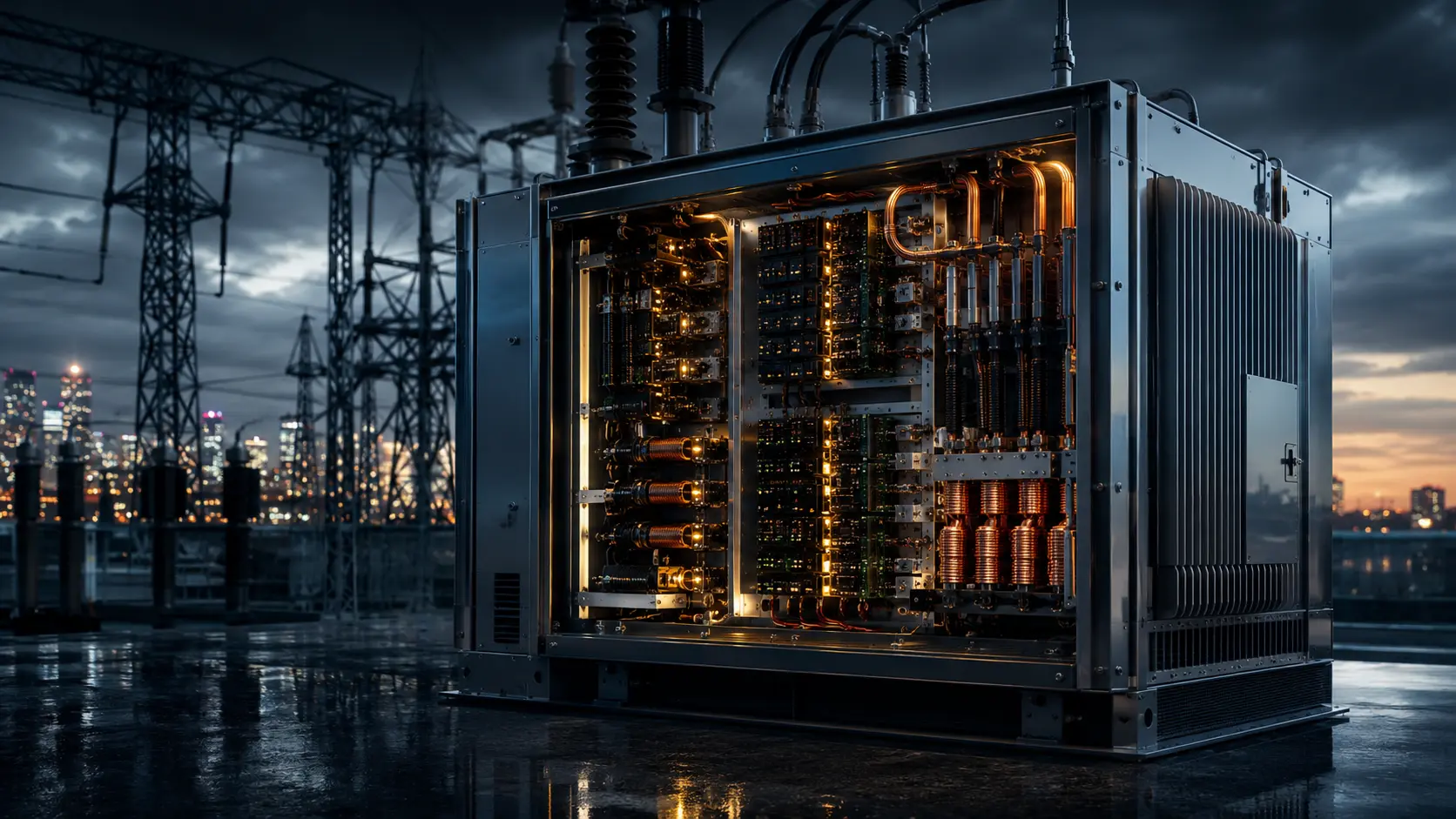

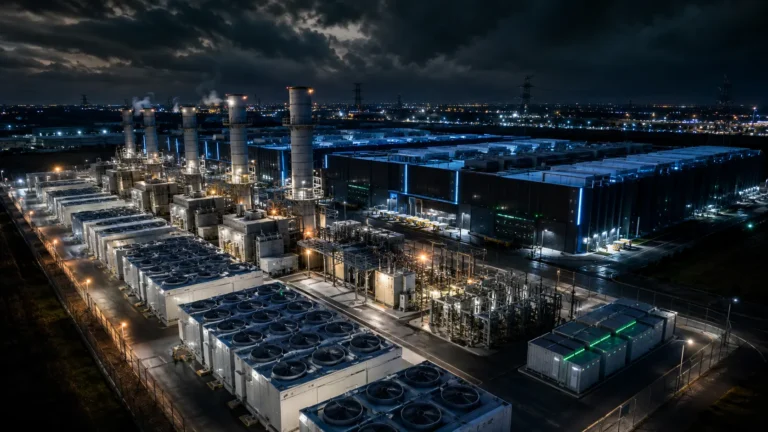
A single gigawatt-scale AI data center now consumes as much electricity as a small city, yet the grid feeding it relies on hardware invented in the 1880s. If you walk past a local substation, you will see massive steel tanks filled with thousands of pounds of copper wire and toxic cooling oil. These legacy transformers are “dumb” blocks of metal that passively push alternating current (AC) in one direction.
But the modern energy economy does not run on traditional AC. Artificial intelligence GPUs, mega-scale solar farms, and ultrafast electric vehicle (EV) chargers all operate natively on direct current (DC). Translating the grid’s high-voltage AC power into usable DC power currently requires warehouses full of heavy, inefficient conversion equipment that loses massive amounts of energy as heat.
To prevent the AI boom from overwhelming the aging power grid, engineers are executing a radical hardware transplant. They are replacing century-old iron and copper with advanced silicon carbide microchips. This breakthrough allows the grid to shrink building-sized substations into the size of a refrigerator, turning electricity from a physical, one-way current into a digitally routed network.
What are Solid-State Transformers (SSTs)?
Solid-State Transformers (SSTs) are advanced electrical devices that replace traditional copper coils and heavy iron cores with high-frequency semiconductor chips, primarily Silicon Carbide (SiC). They step down high-voltage grid electricity while simultaneously converting it to direct current (DC), enabling bidirectional power flow and digital control of the electrical grid.
At a Glance
- Concept: Utilizing high-frequency semiconductor switching to manipulate voltage and current, shrinking the physical size of a transformer by up to 90 percent while adding computational intelligence.
- Why it matters: AI data centers and 350kW EV fast chargers demand massive amounts of DC power. Legacy transformers only output AC, requiring secondary rectifiers that waste energy and floor space. SSTs output pure DC natively, solving the grid’s biggest bottleneck.
- Who uses it: Cloud hyperscalers (AWS, Microsoft, Google) redesigning their data center power architectures, utility companies managing renewable microgrids, and maritime/rail transport engineering divisions.
- Biggest takeaway: The power grid is transitioning from an analog system to a digital one. With an SST, a utility operator can actively throttle, reverse, or reroute power using software, transforming the grid into a smart, highly responsive network similar to the internet.
In Simple Words
A traditional power transformer works using brute physics. It takes high-voltage electricity from power lines and runs it through a massive coil of copper wire wrapped around a heavy iron core. This lowers the voltage so it is safe to enter a building. However, because the electricity on the grid oscillates very slowly (60 times a second, or 60 Hz), the iron core has to be physically massive to handle the magnetic field.
Solid-State Transformers (SSTs) change the frequency of the electricity to shrink the machine.
Instead of routing the power straight into a giant iron core, an SST runs the electricity through computer chips (semiconductors). These chips chop the electricity up and switch it on and off thousands of times a second (e.g., 20,000 Hz). Because the electricity is now moving at an incredibly high frequency, it only requires a microscopic magnetic core to step down the voltage.
The result is a device that is a fraction of the size and weight of a traditional metal transformer. Even better, because it is built using computer chips, it can instantly translate alternating current (AC) into direct current (DC), precisely giving modern technology like servers and batteries exactly the flavor of power they need.
Why This Matters
The real estate economics of artificial intelligence are colliding with the physics of power distribution.
In a modern hyperscale data center, every square foot occupied by electrical conversion equipment is a square foot that cannot hold revenue-generating AI servers. Traditional uninterruptible power supplies (UPS) and step-down transformers take up massive amounts of premium floor space.
By deploying SSTs directly at the medium-voltage grid connection, cloud architects can bypass the bulky legacy AC-to-DC conversion chains entirely. An SST can take 13.8 kV AC straight from the municipal utility pole and output a clean, perfect 800V DC bus directly to the server racks. This eliminates multiple stages of power loss, slashing cooling costs and allowing data centers to reclaim up to 20 percent of their physical footprint for additional computing power.
The Shift to Silicon Carbide (SiC) Power Electronics
The integration of Solid-State Transformers represents the second phase of the silicon revolution. The first phase digitized information; the second phase is digitizing physical power.
This revolution is made possible entirely by the maturation of Silicon Carbide (SiC). For decades, the concept of an SST existed in laboratories, but traditional silicon chips would instantly melt if connected to a 10,000-volt power line. SiC is a “wide-bandgap” material. It can survive extreme voltages, switch at blistering speeds, and operate at temperatures that would destroy standard silicon.
As the EV industry funded the mass production of SiC (driving down the cost of the wafers), the technology became cheap enough to apply to the macro power grid. We are now entering a decade where the entire architecture of power distribution—from the substation to the wall outlet—is being rewritten around the capabilities of this specific crystal.
How Solid-State Transformers Work
Replacing 10,000 pounds of metal with a rack of microchips requires manipulating the fundamental laws of electromagnetism. Here is the first-principles breakdown.
1. The Fundamental Problem: The 60 Hz Limitation
According to Faraday’s Law of Induction, the physical size of a transformer core is inversely proportional to the frequency of the AC power running through it. The global power grid operates at a very low frequency (50 or 60 Hz). To step down high voltage at this sluggish frequency without the magnetic field saturating and destroying the system, the iron core must be gigantic and immensely heavy.
2. The Insufficiency of Legacy AC/DC Conversion
Traditional transformers only step down AC to a lower voltage AC. But batteries, solar panels, and computer chips all run on DC. To bridge this gap, engineers historically placed large “rectifier” units next to the transformer to convert the AC to DC. This multi-step process (AC -> Lower AC -> DC) is bulky, expensive, and bleeds energy as heat at every step.
3. The Core Mechanism: High-Frequency Isolation
An SST utilizes a multi-stage architecture to solve this:
- Stage 1 (AC to DC): High-voltage grid AC enters the SST and is immediately converted into high-voltage DC using semiconductor switches.
- Stage 2 (The High-Frequency Inverter): The DC is chopped back into AC, but at an incredibly high frequency (e.g., 20,000 to 100,000 Hz) using Silicon Carbide MOSFETs.
- Stage 3 (The Micro-Transformer): This high-frequency AC is passed through a high-frequency transformer. Because the frequency is so high, this transformer core can be smaller than a shoebox instead of the size of a car, while safely isolating the dangerous grid voltage from the end-user.
- Stage 4 (Final Rectification): The stepped-down high-frequency AC is immediately converted back into perfect, low-voltage DC (or a customized AC wave) for the user.
4. Technical Depth: Silicon Carbide (SiC) vs. Silicon
Standard silicon transistors cannot handle Stage 2. If you try to switch 13,000 volts at 100,000 Hz using pure silicon, the electron leakage causes the chip to overheat and fail. Silicon Carbide (SiC) possesses a “wide bandgap,” requiring roughly 3x more energy for an electron to jump the gap. This means a SiC chip can withstand 10x the voltage, switch 10x faster, and operate at 200°C without failing, making it the undisputed backbone of medium-voltage power electronics.
5. Real-World Consequences: Bidirectional Flow
Because an SST is built from active semiconductor switches rather than passive copper wire, it is inherently bidirectional. A traditional grid pushes power one way (Utility -> House). An SST allows power to flow backward instantly. If a massive fleet of school buses is plugged into an SST-equipped depot, the utility operator can digitally command the SST to pull DC power out of the buses and push it back onto the AC grid during a peak summer heatwave (Vehicle-to-Grid, or V2G), fundamentally stabilizing the local neighborhood.
Real-World Applications of Solid-State Transformers
The theoretical benefits of SSTs are now translating into massive commercial and industrial deployments.
AI Data Center 800VDC Architectures: The most aggressive adopters of SST technology are hyperscale cloud providers. Traditional data centers experience up to a 10% power loss simply converting AC grid power down to the 48V or 12V DC required by the server motherboard. By using an SST at the building’s edge, operators can pipe high-efficiency 800V DC directly down the server aisles, only stepping it down at the rack level. This slashes cooling loads and drastically lowers the Power Usage Effectiveness (PUE) metric.
Megawatt EV Charging Hubs: Charging a commercial electric semi-truck requires over 1 Megawatt of instantaneous DC power. Doing this with traditional technology requires building a small, highly expensive municipal substation. SSTs allow fleet operators to tap directly into medium-voltage (MV) municipal power lines (e.g., 13.8kV) and convert it straight to the 1,000V DC required by the truck in a single, compact cabinet, bypassing years of utility permitting delays.
Naval and Rail Electrification: Weight and volume are the ultimate constraints on ships and trains. Modern electric locomotives use massive, heavy iron transformers just to pull power from overhead AC catenary lines. European rail consortia are actively replacing these with lightweight SSTs, shedding thousands of pounds of dead weight, allowing trains to accelerate faster and carry more freight.
Economic & Strategic Impact
The widespread adoption of SSTs threatens to disrupt a century-old utility manufacturing oligopoly.
For decades, the global supply of distribution transformers was dominated by heavy industrial conglomerates dealing in raw copper, grain-oriented electrical steel, and mineral oil. The SST pivots the supply chain entirely toward the semiconductor industry. Value is transferring from raw metal extraction to intellectual property and cleanroom wafer fabrication (companies like Wolfspeed, Infineon, and STMicroelectronics).
Furthermore, the intelligence of SSTs enables the true realization of “Microgrids as a Service.” When a neighborhood solar array produces excess power, an SST can instantly identify the load imbalance, stabilize the frequency, and digitally route the power to a neighboring factory without needing instructions from a centralized utility control room. This decentralizes power distribution, making the grid exponentially more resilient to cyberattacks and extreme weather events.
Advantages
- Size and Weight Reduction: By operating at high frequencies, the magnetic core volume is reduced by up to 90 percent compared to legacy low-frequency transformers.
- Power Quality and Fault Isolation: If lightning strikes the grid or a massive voltage sag occurs, the semiconductors inside the SST can instantly absorb and correct the anomaly, ensuring the downstream user (like a sensitive AI server) sees a perfect, uninterrupted waveform.
- Native DC Integration: Bypasses the need for heavy, external rectifiers, allowing seamless plug-and-play integration with solar panels, battery energy storage systems (BESS), and EV chargers.
- Eliminates Toxic Fluids: Legacy transformers rely on hundreds of gallons of highly flammable, toxic mineral oil for cooling. SSTs utilize standard industrial heat sinks and advanced dielectric potting, eliminating environmental spill hazards.
Limitations
- Astronomical Capital Expenditure (CapEx): As of 2026, a massive barrier remains cost. Medium-voltage SiC MOSFETs are incredibly expensive to manufacture. A commercial SST can cost three to five times as much upfront as a standard “dumb” copper transformer.
- Long-Term Reliability Validation: A dumb iron transformer can sit on a wooden utility pole in a rainstorm for 40 years without failing. While solid-state chips are reliable, the complex gate-drive circuitry and cooling fans required for an SST introduce multiple potential points of failure over a multi-decade municipal lifespan.
- Overload Fragility: Iron transformers are rugged; they can survive being pushed to 150% of their rated capacity for short bursts during a heatwave. Silicon Carbide chips are strictly bound by their thermal limits. If an SST exceeds its maximum rated current, the chips will fry in milliseconds unless aggressive active software protections intervene.
Common Misconceptions
Misconception: SSTs use no magnets or coils at all.
Reality: They are called “solid-state,” but they still contain a physical transformer (with magnetic cores and wire). The breakthrough is that the semiconductors change the frequency so high that the physical magnetic transformer can be microscopic compared to the legacy version.
Misconception: SSTs are batteries that store power.
Reality: An SST does not store energy. It is a router and translator for energy. It changes the voltage and the flavor (AC vs DC) of the power as it flows through, but it cannot power a building if the grid goes down (unless a separate battery is plugged into it).
Misconception: We will replace every transformer on every neighborhood street pole with an SST.
Reality: Because of the high CapEx cost, standard residential street poles will likely use cheap iron transformers for decades. SSTs are currently reserved for high-value, high-power commercial nodes: data centers, EV charging hubs, and industrial solar/wind interconnections where native DC and digital routing are financially necessary.
What Most People Miss
The strategic value of Reactive Power Compensation (Volt-VAR support).
In an AC power grid, large industrial motors and HVAC systems cause the voltage and current to fall out of sync with each other—a phenomenon known as “poor power factor” or reactive power drain. This forces the utility to generate more power than is actually being used, wasting massive amounts of money.
Normally, utilities must install massive, expensive capacitor banks at substations to fix this. An SST completely eliminates this need. Because an SST uses smart inverters, it can continuously analyze the waveform and inject “reactive power” back into the grid in real-time. By simply installing an SST to power a data center, that facility automatically acts as a grid-stabilizing asset, physically cleaning up the messy electricity for the entire surrounding industrial park.
Comparison Table
| Feature | Legacy Copper/Iron Transformer | Solid-State Transformer (SST) |
| Operating Frequency | 50 / 60 Hz (Grid default) | 10,000 to 100,000+ Hz |
| Primary Material | Thousands of lbs of Copper/Steel | Silicon Carbide (SiC) Semiconductors |
| Output Type | AC Only | AC or Pure DC (Programmable) |
| Bidirectional Control | No (Passive flow) | Yes (Active software routing) |
| Size & Weight | Massive (Requires heavy foundation) | Compact (Up to 90% lighter) |
| Upfront Cost (CapEx) | Low (Commodity pricing) | Very High (Premium technology) |
Case Study
Situation: A leading global logistics company sought to fully electrify its regional delivery fleet, requiring the installation of twenty 350kW ultra-fast DC chargers at a single depot.
Challenge: The total instantaneous power draw would reach 7 Megawatts. The local municipal utility informed the logistics company that stepping down the neighborhood’s 13.8kV AC power to support that load using traditional infrastructure would require building a custom, football-field-sized substation. The permitting, land acquisition, and construction timeline was estimated at 3 to 4 years.
Solution (The SST Microgrid): The company bypassed the legacy utility design by partnering with a specialized power electronics firm to deploy a Silicon Carbide-based Solid-State Transformer architecture. The SST tapped directly into the 13.8kV medium-voltage overhead line. Inside a single, shipping-container-sized enclosure, the SST stepped the voltage down and immediately converted it to a unified 1,000V DC microgrid bus.
Outcome: By utilizing the SST, the logistics company completely eliminated the need for massive AC switchgear, individual heavy rectifiers at each charging pedestal, and the sprawling substation footprint. The project was completed in 14 months, saving millions in real estate costs and allowing the EV fleet to deploy years ahead of the utility’s original schedule.
Lessons Learned: The case study proves that the bottleneck for fleet electrification is not the vehicles or the chargers, but the grid interconnection. By utilizing SSTs to pull native DC directly from medium-voltage lines, commercial operators can drastically shrink their infrastructural footprint, turning power distribution from a civil engineering problem into a modular hardware solution.
Future Outlook
Next 12–24 Months
The era of the Data Center DC Microgrid. As 100-kilowatt AI server racks (driven by next-generation NVIDIA and AMD silicon) become standard, hyperscalers will refuse to pay the energy penalty of legacy AC/DC conversions. We will see the first massive, ground-up data centers built exclusively around 800VDC internal grids powered by medium-voltage SSTs at the building edge. Simultaneously, the manufacturing yield of 3.3kV and 10kV SiC wafers will improve, slowly driving down the CapEx barrier for early adopters.
Next 3–5 Years
The integration of Solid-State Substations (SSS). By 2030, progressive utilities operating in renewable-heavy zones (like California and South Australia) will begin replacing end-of-life neighborhood substations with hybrid or fully solid-state equivalents. These smart substations will act as the “routers of the energy internet,” capable of instantly balancing the volatile, two-way power flow from thousands of residential rooftop solar panels and home EV batteries without suffering the voltage sags that plague traditional iron transformers.
Next 10 Years
The High-Voltage Direct Current (HVDC) Convergence. By the mid-2030s, the scaling of Ultra-High-Voltage SiC and Gallium Nitride (GaN) materials will allow SSTs to operate directly on massive transmission lines (100kV+). This will unlock the true potential of offshore wind and remote solar. Instead of building massive, billion-dollar converter stations to push renewable DC power onto the AC macro-grid, modular SST stacks will handle the conversion instantly at the source, drastically cheapening the transmission of green energy across continents.
Most Likely Scenario
SSTs will not immediately rip and replace the billions of traditional transformers hanging on wooden poles globally—they are simply too expensive for low-power residential streets. However, they will completely monopolize the “heavy edge” of the grid. Any facility that generates massive amounts of DC (solar farms) or consumes massive amounts of DC (AI data centers, EV hubs, battery storage) will mandate the use of SSTs, finalizing the bifurcation of the grid into a dumb, legacy residential network and a hyper-intelligent, digitally routed commercial energy web.
Key Takeaways
- Solid-State Transformers (SSTs) replace massive copper coils and iron cores with high-frequency semiconductor switches, primarily Silicon Carbide (SiC).
- By operating at extremely high frequencies (e.g., 20,000 Hz) instead of the grid’s standard 60 Hz, the physical magnetic core of the transformer can be shrunk by up to 90 percent.
- Legacy transformers only step down AC power. SSTs actively convert high-voltage AC directly into low-voltage DC, which is desperately needed by AI servers, EV chargers, and battery systems.
- SSTs act as the “routers of the energy internet.” Because they use smart software to switch power, they can instantly reverse the flow of electricity (Vehicle-to-Grid) and stabilize neighborhood voltage.
- The primary barrier to global adoption in 2026 is the high Capital Expenditure (CapEx) cost of manufacturing premium Silicon Carbide chips capable of surviving medium-voltage grid power.
- Hyperscale cloud providers are the most aggressive early adopters, using SSTs to build unified 800V DC microgrids inside data centers to reclaim floor space and slash cooling costs.
Glossary
Alternating Current (AC): The type of electrical current traditionally used on the macro power grid, which periodically reverses direction (usually 50 or 60 times a second).
Direct Current (DC): The type of electrical current that flows in only one direction. It is the native language of all computer chips, batteries, solar panels, and EV powertrains.
Faraday’s Law of Induction: The physical law dictating that the size of a transformer’s magnetic core must increase if the frequency of the electricity passing through it decreases.
Gallium Nitride (GaN) / Silicon Carbide (SiC): “Wide-bandgap” semiconductor materials that can handle massively higher voltages, temperatures, and switching frequencies than standard silicon chips.
Inverter: An electrical device that converts Direct Current (DC) into Alternating Current (AC).
Rectifier: An electrical device that converts Alternating Current (AC) into Direct Current (DC).
Solid-State: Electronic equipment using semiconductor devices (like computer chips) with no moving parts, as opposed to older mechanical, vacuum tube, or heavy electromechanical systems.
Frequently Asked Questions
Are Solid-State Transformers already being used?
Yes, but primarily in specialized commercial applications. They are heavily utilized in modern electric trains (to save weight) and are actively being deployed in cutting-edge AI data centers and commercial EV fast-charging hubs. They are not yet used on standard residential street poles due to cost.
How do SSTs help the environment?
First, they eliminate the need for hundreds of gallons of toxic, highly flammable mineral oil used to cool traditional transformers. Second, by eliminating the need for bulky, separate AC-to-DC converters, they save massive amounts of electricity that is usually lost as waste heat during power translation.
Can an SST protect my equipment from a power surge?
Yes. A traditional transformer will simply pass a massive voltage spike (like a lightning strike on the grid) down the line, potentially frying connected equipment. An SST’s computer chips can detect the surge in milliseconds and instantly disconnect or absorb the spike, outputting a perfectly clean power wave to the user.
If they are so much smaller, why don’t utilities use them everywhere?
Cost and proven longevity. A dumb iron transformer is cheap to build and will reliably sit outside in the rain for 40 years. An SST is highly complex, requires expensive silicon carbide chips, and utilizes cooling fans and software that require more active maintenance over a multi-decade lifespan.
What is the difference between an SST and a normal power adapter?
Conceptually, they do the same thing: step down voltage and convert AC to DC. However, your laptop charger handles 120 volts and a tiny fraction of an amp. An SST is engineered to handle 13,800+ volts and Megawatts of power—enough to run a small factory or charge a fleet of semi-trucks—while meeting the strict safety isolation standards of the municipal power grid.
Sources
[1] U.S. Department of Energy (DOE) / ARPA-E: Solid-State Power Substation (SSPS) Program Overview
[2] IEEE Power Electronics Magazine: The Role of Silicon Carbide in Medium-Voltage Solid-State Transformers (2025)
[3] National Renewable Energy Laboratory (NBER): Impact of Solid-State Transformers on DC Microgrid Efficiency in Data Centers
[4] Hitachi Energy: Next-Generation Traction Transformers for Rail Electrification
[5] Yole Intelligence: Power SiC Market Focus: High-Voltage Applications 2026-2030