Advertisement
)

AT A GLANCE
- Concept: Low Earth Orbit (LEO): An altitude of 2,000 kilometers or less, allowing satellites to communicate with ground antennas with virtually zero latency.
- Concept: ITU Filing: The International Telecommunication Union process where nations legally claim orbital paths and radio frequencies.
- Concept: Optical Inter-Satellite Links: Lasers that beam data directly between satellites in space, bypassing the need to route traffic through vulnerable ground stations.
- Concept: Non-Geostationary Satellite Orbit (NGSO): A regulatory classification for moving satellite networks that require complex routing logic to maintain continuous coverage.
IN SIMPLE WORDS
If a hostile submarine physically cuts the fiber-optic cables resting on the ocean floor, an entire continent can lose access to the global internet. The digital economy instantly collapses.
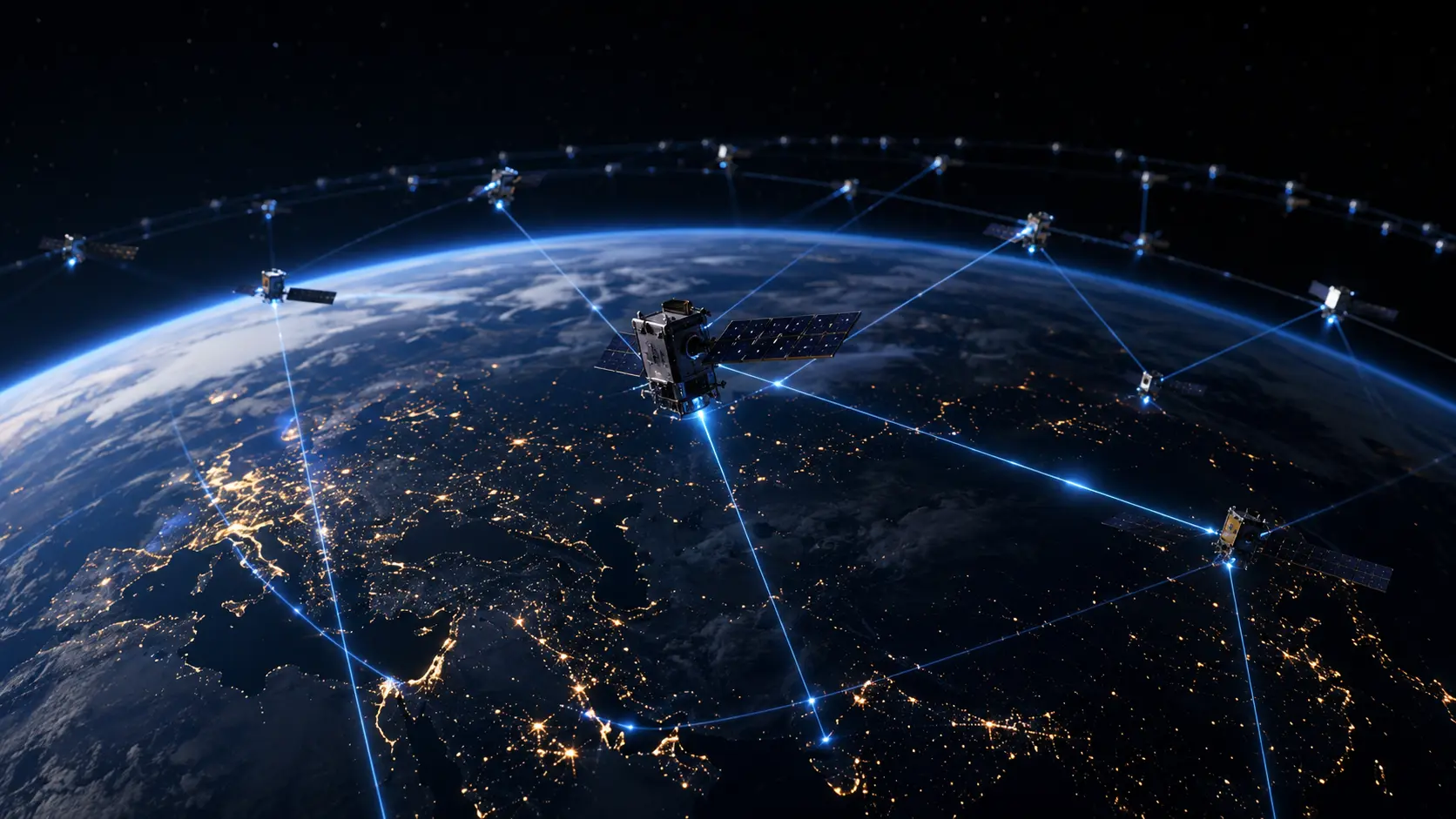
To fix this vulnerability, major nations are moving their internet infrastructure into space. Instead of relying on a few massive, stationary satellites, they are launching swarms containing thousands of small satellites that circle the Earth just above the atmosphere.
Because they fly so low, the internet speeds rival traditional fiber optics. If one satellite breaks or is shot down, the network simply routes the signal to the next one in the swarm. This creates a highly resilient, sovereign internet canopy. Whoever controls these orbital networks controls the flow of global information, turning the vacuum of space into the most critical geopolitical real estate of the 21st century.
HOW IT WORKS
A sovereign mega-constellation functions as a decentralized, orbiting data center. It relies on Non-Geostationary Satellite Orbit (NGSO) architecture. Because Low Earth Orbit (LEO) satellites move at roughly 17,000 miles per hour, they only remain visible to a user on the ground for a few minutes before disappearing over the horizon.
To provide continuous, uninterrupted service, a constellation requires thousands of satellites arranged in perfectly spaced orbital planes. Before a single rocket launches, a nation must secure legal permission to occupy these specific spatial geometries. They submit highly complex frequency filings to the International Telecommunication Union (ITU) in Geneva, which regulates global radio spectrum allocation.
The ITU operates on a strict “first-come, first-served” basis. Once a nation successfully files a mega-constellation, it legally reserves the exclusive right to broadcast on those specific radio frequencies across a massive orbital shell. Latecomers are legally forced to engineer their satellites to avoid interfering with the established priority networks.
Once deployed, the physical architecture relies on optical inter-satellite links (OISL). First-generation LEO networks acted simply as bent pipes—a satellite received a signal from a user and immediately beamed it down to a nearby ground station connected to the local terrestrial grid.
Modern sovereign networks use space-grade lasers to pass data directly between satellites. A user in London can send a secure message that bounces across a chain of ten satellites before beaming down directly to a terminal in Tokyo. The data never touches a third-party ground station or an underwater cable, guaranteeing absolute encryption and national data sovereignty.
REAL WORLD EXAMPLE
China’s “Guowang” (National Network) project exemplifies the sovereign mega-constellation race. Recognizing the strategic dominance of Western networks like SpaceX’s Starlink, the Chinese government consolidated its aerospace sector to construct its own 13,000-satellite swarm.
Beijing aggressively filed its orbital and spectrum claims with the ITU years before they had the physical rockets ready to launch them. By securing the prime Ku and Ka-band frequencies at low altitudes, China established a formidable regulatory wall. The Guowang constellation operates entirely independently of Western technology, providing the People’s Liberation Army and allied nations with a highly resilient, closed-loop communications infrastructure.
WHY IT MATTERS NOW
The geopolitical gravity of the internet has physically shifted from the ocean floor to the upper atmosphere. Historically, nations monitored and censored internet traffic where subsea cables physically emerged from the ocean onto their sovereign shores.
Mega-constellations bypass terrestrial borders entirely. A satellite network can beam uncensored information directly to a portable dish located deep inside an authoritarian regime. Governments can no longer sever digital access simply by flipping a switch at a national telecom utility.
This creates a brutal “use it or lose it” race for orbital real estate. The physical volume of Low Earth Orbit is finite. There are only so many satellites that can safely occupy an altitude of 500 kilometers before the risk of physical collision and radio frequency interference becomes mathematically unmanageable.
Nations that fail to deploy their own mega-constellations by the end of the decade will find the best orbital slots already occupied. They will be forced to rely on foreign-owned networks for their military and civilian communications, effectively surrendering their digital independence to rival superpowers.
COMMON MISCONCEPTIONS
- “Satellites are slow and have terrible lag.” Legacy geostationary satellites parked 22,000 miles away suffered from severe latency. Modern LEO satellites orbit just 300 miles above the surface, offering connection speeds and ping times that rival physical fiber-optic cables.
- “Anyone can launch a satellite.” Launching is heavily regulated. You cannot legally broadcast a radio signal from space without securing complex, multi-year approvals from the International Telecommunication Union to ensure you do not jam existing networks.
- “The satellites stay up there forever.” LEO satellites operate in the upper fringes of the Earth’s atmosphere. They experience microscopic atmospheric drag. If a satellite loses power, this drag naturally pulls it down, burning it up in the atmosphere within five years to prevent permanent space junk.
WHAT MOST PEOPLE MISS
Aerospace commentators obsess over the size and reusability of the rockets launching these satellites, but they entirely overlook the massive manufacturing bottleneck on the ground.
Building 10,000 satellites requires an industrial paradigm that the aerospace sector has never previously achieved. Historically, satellites were bespoke, hand-built machines that took years to construct in highly sterile cleanrooms. Sustaining a mega-constellation requires mass-producing satellites on a Detroit-style automotive assembly line, stamping out three to five highly complex spacecraft every single day. The true victor of the space race is not the nation with the biggest rocket, but the nation with the most ruthless, automated factory floor.
THE ECONOMIC AND STRATEGIC IMPACT
The primary financial beneficiaries are advanced optical hardware manufacturers. The laser communication terminals required to execute inter-satellite links across thousands of miles of moving vacuum represent a highly specialized, multi-billion dollar hardware market.
Strategically, the deployment of sovereign mega-constellations creates an unbreachable military communication architecture. During a major kinetic conflict, traditional terrestrial cell towers and underground fiber lines are immediately targeted and destroyed. A LEO swarm provides a distributed, highly redundant backup that allows a nation’s military to maintain global command and control even if their homeland infrastructure is entirely leveled.
This dynamic economically isolates nations without heavy launch capabilities. Developing countries are actively courted by superpowers offering heavily subsidized access to their sovereign LEO networks. This digital diplomacy binds emerging markets into the technological ecosystem of the providing superpower, establishing a new form of digital colonialism.
THE TRAJECTORY
Next 12–36 Months: The acceleration of direct-to-cell capabilities. Sovereign constellations will deploy massive, unfurling phased array antennas in space that can connect directly to unmodified, standard smartphones. This will eliminate dead zones permanently, merging terrestrial cellular networks directly with orbital infrastructure.
Next Five Years: The escalation of the Kessler Syndrome threshold. As the number of active satellites surpasses 50,000, minor debris-generating events will trigger automated, cascade-collision avoidance maneuvers across multiple networks. Space traffic control will shift from human operators to autonomous, AI-driven routing systems.
Next Ten Years: The weaponization of orbital proximity operations. Superpowers will launch specialized “inspector” satellites designed to maneuver dangerously close to a rival’s mega-constellation. These stealth assets will actively monitor optical laser links and physically jam specific nodes during localized geopolitical crises.
What Could Go Wrong: A catastrophic orbital slot dispute resulting in kinetic interference. If a nation feels the ITU process was manipulated to block its access to space, it may intentionally launch a constellation that blatantly broadcasts on a rival’s frequency. This severe signal jamming could trigger retaliatory physical strikes against the satellites, instantly escalating into an armed conflict in low Earth orbit.
Most Likely Outcome: Low Earth Orbit will be fully partitioned into competing, politically segregated sovereign shells. The global internet will fracture into parallel, space-based intranets, strictly divided along geopolitical alliances to ensure absolute data sovereignty.
KEY TERMS
- Mega-Constellation: A massive network composed of hundreds or thousands of individual satellites working together to provide continuous global coverage.
- Low Earth Orbit (LEO): An orbit relatively close to Earth’s surface (normally at an altitude of less than 2,000 km), allowing for rapid data transmission.
- Non-Geostationary Satellite Orbit (NGSO): A classification for satellites that move relative to the Earth’s surface, requiring complex tracking antennas on the ground to maintain a connection.
- International Telecommunication Union (ITU): The United Nations agency responsible for managing the global radio-frequency spectrum and satellite orbit allocations.
- Optical Inter-Satellite Link (OISL): The use of highly focused lasers to transmit data directly between moving satellites in the vacuum of space.
- Phased Array Antenna: A flat, solid-state antenna that steers radio beams electronically without physically moving, essential for tracking fast-moving LEO satellites.
BEGINNER FAQ
What is a mega-constellation? It is a massive fleet of thousands of small satellites working together to blanket the entire Earth with high-speed internet access.
Why are countries building their own? To protect their data. If a country relies on underwater cables or another nation’s satellites, their internet can be spied on or shut off. A sovereign network guarantees their communications can never be severed.
How is this different from older satellite TV? Old satellites were massive, very expensive, and parked 22,000 miles away, causing a huge delay in the signal. These new satellites are small, cheap, and orbit very close to Earth, providing speeds fast enough for video calls and gaming.
How do the satellites talk to each other? They use incredibly precise lasers. They shoot invisible beams of light across the vacuum of space to bounce data from one satellite to the next until it reaches its destination.
Who decides where the satellites can go? A United Nations group called the International Telecommunication Union (ITU). Countries must file highly complex paperwork years in advance to claim a specific altitude and radio frequency.
Is space getting too crowded? Yes. With multiple countries launching thousands of satellites, the risk of two satellites crashing into each other is rising rapidly, requiring advanced computer algorithms to steer them out of the way.
What happens if a satellite breaks? Because they orbit so low, gravity slowly pulls them down. If they break and lose propulsion, they will naturally fall back to Earth and burn up completely in the atmosphere within a few years.
Will this replace my local cell tower? Eventually, yes. Companies and governments are currently testing satellites with massive antennas that can send a signal directly to the standard smartphone already sitting in your pocket.
SOURCES
- Center for Strategic and International Studies (CSIS) — Space Security and the Geopolitics of Sovereign Mega-Constellations
- International Telecommunication Union (ITU) — NGSO Frequency Allocation and Regulatory Frameworks
- Royal United Services Institute (RUSI) — The Military Applications of Low Earth Orbit Communications
- Institute of Electrical and Electronics Engineers (IEEE) — Optical Inter-Satellite Links and LEO Network Routing Algorithms