Advertisement
)

AT A GLANCE
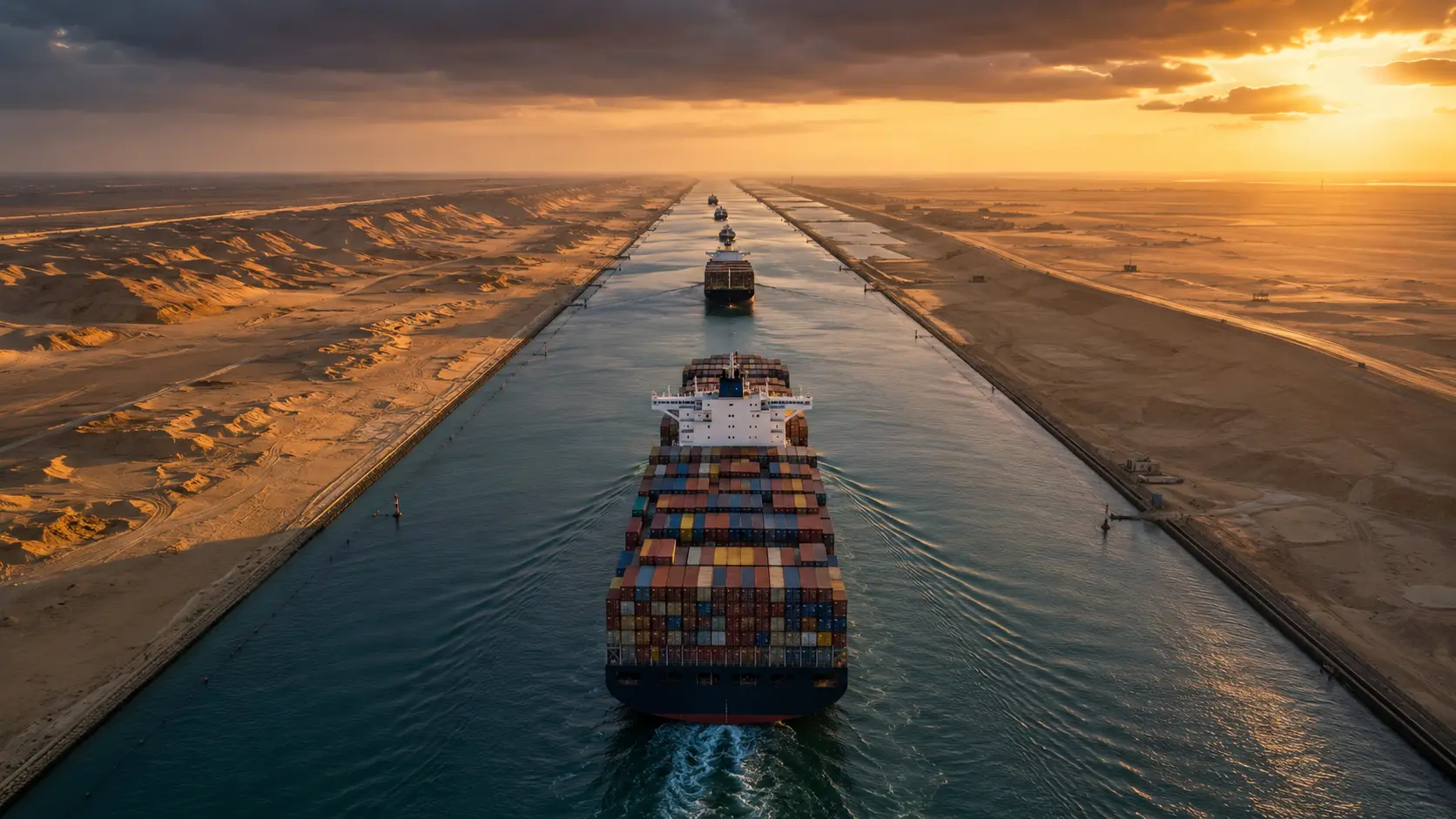
- Concept: Convoy Staging: Ships queue in algorithmic blocks to maximize throughput in a single-lane channel.
- Concept: The Bank Effect: Displaced water creates asymmetrical low pressure, physically sucking massive ships into the sand.
- Concept: Tidal Hydrodynamics: Navigators must mathematically offset opposing tidal currents that alter the steering speed.
- Concept: Insurance Contagion: A single navigational error paralyzes cargo, structurally spiking global maritime insurance premiums.
HOW IT WORKS
The Suez Canal is not open water; it is a rigid hydrodynamic trench. Moving a 400-meter, 200,000-ton container ship through this channel requires displacing massive volumes of liquid. As the ship’s bow pushes water forward, that water must rush backward along the hull to fill the void left by the stern.
In the open ocean, this displacement dissipates infinitely. In a confined canal, the water accelerates rapidly between the steel hull and the sloped sandbanks. According to Bernoulli’s principle, this localized fluid acceleration causes a severe, immediate drop in static water pressure.
If the ship drifts slightly off the exact centerline, the water on the narrower side accelerates faster. This creates asymmetric low pressure, physically sucking the stern of the vessel toward the nearest bank. Pilots must continuously apply counter-rudder to fight this invisible hydraulic vacuum, known as the bank effect.
To manage this extreme physical risk, the Suez Canal Authority operates a strict algorithmic convoy system. Ships assemble in holding lakes at either end of the canal before proceeding sequentially. Scheduling algorithms calculate the exact sequence and spacing of the convoy based on each vessel’s draft, gross tonnage, and the specific tidal flow constraints of the hour.
A heavier ship requires a significantly larger spatial buffer because it displaces more water and generates a stronger bank effect. The convoy moves at a strictly regulated 11 to 16 kilometers per hour. Moving too slowly destroys rudder authority, while moving too quickly amplifies the suction forces beyond the mechanical limits of the ship’s steering gear.
WHY IT MATTERS NOW
Roughly twelve percent of all global trade physically passes through this specific 120-mile corridor. This encompasses massive flows of Middle Eastern crude oil heading to Europe and Asian manufactured goods destined for Western markets. The global economy operates on a highly optimized, just-in-time delivery model that assumes this artery never clogs.
When a vessel experiences a mechanical failure or severe crosswind and succumbs to the bank effect, the entire system halts immediately. The 2021 grounding of the Ever Given proved that a single navigational error can physically block ten billion dollars of daily global trade. This absolute geographic fragility defines modern supply chain risk.
The financial consequences of a blockage trigger instant contagion across global capital markets. If ships are forced to abandon the convoy line and reroute around the Cape of Good Hope, they add two weeks of transit time. This effectively removes available vessels from the global fleet, artificially constricting global shipping capacity.
This sudden drop in available capacity instantly spikes spot freight rates worldwide. Manufacturers who rely on precise component deliveries are forced into bidding wars to secure space on the remaining active ships. The cost of moving a single shipping container can triple in a matter of days, injecting structural inflation directly into the global macro economy.
The maritime insurance industry explicitly prices this hydraulic risk. Reinsurance syndicates monitor convoy spacing and canal dredging operations continuously to model the probability of a multi-ship collision. A single major grounding event forces underwriters to recalculate this probability, permanently raising the baseline cargo insurance premiums for every shipping conglomerate on Earth.
WHAT MOST PEOPLE MISS
Media coverage blames canal blockages on high winds, poor visibility, or simple human error. They completely miss the mathematical reality of ship scaling versus infrastructure inertia. Shipping companies have aggressively built ultra-large container vessels (ULCVs) to maximize economies of scale, pushing the physical dimensions of these ships exactly to the maximum operational limits of the canal’s geometry.
The margin for error has mathematically collapsed to zero. A modern 24,000-TEU ship occupies so much physical volume within the canal profile that the displaced water has barely any room to flow backward. This extreme blockage factor exponentially amplifies the bank effect.
Minor steering deviations turn into unrecoverable physical groundings before a human pilot can mechanically turn the wheel. The kinetic energy of a 200,000-ton vessel in motion vastly exceeds the corrective force of its own rudder under low-speed, high-suction conditions.
THE TRAJECTORY
Next 12–36 Months: The Suez Canal Authority will aggressively expand the parallel, two-lane sections of the waterway. This dredging will allow uninterrupted two-way traffic, eliminating the need for holding lakes and reducing the catastrophic bottleneck risk of a single-point blockage.
Next Five Years: Pilots will transition from visual and radar-based navigation to predictive algorithmic steering. Shipborne sensors will read real-time hydrodynamic pressure differentials along the hull, automatically feeding micro-adjustments directly to the ship’s thrusters to counter the bank effect autonomously.
Next Ten Years: The physical limit of canal expansion will cap the size of global shipping assets. Naval architects will stop designing wider ships, as the physics of canal hydrodynamics and the staggering cost of insurance premiums will mathematically destroy the economies of scale for any vessel exceeding 25,000 TEUs.
What Could Go Wrong: A massive container ship suffers a catastrophic engine blackout during a high-tide transit. Without propulsion to maintain rudder authority, the bank effect instantly wedges the ship diagonally into the rockbed, requiring weeks of heavy salvage operations and severely fracturing European energy security.
Most Likely Outcome: The Suez Canal will remain the absolute chokepoint of global maritime trade. Shipping conglomerates will be forced to internalize the rising costs of transit tolls and insurance, passing this structural geographic premium directly into the baseline cost of global consumer goods.
KEY TERMS
- Bank Effect: A hydrodynamic phenomenon where asymmetric water pressure in a narrow channel physically sucks the stern of a ship toward the nearest shallow bank.
- Blockage Factor: The mathematical ratio between the cross-sectional area of a ship’s underwater hull and the cross-sectional area of the canal it is transiting.
- Bernoulli’s Principle: A fluid dynamics law stating that an increase in the speed of a fluid occurs simultaneously with a decrease in the fluid’s static pressure.
- Rudder Authority: The degree of physical control a ship’s steering mechanism possesses, which drops significantly if the ship moves too slowly relative to the surrounding water.
- Reinsurance: The financial practice where primary insurance companies transfer portions of their own risk portfolios to other parties to absorb systemic catastrophic losses.
SOURCES
- Suez Canal Authority — Rules of Navigation and Convoy Spacing Regulations
- International Maritime Organization (IMO) — Hydrodynamic Interactions and Ship Handling in Confined Waters
- Journal of Marine Science and Technology — Mathematical Modeling of the Bank Effect on Ultra-Large Container Ships
- Lloyd’s Register — Maritime Risk Assessment and Global Supply Chain Insurance Metrics