Advertisement
)

AT A GLANCE
- Concept: The Trust Deficit: A manufacturer in China will not ship steel without being paid, and a buyer in Germany will not pay before the steel arrives.
- Concept: Bank Intermediation: A Letter of Credit resolves this standoff by having the buyer’s bank legally assume the risk of non-payment.
- Concept: Documentary Compliance: The seller receives the cash only after presenting exact, mathematically precise shipping documents to their local bank.
- Concept: The MT700 Protocol: The specific SWIFT message type that transmits this highly structured, legally binding guarantee across international borders in seconds.
HOW THE SWIFT MT700 WORKS
International trade operates on an inherent trust deficit. If an American retailer orders $50 million of electronics from a Taiwanese factory, neither party trusts the other. The factory demands cash before loading the cargo ship, fearing the retailer will default. The retailer refuses to pay upfront, fearing the factory will ship defective goods or simply steal the money.
To break this deadlock, they utilize a Letter of Credit (LC), governed by the strict legal framework of the International Chamber of Commerce (specifically the UCP 600 rules). The American retailer goes to their local bank (the Issuing Bank) and requests an LC in favor of the Taiwanese factory (the Beneficiary).
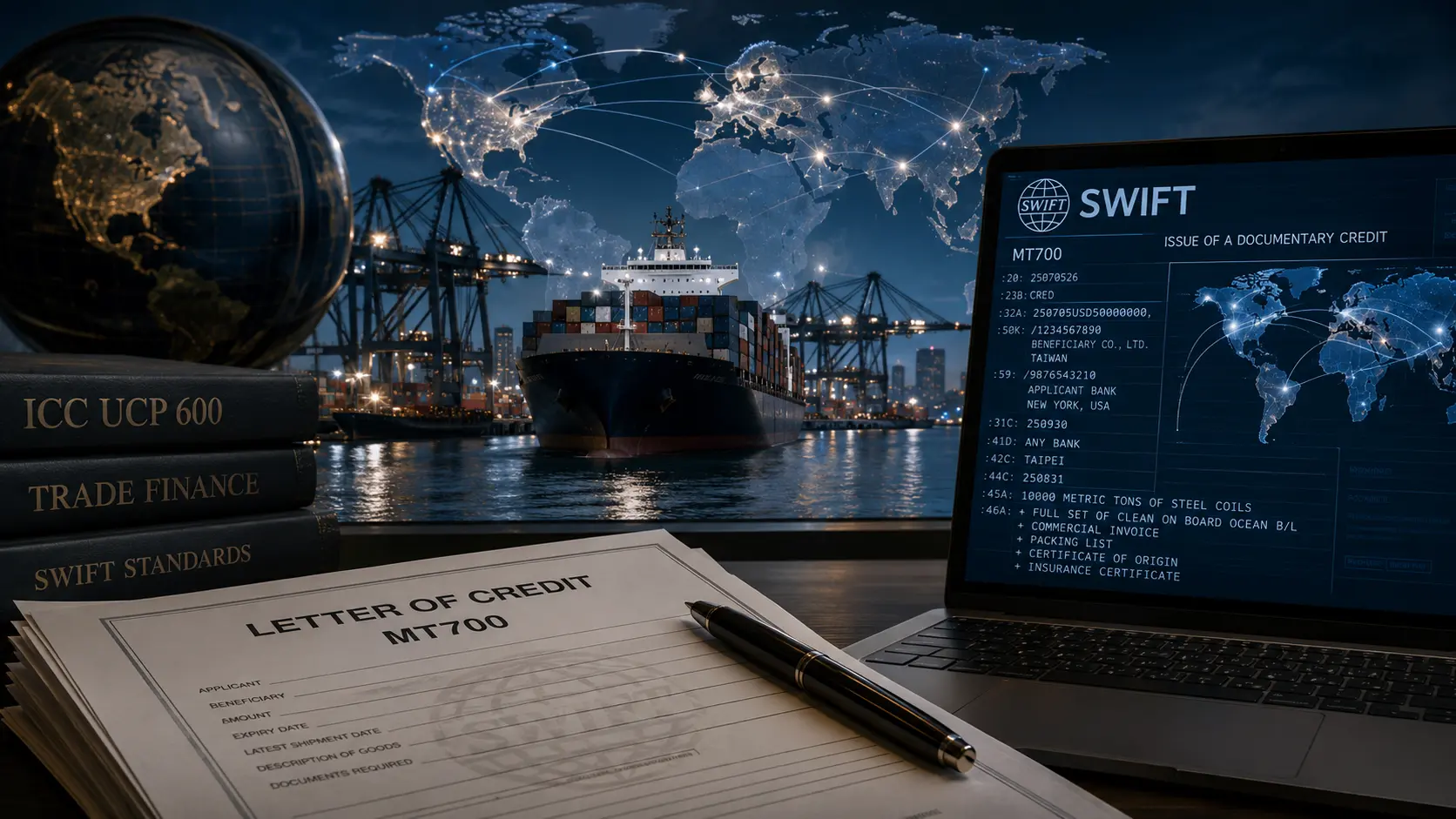
The Issuing Bank does not send cash. Instead, it generates a highly structured electronic message known as a SWIFT MT700. The Society for Worldwide Interbank Financial Telecommunication (SWIFT) network is an encrypted messaging system linking 11,000 global financial institutions. The MT700 is the specific format used exclusively to issue a documentary credit.
This message contains rigid alphanumeric fields detailing the exact conditions of the trade. Field 45A describes the goods. Field 44C dictates the latest allowable shipment date. Most importantly, Field 46A lists the exact documents the factory must produce—such as a clean Bill of Lading, a commercial invoice, and a customs certificate—to prove they actually loaded the correct cargo onto the ship.
The Issuing Bank transmits the MT700 to a partner bank in Taiwan (the Advising Bank). The Advising Bank notifies the factory that the American bank has irrevocably guaranteed the funds. The factory manufactures and ships the goods. They take the physical Bill of Lading provided by the ocean carrier and present it to the Taiwanese bank. If the documents perfectly match the requirements hardcoded in the MT700 message, the banking network executes the payment, completely neutralizing the counterparty risk for both the buyer and the seller.
WHY IT MATTERS NOW
The SWIFT MT700 dictates the physical velocity of the global supply chain. Roughly 15% of all global trade—representing trillions of dollars in physical commodities, manufactured goods, and raw materials—is directly financed and underwritten by Letters of Credit.
During periods of severe macroeconomic stress or geopolitical instability, the use of LCs skyrockets. When global interest rates rise, corporate bankruptcies surge, and the baseline trust between international corporations evaporates. Without the MT700 protocol providing a mathematical, bank-backed guarantee of payment, multinational corporations would instantly refuse to load physical cargo onto ocean freighters.
This architecture also creates a massive, high-margin revenue stream for global tier-one banks. Banks charge a percentage fee based on the total value of the MT700. Because the bank is essentially renting out its AAA credit rating, it executes strict due diligence on the buyer before issuing the message.
Consequently, the MT700 acts as a highly sensitive geopolitical choke point. When Western governments implement economic sanctions against a nation, they do not just freeze bank accounts; they legally prohibit Western banks from issuing or receiving MT700 messages involving that nation’s corporations. By severing access to documentary trade finance, regulators instantly paralyze a targeted country’s ability to import basic industrial machinery or export physical commodities.
WHAT MOST PEOPLE MISS
Mainstream coverage treats SWIFT as a payment system. They completely miss the reality that SWIFT does not move money; it only moves information. The MT700 is purely a legal contract transmitted electronically.
Furthermore, the legal doctrine governing the MT700 is the “Principle of Strict Compliance.” Banks deal exclusively in documents, not in physical goods. If the MT700 requires a Bill of Lading stating “10,000 Metric Tons of Steel,” and the seller submits a document stating “10,000 MT of Steel,” the bank will instantly reject the payment due to a typographical discrepancy. The bank has zero obligation to verify if the actual steel is sitting on the ship; it only verifies if the letters on the paper perfectly match the letters in the SWIFT message.
THE TRAJECTORY
Next 12–36 Months: The SWIFT network is currently executing a massive global migration from the legacy MT (Message Type) format to the ISO 20022 XML standard. The MT700 will be replaced by vastly richer data structures, allowing banks to embed complete digital invoices and automated compliance checks directly into the message, reducing the typographical errors that cause 70% of document rejections.
Next Five Years: The integration of optical character recognition (OCR) and machine learning in document checking. Currently, human bankers must manually read physical Bills of Lading to ensure they match the SWIFT message. AI algorithms will automate this document-to-message reconciliation, instantly verifying compliance and clearing multi-million dollar commodity trades in seconds rather than days.
Next Ten Years: The absolute digitization of the Bill of Lading (eBL). As the shipping industry phases out physical paper documents, the electronic Bill of Lading will integrate directly with blockchain-based trade finance platforms. The presentation of shipping documents and the execution of the payment guarantee will become a simultaneous, trustless smart-contract execution, functionally bypassing the need for manual bank intermediation.
What Could Go Wrong: A fragmentation of the global messaging standard. If geopolitical blocks (such as the BRICS nations) aggressively scale alternative trade finance messaging systems (like China’s CIPS or Russia’s SPFS) to bypass Western sanctions, multinational corporations will be forced to maintain multiple, incompatible software architectures to execute basic international commerce, severely degrading the efficiency of global supply chains.
Most Likely Outcome: The documentary mechanics of trade finance will remain heavily centralized around SWIFT’s data standards. The ability to guarantee a transaction through a standardized, legally binding electronic message will continue to dictate the physical movement of global capital and cargo.
KEY TERMS
- MT700: The specific, highly formatted SWIFT message type used by a bank to issue a documentary Letter of Credit.
- Letter of Credit (LC): A legally binding document issued by a bank guaranteeing that a seller will receive payment in full as long as certain delivery conditions are met.
- UCP 600 (Uniform Customs and Practice for Documentary Credits): The internationally recognized set of rules published by the International Chamber of Commerce that dictates exactly how banks must handle Letters of Credit.
- Bill of Lading (B/L): A legal document issued by a carrier (like an ocean shipping line) to a shipper that details the type, quantity, and destination of the goods being carried.
- ISO 20022: The new, data-rich global standard for electronic data interchange between financial institutions, currently replacing legacy SWIFT MT formats.
SOURCES
- Society for Worldwide Interbank Financial Telecommunication (SWIFT) — Trade Finance Standards and MT700 Message Reference Guide
- International Chamber of Commerce (ICC) — Uniform Customs and Practice for Documentary Credits (UCP 600)
- Bank for International Settlements (BIS) — Trade Finance and the Mechanics of Supply Chain Liquidity
- World Trade Organization (WTO) — The Role of Documentary Credits in Mitigating Global Trade Risk