Advertisement
)

AT A GLANCE
- Concept: Gas Pyrolysis: Superheated silane chemically breaks down to deposit pure solid silicon onto suspended particles.
- Concept: Fluidization Mechanics: Upward gas flow balances gravitational forces, creating a continuously churning, liquid-like particle bed.
- Concept: Granular Yield: The process produces spherical silicon beads optimized perfectly for automated downstream wafer manufacturing.
- Concept: Energy Compression: Continuous thermal reactions eliminate the massive electrical costs of legacy batch-based refining methods.
HOW IT WORKS
Global solar energy relies on highly purified, multi-crystalline silicon. Traditional refineries produce this material using the Siemens process, a slow, batch-based method that deposits silicon onto heated rods inside a bell jar. This legacy method consumes massive amounts of electricity just to maintain the internal reaction temperatures.
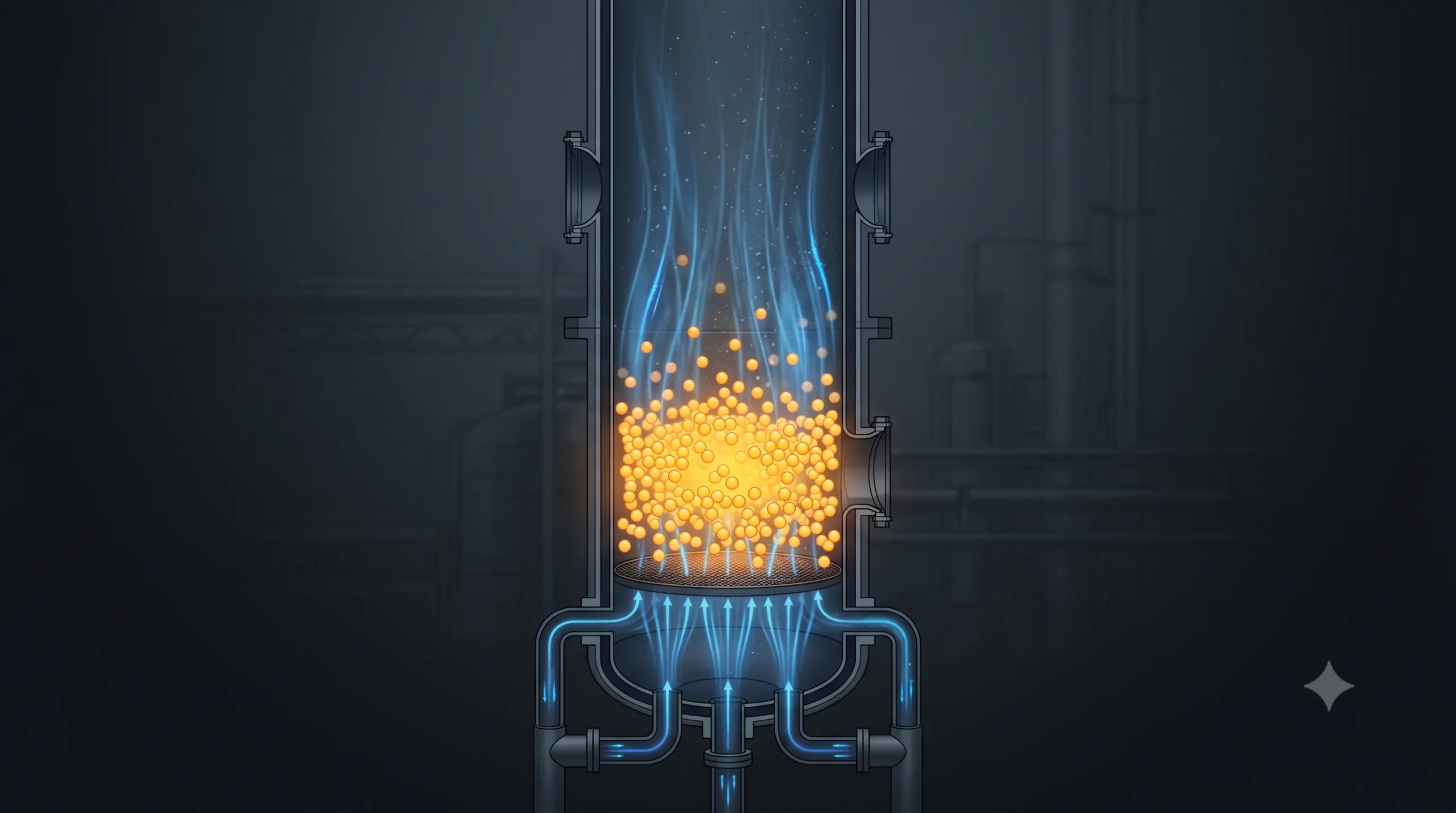
The fluidized bed reactor (FBR) replaces this static batch process with a continuous fluid dynamic system. Operators inject microscopic silicon seed particles into a tall, cylindrical vessel. They then pump highly pressurized silane gas (SiH4) up through a distributor plate at the bottom of the reactor.
Engineers perfectly tune the upward velocity of the silane gas to match the terminal falling velocity of the silicon seeds. This physical equilibrium suspends the solid particles in mid-air. The mass of seeds behaves exactly like a boiling liquid, continuously churning and mixing, creating an environment known as a fluidized bed.
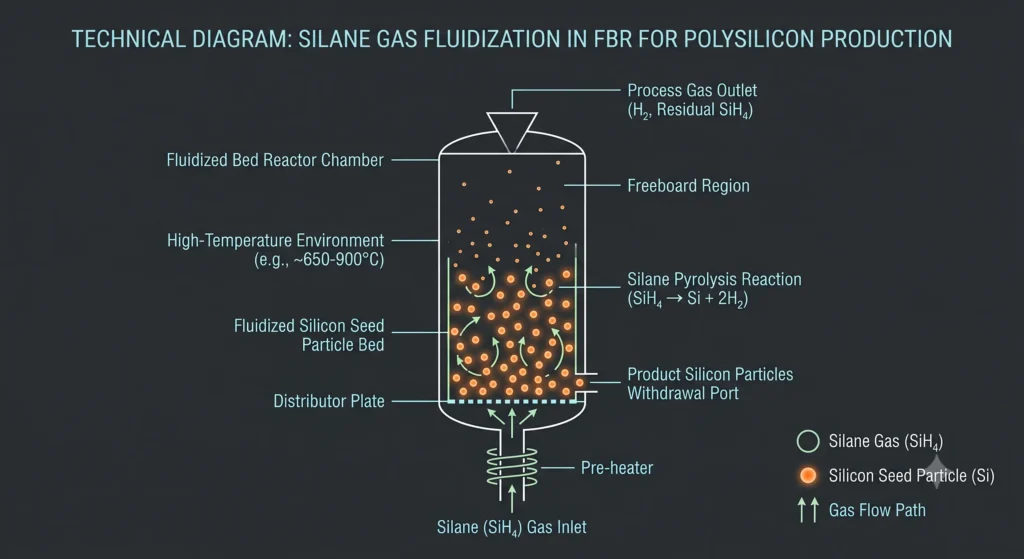
The reactor maintains an internal temperature of roughly 700°C. When the silane gas contacts the heated seeds, it undergoes pyrolysis—a severe thermochemical decomposition. The gas molecules physically shatter, following a direct chemical pathway:
$$SiH_4(g) \xrightarrow{\Delta} Si(s) + 2H_2(g)$$
Pure silicon deposits uniformly onto the surface of the suspended seeds, while hydrogen gas vents out the top of the reactor. As the seeds accumulate silicon layers, they grow heavier. Once a particle reaches the target mass of a two-millimeter granular bead, gravity overcomes the upward gas velocity, and the finished silicon bead drops to the bottom for continuous harvesting.
WHY IT MATTERS NOW
The transition to renewable energy depends entirely on the midstream solar supply chain. Polysilicon refining represents the absolute physical bottleneck of global photovoltaic manufacturing. The cost to produce this raw material establishes the baseline price for every solar panel installed globally.
Energy dictates refinery economics. The legacy Siemens process requires up to fifty kilowatt-hours of electricity to produce a single kilogram of polysilicon. FBR technology drops this energy requirement by eighty to ninety percent, consuming less than ten kilowatt-hours per kilogram.
This thermodynamic efficiency carries massive geopolitical weight. Historically, Chinese refineries monopolized global polysilicon output by building Siemens plants directly adjacent to heavily subsidized coal power stations in Xinjiang. Western manufacturers could not compete with this artificial energy arbitrage using traditional technology.
Western chemical giants like REC Silicon and Wacker Chemie use FBR technology to neutralize this geographic energy advantage. By stripping the electrical intensity out of the refining process, nations with strict environmental regulations and higher grid costs can successfully reshore domestic solar supply chains.
The granular yield provides an operational advantage for downstream buyers. Traditional Siemens chunks require manual hammering and crushing, introducing severe contamination risks. FBR beads flow like liquid, allowing solar ingot manufacturers to feed their Czochralski crystal pullers via automated continuous vacuum tubes, drastically increasing factory throughput.
WHAT MOST PEOPLE MISS
Macroeconomic analysts track solar capacity by counting assembled panels rolling off assembly lines. They treat the raw silicon supply as a guaranteed commodity, ignoring the brutal physical constraints inside the chemical reactors.
They miss the parasitic threat of homogeneous nucleation. If the reactor temperature profile becomes slightly imbalanced, the silane gas breaks down in the empty space between the seeds rather than directly on their surfaces. This error produces sub-micron silicon dust instead of usable granular beads.
This fine powder physically clogs the reactor exhaust filters and ruins the purity of the harvested batch. Controlling the exact thermal gradients and gas velocity to prevent dust formation requires highly guarded algorithmic trade secrets. Mastering this specific fluid dynamic boundary separates profitable refineries from bankrupt industrial experiments.
THE TRAJECTORY
Next 12–36 Months: Western nations will subsidize the rapid reopening of dormant FBR facilities. Legislators will use domestic content mandates to guarantee local demand, explicitly protecting high-efficiency polysilicon producers from international price dumping.
Next Five Years: Reactor operators will integrate artificial intelligence with acoustic emission sensors. These systems will listen to the specific frequencies of particles striking the reactor walls, allowing the software to map particle size distribution dynamically without inserting physical probes into the 700°C chamber.
Next Ten Years: Fluidized bed architecture will become the undisputed global standard for non-semiconductor-grade silicon. The complete phase-out of the Siemens process will permanently lower the unit cost of solar generation, accelerating parity with legacy fossil fuel baseload pricing.
What Could Go Wrong: Silane gas is aggressively pyrophoric, meaning it spontaneously explodes upon contact with atmospheric oxygen. A microscopic valve failure or physical containment breach instantly triggers a catastrophic industrial fire, capable of leveling the entire refinery and halting regional supply lines for years.
Most Likely Outcome: FBR technology will dictate global solar independence. Nations and corporations that successfully scale silane gas pyrolysis will command the midstream architecture of the entire renewable energy transition, holding a permanent material advantage over competitors reliant on legacy batch refining.
KEY TERMS
- Polysilicon: Highly purified, multi-crystalline silicon used as the foundational raw material for solar photovoltaics and semiconductors.
- Fluidization: A physical process where a granular material converts from a static solid state into a dynamic fluid-like state using an upward flow of gas.
- Silane Gas: A highly volatile, pyrophoric inorganic compound used as the primary silicon source molecule in advanced refining.
- Pyrolysis: The thermochemical decomposition of organic or inorganic material at elevated temperatures in the absence of oxygen.
- Homogeneous Nucleation: A parasitic chemical reaction where silane decomposes directly in the gas phase, forming useless microscopic silicon dust instead of depositing on a solid surface.
SOURCES
- U.S. Department of Energy (DOE) — Solar Photovoltaics Supply Chain Deep Dive Assessment
- Journal of Crystal Growth — Fluidized Bed Reactor Technology for the Production of Granular Polysilicon
- REC Silicon — FBR Technology, Energy Consumption, and Granular Polysilicon Metrics
- International Energy Agency (IEA) — Special Report on Solar PV Global Supply Chains