Advertisement
)

AT A GLANCE
- Concept: Metabolic Heating: Stored grain respires and generates heat, creating isolated moisture pockets that accelerate biological decay.
- Concept: Static Pressure: Massive vertical columns of grain resist airflow, requiring highly engineered fans to push oxygen upward.
- Concept: Ambient Aeration: Controllers use outside atmospheric temperature and humidity to systematically cool the internal silo core.
- Concept: Dust Explosion: Confined, dry agricultural particulates ignite violently if thermal runaway produces a static electrical spark.
HOW IT WORKS
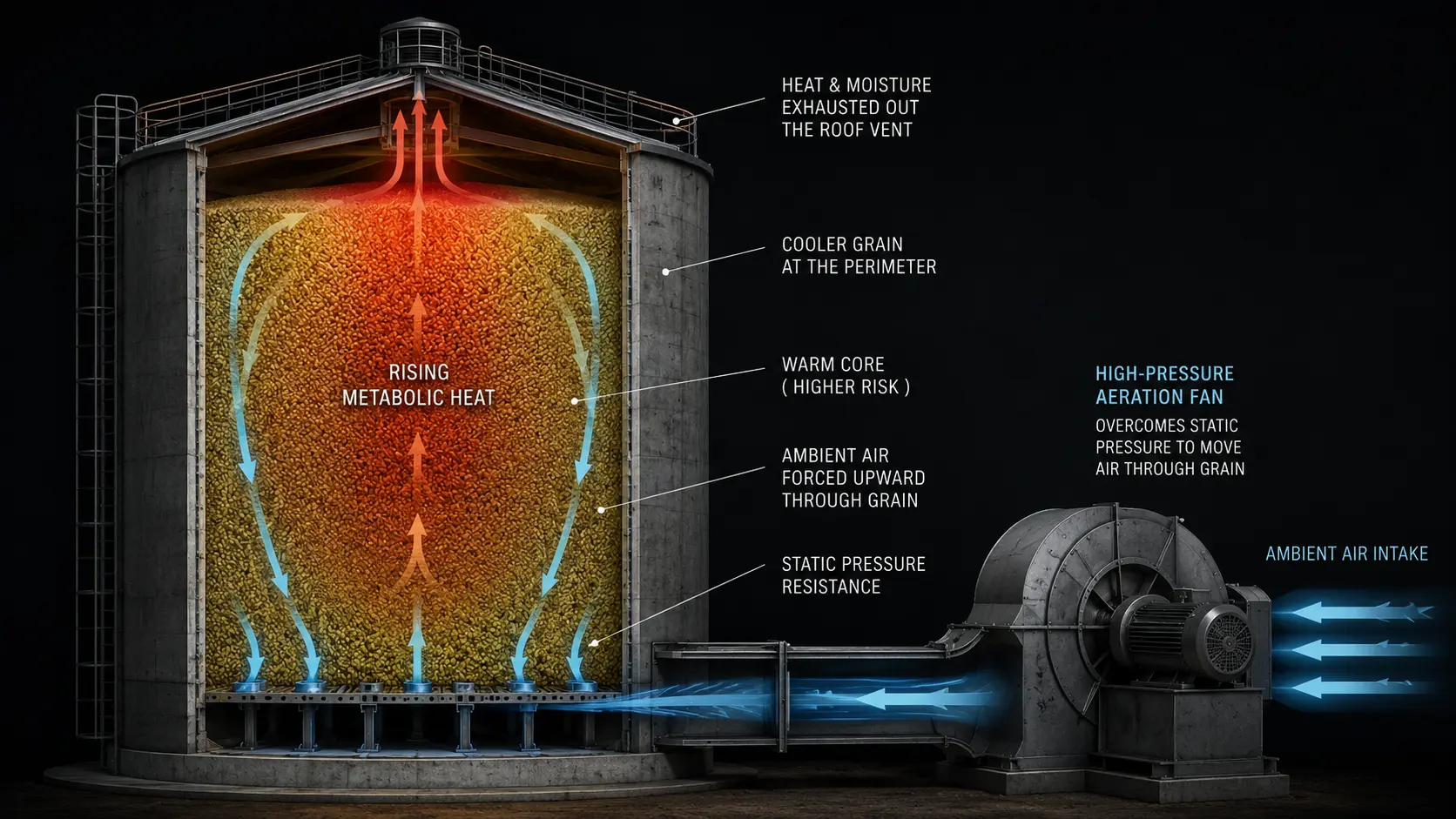
When a combine harvests corn or wheat, the grain remains biologically active. The living kernels continuously consume oxygen and release carbon dioxide, water, and heat. If engineers dump ten thousand tons of this living organic matter into a sealed concrete cylinder, the internal core immediately begins to cook itself.
As the internal temperature rises, moisture migrates toward the cold outer walls of the silo. This condensation creates a crust of mold that physically glues the grain together, sealing off the core. To prevent this thermal runaway, storage operators utilize active aeration systems to force ambient air through the entire grain mass.
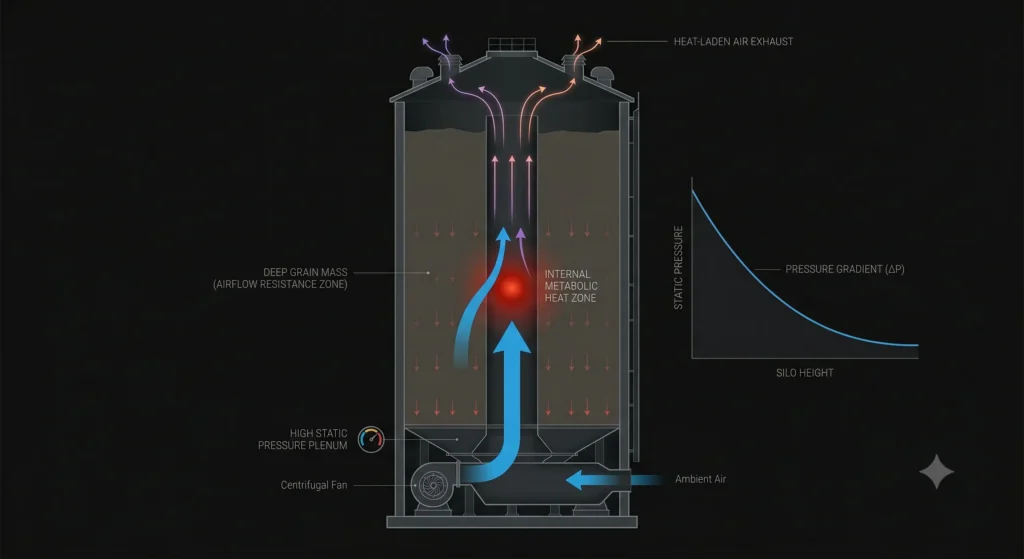
Pushing air through a massive vertical column of tightly packed kernels creates immense physical resistance. This resistance generates static pressure, measured in inches of water gauge. Engineers must perfectly size centrifugal fans to overcome this static pressure without pushing the air so fast that it physically strips the moisture out of the grain, which would destroy its market weight and financial value.
The exact relationship between airflow, static pressure, and grain depth relies on Shedd’s Equation:
$$\frac{\Delta P}{L} = a Q^2 + b Q$$
Where ΔP is the pressure drop, L is the depth of the grain bed, Q is the airflow rate, and a and b are crop-specific resistance constants. This fluid dynamic calculation prevents the formation of explosive dust pockets while successfully bleeding metabolic heat out of the roof vents.
WHY IT MATTERS NOW
Global caloric security relies entirely on time-shifting the harvest. The world produces food during highly concentrated seasonal windows but consumes it at a perfectly flat daily rate. The deep-bin concrete silo network acts as the primary temporal buffer holding this civilization-scale biological inventory.
Multinational commodities traders like Cargill and ADM operate massive terminal elevators situated along deep-water ports and major rail junctions. These facilities do not simply hold grain; they chemically stabilize it for international export. If an aeration system fails, a single hundred-foot silo can rot internally within weeks, instantly erasing millions of dollars of sovereign food supply.
The financial stakes multiply due to the extreme kinetic danger of grain dust. When agricultural matter grinds together during loading, it produces a microscopic, highly combustible powder. If aeration fails to extract metabolic heat, spontaneous combustion deep within the bin provides a direct ignition source.
A localized spark triggers a primary explosion, which shakes loose dormant dust across the facility to ignite a catastrophic secondary pressure wave. The 2017 Didion Milling explosion in Wisconsin leveled an entire facility due to combustible corn dust, proving the extreme kinetic reality of mismanaged agricultural processing. Proper thermodynamic management dictates the physical survival of the entire agricultural trading architecture.
WHAT MOST PEOPLE MISS
Economic policymakers assume grain storage is a passive, static operation involving simple concrete walls and a roof. They view the silo network as a physical bank vault for food, completely ignoring the intense, continuous biological and atmospheric engineering required to prevent the inventory from digesting itself.
They miss the severe economic penalty of over-aeration. If a facility manager runs the high-pressure fans for too long during low-humidity days, the moving air actively dehydrates the grain. Because global commodities trade strictly by weight, accidentally evaporating one percent of the moisture from a million-bushel terminal permanently erases hundreds of thousands of dollars in pure profit into thin air.
THE TRAJECTORY
Next 12–36 Months: Facility operators will deploy automated carbon dioxide sensors throughout the vertical grain columns. These sensors will detect the exact chemical signature of biological respiration, triggering targeted aeration zones days before the grain physically heats up.
Next Five Years: Acoustic monitoring cables will replace traditional temperature probes. Artificial intelligence algorithms will listen to the microscopic sounds of grain weevils and physical kernel settling to construct real-time three-dimensional tomographic maps of internal bin dynamics.
Next Ten Years: The industry will shift toward vacuum-sealed, nitrogen-purged storage architectures. By replacing oxygen entirely with inert nitrogen gas, engineers will completely arrest biological decay and physically eliminate the chemical possibility of a dust explosion.
What Could Go Wrong: Extreme climate volatility disrupts historical ambient cooling windows. If nighttime temperatures fail to drop low enough after the autumn harvest, aeration fans will pump warm, humid air into the silos, rapidly accelerating internal spoilage and triggering localized food shortages.
Most Likely Outcome: The deep-bin silo will transition from a passive concrete container into an active, algorithmically managed biological incubator. Multinational traders will rely entirely on thermodynamic software to balance caloric preservation against maximum water-weight profitability.
KEY TERMS
- Static Pressure: The physical resistance to airflow created by a densely packed vertical column of agricultural material.
- Aeration: The controlled movement of ambient air through stored grain to manage internal temperature and moisture levels.
- Spontaneous Combustion: The ignition of organic material caused by the rapid accumulation of internal metabolic and bacterial heat.
- Grain Dust: A highly combustible particulate byproduct generated by the mechanical friction of moving and storing agricultural commodities.
- Shedd’s Equation: A fluid dynamic mathematical formula used to calculate the required fan power to force air through specific types of crop beds.
SOURCES
- Food and Agriculture Organization (FAO) — Aeration and Thermodynamic Management of Grain Storage Systems
- United States Department of Agriculture (USDA) — Post-Harvest Engineering and Grain Dust Explosion Prevention
- American Society of Agricultural and Biological Engineers (ASABE) — Standards for Static Pressure and Airflow in Deep-Bin Silos
- Journal of Stored Products Research — Carbon Dioxide Monitoring and Early Detection of Biological Decay in Bulk Storage