Advertisement
)

AT A GLANCE
- Concept: Phase Angle: The mathematical timing difference between alternating current waves directly dictates active power flow.
- Concept: Voltage Injection: Specialized copper windings add perpendicular voltage to shift the timing of the electrical wave.
- Concept: Loop Flows: Unscheduled electricity takes the path of least physical resistance, overloading specific regional transmission cables.
- Concept: Active Routing: Operators physically force power off congested lines and onto underutilized parallel grid corridors.
HOW IT WORKS
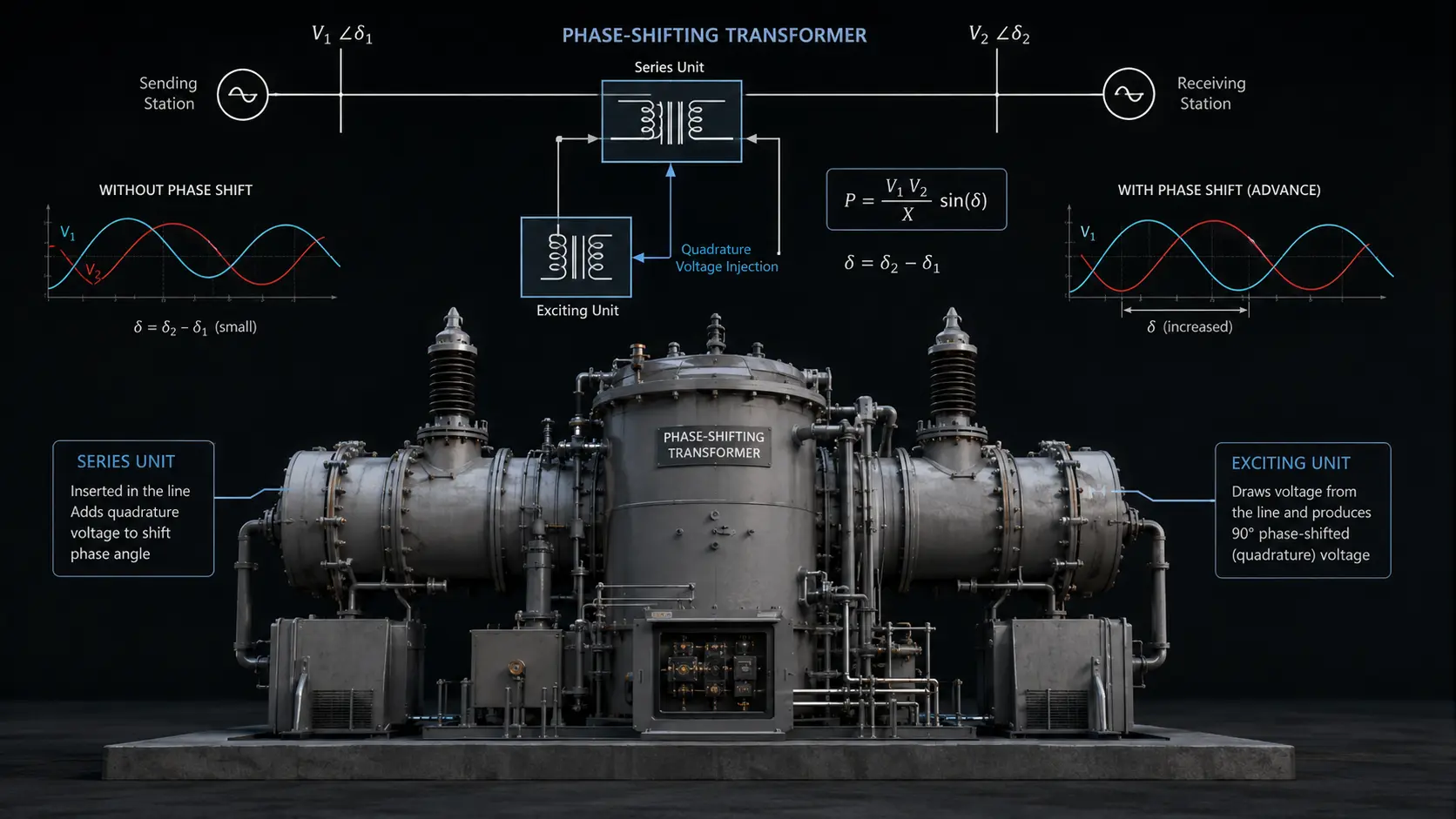
Standard electricity flows naturally like water, seeking the path of least physical resistance based on basic electrical laws. Active power transfer across a high-voltage alternating current line depends entirely on the phase angle difference between the sending station and the receiving station.
The exact mathematical relationship relies on the active power transmission equation:
$$P = \frac{V_1 V_2}{X} \sin(\delta)$$
Where P is active power, V_1 and V_2 are the voltages at each end, X is the line reactance, and δ (delta) is the phase angle difference.If a grid operator wants to force more power down a specific line, they must artificially increase this precise phase angle.
A phase-shifting transformer achieves this control through a highly complex internal dual-core design. The series unit sits directly in the main power line, while the exciting unit draws voltage from that exact same line and shifts its physical timing by ninety degrees.
The machine injects this perpendicular, or quadrature, voltage back into the main line through the series copper windings. This geometric addition physically shifts the original sine wave forward or backward in time, acting as a massive electrical valve that actively dictates where the continental current must flow.
WHY IT MATTERS NOW
Continental power grids were originally built as one-way delivery systems carrying baseload coal and nuclear power to specific local cities. The modern energy transition replaces this static generation with massive, highly variable renewable energy fields separated by national borders.
When offshore wind farms in northern Germany overproduce electricity, utilities sell this excess power to customers in southern Europe. Because electrons follow the physical path of least resistance rather than the commercial contract, this massive energy surge often floods through the grids of neighboring countries like Poland and the Czech Republic, creating dangerous unscheduled loop flows.
These loop flows threaten to melt aging transmission cables and trigger cascading, multi-nation blackouts. To protect their sovereign infrastructure, national grid operators install massive phase-shifting transformers at their physical borders to mathematically repel this foreign electricity and push it back onto intended transmission corridors.
Manufacturers like Siemens Energy and Hitachi Energy treat these transformers as highly customized, national security assets. Procuring a single unit requires a capital expenditure exceeding ten million dollars and a two-year manufacturing timeline, establishing a severe heavy-industry bottleneck for continental grid decarbonization.
WHAT MOST PEOPLE MISS
Energy market analysts assume that if a wind farm generates a megawatt, the grid automatically delivers it to the buyer. They entirely ignore the physical congestion reality that electricity cannot be digitally routed like packets of data on the internet.
Without phase-shifting transformers, grid operators manage congestion through costly redispatch mechanisms. They must pay the cheap wind farm to shut down and simultaneously pay an expensive local gas plant to turn on, costing European utilities billions of dollars annually simply because they lack the physical hardware to steer electrons around a local bottleneck.
THE TRAJECTORY
Next 12–36 Months: Transmission system operators will rapidly digitize phase-shifting transformer tap changers. This upgrade allows control rooms to adjust phase angles continuously in real-time, responding dynamically to sudden drops in regional cloud cover or unexpected wind surges.
Next Five Years: Grid planners will install phase-shifting transformers in direct sequence with existing High-Voltage Direct Current (HVDC) converter stations. This hybrid architecture will allow operators to precisely balance alternating current load distributions before feeding the power into long-distance direct current superhighways.
Next Ten Years: The integration of wide-area monitoring systems will fully automate phase angle adjustments across entire continents. Artificial intelligence algorithms will continuously calculate optimal power flows, autonomously sending command signals to hundreds of phase-shifting transformers simultaneously to prevent localized line melting.
What Could Go Wrong: The mechanical tap changers inside these transformers operate under extreme high-voltage electrical stress. If a mechanical switch fails to extinguish an electrical arc during a tap change, the arc will ignite the thousands of gallons of insulating mineral oil inside the housing, triggering a massive industrial fire that destroys the substation.
Most Likely Outcome: Phase-shifting transformers will transition from obscure reliability assets to the primary operational tools of the global energy market. The physical ability to mathematically block or pull electricity will dictate exactly how nations secure their borders against rogue energy flows in an increasingly interconnected grid.
KEY TERMS
- Phase Angle: The specific mathematical difference in timing between two alternating current waveforms.
- Quadrature Voltage: A secondary electrical voltage introduced exactly ninety degrees out of phase with the primary source voltage.
- Loop Flow: Unscheduled active power that flows through adjacent regional grids because electricity naturally follows the path of least physical resistance.
- Redispatch: The costly operational practice of commanding specific power plants to increase or decrease generation to relieve physical grid congestion.
- Tap Changer: A heavy mechanical switch inside a transformer that physically alters the number of active copper windings to adjust voltage or phase angle.
SOURCES
- European Network of Transmission System Operators for Electricity (ENTSO-E) — Managing Unscheduled Transit Flows and Phase-Shifting Transformers
- North American Electric Reliability Corporation (NERC) — System Operating Limits and Interconnection Flow Control
- IEEE Power and Energy Society — Phase Shifting Transformers: Principles, Applications, and Design
- Siemens Energy — High-Voltage Grid Stabilization and Active Power Flow Control Systems