Advertisement
)

AT A GLANCE
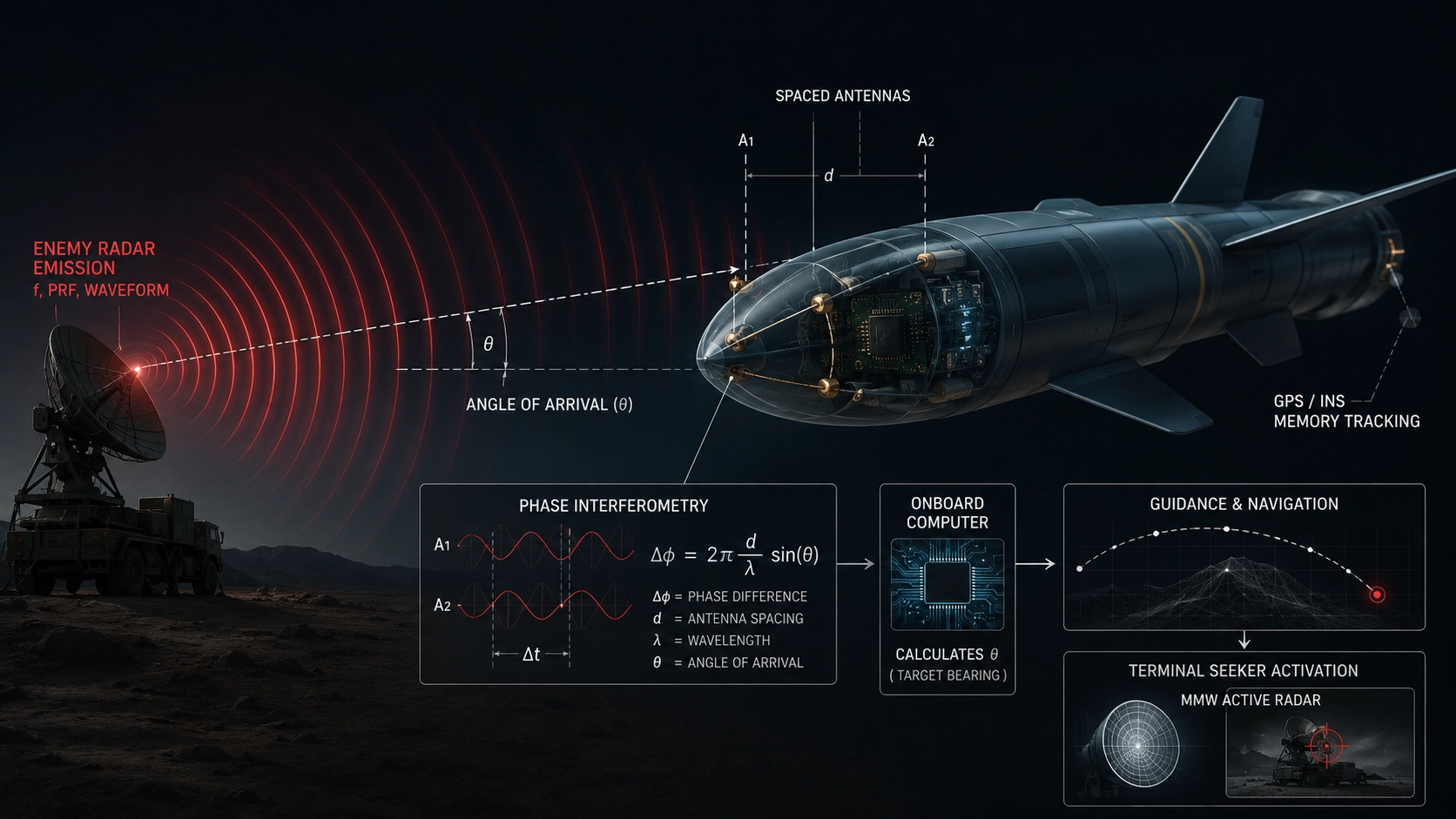
- Concept: Passive Homing: The missile emits no radar of its own, remaining completely invisible while listening for enemy broadcasts.
- Concept: Phase Interferometry: Spaced antennas calculate the microscopic time delay of incoming signals to determine exact target bearing.
- Concept: Memory Tracking: GPS and inertial sensors allow the missile to fly to the target’s exact coordinates even if the radar powers down.
- Concept: Terminal Seeking: A millimeter-wave active radar turns on in the final seconds to visually identify the physical satellite dish.
HOW IT WORKS
Surface-to-air missile batteries rely on active radar to find target aircraft. To see the sky, these systems must broadcast massive amounts of electromagnetic energy and listen for the returning echo. This physical requirement turns the radar dish into a blindingly bright electronic beacon.
Anti-radiation missiles exploit this broadcast. Weapons like the AGM-88G Advanced Anti-Radiation Guided Missile (AARGM) carry a passive broadband radio-frequency receiver in their nose cone. This seeker constantly scans the electromagnetic spectrum, isolating the highly specific frequency bands, pulse repetition intervals, and waveforms utilized by enemy air defense radars.
When the seeker detects an enemy emission, it calculates the exact Angle of Arrival (AoA). It achieves this using phase interferometry, measuring the microscopic time delay between the radar wave striking multiple, physically separated antennas located inside the missile’s nose.
The calculation of this phase difference relies on strict trigonometric principles:
$$\Delta \phi = \frac{2 \pi d}{\lambda} \sin(\theta)$$
Where Δφ is the phase difference between antennas, d is the physical distance separating them, λ (lambda) is the wavelength of the incoming radar signal, and θ (theta) is the angle of arrival.The onboard computer continuously runs this equation, generating a precise compass bearing pointing directly at the emitting radar dish.
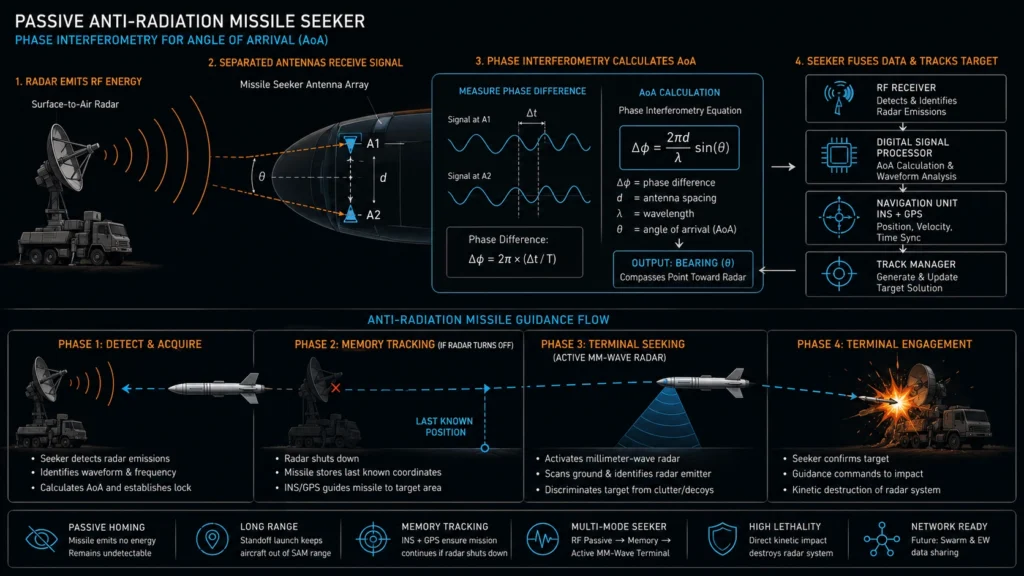
Historically, radar operators defeated these missiles simply by turning off their equipment. If the emission stopped, the missile went blind and harmlessly impacted empty dirt. Modern seekers eliminate this vulnerability by tightly coupling the passive receiver with advanced Global Positioning System (GPS) and Inertial Navigation System (INS) hardware.
If the enemy radar powers down mid-flight, the missile immediately logs the last known geometric coordinate. It transitions into a memory-tracking glide, flying blindly toward that exact location. In the final seconds of flight, the missile activates its own high-resolution millimeter-wave radar. This active terminal seeker scans the ground, physically identifies the metallic shape of the radar dish amidst local ground clutter, and guides the warhead to a direct kinetic impact.
WHY IT MATTERS NOW
Modern geopolitical conflicts are dictated by Anti-Access/Area Denial (A2/AD) networks. Nations deploy layered Integrated Air Defense Systems (IADS) to create massive exclusion zones that prevent foreign fighter jets and bombers from entering sovereign airspace.
Before an air force can execute strategic bombing campaigns or provide close air support to ground troops, it must dismantle this electronic shield. This tactical phase, known as the Suppression of Enemy Air Defenses (SEAD), is the mandatory prerequisite for establishing air superiority in any modern theater of war.
Stealth aircraft like the F-35 heavily degrade high-frequency targeting radars, but lower-frequency early warning radars can still detect their general presence. Anti-radiation missiles serve as the ultimate kinetic equalizer. By firing these weapons, an air force actively hunts and destroys the very sensors designed to track them.
Defense contractors like Northrop Grumman and Raytheon are heavily investing in extended-range propulsion for these missiles. By utilizing advanced ramjet engines or larger solid-rocket motors, the latest variants allow launch aircraft to release the weapon from hundreds of miles away.
This extreme standoff range keeps multi-million dollar fighter jets safely outside the kinematic reach of the enemy’s surface-to-air missiles. It forces the defending military into an inescapable dilemma: turn on the radar and be destroyed by the incoming missile, or keep the radar turned off and allow the enemy aircraft to operate with total impunity.
WHAT MOST PEOPLE MISS
General military analysis assumes that the primary measure of a SEAD mission is the number of destroyed radar vehicles. They miss the paradox that actual physical destruction is entirely optional for a successful mission.
The ultimate operational goal of an anti-radiation missile is simply to force the enemy radar operator to shut down their system. By simply launching the weapon, the attacking force temporarily blinds the enemy air defense grid. While the radar is powered down to survive the missile, heavy strike packages can safely fly through the unprotected airspace. The mere threat of the seeker achieving a lock successfully completes the tactical objective.
THE TRAJECTORY
Next 12–36 Months: Aerospace manufacturers will complete the integration of extended-range anti-radiation missiles into the internal weapons bays of fifth-generation fighters. This physical packaging optimization allows stealth aircraft to carry radar-hunting munitions without ruining their low-observable radar cross-sections.
Next Five Years: Anti-radiation munitions will deploy autonomous swarm networking. Multiple missiles in flight will communicate continuously, cross-referencing their phase interferometry data to instantly triangulate mobile radar sites that utilize “blinking” tactics—rapidly turning on and off to confuse single seekers.
Next Ten Years: Seeker heads will transition to cognitive electronic warfare architectures. Neural networks embedded directly on the missile will analyze unknown, novel radar waveforms in real-time, autonomously rewriting their own tracking algorithms mid-flight to destroy previously unseen air defense systems without requiring pre-programmed mission data files.
What Could Go Wrong: Sophisticated adversaries are aggressively deploying highly advanced, inflatable radar decoys equipped with cheap, disposable microwave emitters. If the missile’s terminal millimeter-wave seeker lacks the resolution to differentiate a rubber decoy from a steel radar dish, an air force will rapidly deplete its multi-million dollar inventory on empty rubber balloons.
Most Likely Outcome: Passive broadband radio-frequency homing will become a standard, secondary capability integrated across all long-range strike weapons. Every modern cruise missile will possess the latent ability to dynamically divert from its primary target to autonomously hunt and destroy pop-up radar threats.
KEY TERMS
- Suppression of Enemy Air Defenses (SEAD): Military operations specifically designed to neutralize, destroy, or temporarily degrade surface-based air defense systems.
- Angle of Arrival (AoA): The precise geographic direction from which an incoming radio-frequency signal is propagating, calculated to determine the target’s location.
- Passive Homing: A guidance method where a missile tracks the natural or active emissions of a target without broadcasting any detectable radar energy of its own.
- Millimeter-Wave Radar: An extremely high-frequency radar system used in the terminal flight phase to generate high-resolution imagery of ground targets.
- Integrated Air Defense System (IADS): A heavily networked structure of overlapping early warning radars, command centers, and surface-to-air missile launchers designed to protect sovereign airspace.
SOURCES
- United States Navy — Advanced Anti-Radiation Guided Missile (AARGM) Program Overview
- Northrop Grumman — AGM-88G AARGM-ER Seeker Architecture and Multi-Mode Guidance
- Journal of Electronic Defense — Cognitive Electronic Warfare and Passive Radar Seeker Technology
- Department of Defense (DoD) — Joint Publication 3-01: Countering Air and Missile Threats