Advertisement
)

AT A GLANCE
- Concept: The Hypersonic Problem: Traditional ballistic missiles follow predictable arcs, but hypersonic glide vehicles maneuver unpredictably within the atmosphere, evading standard radar.
- Concept: Geostationary Blindness: Legacy warning satellites sit 22,000 miles away and lose the faint heat signatures of gliding missiles against the warm background of the Earth.
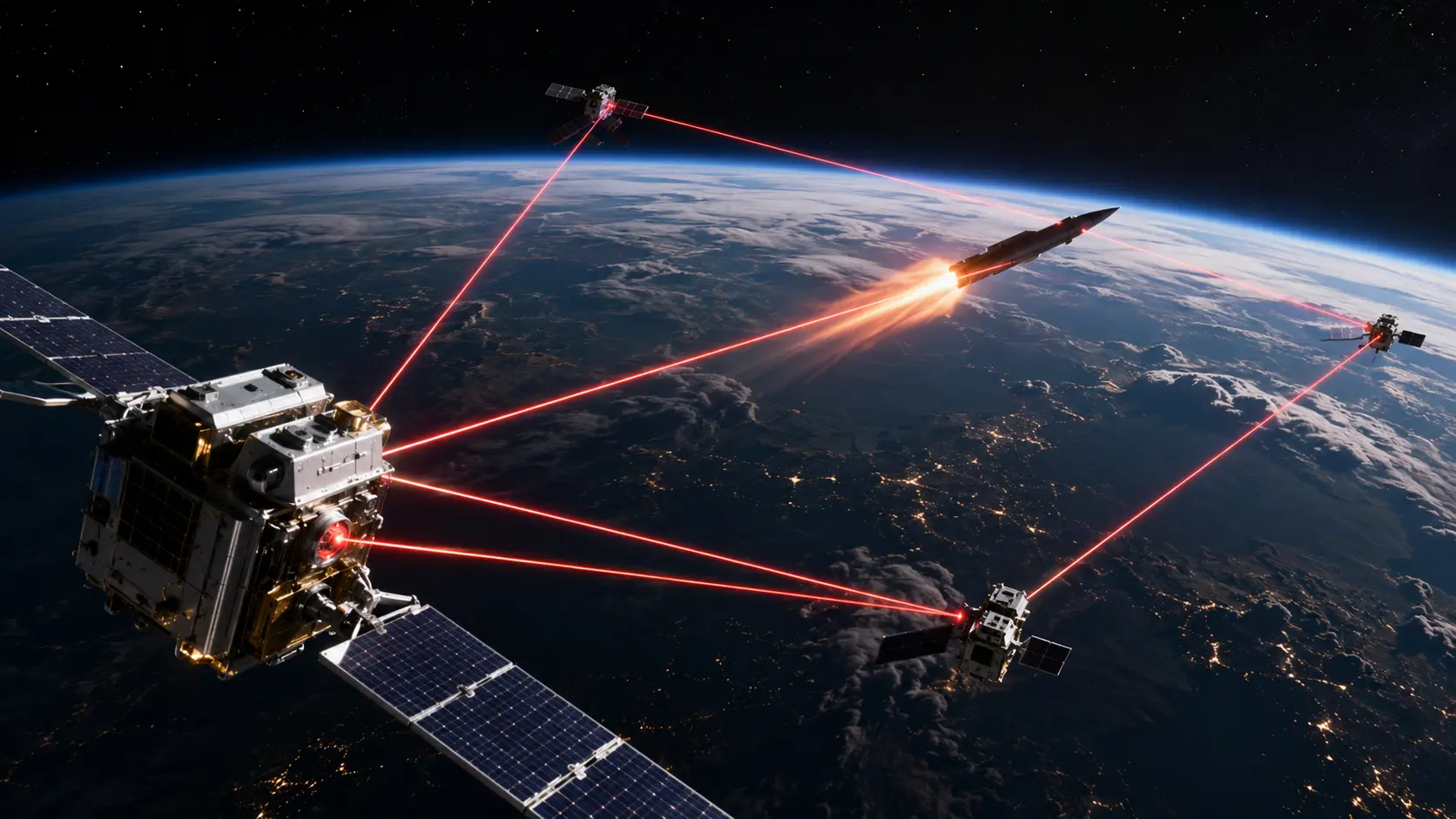
- Concept: Proliferated Mesh Networks: Deploying hundreds of cheap, low-orbit satellites ensures multiple sensors maintain continuous visual custody of a target from different angles.
- Concept: Optical Cross-Links: Satellites pass targeting data to each other using space-based lasers, calculating a real-time intercept trajectory without routing data through vulnerable ground stations.
HOW IT WORKS
Standard ballistic missiles are easy to track because they follow basic Newtonian physics. Once the rocket motor burns out, gravity dictates the exact parabolic trajectory to the target. Legacy defense systems rely on a handful of massive satellites in Geostationary Earth Orbit (GEO) to spot the initial launch flash, then pass the math to ground-based radar for interception.
Hypersonic glide vehicles (HGVs) break this mathematical model completely. After launch, an HGV dips back into the upper atmosphere and surfs the air currents at Mach 10. It executes sharp, unpredictable turns, rendering traditional parabolic tracking algorithms entirely useless.
Additionally, because the HGV flies inside the atmosphere rather than the cold vacuum of space, aerodynamic friction heats the vehicle. Legacy GEO satellites, observing from 22,000 miles away, struggle to distinguish this specific heat signature against the overwhelming background thermal noise of the Earth itself.
To solve this, the Space Development Agency (SDA) designed the Proliferated Warfighter Space Architecture (PWSA). Instead of a few massive satellites, the military deploys hundreds of small, highly networked satellites into Low Earth Orbit (LEO), just a few hundred miles above the surface. These satellites form two distinct layers: the Tracking Layer and the Transport Layer.
The Tracking Layer uses Wide Field of View (WFOV) infrared sensors to spot the friction heat of the HGV. Because the satellites move at 17,000 miles per hour and the missile moves at Mach 10, a single satellite can only see the target for a few minutes. Before the missile crosses the horizon, the satellite uses highly focused optical inter-satellite links to physically hand the tracking data over to the next satellite in the mesh. This continuous machine-to-machine handoff calculates a unified fire-control solution, beaming it down to the Transport Layer and directly to ground-based interceptors in milliseconds.
WHY IT MATTERS NOW
The deployment of operational hypersonic weapons by state adversaries physically bypassed the trillion-dollar missile defense architecture of the United States. A weapon that cannot be tracked cannot be intercepted. This created a highly destabilizing strategic vulnerability, forcing the Pentagon to completely redesign its space acquisition strategy.
Historically, military satellites were multi-billion-dollar exquisite assets that took ten years to build. If an adversary shot one down with an anti-satellite (ASAT) missile, a massive hole opened in the early warning grid. Proliferated LEO mathematically neutralizes this threat through sheer volume.
By placing hundreds of nodes in the Tracking Layer, the architecture becomes inherently resilient. If a hostile force uses kinetic interceptors to destroy five satellites over the Pacific, the mesh network instantly reroutes the tracking data through surviving adjacent nodes. Shooting down enough satellites to blind the system would exhaust an adversary’s entire ASAT inventory and instantly trigger a massive debris cascade.
This architectural shift violently disrupts the traditional defense industrial base. The Space Development Agency now demands rapid, iterative satellite production similar to commercial automotive manufacturing. Defense primes like Lockheed Martin and Northrop Grumman are forced to behave like agile tech startups, securing contracts to deliver dozens of standardized satellites every twenty-four months in specific increments called “Tranches.”
This economic consequence ripples directly into the commercial space sector. The sheer volume of satellites required for the PWSA dictates continuous heavy reliance on commercial launch providers. This guarantees a permanent, state-backed revenue stream for reusable rocket operators, artificially subsidizing the rapid expansion of the domestic commercial space economy.
WHAT MOST PEOPLE MISS ABOUT HYPERSONIC WEAPONS
Defense analysts frequently assume the primary challenge of hypersonic tracking is simply building a more sensitive infrared camera. They entirely miss the staggering computational processing required to execute the data handoff. Maintaining custody of a maneuvering target while the sensors themselves are moving at orbital velocity requires solving immense geometric equations continuously in a high-radiation environment.
The true bottleneck is onboard edge computing. Sending raw video feeds down to Earth for processing introduces unacceptable latency; by the time the ground computer calculates the missile’s location, the weapon has already moved ten miles. The LEO satellites must process the infrared data natively on the spacecraft, filtering out false positives like cloud reflections and industrial fires, before transmitting only the pure, refined targeting coordinates across the laser mesh.
THE TRAJECTORY
Next 12–36 Months: The Space Development Agency will complete the deployment of Tranche 1, establishing the first operational global mesh of interconnected Tracking and Transport satellites. This phase permanently transitions the US military from localized theater tracking to persistent global custody of advanced maneuvering threats.
Next Five Years: Integration of medium-field-of-view (MFOV) targeting sensors. While current wide-field sensors can spot the missile, MFOV sensors will provide the extreme mathematical precision required to guide a kinetic interceptor directly into the hypersonic vehicle at closing speeds exceeding Mach 15.
Next Ten Years: The architecture will absorb artificial intelligence directly into the constellation’s operating system. Satellites will autonomously negotiate bandwidth, re-task their own sensors, and coordinate intercept logistics without requiring explicit command inputs from terrestrial human operators.
What Could Go Wrong: The optical inter-satellite links are highly complex and sensitive to thermal warping. If the precision lasers fail to mathematically align due to microscopic vibrations on the spacecraft, the mesh network fractures. The satellites would become isolated nodes, entirely incapable of passing the fire-control data required to intercept the weapon.
Most Likely Outcome: Proliferated LEO will become the mandatory baseline for all future national security space architectures. The ability to mass-produce cheap, interchangeable satellite buses and operate them as a unified software-defined network will replace the legacy model of large, singular, exquisite spacecraft.
KEY TERMS
- Proliferated Low Earth Orbit (pLEO): An architectural strategy that uses hundreds of small, networked satellites operating close to the Earth to provide resilient, low-latency coverage.
- Hypersonic Glide Vehicle (HGV): A maneuverable weapon that travels above Mach 5 within the Earth’s atmosphere, using aerodynamic lift to evade traditional ballistic missile defense systems.
- Optical Inter-Satellite Link (OISL): A communication system utilizing highly focused lasers to transmit massive amounts of data directly between satellites without routing the signal through ground stations.
- Fire Control Solution: The precise mathematical calculation of a target’s velocity, altitude, and trajectory required to successfully guide an interceptor missile to a physical collision.
- Overhead Persistent Infrared (OPIR): A space-based sensor technology that detects the thermal signatures of rocket plumes and aerodynamic friction against the cold background of space.
SOURCES
- Space Development Agency (SDA) — Proliferated Warfighter Space Architecture and Tranche Deployment Strategy
- Congressional Budget Office (CBO) — National Security Space: Tracking and Defeating Hypersonic Weapons
- Center for Strategic and International Studies (CSIS) — Complex Air Defense and the Evolution of Missile Warning Architectures
- IEEE Aerospace and Electronic Systems — Optical Inter-Satellite Link Engineering for Low Latency Mesh Networks