Advertisement
)

AT A GLANCE
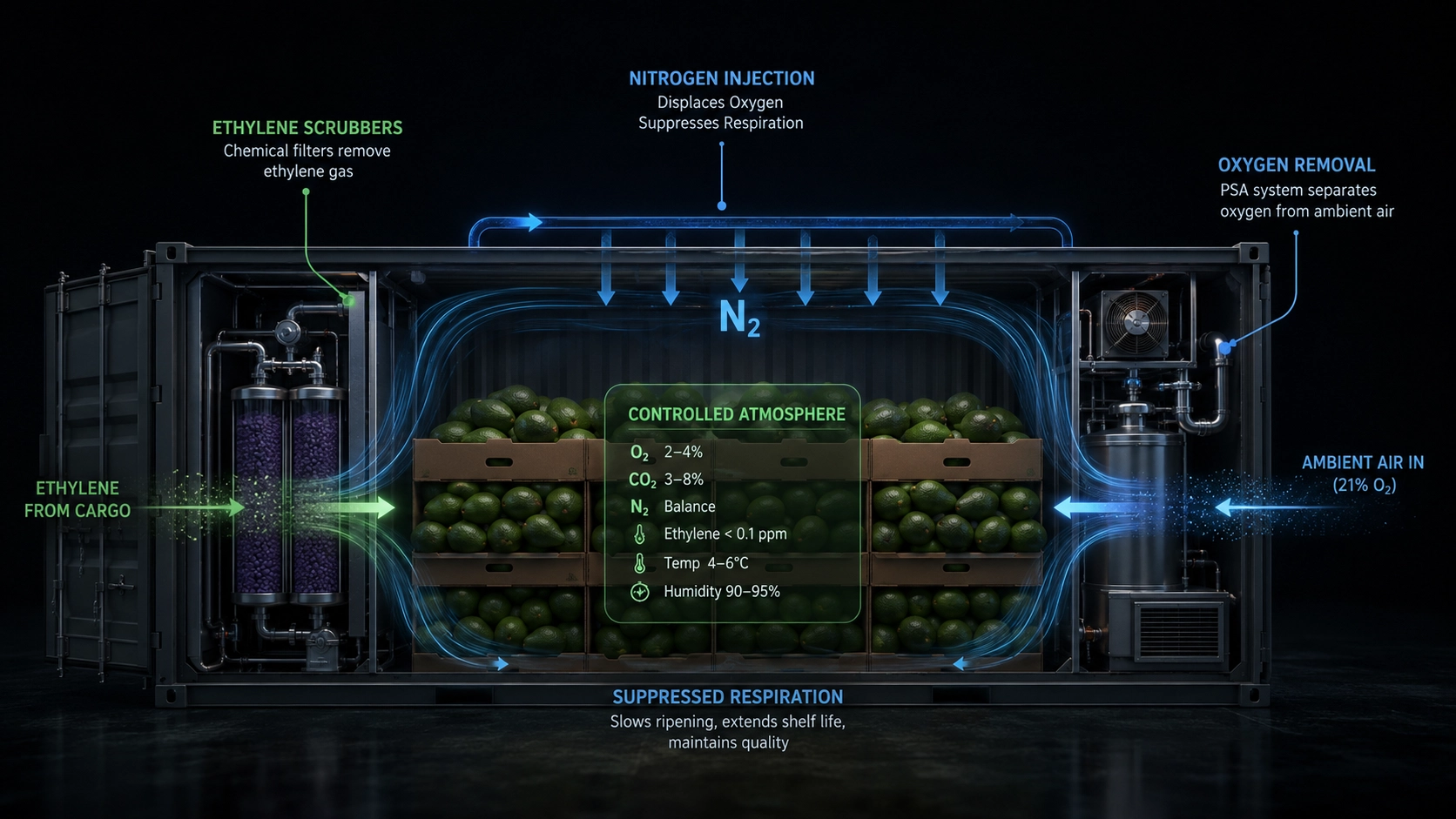
- Concept: Biological Respiration: Harvested fruit remains alive, continuously consuming oxygen and emitting carbon dioxide and heat.
- Concept: Ethylene Scrubbing: Advanced filtration systems actively strip away the natural chemical hormone that triggers organic decay.
- Concept: Nitrogen Purging: Compressors pump inert nitrogen gas into the container to displace oxygen and suffocate the cargo.
- Concept: Temporal Arbitrage: Halting biological time allows South American growers to sell delicate produce in Asian markets weeks later.
HOW IT WORKS
When a farmer cuts an avocado or a banana from a tree, the fruit does not immediately die. It enters a state of biological panic, accelerating its respiration rate to ripen and spread its seeds before rotting. This respiration consumes atmospheric oxygen and violently exhausts carbon dioxide, water vapor, and a specific gaseous hormone called ethylene.
Ethylene is highly contagious. If one overripe banana releases ethylene inside a sealed steel box, it immediately triggers the adjacent bananas to ripen, creating a cascading biological chain reaction that turns thousands of pounds of valuable inventory into worthless liquid rot in a matter of days.
Standard refrigerated containers (reefers) simply blow cold air to slow this process, which is insufficient for long transoceanic voyages. A Controlled Atmosphere (CA) container actively manipulates the chemical composition of the air itself.
The system utilizes an active membrane separator or pressure swing adsorption unit. It pulls outside ambient air, strips away the oxygen molecules, and pumps pure, inert nitrogen directly into the cargo hold. By driving the internal oxygen concentration down from a natural 21 percent to a suffocating 2 percent, the biological respiration of the fruit mathematically collapses.
Simultaneously, active chemical scrubbers utilizing potassium permanganate or specialized ozone generators constantly filter the recirculating air. These scrubbers chemically bind and neutralize the microscopic traces of ethylene gas emitted by the stressed cargo, entirely preventing the chemical ripening signal from propagating through the container.
WHY IT MATTERS NOW
Global food security and agricultural economics rely entirely on conquering distance and time. A blueberry grown in Peru holds zero financial value if it turns to mush before reaching a supermarket shelf in Tokyo. The CA container is the specific hardware that enforces this temporal arbitrage, physically extending the shelf life of highly perishable goods from a few days to over six weeks.
Multinational logistics giants like Maersk and equipment manufacturers like Carrier Transicold operate massive fleets of these specialized units. The financial margins of the entire global fresh produce market—valued at hundreds of billions of dollars annually—rest entirely on the absolute reliability of these specific atmospheric controllers.
This reliance exposes severe vulnerabilities in the global food supply chain. A CA container is an active, heavily energy-dependent life support system. If a container ship sits idle outside a congested port for an extra two weeks, the onboard generators must burn massive amounts of diesel fuel to maintain that two percent oxygen concentration.
If the port lacks sufficient electrical infrastructure (reefer plugs) to power these containers upon offloading, the internal atmosphere normalizes. Within forty-eight hours of losing nitrogen suppression, a month’s worth of suppressed biological aging catches up to the cargo simultaneously, resulting in a total inventory loss that spikes regional grocery prices and bankrupts agricultural exporters.
WHAT MOST PEOPLE MISS
Macroeconomic analysts track the broad tonnage of agricultural exports, assuming a container of apples equals a container of avocados. They miss the severe, crop-specific atmospheric tuning required to prevent the cargo from accidentally executing cellular suicide.
Every distinct fruit requires a highly specific, algorithmically managed atmospheric setpoint. An avocado requires roughly 4 percent oxygen to remain dormant. If the container algorithm accidentally drops the oxygen level to 1 percent, the avocado switches from aerobic respiration to anaerobic fermentation. It begins physically converting its internal sugars into alcohol, permanently ruining the flavor profile and completely destroying its commercial value before it ever reaches the destination port. The true intellectual property of logistics companies lies in maintaining these exact, fragile chemical tolerances across turbulent, four-week ocean voyages.
THE TRAJECTORY
Next 12–36 Months: Shipping lines will integrate low-earth orbit satellite telemetry directly into the container control modules. This real-time bandwidth will allow agricultural owners to continuously monitor internal ethylene spikes mid-ocean, granting them the ability to remotely trigger emergency atmospheric flushes to save degrading cargo.
Next Five Years: Advanced biochemical sensors will transition from reading simple gas concentrations to detecting volatile organic compounds (VOCs) emitted by specific fungal pathogens. The container will autonomously alter its humidity and ozone output to actively execute localized chemical warfare against mold outbreaks before they spread.
Next Ten Years: The industry will commercialize hyper-localized micro-atmospheres using advanced packaging films. Instead of regulating the entire 40-foot container, intelligent polymer wraps will actively manage the exact oxygen and carbon dioxide exchange rate for each individual pallet, allowing logistics companies to ship highly incompatible fruits inside the exact same steel box.
What Could Go Wrong: The active nitrogen generators require significant mechanical compression and membrane filtration. If a microscopic tear develops in the separation membrane during heavy seas, the system will pump raw, oxygen-rich ocean air directly into the dormant cargo hold, immediately triggering rapid, unstoppable thermal runaway and total inventory spoilage.
Most Likely Outcome: The controlled atmosphere container will become the mandatory baseline for all high-value international agriculture. As extreme climate volatility disrupts local growing seasons, nations will rely entirely on these active life-support boxes to secure their year-round sovereign caloric and nutritional requirements from across the globe.
KEY TERMS
- Controlled Atmosphere (CA): A highly regulated storage environment where oxygen, carbon dioxide, and nitrogen levels are precisely maintained to halt the biological aging of organic cargo.
- Ethylene: A naturally occurring gaseous plant hormone that actively triggers and accelerates the ripening and eventual decay of fruit.
- Respiration Rate: The speed at which harvested organic material consumes oxygen and releases carbon dioxide to maintain its cellular functions.
- Temporal Arbitrage: The economic practice of generating profit by artificially delaying the sale of a perishable good until it reaches a more lucrative geographic market.
- Pressure Swing Adsorption: A mechanical gas separation technology used to extract pure nitrogen from ambient air by trapping oxygen molecules under high pressure.
SOURCES
- United Nations Food and Agriculture Organization (FAO) — Post-Harvest Management and Controlled Atmosphere Storage
- Carrier Transicold — EverFRESH Controlled Atmosphere System Architecture
- Maersk — StarCare Controlled Atmosphere Logistics and Perishable Supply Chains
- Postharvest Biology and Technology Journal — Ethylene Scrubbing and Anaerobic Fermentation Thresholds in Marine Transport