Advertisement
)

AT A GLANCE
- Concept: Block Scheduling: Programmers manipulate large blocks of data instead of micromanaging millions of individual threads.
- Concept: Memory Coalescing: The compiler autonomously aligns scattered memory requests into single, highly efficient hardware read operations.
- Concept: SRAM Management: Software automatically dictates exactly when to move data from slow global memory into fast onboard cache.
- Concept: Hardware Agnosticism: Engineers write mathematical logic once and compile it universally across competing silicon architectures.
HOW IT WORKS
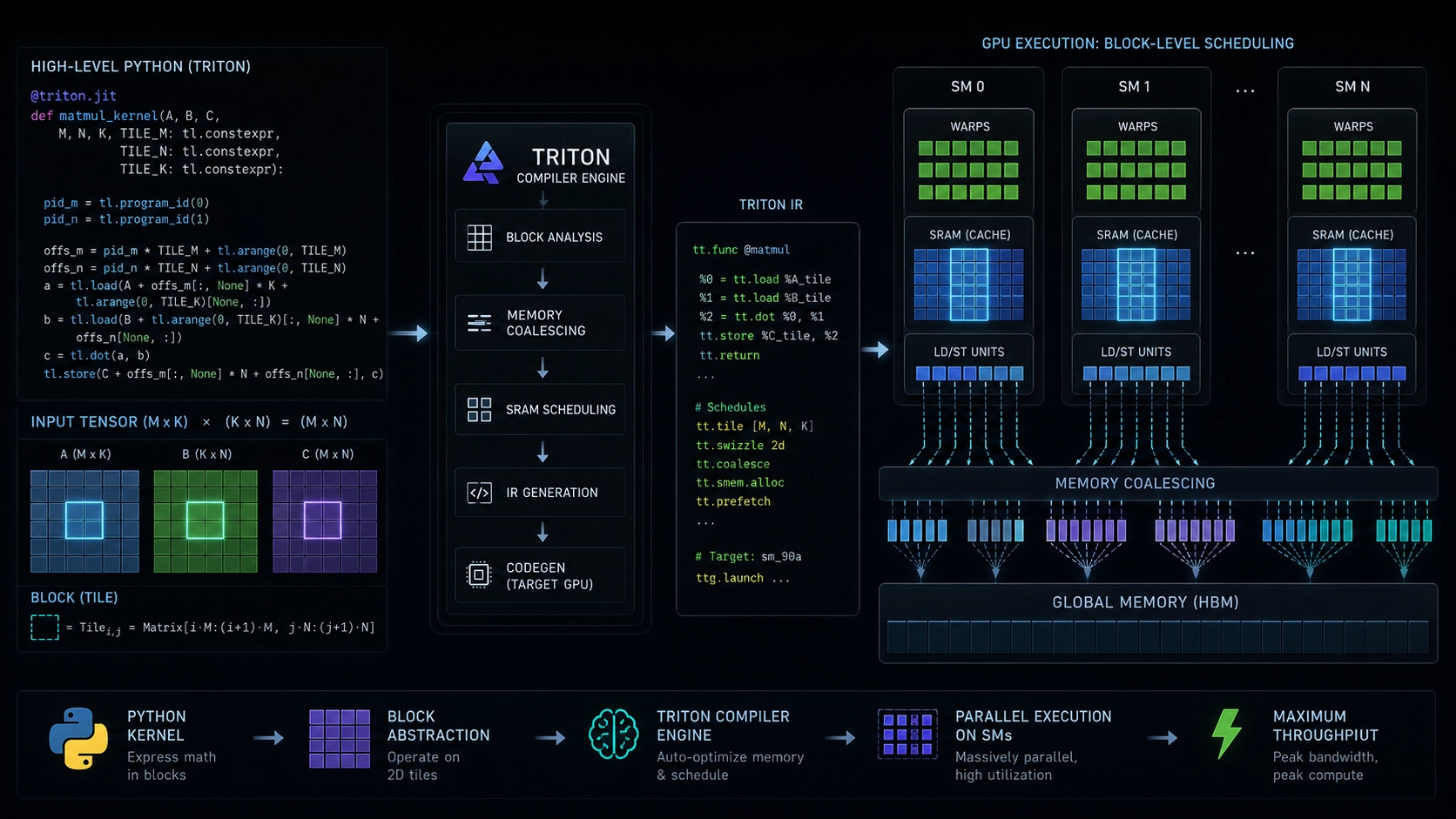
Graphics processing units derive their immense computational speed from massive parallelism. A modern artificial intelligence chip contains thousands of individual processing cores grouped into larger clusters known as Streaming Multiprocessors (SMs). To achieve maximum performance, data must physically move from the massive, slow global memory into the tiny, ultra-fast internal static random-access memory (SRAM) at the exact millisecond the processing cores require it.
Historically, programming these chips required writing manual kernels in NVIDIA’s Compute Unified Device Architecture (CUDA) language. Engineers had to manually assign mathematical operations to microscopic hardware threads. They had to group these threads into specific execution units and precisely calculate exactly how each thread would fetch a specific byte of data.
This manual alignment ensures the hardware reads the memory in one unified sweep, a critical thermodynamic process known as memory coalescing. If the threads request scattered data, the hardware executes multiple expensive reads, severely choking the total electrical bandwidth of the chip.
The Triton compiler completely abstracts away this thread-level micromanagement. Instead of forcing the human engineer to dictate the behavior of a single thread, Triton introduces a block-level programming paradigm. Developers define two-dimensional block coordinates to map specific chunks of an input matrix directly to the hardware SRAM, governed by the dimension indices:
$$\text{Tile}_{i,j} = \text{Matrix}[i \cdot M : (i+1) \cdot M, \ j \cdot N : (j+1) \cdot N]$$
Where M and N represent the geometric block dimensions optimizing the finite SRAM footprint. The compiler engine reads this block-level logic and autonomously generates the complex, low-level machine code. It automatically calculates the optimal memory coalescing patterns and dictates exactly when data should move into the cache. By managing these memory transfers algorithmically, the compiler mathematically ensures the hardware executes tensor operations with absolute peak electrical efficiency.
WHY IT MATTERS NOW
The global artificial intelligence economy is currently bottlenecked by a severe shortage of specialized human capital. While thousands of data scientists can write high-level neural networks in Python, only a tiny fraction possess the deep hardware physics knowledge required to write hyper-optimized custom CUDA kernels. This labor scarcity directly restricts how fast major research laboratories can experiment with novel mathematical architectures.
OpenAI developed the Triton compiler specifically to break this human bottleneck. By allowing researchers to write hardware-accelerated kernels in standard Python, the engine broadens access to extreme-performance GPU programming. An AI researcher can now draft a custom, memory-efficient algorithm in hours instead of weeks, achieving performance parity with hand-tuned hardware logic.
This software shift carries massive geopolitical and financial consequences for the global semiconductor supply chain. NVIDIA’s absolute dominance in the artificial intelligence market relies just as heavily on its proprietary CUDA software ecosystem as it does on its physical silicon. Because millions of legacy applications are hard-coded exclusively in CUDA, switching to a competitor’s hardware requires rewriting the entire corporate software stack from scratch.
Triton actively threatens this protective software moat. The compiler translates high-level block logic into an intermediate representation that is completely hardware-agnostic. Engineers can write the mathematical operations once and legally compile them to run on alternative hardware platforms, such as AMD’s Instinct accelerators.
This interoperability standardizes the artificial intelligence software layer. It gives hyperscale cloud providers the ultimate financial leverage to purchase cheaper, non-NVIDIA silicon without destroying their existing software infrastructure. Breaking the CUDA monopoly fundamentally relies on Triton successfully functioning as the universal translation layer.
WHAT MOST PEOPLE MISS
Software developers frequently assume that writing code closer to the physical hardware always yields superior performance. They view compilers as a convenient compromise that trades raw computational speed for human ease of use. They miss the mathematical paradox of modern GPU architecture: manual thread management has become so complex that human engineers routinely make microscopic alignment errors that destroy memory bandwidth.
Triton routinely outperforms average human-written CUDA code precisely because it removes human intuition from the process. The compiler relies on strict algorithmic heuristics to allocate SRAM and schedule block memory transfers. By mathematically guaranteeing perfect memory coalescing on every single data fetch, the automated engine ensures the GPU spends its electrical budget executing logic rather than waiting idly for scattered data.
THE TRAJECTORY
Next 12–36 Months: Major machine learning frameworks, specifically PyTorch 2.0, will fully default to Triton for their backend execution compilation. This integration will automatically accelerate millions of existing AI models upon recompilation, generating an immediate, global reduction in the total electricity consumed by artificial intelligence training clusters.
Next Five Years: The intermediate representation utilized by Triton will standardize across the entire semiconductor industry. Custom silicon manufacturers will design their new application-specific integrated circuits (ASICs) explicitly to accept Triton instructions, permanently decoupling global AI software development from any single hardware vendor’s proprietary ecosystem.
Next Ten Years: The compiler will transition from static compilation to dynamic, runtime self-optimization. The software engine will utilize localized machine learning to analyze the specific physical thermal constraints of the GPU it is currently running on, actively adjusting its own block sizes and memory schedules mid-calculation to prevent silicon thermal throttling.
What Could Go Wrong: NVIDIA actively guards its software monopoly. If NVIDIA releases a fundamentally new, highly complex streaming multiprocessor architecture and legally restricts the low-level documentation, the open-source Triton project will struggle to build the updated memory heuristics required to compile efficient code, immediately restoring the manual CUDA advantage.
Most Likely Outcome: The Triton compiler will establish itself as the absolute baseline for all future deep learning kernel generation. The era of manual, thread-level GPU programming will end entirely, transitioning into an era where mathematical abstractions dictate all hyperscale hardware execution.
KEY TERMS
- Streaming Multiprocessor (SM): The fundamental processing core within a graphics processing unit that executes parallel mathematical operations.
- Memory Coalescing: The hardware optimization technique where multiple scattered data requests are mathematically aligned into a single, highly efficient memory transaction.
- Static Random-Access Memory (SRAM): The ultra-fast, highly expensive microscopic memory banks located physically adjacent to the processing cores on the silicon die.
- Kernel: A specialized, self-contained software function specifically written to execute mathematical operations across thousands of parallel hardware threads simultaneously.
- Intermediate Representation (IR): A standardized, machine-readable code structure used by a compiler to transition high-level human programming into low-level physical hardware instructions.
SOURCES
- OpenAI Research — Triton: An Intermediate Language and Compiler for Tiled Neural Network Computations
- IEEE International Symposium on Code Generation and Optimization — Block-Level Abstractions for GPU Tensor Acceleration
- PyTorch Foundation — PyTorch 2.0: Compiling the Next Generation of Machine Learning
- Association for Computing Machinery (ACM) — Memory Coalescing and SRAM Scheduling in Highly Parallel GPU Architectures