Advertisement
)

AT A GLANCE
- Concept: Physical Translation: Software is not an ethereal concept; it is the physical manipulation of electrons flowing through microscopic silicon gates.
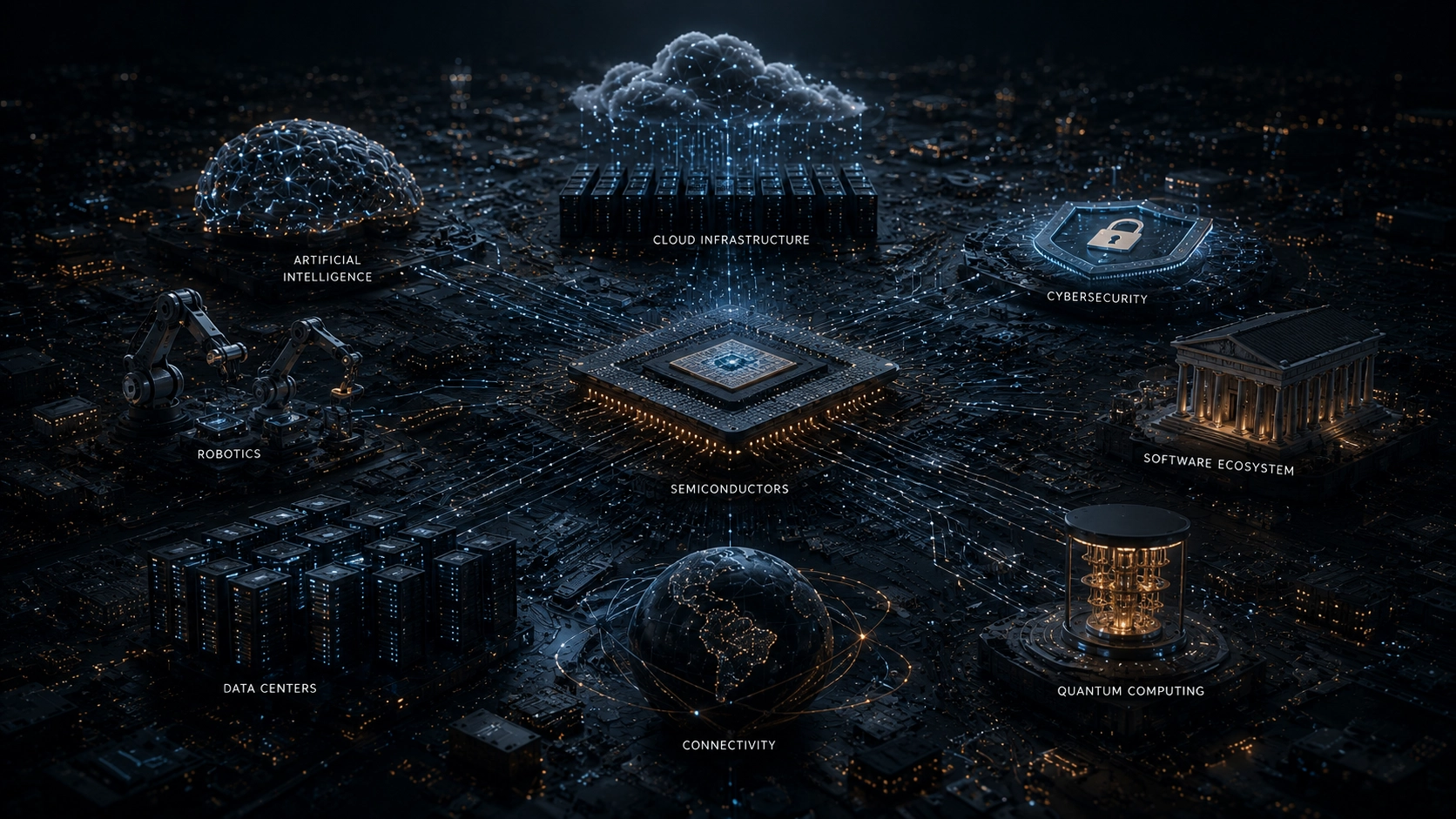
- Concept: The Stack Architecture: Computation operates in distinct layers, from raw semiconductor fabrication up to cloud infrastructure and cognitive artificial intelligence.
- Concept: Thermodynamic Constraints: The speed limit of the modern digital economy is no longer code, but the physics of generating electricity and dissipating heat.
- Concept: Geopolitical Monopoly: Control over highly specific manufacturing bottlenecks—like extreme ultraviolet lithography and advanced graphic processor design—dictates global sovereign power.
WHY THIS SYSTEM MATTERS
For the first two centuries of the industrial revolution, national power relied entirely on the extraction and refinement of physical commodities: coal, steel, and oil. Today, the foundational commodity of human civilization is computation.
Every modern system exists completely downstream of the computing stack. Global equity markets do not trade paper; they are algorithms executing high-frequency math inside data centers. Modern militaries do not fire dumb artillery; they launch flying computers that calculate real-time hypersonic interception vectors. Biological research no longer relies exclusively on petri dishes; scientists simulate protein folding using parallel supercomputers.
Historically, computation simply accelerated existing human processes. A spreadsheet calculated taxes faster than a human accountant. Today, computation has crossed a critical threshold into generative intelligence. Large language models and autonomous agents do not just accelerate tasks; they generate original logic, execute reasoning, and synthesize information independently.
Because computation now acts as a direct substitute for human cognitive labor, the entities that control the computing stack effectively control the future economic output of the planet. Nations that possess advanced artificial intelligence data centers will experience compounding productivity gains. Nations locked out of the semiconductor supply chain will suffer severe, irreversible economic stagnation. Computing is no longer a sector of the economy; computing is the entire operating system upon which the global economy runs.
HOW THE SYSTEM WORKS
At its lowest physical level, all computing is the controlled movement of electricity.
A computer relies on a transistor, a microscopic switch built from a semiconducting material like silicon. When engineers apply a specific voltage to the transistor’s gate, it allows electrical current to flow (representing a binary “1”). When they remove the voltage, the current stops (representing a binary “0”).
By wiring billions of these microscopic switches together, engineers create logic gates (AND, OR, NOT). These gates execute basic arithmetic. The energy required to switch a transistor relies on a strict physical relationship:
$$E = \frac{1}{2} C V^2$$
Where $E$ is the dynamic energy consumed, $C$ is the physical capacitance of the transistor gate, and $V$ is the voltage. To make computers faster and more efficient, engineers must constantly shrink the physical capacitance by making the transistors smaller, a trend historically described by Moore’s Law.
Because humans cannot manually organize billions of electrical switches, computing relies on extreme abstraction. The hardware executing the physical switches is abstracted by an operating system. The operating system provides a platform for programming languages. Programming languages allow developers to write human-readable code, which a compiler translates back down into the exact electrical binary instructions the silicon requires.
This localized architecture scales up into the macro-system. A single server connects to millions of other servers via fiber-optic cables, forming the internet. Today, hyperscale cloud providers group hundreds of thousands of servers into massive data centers. This allows developers to write code on a single laptop and instantly deploy it to run on millions of processors simultaneously across the globe, creating the illusion of infinite, invisible computing power.
MAJOR COMPONENTS
1. Semiconductors (The Physical Foundation) Semiconductors are the physical brains of the computing stack. Manufacturing them represents the most complex engineering process in human history. Foundries like TSMC use extreme ultraviolet (EUV) lithography to print circuit patterns onto silicon wafers. These patterns are so small—measured in single-digit nanometers—that a single processor can contain over eighty billion individual transistors. The industry is divided into distinct specializations. “Fabless” companies like NVIDIA, AMD, and Apple design the chip architectures but own no factories. They send their mathematical blueprints to foundries like TSMC or Samsung, which operate massive, $30 billion fabrication plants (fabs) to physically manufacture the silicon.
2. Computing Infrastructure (The Macro System) The cloud does not exist in the sky; it exists inside massive concrete buildings. Hyperscale data centers form the physical infrastructure of the internet. These facilities consume hundreds of megawatts of electricity. Inside, thousands of servers are networked together using high-speed optical transceivers. Because massive computation generates extreme waste heat, the infrastructure layer is fundamentally an exercise in thermodynamics. Operators must continually pump chilled water through direct-to-chip liquid cooling plates just to prevent the processors from melting their own silicon. The infrastructure extends across the ocean floor via thousands of miles of submarine fiber-optic cables, carrying petabytes of data between continents at the speed of light.
3. Artificial Intelligence (The Cognitive Layer) Traditional software executes rigid, hard-coded rules written by a human. Artificial intelligence bypasses manual programming through machine learning. Engineers feed massive datasets into a neural network—an algorithm modeled loosely on the human brain. Through a process called training, the algorithm uses matrix multiplication to identify mathematical patterns within the data. Once trained, the model executes “inference,” predicting the most likely correct answer to a novel query. Large Language Models (LLMs) rely on the Transformer architecture to understand context, predicting the next word in a sequence with extreme accuracy. This specific mathematical calculation requires massive parallel processing, pushing the industry away from traditional Central Processing Units (CPUs) and toward Graphics Processing Units (GPUs) designed exclusively for simultaneous tensor math.
4. Cybersecurity (The Defense Mechanism) Because all societal value now rests on digital infrastructure, cybersecurity acts as the mandatory immune system. The old model of “castle-and-moat” security—building a strong firewall around a corporate network—is obsolete in a cloud-first world. Modern systems utilize Zero Trust Architectures. The network assumes it is already compromised. Every single request between any two computers must be cryptographically verified using public-key infrastructure. Cryptography mathematically scrambles data so that even if an attacker intercepts the physical fiber-optic signal, they extract only useless noise. As computing power grows, cybersecurity must constantly evolve its mathematical encryption to stay ahead of brute-force decryption attempts.
5. Quantum Computing (The Next Paradigm)
Classical computers process binary bits (1 or 0). Quantum computers process quantum bits, or qubits. Through a physical property called superposition, a qubit can exist as a 1, a 0, or a complex probability of both simultaneously.
$$|\psi\rangle = \alpha|0\rangle + \beta|1\rangle$$
This allows quantum computers to calculate millions of possibilities simultaneously rather than sequentially. While still in its infancy and highly prone to error (decoherence), a mature quantum computer will instantly solve specific optimization, chemical simulation, and logistics problems that would take a classical supercomputer a million years to crack.
6. Robotics (The Embodied Layer) Robotics represents the physical manifestation of the computing stack. While AI operates in the digital realm, robotics forces algorithms to interact with gravity, friction, and unpredictable physical environments. Modern robotics merges advanced mechanical actuators with real-time computer vision. Utilizing Vision-Language-Action (VLA) models, robots no longer require hard-coded instructions for every movement. They observe their environment through cameras, process the spatial data through onboard neural networks, and autonomously calculate the precise motor torques required to navigate a warehouse or assemble a vehicle.
THE ECONOMICS
The computing stack requires the most extreme capital expenditure of any industry on Earth. Building a single modern semiconductor fabrication plant costs upwards of $30 billion. Equipping a single artificial intelligence data center costs over $5 billion in specialized GPUs, networking switches, and cooling infrastructure.
This brutal capital intensity creates absolute monopolies and oligopolies. Only three companies in the world (TSMC, Intel, Samsung) can physically manufacture leading-edge silicon. Only one company in the world (ASML) can build the EUV lithography machines required by those foundries. Only one company (NVIDIA) controls the dominant hardware and software ecosystem for AI training.
These bottlenecks dictate global economics. Hyperscale cloud providers (Amazon Web Services, Microsoft Azure, Google Cloud) spend tens of billions of dollars annually purchasing physical hardware. They recoup this investment by renting out the computing power at high margins. Startups and enterprise companies no longer buy their own servers; they pay a monthly operational expense to rent fractions of a massive hyperscale cluster.
This shifts the entire global economy from a capital ownership model to an operational rental model. Every time a user streams a video, orders food, or queries an AI, a micro-transaction flows back up the stack, enriching the foundational infrastructure providers.
GEOPOLITICAL IMPORTANCE
Computing is the primary axis of modern geopolitical conflict. The nation that controls the highest-quality silicon holds an absolute military and economic advantage.
The epicenter of this conflict is the island of Taiwan. TSMC manufactures over ninety percent of the world’s most advanced logic chips. If a military conflict or natural disaster halts Taiwanese production, the global supply chains for smartphones, automobiles, medical devices, and weapons systems will freeze instantly. Trillions of dollars of global GDP rely entirely on the operational continuity of a few factories located on a seismically active fault line.
Recognizing this vulnerability, the United States executed aggressive export controls against China. By legally blocking the sale of advanced AI training chips and semiconductor manufacturing equipment to Chinese firms, the US attempts to physically cap the cognitive capability of the Chinese military. In response, nations are aggressively subsidizing local manufacturing through initiatives like the CHIPS Act, desperately attempting to onshore fabrication to guarantee sovereign access to processing power.
Data sovereignty mirrors this hardware conflict. Nations are passing strict localization laws, demanding that the physical data of their citizens remain on servers located within their own borders, fundamentally fracturing the global internet into regional, highly fortified digital walled gardens.
CURRENT CHALLENGES
The computing stack faces a severe thermodynamic ceiling. As transistor sizes approach the physical width of individual atoms, electrons begin to leak through the logic gates via quantum tunneling, destroying electrical efficiency.
Artificial intelligence training exacerbates this crisis. Modern GPU clusters require massive amounts of continuous power. A single hyperscale data center now demands the electrical output of a medium-sized nuclear reactor. Local power grids lack the transmission capacity to support this hyper-growth, creating massive backlogs for data center construction.
Furthermore, the industry faces the “data wall.” Large language models consume the entire text of the public internet in a matter of months. As high-quality human data runs out, companies are forced to train new models on synthetic data—text generated by older AI models. If this feedback loop degrades, the models suffer model collapse, mathematically losing their ability to generate coherent logic.
WHAT MOST PEOPLE MISS
The general public treats “the cloud” and “AI” as ethereal, almost magical concepts that exist in the air. They completely miss the brutal, heavy-industry reality of the computing stack.
Software has profound physical weight. Every digital action requires digging lithium out of the ground for batteries, smelting copper for transmission lines, laying fiber-optic glass across the ocean floor, and pumping thousands of gallons of water to cool server racks.
When a user asks an artificial intelligence a simple question on their phone, they are triggering a physical chain reaction that spans thousands of miles. The request beams to a cell tower, travels through a submarine cable, hits a server rack in Virginia, forces millions of microscopic silicon gates to violently switch state, generates physical heat, and sends the answer back. The internet is the largest, heaviest, and most physically complex machine humans have ever built.
THE TRAJECTORY
Next 12–36 Months: The transition from passive AI chatbots to active AI agents. Artificial intelligence models will gain direct read-write access to enterprise software, executing complex, multi-step workflows autonomously, fundamentally disrupting entry-level corporate white-collar labor.
Next Five Years: The proliferation of custom, application-specific integrated circuits (ASICs). Cloud providers will heavily deploy their own proprietary silicon explicitly designed for AI inference, breaking the reliance on general-purpose GPUs and driving down the baseline cost of running generative intelligence.
Next Ten Years: Advanced robotics will solve the physical labor shortage. Pre-trained foundational AI models will be downloaded directly into standardized humanoid robotic chassis, allowing massive automation of logistics, manufacturing, and healthcare.
What Could Go Wrong: An escalation in the Taiwan Strait blocks global access to TSMC. Without a continuous supply of replacement parts and new silicon, the hyperscale data centers slowly degrade. Global technological progress halts immediately, triggering a massive deflationary spiral across all technology-dependent economic sectors.
Most Likely Outcome: Computation will cement itself as a sovereign utility, managed and guarded like a national power grid. The physical infrastructure of intelligence will consolidate into a handful of massive, highly regulated global entities, while the application layer fragments into billions of highly personalized, autonomous algorithmic agents.
FREQUENTLY ASKED QUESTIONS
- What exactly is a semiconductor? A semiconductor is a material, typically silicon, that can conditionally conduct electricity. Engineers manipulate this material to build microscopic transistors, acting as the fundamental physical switches that process all digital logic.
- How does a GPU differ from a CPU? A Central Processing Unit (CPU) has a few highly complex cores designed to handle sequential tasks quickly. A Graphics Processing Unit (GPU) has thousands of simpler cores designed to process massive amounts of basic math simultaneously, making it perfectly suited for training artificial intelligence networks.
- What is EUV lithography? Extreme Ultraviolet (EUV) lithography is a manufacturing process that uses light with a wavelength of 13.5 nanometers to print impossibly small circuit patterns onto silicon wafers. ASML is the only company capable of building these machines.
- Why is TSMC so dominant? Taiwan Semiconductor Manufacturing Company (TSMC) operates as a pure-play foundry. By never designing its own chips, it avoids competing with its customers. This trust, combined with decades of massive capital reinvestment, allowed them to master the extreme chemistry required to yield advanced logic chips reliably.
- What is a Large Language Model (LLM)? An LLM is a massive neural network trained on vast amounts of text. By utilizing the Transformer architecture, it analyzes the mathematical probability of word sequences, allowing it to understand context and generate highly accurate, human-like text responses.
- What is the cloud, physically? The cloud is a global network of massive, heavily fortified data centers. These concrete buildings contain hundreds of thousands of computer servers, massive cooling systems, and redundant backup power generators, all connected via fiber-optic cables.
- Why does artificial intelligence consume so much power? Training an AI requires running trillions of matrix multiplication calculations simultaneously across tens of thousands of GPUs for months. Every calculation requires physical electrical current, converting massive amounts of electricity directly into computational logic and waste heat.
- What is edge computing? Edge computing physically moves data processing closer to the user or device generating the data, rather than sending it to a centralized cloud. This reduces latency, allowing autonomous vehicles and factory robots to make split-second calculations without relying on an internet connection.
- How does quantum computing work? While classical computers use bits representing 1 or 0, quantum computers use qubits. Through quantum superposition and entanglement, qubits can represent complex probabilities, theoretically allowing the machine to solve complex optimization problems instantly that would take a classical computer millions of years.
- What is a Zero Trust architecture? Zero Trust is a cybersecurity framework that abandons the concept of a safe internal network. It requires strict identity verification and cryptographic authorization for every single user, device, and software request, regardless of whether they are located inside or outside the corporate firewall.
- What is an Application-Specific Integrated Circuit (ASIC)? An ASIC is a custom silicon chip designed to perform one specific calculation perfectly, rather than handling general-purpose tasks. Cryptocurrency mining rigs and Google’s Tensor Processing Units (TPUs) are ASICs.
- What does “node size” (e.g., 3nm, 2nm) mean? Historically, node size referred to the physical length of a transistor gate. Today, it is largely a marketing term indicating a new generation of chip manufacturing technology that offers higher density, better performance, and lower power consumption than the previous generation.
- What is inference in artificial intelligence? Training is the process of teaching an AI model by feeding it data. Inference is the operational phase where the trained model actually answers a user’s prompt or analyzes new data in real-time.
- How do submarine cables impact the computing stack? Over 95 percent of international internet traffic travels through physical fiber-optic cables laid across the ocean floor. If these physical cables are severed by anchors or hostile submarines, international data flow ceases instantly.
- What is model alignment? Alignment is the highly complex mathematical process of fine-tuning a raw artificial intelligence model to ensure its outputs adhere to human safety guidelines, preventing the model from generating toxic, biased, or dangerous information.
KEY TERMS
- Transistor: A microscopic semiconductor device that acts as an electrical switch to process binary logic.
- Foundry: A massive manufacturing facility dedicated exclusively to physically printing semiconductor chips based on designs provided by other companies.
- EUV Lithography: An advanced manufacturing technology using extreme ultraviolet light to print nanometer-scale circuits on silicon.
- GPU (Graphics Processing Unit): A specialized processor utilizing thousands of cores to execute simultaneous parallel calculations, essential for AI training.
- Hyperscaler: Massive global technology companies (like AWS, Microsoft, Google) that operate vast, geographically distributed data center networks.
- Submarine Cable: Fiber-optic cables laid on the ocean floor that carry the vast majority of international internet data traffic.
- Transformer Architecture: A deep learning architecture that tracks relationships in sequential data to understand context, forming the basis of all modern language models.
- Neural Network: A computing algorithm modeled on the human brain, utilizing interconnected nodes to recognize patterns in raw data.
- LLM (Large Language Model): An artificial intelligence model trained on massive text datasets to understand and generate human language.
- Qubit: The fundamental unit of quantum information, capable of existing in multiple states simultaneously due to quantum superposition.
- Edge Computing: A decentralized computing architecture that processes data physically close to the source to reduce latency and bandwidth usage.
- Zero Trust: A strict cybersecurity paradigm requiring constant, cryptographic verification for every user and device attempting to access network resources.
- ASIC: A custom-designed semiconductor chip engineered to execute one specific, highly optimized mathematical task.
- Inference: The live operational phase of an artificial intelligence model where it processes new data and generates outputs.
- Moore’s Law: The historical observation that the number of transistors on a microchip doubles roughly every two years, driving down the cost of computation.