Advertisement
)

AT A GLANCE
- Concept: Batch Processing: Banks do not send money instantly; they stockpile millions of transaction instructions into single, highly structured files.
- Concept: Multilateral Netting: Algorithms mathematically cancel out opposing transactions between banks, drastically reducing the actual capital requiring physical transfer.
- Concept: Format Validation: The Federal Reserve verifies the exact syntax of the text file before authorizing any movement of central bank reserves.
- Concept: Settlement Risk: If a commercial bank collapses before the daily batch clears, the pending text instructions instantly become toxic, unfunded liabilities.
HOW IT WORKS
When an employer pays a worker via direct deposit, physical money does not move. The employer’s bank, acting as the Originating Depository Financial Institution (ODFI), creates a single line of text code. This code contains routing numbers, account digits, and the exact dollar amount of the transaction.
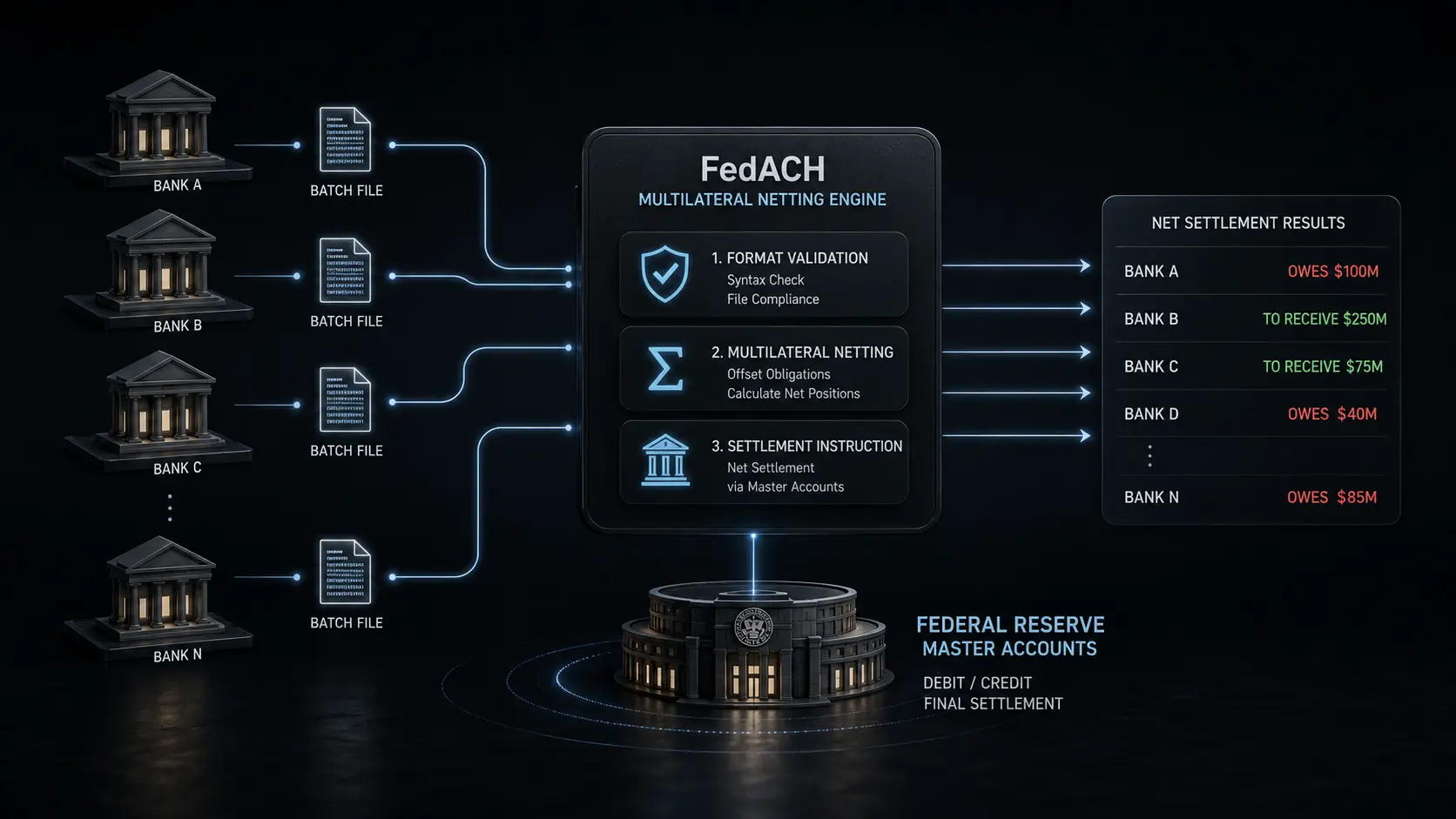
The bank stockpiles millions of these individual text lines throughout the business day. At a designated cutoff time, it packages them into a flat data file governed by strict rules set by NACHA, the governing body for the network. The bank transmits this batch file to a central clearing operator, primarily FedACH, managed by the Federal Reserve.
FedACH does not instantly transfer the funds. Instead, it executes rigorous format validation. The central system parses the incoming file to ensure the data strictly adheres to the mandated syntax, automatically rejecting any flawed files to prevent cascading accounting errors across the banking system.
Once validated, the Federal Reserve applies multilateral netting. If Bank A owes Bank B one billion dollars, and Bank B owes Bank A nine hundred million dollars, moving the full amounts creates unnecessary liquidity strain. The algorithm mathematically nets the opposing flows across all participating institutions. It instructs Bank A to send exactly one hundred million dollars to Bank B. The Federal Reserve executes this final, compressed transfer by debiting and crediting the respective master accounts held by the commercial banks at the central bank.
WHY IT MATTERS NOW
The ACH pipeline processes over 30 billion transactions annually, moving roughly $80 trillion across the American economy. It functions as the absolute baseline infrastructure for civilian capital distribution. Every corporate payroll, social security check, and automated mortgage payment relies entirely on the structural integrity of this netting algorithm.
This architecture directly dictates domestic banking liquidity. Multilateral netting reduces the actual amount of capital that must physically move between banks by over ninety percent. This extreme capital efficiency allows commercial banks to maintain lower cash reserves at the central bank, freeing up billions of dollars to deploy into high-yield corporate lending and consumer credit markets.
However, this delayed batch system creates massive intraday settlement risk. Between the moment a bank submits a file and the moment the Federal Reserve physically settles the master accounts, the system operates purely on uncollateralized trust. If a mid-sized regional bank collapses at noon, its pending ACH files remain in the pipeline, creating a sudden mathematical void in the daily clearing cycle.
To manage this risk, regulators heavily monitor the specific intraday credit limits of every participating institution. If a bank attempts to submit an ACH file that exceeds its federally mandated capital buffers, FedACH automatically halts the batch. This automated circuit breaker prevents a localized bank failure from transmitting toxic, unfunded liabilities through the central clearinghouse and infecting the broader financial system.
WHAT MOST PEOPLE MISS
Consumers fundamentally confuse messaging with settlement. When a retail banking application displays a pending direct deposit on a Thursday, the user assumes the money is sitting in their account. In reality, the user is merely looking at a graphical representation of an unverified text file; the actual central bank reserves will not settle and legally transfer until Friday morning.
This temporal gap functions as a highly lucrative float for commercial banks. Institutions aggressively utilize the mechanical delay between the time they debit a corporate payroll account and the time they must surrender the funds to the Federal Reserve. By holding billions of dollars of corporate cash for an extra twelve hours, banks execute short-term overnight lending, mathematically generating massive, risk-free interest revenue purely from the latency of the batch system.
THE TRAJECTORY
Next 12–36 Months: The Federal Reserve will continuously expand the operating hours for Same Day ACH processing. This will force commercial banks to upgrade their core ledger software to handle multiple, high-frequency batch settlements per day, shrinking the lucrative overnight float window.
Next Five Years: The ACH network will transition entirely away from 1970s-era flat files to the ISO 20022 XML messaging standard. This richer data format will embed complex invoicing and remittance data directly into the settlement file, heavily automating corporate accounting and reducing the need for manual reconciliation.
Next Ten Years: Real-time gross settlement systems, like FedNow, will begin aggressively cannibalizing the low-value, high-velocity segments of the ACH network. Instant payment rails will settle transactions individually in milliseconds, bypassing the multilateral netting algorithm entirely for peer-to-peer and point-of-sale retail transfers.
What Could Go Wrong: If a sophisticated state-sponsored cyberattack successfully injects malicious code into the FedACH format validation engine, the central operator could inadvertently approve structurally corrupted batch files. This would instantly misroute billions of dollars across thousands of banks, forcing the Federal Reserve to completely halt the U.S. payments system to manually unwind the corrupted ledgers.
Most Likely Outcome: The ACH network will remain the undisputed, heavy-lift transport layer for massive, scheduled institutional capital flows. While retail consumers will shift toward instant settlement rails, large corporations and government treasuries will continue relying on the absolute capital efficiency provided by end-of-day multilateral netting.
KEY TERMS
- Automated Clearing House (ACH): An electronic network for financial transactions in the United States that processes massive volumes of credit and debit transfers in batches.
- Multilateral Netting: A mathematical process that offsets the total obligations among multiple parties to calculate a single, minimized net balance for final settlement.
- Originating Depository Financial Institution (ODFI): The specific commercial bank that creates the original batch file and transmits the transaction data into the ACH network.
- FedACH: The central automated clearinghouse service operated by the Federal Reserve Banks, responsible for validating, sorting, and clearing batch files.
- Float: The double-counted money present in the banking system during the time delay between a transaction being initiated and the funds physically settling at the central bank.
SOURCES
- Board of Governors of the Federal Reserve System — Payment System Risk Policy and Intraday Credit Mechanics
- NACHA (National Automated Clearing House Association) — ACH Network Rules and Operating Guidelines
- Bank for International Settlements (BIS) — The Role of Multilateral Netting in Payment System Efficiency
- U.S. Department of the Treasury — Financial Management Service and Automated Payment Processing Architectures