Advertisement
)

AT A GLANCE
- Concept: Leveraged Loans: The raw material of a CLO consists of high-yield, floating-rate debt issued by heavily indebted corporations.
- Concept: The Waterfall: Cash generated by the loan pool flows strictly from the top (AAA-rated) down to the bottom (Equity).
- Concept: Default Absorption: If a company goes bankrupt, the equity tranche takes a 100 percent loss on that loan before any other tier feels the impact.
- Concept: Coverage Triggers: Automated accounting tests constantly monitor the loan pool, instantly cutting off cash to the equity tranche if overall credit quality drops.
HOW THE CLO EQUITY TRANCHE WORKS
A Collateralized Loan Obligation (CLO) is a financial machine designed to transform risky corporate debt into highly structured, investment-grade bonds. Wall Street banks aggregate hundreds of high-yield, floating-rate loans from companies with poor credit ratings. They place these loans into a single massive pool, essentially creating a diversified portfolio of corporate debt.
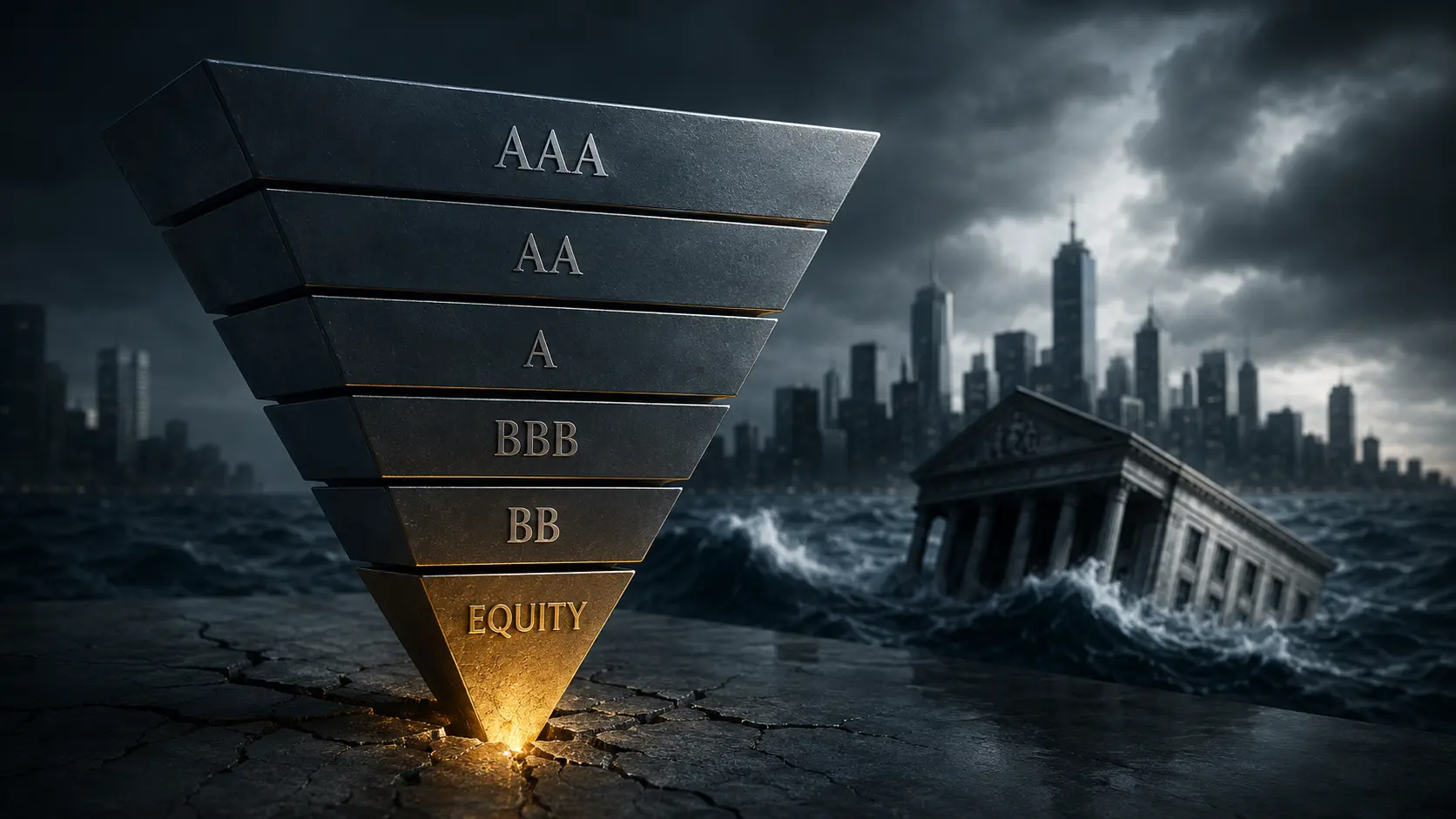
The CLO manager then issues distinct classes of bonds, known as tranches, backed by the cash flow from this specific pool. These tranches are stacked in a strict hierarchy called the cash flow waterfall. At the top sits the AAA tranche, which receives the lowest interest rate but holds the absolute first claim on any cash generated by the underlying loans.
Below the AAA sit the AA, A, BBB, and BB tranches, each accepting slightly more risk for a higher yield. At the absolute bottom of this structure lies the equity tranche. The equity tranche is not a bond; it is an unrated ownership claim on the residual cash flow of the entire CLO.
When the underlying corporations make their monthly interest payments, the cash enters the top of the waterfall. The CLO algorithm mathematically pays the AAA investors first, then the AA, moving downward sequentially. Once all the debt tranches receive their guaranteed interest, every remaining dollar pools at the bottom for the equity investors.
Because the equity tranche represents a tiny fraction of the total CLO capital structure, it captures an outsized yield. It routinely generates 15 to 20 percent annual returns in healthy economic environments. However, the equity tranche is the designated shock absorber for the entire multi-billion-dollar structure.
If an underlying corporation defaults on its loan, the total cash entering the waterfall shrinks. The top tranches remain unaffected because they are paid first, forcing the equity tranche to absorb the entire financial loss. To enforce this protection, CLOs utilize rigid Overcollateralization (OC) and Interest Coverage (IC) tests.
If the ratio of performing loans to outstanding debt drops below a mathematical threshold, these tests instantly trigger. The waterfall halts at the BB tier, entirely severing cash flow to the equity tranche. The algorithm redirects those funds back to the top to rapidly pay down the senior AAA debt until the portfolio mathematically restabilizes.
WHY IT MATTERS NOW
The CLO market currently holds over one trillion dollars in corporate debt, functioning as the primary shadow banking engine for the global private equity industry. When a private equity firm executes a debt-financed acquisition of a major corporation, they fund the purchase by issuing massive amounts of floating-rate debt. Wall Street banks immediately securitize this debt into CLOs.
Without the CLO machine continuously buying these high-yield loans, the entire private equity acquisition model would freeze overnight. This architecture creates a brilliant, yet precarious, transfer of systemic risk. The AAA tranches are purchased almost exclusively by global pension funds, insurance companies, and commercial banks seeking safe, regulated yields.
The equity tranches are purchased by specialized hedge funds and the private equity firms themselves. The CLO structure mathematically isolates the toxic default risk of corporate America and concentrates it entirely into the equity tranche. This allows pension funds to finance debt-funded corporate buyouts while maintaining the strict illusion of absolute safety.
The system is currently undergoing unprecedented stress due to structurally elevated interest rates. Leveraged loans are floating-rate instruments, meaning their interest payments mechanically adjust upward when central banks hike baseline rates. While this generates massive incoming cash flow for the CLO waterfall in the short term, it places extreme financial strain on the underlying corporations.
Companies that borrowed billions when debt was essentially free are now structurally incapable of servicing their new, vastly higher interest obligations. As corporate defaults rise, the automated OC tests within the CLOs are beginning to trip. This dynamic silently strangles the cash flow to the equity tranches.
Investors who modeled double-digit yields are suddenly trapped in positions generating zero cash. The CLO equity market dictates the baseline cost of capital for speculative-grade companies. As equity investors demand higher risk premiums to absorb these defaults, heavily indebted corporations face an insurmountable wall of refinancing costs, setting the stage for a localized wave of corporate bankruptcies.
WHAT MOST PEOPLE MISS
Mainstream financial media frequently mischaracterizes CLOs as a repeat of the 2008 mortgage-backed securities crisis. They completely miss the structural difference between consumer mortgages and corporate loans. A 2008 CDO failed because it was built on fraudulent, undocumented residential mortgages that defaulted simultaneously.
A modern CLO is built on senior secured corporate debt. If a corporation goes bankrupt, the CLO holds a direct legal claim on the company’s physical assets. This guarantees a high recovery rate that mathematically protects the AAA tranches even in a severe economic recession.
The hidden incentive of the system lies in the compensation structure of the CLO manager. The manager who selects the loans and builds the waterfall is rarely a neutral party. They frequently retain a significant portion of the equity tranche themselves, creating a severe structural misalignment.
Because the equity tranche captures all the excess yield, the manager is mathematically incentivized to pack the underlying pool with the riskiest, highest-yielding loans legally permitted by the CLO charter. They deliberately push the portfolio to the absolute brink of the OC test thresholds. This maximizes their own short-term equity payouts while secretly eroding the long-term safety margin intended to protect the senior pension fund investors.
THE TRAJECTORY
Next 12–36 Months: Defaults in the high-yield loan market will trigger localized OC test failures across older CLO vintages. Equity tranche cash flows will sharply sever, forcing specialized hedge funds to liquidate their positions at severe discounts to private credit vultures specializing in distressed debt.
Next Five Years: The complete convergence of Middle Market CLOs and Private Credit. As traditional banks retreat from corporate lending due to Basel III capital requirements, massive private credit firms will directly originate loans and immediately securitize them into proprietary CLOs, completely bypassing the syndicated Wall Street banking syndicate.
Next Ten Years: The automation of CLO portfolio management via machine learning. AI algorithms will continuously analyze corporate cash flow statements and macroeconomic telemetry, autonomously trading loans within the CLO pool in milliseconds to mathematically optimize the arbitrage spread between the underlying assets and the debt liabilities.
What Could Go Wrong: A severe, prolonged stagflationary recession. If corporate earnings collapse simultaneously with structurally high interest rates, recovery rates on defaulted loans will plummet below historical averages. The equity tranches will be instantly wiped out, and the resulting losses will bleed upward into the BB and BBB tranches, triggering a cascading liquidity crisis across the global shadow banking system.
Most Likely Outcome: The CLO structure will remain the absolute bedrock of corporate debt securitization. However, the equity tranche will transition from a high-yield retail investment into a highly specialized, illiquid instrument traded exclusively by distressed debt funds capable of actively restructuring the bankrupt corporations trapped at the top of the waterfall.
KEY TERMS
- Collateralized Loan Obligation (CLO): A highly structured financial vehicle that pools risky corporate loans and issues tiered bonds backed by the cash flow of those loans.
- Cash Flow Waterfall: The strict legal and mathematical hierarchy that dictates exactly how interest and principal payments are distributed to investors, prioritizing senior debt over equity.
- Leveraged Loan: A high-yield, floating-rate commercial loan extended to a corporation that already possesses significant amounts of existing debt or a poor credit history.
- Overcollateralization (OC) Test: An automated accounting mechanism within a CLO that redirects cash flow away from the equity tranche if the total value of the loan pool drops below a safe threshold.
- Arbitrage Spread: The financial profit generated by the mathematical difference between the high interest earned on the underlying corporate loans and the lower interest paid out to the CLO bondholders.
SOURCES
- Federal Reserve Board — Financial Stability Implications of Collateralized Loan Obligations
- Securities and Exchange Commission (SEC) — Complex Structured Finance and CLO Market Microstructure
- Bank for International Settlements (BIS) — The Macroeconomic Mechanics of Leveraged Finance and CLO Tranching
- Standard & Poor’s Global Ratings — CLO Default Metrics and Overcollateralization Test Analytics