Advertisement
)
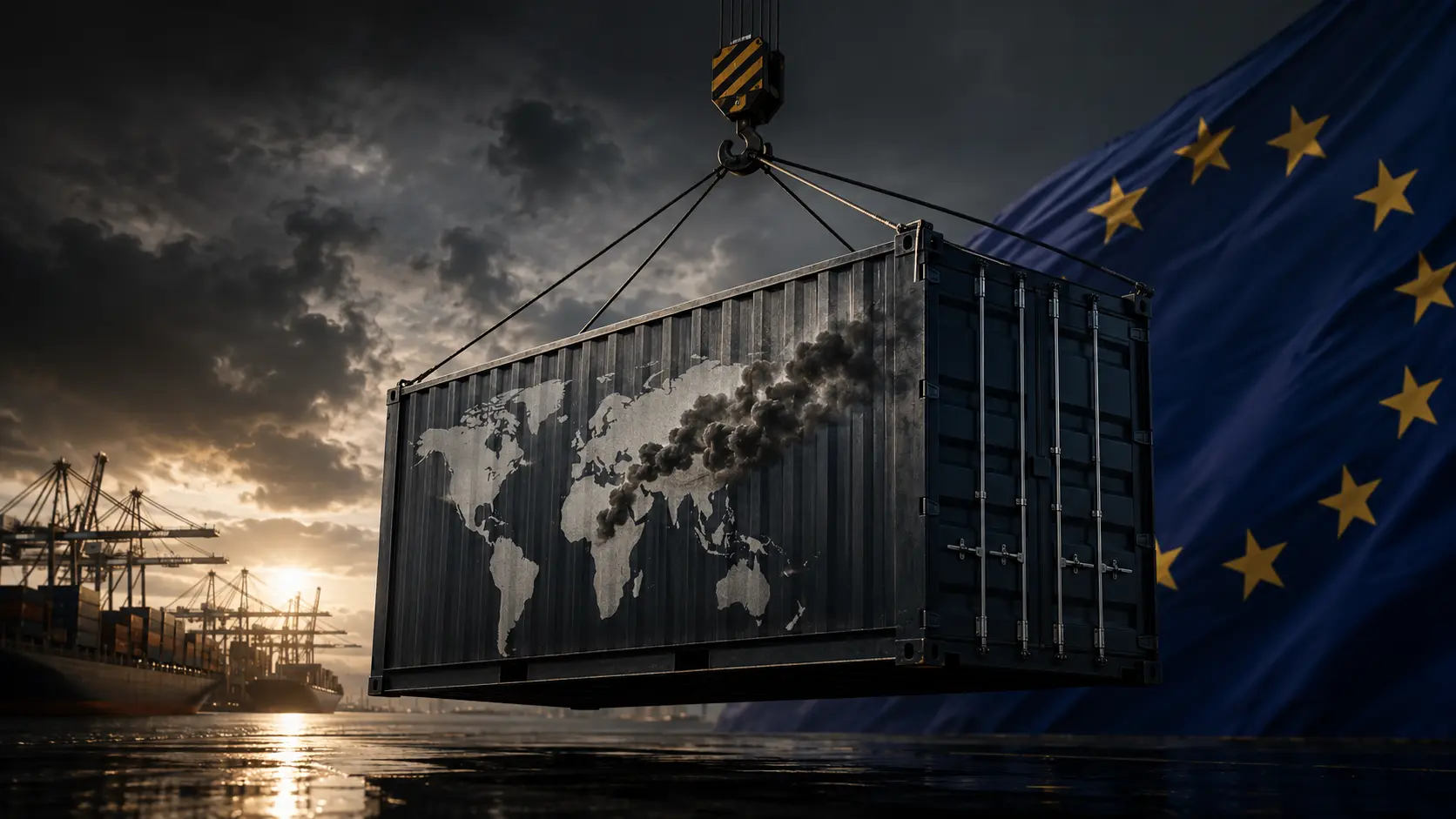

AT A GLANCE
- Concept: Carbon Leakage: CBAM ensures foreign competitors cannot undercut domestic manufacturers by offshoring their industrial emissions.
- Concept: Embedded Emissions: The system tracks the exact tonnage of greenhouse gases emitted during foreign product manufacturing.
- Concept: Algorithmic Pricing: Importers purchase certificates strictly pegged to the volatile pricing of the European carbon market.
- Concept: Default Penalties: Regulators apply artificially high financial penalties to importers lacking verified foreign factory emission telemetry.
HOW THE CARBON BORDER ADJUSTMENT MECHANISM WORKS
The European Union Emissions Trading System (EU ETS) forces domestic heavy industry to purchase allowances for every ton of carbon dioxide they emit. This strict carbon pricing mathematically raises the production cost of European steel, aluminum, and chemicals. To prevent companies from closing European factories and importing cheaper, dirtier materials from abroad—a process known as carbon leakage—the European Commission engineered the Carbon Border Adjustment Mechanism (CBAM).
CBAM functions as a dynamic, algorithmic import tariff. It does not tax the financial value of the goods; it taxes the specific carbon intensity of the manufacturing process. When a European company imports a shipment of covered goods, they must declare the exact volume of embedded emissions contained within that physical shipment.
To legally clear customs, the importer must purchase and surrender CBAM certificates matching this declared emission volume. The price of these certificates is not static. In 2026, the European Commission prices these certificates quarterly based on the volume-weighted average of the EU ETS auction clearing prices, hovering near €75 per ton.
Beginning in 2027, this algorithmic peg shifts to a weekly rolling average. This structural change directly links the cost of international imports to the real-time volatility of the European carbon market. Importers are forced to continuously hedge their physical supply chains against financial carbon pricing fluctuations.
The system incorporates a strict deduction mechanism to avoid double taxation. If the foreign manufacturer already paid a legally mandated carbon price in their home country, the EU importer subtracts that exact financial value from their CBAM certificate obligation. This mathematical equation forces foreign nations to either implement their own domestic carbon pricing or passively surrender that tax revenue directly to Brussels.
WHY IT MATTERS NOW
The definitive financial phase of CBAM officially activated on January 1, 2026. This transitions the framework from a harmless reporting exercise into a brutal, margin-crushing financial liability. Global commodity markets no longer price industrial materials strictly by their physical weight and metallurgical grade; they now price the exact thermochemical efficiency of the foreign factory that produced them.
This alters the fundamental calculus of global supply chain economics. An importer evaluating a shipment of Indian steel and a shipment of American steel must now mathematically calculate the specific kiln thermal efficiency and localized grid carbon intensity of each source. If a factory relies on a coal-fired power grid, the resulting CBAM certificate penalty instantly erases the geographical labor savings.
To enforce compliance, the European Commission strictly applies punitive default values. If an importer cannot secure verified, third-party audited emissions telemetry directly from their foreign supplier, they are legally forced to use EU-generated default emission benchmarks. In 2026, these default values feature an automatic ten percent upward penalty markup.
This markup intentionally overcharges the importer. Regulators engineered this physical financial pain to ruthlessly incentivize the deployment of localized factory sensors and transparent carbon accounting across the developing world. Foreign suppliers refusing to install verified emissions tracking physically lose their cost competitiveness overnight.
This dynamic aggressively weaponizes European market access to force global industrial decarbonization. Major exporting nations are rapidly scrambling to restructure their domestic heavy industry simply to retain their European buyers. Developing economies lacking the capital to rapidly deploy low-carbon manufacturing technologies face structural exclusion from the world’s most lucrative single market.
WHAT MOST PEOPLE MISS
Trade commentators routinely analyze CBAM strictly as an environmental policy designed to lower global emissions. They entirely miss its function as an aggressive, highly engineered protectionist shield for European heavy industry. By artificially inflating the cost of foreign goods, the EU protects its domestic steel and cement conglomerates from international price competition while simultaneously stripping them of their free EU ETS carbon allowances.
Procurement departments also incorrectly assume CBAM applies exclusively to raw, unprocessed commodities. They fail to track the aggressive regulatory expansion targeting downstream manufactured goods. When the mechanism expands to include complex machinery and automotive components in 2028, manufacturers will be forced to meticulously trace the microscopic embedded emissions of every individual screw and aluminum housing originating from deeply nested Asian supply chains.
THE TRAJECTORY
Next 12–36 Months: The European Commission will deploy the common central platform for CBAM certificate purchasing and surrender. Importers will execute their first massive financial compliance purchases in February 2027 to cover their 2026 embedded emission liabilities, triggering severe localized cash flow crises for mid-sized European logistics and procurement firms.
Next Five Years: CBAM will expand aggressively down the manufacturing value chain to include 180 new downstream products. This will force global aerospace, automotive, and heavy machinery conglomerates to mandate strict carbon telemetry hardware requirements for their lowest-tier suppliers across China and Southeast Asia.
Next Ten Years: The proliferation of carbon border adjustments will balkanize global trade. The United States, the United Kingdom, and Japan will implement their own localized versions of CBAM, establishing completely isolated, mathematically incompatible carbon pricing zones that force multinational corporations to continuously reroute raw materials based on real-time algorithmic tariff arbitrage.
What Could Go Wrong: Severe retaliation through the World Trade Organization (WTO). Developing nations, heavily dependent on commodity exports, aggressively litigate CBAM as an illegal, discriminatory trade barrier. If a massive trade bloc like the BRICS nations synchronizes retaliatory tariffs against European high-value exports, it could trigger a catastrophic, decade-long global trade war that shatters the established rules-based international order.
Most Likely Outcome: The embedded carbon intensity of a product will become an immutable, globally tracked physical property, heavily monitored and traded exactly like currency. The nations that successfully mandate transparent, low-carbon industrial grids will permanently capture the export market share of nations that fail to decarbonize.
KEY TERMS
- Carbon Border Adjustment Mechanism (CBAM): An EU regulatory framework that places a strict financial price on the greenhouse gases emitted during the production of imported carbon-intensive goods.
- Embedded Emissions: The exact, mathematically verifiable volume of carbon dioxide released into the atmosphere to manufacture a specific physical product.
- Carbon Leakage: The economic phenomenon where strict domestic environmental regulations force businesses to transfer their physical production to foreign countries with weaker emission laws.
- EU Emissions Trading System (ETS): The internal European carbon market that caps total emissions and forces heavy industry to buy and trade pollution allowances.
- Default Values: Punitive, artificially high emission estimates applied by regulators when an importer fails to provide verified, factory-level carbon accounting data.
SOURCES
- European Commission Directorate-General for Taxation and Customs Union — Carbon Border Adjustment Mechanism Definitive Phase Regulations
- World Trade Organization (WTO) — Trade and Environment Contexts: The Legality of Carbon Border Adjustments
- International Carbon Action Partnership (ICAP) — Global ETS Pricing and CBAM Implementation Timelines
- Oxford Institute for Energy Studies — The Geopolitics of Carbon Pricing and Industrial Supply Chain Shocks