Advertisement
)
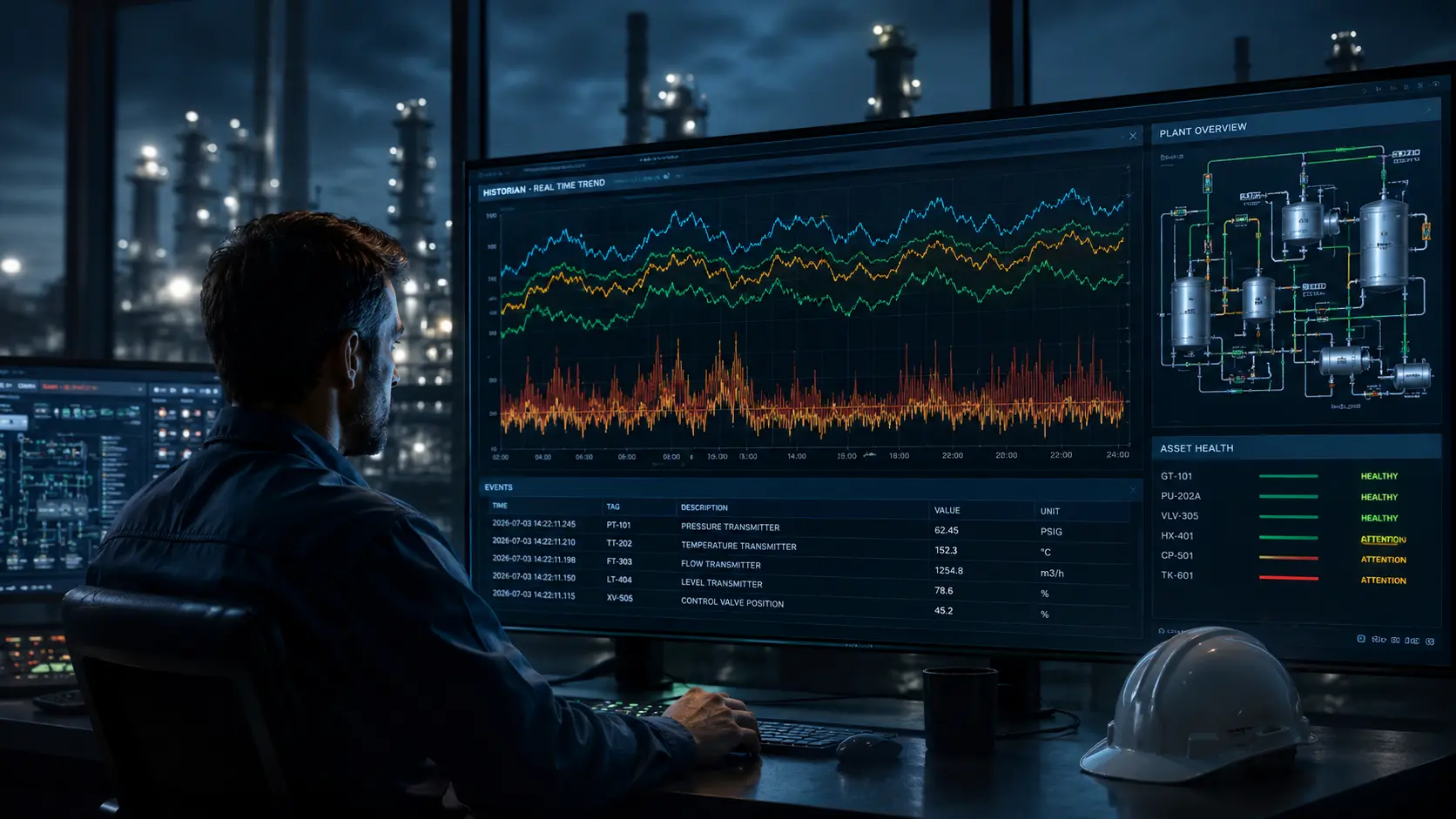

AT A GLANCE
- Concept: The Relational Limit: Standard databases crash if forced to log 100,000 rapid, continuous temperature updates per second from a single turbine.
- Concept: Time-Series Architecture: Historians index data not by complex categories or relationships, but strictly by a single, unyielding metric: the exact millisecond the event occurred.
- Concept: Algorithmic Compression: To prevent petabytes of data from overwhelming local hard drives, historians use “swinging door” algorithms to quietly delete redundant data points that do not represent a physical change in the machine’s state.
- Concept: The Forensic Ledger: When a regional power grid violently collapses, the historian is the only system capable of providing the exact chronological timeline required to determine the physical cause.
HOW A SCADA HISTORIAN WORKS
Industrial infrastructure operates through Supervisory Control and Data Acquisition (SCADA) networks. These networks are vast, decentralized webs of Programmable Logic Controllers (PLCs) and remote terminal units. Every valve on a natural gas pipeline, every generator in a nuclear power plant, and every pump in a municipal water system constantly generates telemetry.
A single offshore oil rig can possess 50,000 distinct sensors. Each sensor might transmit its current state—pressure, temperature, flow rate—ten times a second. This generates a staggering volume of incoming data. A standard relational database (like an SQL server used for financial transactions) physically cannot ingest data at this velocity. The database locking mechanisms required to organize relational tables would immediately choke, causing the system to drop critical telemetry.
To solve this, industrial operators use a Data Historian, such as AVEVA PI System or Siemens SIMATIC. A historian is a time-series database. It strips away all relational complexity. The architecture simply pairs a sensor’s identification tag with a specific value and an exact timestamp.
To store this infinite stream of data without exhausting physical hard drives, historians utilize extreme, lossy compression algorithms directly at the point of ingestion. The most common is the Swinging Door algorithm. If a sensor reports a pipe temperature of 100 degrees Celsius 5,000 times in a row over ten minutes, the historian does not save 5,000 identical rows of data.
The algorithm mathematically draws a boundary (the “door”) around a baseline value. As long as incoming telemetry stays within that tiny tolerance band, the database ignores it. The historian only commits a new data point to the hard drive when the physical temperature actually spikes or drops, breaking the algorithm’s boundary. This mathematical filter violently compresses the data footprint by up to 90 percent, allowing a single server to retain twenty years of continuous, high-fidelity industrial history.
WHY IT MATTERS NOW
A modern power grid or petroleum refinery cannot function without its historian. While the SCADA system provides the live dashboard to open and close physical valves, the historian provides the contextual reality required to prevent catastrophic failure.
If a 500-megawatt steam turbine begins to vibrate slightly out of phase, a human operator looking at a live SCADA screen will likely not notice the anomaly. However, the historian continuously feeds its compressed data into predictive maintenance machine-learning models. These models instantly compare the current microsecond vibration signature against five years of historical baseline telemetry. The system detects the anomaly, calculates the exact metallurgical fatigue rate of the turbine blades, and orders a controlled shutdown weeks before the machine physically tears itself apart.
This capability dictates the financial survival of heavy industry. An unplanned shutdown of a major liquefied natural gas (LNG) terminal costs millions of dollars per day in lost revenue. By utilizing the historian to perfectly optimize maintenance schedules, infrastructure operators drastically reduce downtime and extract years of extended lifespan from billion-dollar capital assets.
The historian is also the ultimate forensic authority during a national crisis. When the Texas power grid failed during Winter Storm Uri in 2021, investigators did not rely on operator testimonies. They queried the regional SCADA historians to reconstruct the exact millisecond-by-millisecond cascade of voltage drops and frozen generator trips. The historian is the indestructible black box of civilizational infrastructure.
WHAT MOST PEOPLE MISS
Cybersecurity analysts frequently fixate on protecting the active SCADA control network to prevent hackers from physically opening pipeline valves. They often overlook the catastrophic consequences of a threat actor silently poisoning the historian database itself.
If a sophisticated state-sponsored malware slightly alters the historical temperature data logged from a chemical reactor, the predictive maintenance algorithms will process that falsified data as truth. The AI will mathematically conclude that the reactor is running perfectly fine when it is actually overheating. By destroying the integrity of the time-series ledger, an adversary can trick an entire industrial facility into ignoring its physical safety limits, effectively weaponizing the plant’s own optimization software to cause a catastrophic industrial accident without ever touching a physical control valve.
THE TRAJECTORY
Next 12–36 Months: The heavy migration of edge historians. Instead of transmitting raw telemetry from a remote wind turbine back to a central corporate server for compression, companies will install micro-historians directly inside the base of the turbine. This localized compression instantly solves the severe bandwidth constraints of operating industrial assets in geographically isolated regions with poor cellular connectivity.
Next Five Years: The integration of semantic data models. Currently, a historian logs a tag like “PT-104_VAL.” A human engineer must physically memorize that this tag represents the pressure of a specific cooling pump. Next-generation historians will universally adopt unified namespace architectures, automatically organizing billions of tags into contextual hierarchies so AI models can instantly query the entire global fleet of pumps simultaneously without requiring manual tag mapping.
Next Ten Years: Cloud-native, hyperscale historians will dominate. Legacy industrial conglomerates will abandon on-premise historian servers, streaming their compressed edge data directly into massive, dedicated time-series databases hosted by AWS and Google Cloud (like Amazon Timestream). This will allow global manufacturing firms to execute real-time, cross-continental algorithmic optimization of their entire physical supply chain from a single, unified data lake.
What Could Go Wrong: The strict compliance demands of the North American Electric Reliability Corporation (NERC) require utilities to maintain absolute physical custody of their grid data. If a major cloud provider hosting a centralized utility historian suffers a catastrophic regional outage, grid operators will be instantly blinded to their historical baselines. This regulatory friction will severely delay the transition from secure, on-premise servers to cheaper cloud infrastructure.
Most Likely Outcome: The SCADA historian will transition from a passive data logging tool into an active, algorithmic orchestrator. As artificial intelligence becomes deeply embedded into industrial operations, the absolute mathematical integrity of the time-series database will become the primary foundation of national physical security.
KEY TERMS
- SCADA (Supervisory Control and Data Acquisition): The overarching software and hardware architecture used to monitor, control, and automate physical infrastructure globally.
- Time-Series Database: A software system specifically optimized for handling massive volumes of data indexed primarily by time, designed for extreme write speeds rather than complex relational queries.
- Data Historian: An industrial software application that logs and compresses continuous time-series telemetry from physical machinery for long-term storage and analysis.
- Swinging Door Algorithm: A specific data compression technique that discards redundant sensor readings by only logging values that deviate significantly from an established mathematical trend line.
- Predictive Maintenance: The use of historical data and machine learning algorithms to calculate the exact future point of mechanical failure, allowing repairs to be scheduled just before a breakdown occurs.
SOURCES
- National Institute of Standards and Technology (NIST) — Guide to Industrial Control Systems (ICS) Security and Data Historian Architecture
- IEEE Transactions on Industrial Informatics — Data Compression Algorithms for High-Speed Time-Series Telemetry in Smart Grids
- Cybersecurity and Infrastructure Security Agency (CISA) — Protecting SCADA Systems and Operational Technology Data Integrity
- Department of Energy (DOE) — The Role of Data Historians in Power Grid Resilience and Forensic Analysis