Advertisement
)

AT A GLANCE
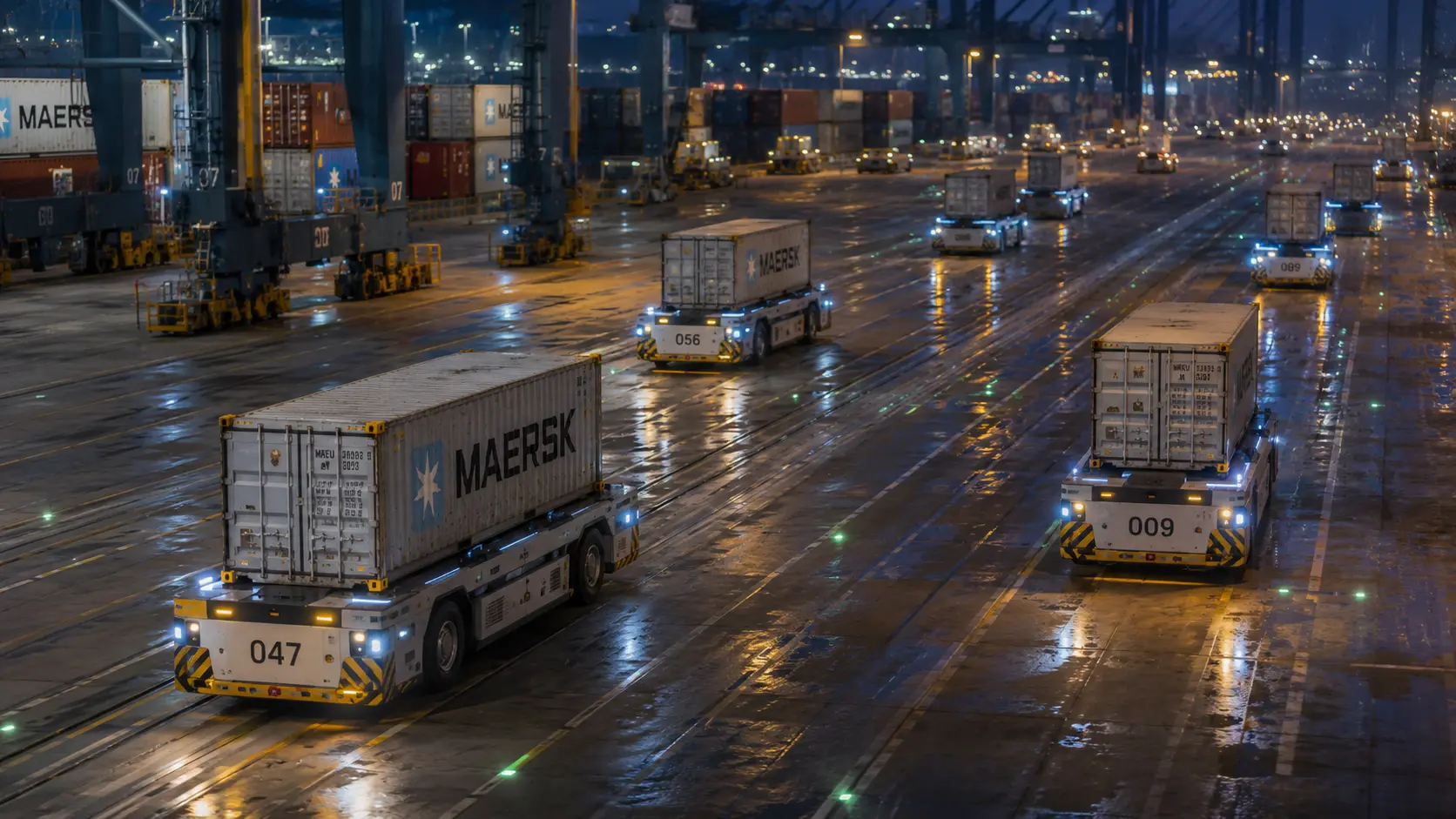
- Concept: The Automated Guided Vehicle (AGV): A heavy-duty, unmanned robotic flatbed that physically transports 40-foot shipping containers between ship-to-shore cranes and storage yards.
- Concept: Transponder Navigation: AGVs do not rely solely on GPS; they navigate by reading a grid of thousands of magnetic transponders physically buried in the terminal concrete.
- Concept: Kinematic Pathfinding: Algorithms calculate not just where a vehicle should go, but its exact acceleration, turning radius, and braking distance relative to every other vehicle on the grid.
- Concept: Deadlock Prevention: The software must anticipate and prevent mathematical traffic jams where multiple AGVs simultaneously block each other’s only available exit paths.
HOW THE AGV DISPATCH ALGORITHM WORKS
Unloading a 24,000-TEU mega-ship requires moving a staggering volume of physical steel boxes from the water’s edge to a temporary storage stack in the yard. In legacy ports, human-driven diesel trucks execute this task. In advanced automated terminals, like the Maasvlakte II in the Port of Rotterdam, the diesel trucks are entirely replaced by a fleet of electric Automated Guided Vehicles (AGVs).
The true engineering challenge is not building the robotic chassis; the challenge is traffic control. If two hundred AGVs attempt to move simultaneously in a confined concrete grid without a centralized intelligence, they will instantly collide or gridlock. To manage this chaos, the terminal operates a Fleet Management System (FMS) powered by advanced pathfinding algorithms, frequently variations of the A* (A-Star) search algorithm or dynamic routing matrices.
When a ship-to-shore crane is ready to drop a container, the FMS issues a dispatch command. The software scans the fleet, identifies an empty AGV, and calculates the fastest route to the crane. The port surface is divided into a strict mathematical grid, with magnetic transponders embedded in the pavement every few meters. As the AGV drives, a sensor on its underbelly reads these transponders, confirming its exact physical coordinates to the central server with millimeter precision.
The FMS executes continuous kinematic validation. It does not just draw a line on a map; it calculates the physics. It factors in the specific weight of the container, the battery level of the AGV, and the physical time required to accelerate and brake.
To prevent collisions, the algorithm uses a “moving block” system. As an AGV travels, the FMS temporarily locks the grid squares immediately in front of it, reserving that physical space. If AGV-1’s reserved path intersects with AGV-2’s reserved path, the algorithm mathematically forces one vehicle to slow down or reroute micro-seconds before a conflict occurs. This creates a mesmerizing, perfectly synchronized industrial ballet of massive steel robots passing within inches of each other at high speeds.
WHY IT MATTERS NOW
Global maritime trade is mathematically bottlenecked by the physical speed of port intralogistics. When ships wait weeks to unload off the coast of California or Shanghai, the delay is rarely caused by the cranes; it is caused by the severe congestion of trucks moving the boxes away from the cranes.
Automated AGV fleets completely decouple port velocity from the limitations of human labor and fatigue. An AGV does not require shift changes, bathroom breaks, or lighting. The FMS can operate the terminal at maximum mathematical efficiency 24 hours a day, executing complex optimization routines that a human dispatcher could never manually calculate.
This automation directly dictates the financial viability of ultra-large container vessels (ULCVs). Shipping conglomerates build massive ships to achieve economies of scale. However, dumping 24,000 containers onto a dock simultaneously creates an immediate logistical stroke. Only an automated dispatch algorithm can process that volume of physical displacement quickly enough to allow the ship to return to sea on schedule.
The deployment of these algorithms completely restructures the labor economics of global trade. The transition to AGVs physically removes thousands of high-paying, unionized longshoreman jobs from the waterfront. This triggers severe, systemic geopolitical tension. Dockworker unions aggressively strike to block automation, utilizing their ability to physically paralyze national supply chains as leverage against terminal operators attempting to install the magnetic grids and software required for AGV deployment.
WHAT MOST PEOPLE MISS
Tech observers often compare port AGVs to autonomous self-driving cars, assuming the robots are highly intelligent. They completely miss the reality that port AGVs are functionally brainless.
A self-driving Tesla uses onboard AI and LIDAR to constantly guess what unpredictable humans and other cars will do next. An AGV operates in a strictly controlled, deterministic environment. It has zero autonomy. It does not decide where to go; it simply executes the exact velocity and steering commands fed to it over Wi-Fi by the central FMS server.
This absolute centralization is the system’s greatest vulnerability. If the terminal’s central Wi-Fi network suffers a severe latency spike or a cyberattack takes the main server offline, the entire fleet of AGVs instantly halts in place. They lack the onboard intelligence to navigate independently, paralyzing the entire port until the centralized brain comes back online.
THE TRAJECTORY
Next 12–36 Months: Terminal operators will aggressively upgrade legacy 4G Wi-Fi networks to private 5G mesh architectures. This will drastically reduce network latency, allowing the FMS to tighten the “moving block” buffer zones between AGVs. By safely allowing the robots to drive physically closer together, ports will instantly increase total fleet throughput by 10 to 15 percent without buying a single new vehicle.
Next Five Years: The integration of predictive digital twin simulations. The FMS will not just manage current traffic; it will constantly run parallel simulations thousands of times a second to predict gridlock scenarios ten minutes into the future. If a specific intersection is mathematically predicted to jam, the algorithm will autonomously reroute empty vehicles early to preemptively clear the traffic pressure.
Next Ten Years: The death of the magnetic transponder grid. Next-generation AGVs will abandon the costly, maintenance-heavy practice of burying magnets in concrete. They will rely entirely on Sensor Fusion, combining highly advanced visual odometry, LIDAR mapping, and differential GPS to navigate dynamic, unmarked terminal environments, significantly lowering the capital expenditure required to automate legacy ports.
What Could Go Wrong: Severe algorithmic deadlocks. If a poorly coded FMS update is deployed during peak cargo volume, the system could inadvertently command a circular dependency—where AGV-A is waiting for AGV-B to move, AGV-B is waiting for AGV-C, and AGV-C is waiting for AGV-A. This mathematical failure state physically locks the robots together, requiring human engineers to manually enter the active robotic zone and physically drive the vehicles out of the knot.
Most Likely Outcome: The AGV dispatch algorithm will become the absolute limiting factor of global supply chain velocity. Software supremacy in intralogistics will replace sheer physical crane count as the primary metric defining the world’s most competitive and profitable maritime gateways.
KEY TERMS
- Automated Guided Vehicle (AGV): A robotic, unmanned platform used to transport heavy materials or shipping containers along predefined paths within an industrial facility.
- Fleet Management System (FMS): The centralized software architecture that calculates routes, assigns tasks, and manages the continuous traffic flow of an entire AGV fleet.
- Kinematics: The branch of mechanics that describes the motion of points, bodies, and systems without considering the forces that cause them to move, heavily utilized in pathfinding algorithms.
- Moving Block: A traffic management concept where a central system continuously reserves a specific physical safety buffer around a moving vehicle, moving the reservation as the vehicle moves.
- Digital Twin: A highly accurate virtual representation of a physical system, continuously updated with real-time data, used to simulate and optimize future physical operations.
SOURCES
- Port of Rotterdam Authority — Maasvlakte II Automation and Intralogistics Architecture
- IEEE Robotics and Automation Letters — Collision-Free Path Planning and Deadlock Avoidance in Automated Container Terminals
- Kalmar Global — Terminal Automation Systems and AGV Fleet Management Specifications
- World Maritime University — The Economic Impact of Port Automation on Global Supply Chain Velocity