Advertisement
)

AT A GLANCE
- Concept: Silicon Enclave: The chip functions as a physically isolated vault completely separated from the main computer processor.
- Concept: Key Generation: It uses microscopic thermal noise to generate mathematically perfect, unpredictable random numbers.
- Concept: Boot Measurement: The module mathematically hashes every piece of startup software to detect stealthy modifications.
- Concept: Key Sealing: The chip refuses to release the hard drive decryption keys if the system state changes.
HOW THE TRUSTED PLATFORM MODULE WORKS
Modern operating systems utilize software like BitLocker to encrypt the entire hard drive. This full-volume encryption prevents thieves from physically removing the drive and reading the data on another machine. However, the system must securely store the master decryption key when the computer is turned off.
Storing this decryption key on the encrypted hard drive itself presents a structural paradox. The system requires the key to read the drive, but it cannot access the drive to retrieve the key. Engineers solved this paradox by physically extracting the key storage away from the primary storage disk.
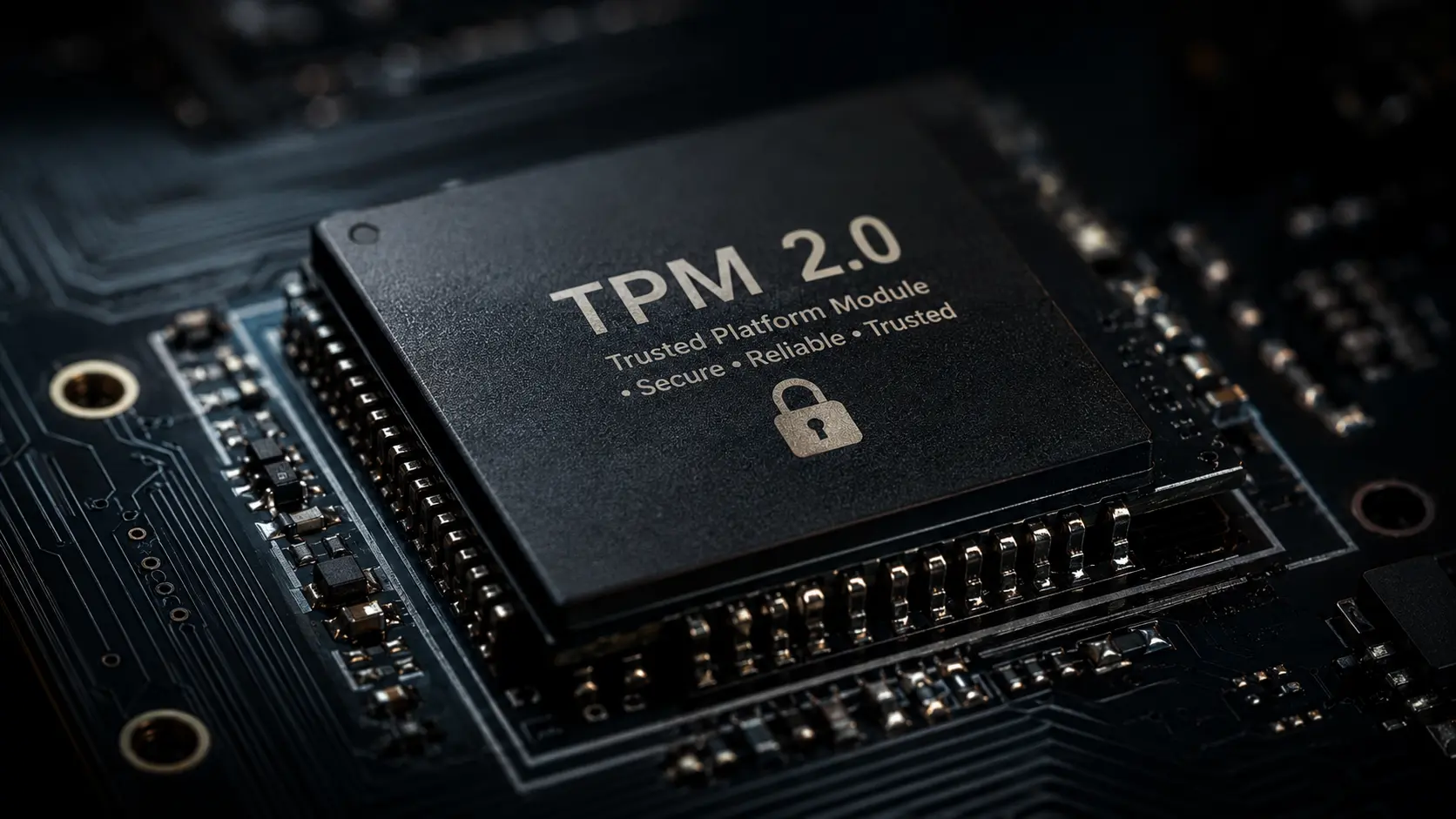
They engineered the Trusted Platform Module (TPM), a dedicated cryptographic micro-controller soldered directly to the motherboard. The TPM acts as an independent hardware vault, possessing its own isolated memory, firmware, and processing logic. It contains a True Random Number Generator (TRNG) that measures physical thermal noise on the silicon to create mathematically perfect, unpredictable cryptographic keys.
When a computer powers on, it executes a sequence of microscopic software handoffs, moving from the firmware to the bootloader, and finally to the operating system kernel. The TPM observes this entire chain of events. It uses internal storage spaces called Platform Configuration Registers (PCRs) to calculate and store a mathematical hash of each startup component before it executes.
The TPM constantly compares these fresh startup hashes against known, uncorrupted baseline measurements stored permanently inside its physical memory. If a hacker installs a stealthy rootkit or alters the boot sequence, the new mathematical hash will mismatch the baseline. The TPM recognizes the anomaly and instantly refuses to release the BitLocker volume encryption key, permanently locking the hard drive and starving the malware of any readable data.
WHY IT MATTERS NOW
The physical perimeter of the corporate network dissolved during the global shift to decentralized remote work. Enterprise security architects can no longer rely on corporate firewalls to protect sensitive data. They must enforce a Zero Trust architecture across thousands of geographical locations simultaneously.
This architecture requires continuous mathematical proof that both the user and the specific physical device are legitimate before granting access to cloud infrastructure. The TPM provides the non-forgeable hardware identity required to satisfy this requirement. When a remote employee attempts to access a corporate database, the cloud server issues a cryptographic challenge directly to the physical TPM chip inside the employee’s laptop.
Because the private keys stored inside a TPM cannot be duplicated, cloned, or extracted via software, the chip’s response provides absolute mathematical proof of physical device possession. This hardware attestation neutralizes the most sophisticated phishing attacks.
Even if a hacker successfully steals an employee’s password and intercepts their multi-factor authentication token, they cannot access the corporate network. The attacker lacks the physical silicon chip required to cryptographically sign the server’s challenge. Hardware-bound identity physically severs the primary monetization vector of global ransomware syndicates.
Microsoft aggressively capitalized on this hardware capability by strictly mandating TPM 2.0 for all Windows 11 installations. This singular policy decision forced the entire global PC manufacturing supply chain to integrate cryptographic enclaves into every consumer and enterprise motherboard. This mass deployment physically raises the baseline cost and operational complexity of executing automated, large-scale attacks against global endpoints.
WHAT MOST PEOPLE MISS
Cybersecurity teams frequently view the TPM as an impenetrable black box, falsely assuming that BitLocker encryption offers absolute immunity against physical extraction. They entirely miss the structural vulnerability of the physical motherboard traces connecting the TPM to the Central Processing Unit (CPU).
When the TPM validates the boot sequence, it must physically transmit the unencrypted BitLocker volume master key across the Serial Peripheral Interface (SPI) or Inter-Integrated Circuit (I2C) bus to the main processor. The data crossing these older bus architectures travels entirely in plaintext.
Sophisticated attackers bypass the TPM’s internal defenses entirely by attaching a ten-dollar logic analyzer directly to the exposed motherboard pins. They passively sniff the electrical signals crossing the unencrypted bus, quietly extracting the plaintext master key in seconds to fully decrypt the stolen hard drive without ever breaching the silicon enclave itself.
THE TRAJECTORY
Next 12–36 Months: Enterprise adoption of parameter-encrypted bus architectures. Hardware manufacturers will mandate encrypted communication channels between the CPU and the discrete TPM chip directly on the motherboard. This transition completely neutralizes the threat of physical logic analyzer sniffing attacks.
Next Five Years: The integration of CPU-embedded enclaves, heavily driven by architectures like Microsoft Pluton. The TPM will transition from a standalone chip soldered on the motherboard to a dedicated, isolated silicon block manufactured directly inside the main processor die. This physical integration mathematically prevents any interception of cryptographic keys during hardware transit.
Next Ten Years: Post-Quantum Cryptography (PQC) hardware replacement cycles. As quantum computers reach maturity, they will easily shatter the RSA and Elliptic Curve algorithms currently hardcoded into legacy TPM 2.0 chips. The global supply chain will undergo a massive, mandatory hardware replacement cycle to deploy TPM 3.0 chips embedded with quantum-resistant cryptographic lattice algorithms.
What Could Go Wrong: A severe supply chain compromise at the silicon foundry level. If a nation-state adversary successfully implants a microscopic hardware backdoor into the random number generator of a major TPM manufacturer, they could mathematically predict the encryption keys generated by millions of corporate laptops, rendering the entire global hardware trust architecture instantly useless.
Most Likely Outcome: The hardware root of trust will become the absolute legal and operational prerequisite for accessing any digital asset. Software-only security will be deemed structurally invalid, forcing all high-value transactions to rely entirely on the cryptographic signatures generated by physical silicon enclaves.
KEY TERMS
- Trusted Platform Module (TPM): A specialized, tamper-resistant microchip that securely stores artifacts used to authenticate a physical computer hardware platform.
- Hardware Root of Trust: A foundational cryptographic module embedded in hardware that is inherently trusted to perform secure operations and measurements.
- Platform Configuration Registers (PCR): Specialized memory slots inside the TPM used to store cryptographic hashes representing the exact state of the system’s software during the boot process.
- BitLocker: A full volume encryption feature included with Microsoft Windows designed to protect data by providing encryption for entire storage drives.
- Zero Trust Architecture: A cybersecurity model requiring strict identity verification for every person and device trying to access resources on a private network, regardless of their location.
SOURCES
- Trusted Computing Group (TCG) — TPM 2.0 Library Specification and Architecture
- National Institute of Standards and Technology (NIST) — Hardware Roots of Trust in Device Security
- Microsoft Security Documentation — BitLocker Countermeasures and TPM Integration
- IEEE Security & Privacy — Bypassing BitLocker: Bus Sniffing Attacks on Discrete TPMs