Advertisement
)

AT A GLANCE
- Concept: The Bandgap: Pure silicon breaks down under high voltages, while silicon carbide requires three times the atomic energy to fail.
- Concept: Switching Losses: Standard silicon switches waste massive amounts of electricity as heat every time they turn on and off.
- Concept: Trench Architecture: Engineers etch deep microscopic trenches into the silicon carbide crystal to vertically channel electrical currents.
- Concept: Thermal Conductivity: The material naturally dissipates heat three times faster than pure silicon, eliminating heavy liquid cooling systems.
HOW A SILICON CARBIDE MOSFET WORKS
Every electrical system requires switches to convert direct current (DC) from a battery into alternating current (AC) to drive a motor. For decades, the global industry relied on the Silicon Insulated-Gate Bipolar Transistor (IGBT). This component operates by forcing electrons through a pure silicon substrate.
Standard pure silicon possesses a narrow bandgap of 1.1 eV and 3.26 eV. When an engineer pushes more than 600 volts through a standard silicon IGBT, the electrons violently breach the atomic structure, short-circuiting the hardware.
To prevent this failure, legacy systems must operate at lower voltages and switch on and off relatively slowly. Every time an IGBT switches state, it bleeds raw electricity into the surrounding air as wasted thermodynamic heat.
Silicon Carbide (SiC) fundamentally alters this atomic limitation. By bonding silicon with carbon, manufacturers create a wide-bandgap material possessing an electron bandgap of $3.26 \text{ eV}$.
This physical structure requires three times the ambient energy to push an electron into a conductive state. The material physically withstands internal electrical fields ten times stronger than pure silicon without breaking down.
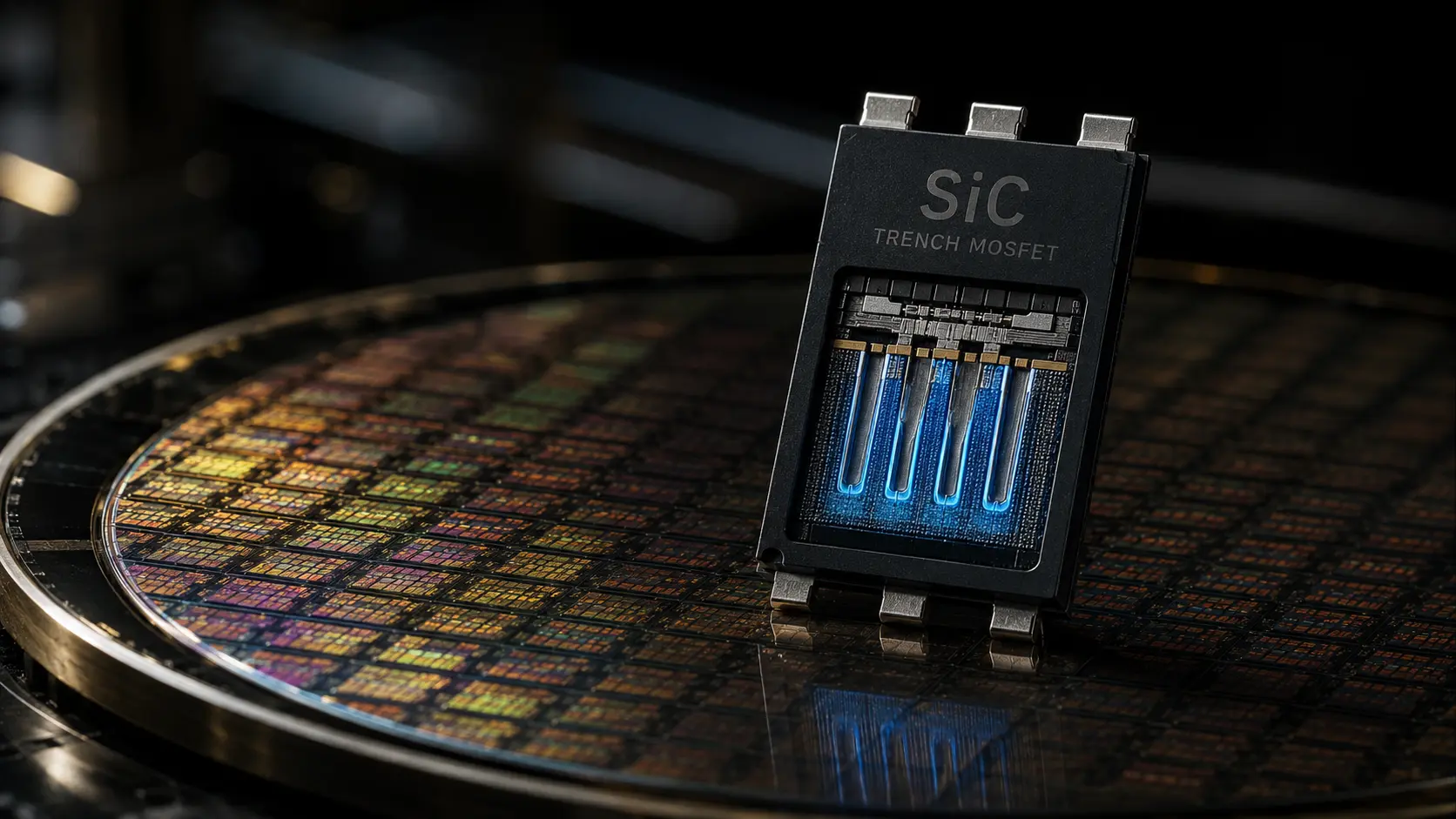
To maximize this material advantage, companies like Infineon and Wolfspeed engineer a specific geometry called the Trench MOSFET. Instead of building the electrical gates flat on the surface of the chip, they etch microscopic vertical trenches deep into the crystalline substrate.
This vertical architecture forces the electrons to travel straight down through the crystal. The design mathematically eliminates the electrical resistance that plagues traditional flat planar structures.
A SiC Trench MOSFET can switch high-voltage electricity thousands of times per second with near-zero energy loss. It operates perfectly at temperatures that would physically melt a legacy silicon chip.
WHY IT MATTERS NOW
The entire economic viability of the global electric vehicle (EV) transition depends on mitigating power loss. When a consumer buys an EV, they pay thousands of dollars primarily for the heavy lithium-ion battery pack.
If the vehicle uses legacy silicon IGBTs in its main traction inverter, the car loses nearly 10% of that stored battery energy strictly to internal electrical heat.
Tesla triggered a global supply chain shock in 2018 when it replaced silicon IGBTs with SiC MOSFETs in the Model 3 inverter. This singular material swap mathematically extended the car’s driving range by six percent without adding a single extra battery cell.
The high-bandgap physics allowed the inverter to operate at much higher frequencies. This shrunk the physical size of the magnetic copper coils and stripped hundreds of pounds of cooling equipment out of the vehicle chassis.
This thermal efficiency now dictates macro-infrastructure economics. Fast-charging stations attempting to push 350 kilowatts of DC power into a vehicle hit a physical thermal wall using pure silicon components.
SiC technology enables ultra-fast chargers to manage massive 800-volt architectures safely. It executes this extreme energy transfer without requiring liquid-cooled, industrially thick charging cables.
Consequently, the semiconductor industry is executing a massive capital reallocation. Global foundries are spending billions of dollars to build dedicated silicon carbide fabrication plants across Europe and the United States.
Control over the SiC wafer supply chain effectively equals control over the physical limits of planetary electrification. This shifts geopolitical leverage away from lithium miners and directly toward advanced materials engineering.
WHAT MOST PEOPLE MISS
Automotive journalists routinely credit the extended range of modern electric vehicles entirely to incremental improvements in battery chemistry. They completely miss the reality that battery cells remain stubbornly heavy and expensive.
The actual efficiency gains over the last five years stem almost exclusively from the software-defined, high-frequency switching capabilities of silicon carbide power electronics sitting between the battery and the motor.
Furthermore, manufacturing silicon carbide is a brutal, geologically slow process. Unlike pure silicon, which is easily pulled into massive uniform cylindrical ingots, SiC crystals must be grown in specialized vacuum furnaces operating at 2,500°C.
The material is nearly as hard as a diamond, requiring days of continuous diamond-wire sawing to slice ultra-thin wafers. This physical difficulty results in extreme defect rates and a systemic, permanent supply bottleneck for the entire hardware industry.
THE TRAJECTORY
Next 12–36 Months: The mass commercialization of 800-volt EV architectures. Automakers will abandon legacy 400-volt systems entirely, leveraging 1200-volt rated SiC MOSFETs to double charging speeds and halve the physical weight of copper wiring harnesses inside the vehicle chassis.
Next Five Years: The transition from 150mm to 200mm SiC wafers. Foundries will master the extreme metallurgical stress required to grow larger silicon carbide crystals. This will double the number of usable microchips per wafer, mathematically crashing the unit cost of SiC MOSFETs and driving pure silicon out of the high-power industrial market.
Next Ten Years: The integration of SiC into High-Voltage Direct Current (HVDC) macro-grids. Utilities will deploy massive silicon carbide solid-state transformers to route multi-gigawatt renewable energy across continents. These SiC nodes will physically replace archaic, heavy magnetic transformers, creating a fully digitized, instantly routable global power grid.
What Could Go Wrong: Gallium Nitride (GaN) leapfrogging. While SiC dominates high-voltage applications today, GaN—another wide-bandgap material—excels at high-frequency switching. If engineers successfully scale GaN architectures to safely handle 1200-volt electrical loads, it could mathematically render the expensive, slow-growing silicon carbide supply chain obsolete.
Most Likely Outcome: Silicon carbide will become the permanent physical baseline for heavy electrification. The material will completely monopolize electric vehicle powertrains, heavy rail, industrial motor drives, and renewable energy inverters, permanently capping the utility of pure silicon at low-power logic and memory.
KEY TERMS
- Bandgap: The minimum amount of energy required to free an electron from its home atom so it can conduct electricity, dictating a material’s voltage tolerance.
- MOSFET (Metal-Oxide-Semiconductor Field-Effect Transistor): A semiconductor device widely used for switching and amplifying electronic signals in active circuits.
- Switching Loss: The electrical energy wasted as thermodynamic heat during the microscopic fraction of a second a transistor takes to turn on or off.
- Inverter: An electrical component that converts direct current (DC) from a battery into alternating current (AC) to drive an electric motor.
- Solid-State Transformer: An advanced grid component that uses power semiconductors to route electricity, eliminating the heavy iron cores and copper coils of traditional transformers.
SOURCES
- Institute of Electrical and Electronics Engineers (IEEE) — Silicon Carbide Power Devices: Physics, Applications, and Reliability
- Department of Energy (DOE) — Wide Bandgap Semiconductors: Opportunities in Power Electronics
- Wolfspeed — Silicon Carbide Trench MOSFET Architecture and High-Voltage Switching Efficiency
- Yole Group — Power SiC: Materials, Devices, and Applications Market Report