Advertisement
)

AT A GLANCE
- Concept: Extraterritoriality: The rule legally extends United States sovereign authority far beyond its physical geographic borders.
- Concept: The Chokepoint: Almost all global semiconductor manufacturing relies heavily on American electronic design automation software.
- Concept: Entity List: Companies placed on specific federal watchlists trigger immediate global trade embargoes under this legal framework.
- Concept: Secondary Sanctions: Foreign foundries that violate the rule risk instantly losing their own access to the American financial system.
HOW THE FOREIGN DIRECT PRODUCT RULE WORKS
Traditional export controls operate purely on physical geography. If an American company manufactures a sensitive radar component in Texas and attempts to ship it to a hostile nation, federal customs agents seize the cargo at the physical border. This legacy framework works perfectly for physical munitions, but it completely fails to secure highly distributed, globalized digital supply chains.
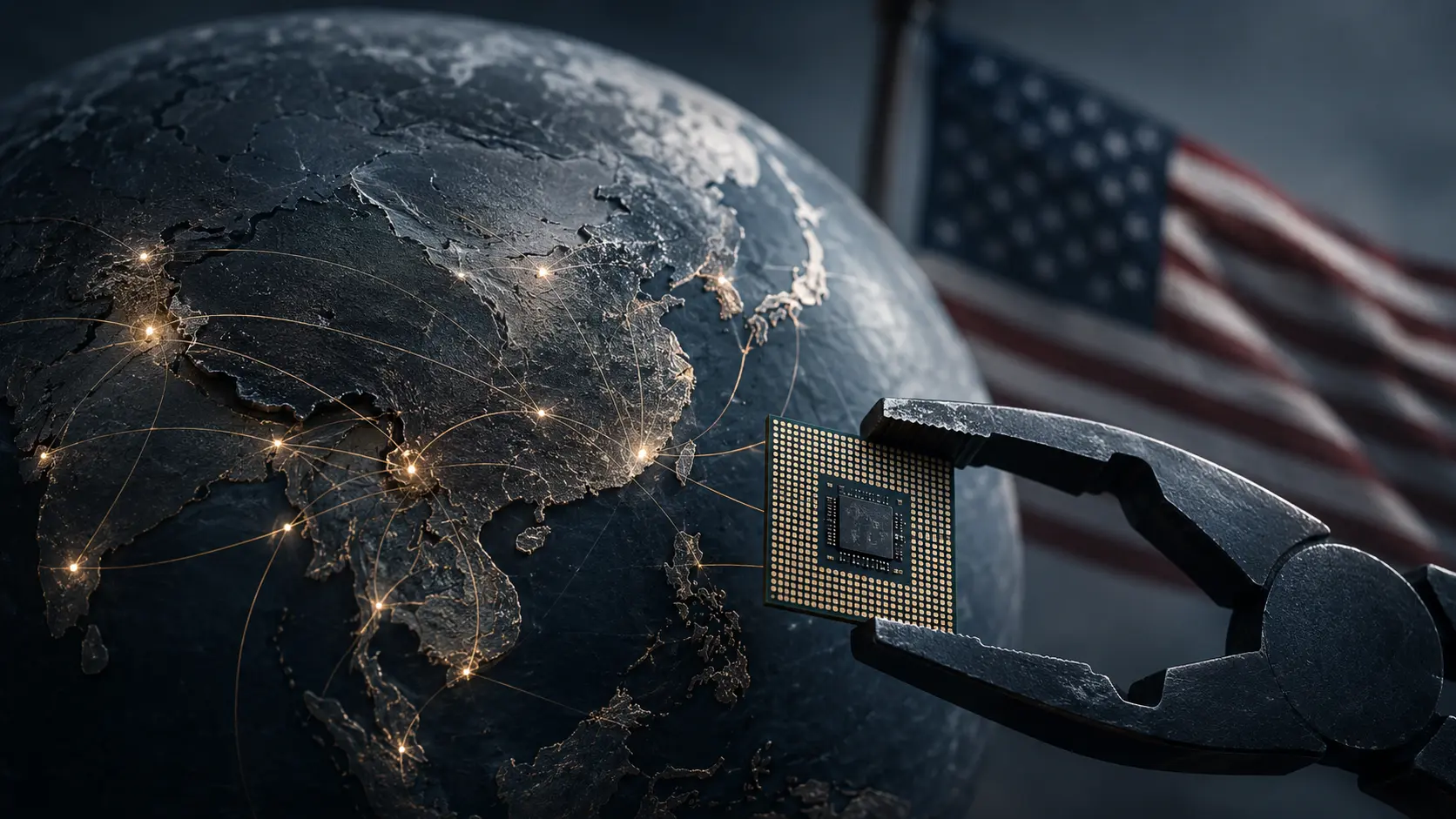
The United States government closed this architectural loophole using the Foreign Direct Product Rule (FDPR). Embedded deep within the Export Administration Regulations (EAR) managed by the Bureau of Industry and Security (BIS), the FDPR acts as a legal virus. It attaches United States jurisdiction directly to intellectual property itself, completely ignoring physical geographic borders.
If a Taiwanese foundry manufactures a microchip for a Chinese technology company using raw silicon mined in Australia, that physical chip never touches American soil. However, if the Taiwanese foundry uses American-origin Electronic Design Automation (EDA) software to map the chip’s circuitry, the FDPR activates instantly. The rule applies equally if the foreign factory uses an American-origin deposition machine to print the silicon layers.
The law mathematically dictates that the foreign-made microchip is the “direct product” of American technology. Because the chip is legally classified as an American product, the Taiwanese foundry must apply to the United States Department of Commerce for a specialized export license before shipping the physical hardware to China. The BIS routinely denies these applications, effectively turning foreign factories into deputized enforcement agents of American foreign policy.
WHY IT MATTERS NOW
The FDPR represents the absolute weaponization of the global semiconductor supply chain. As artificial intelligence models scale exponentially, geopolitical dominance relies entirely on access to advanced logic chips and massive data center clusters. The United States government recognized it could not physically stop foreign nations from learning the underlying mathematics required to build AI models.
Instead, the United States specifically targeted the hardware required to run the math. By invoking sweeping FDPR restrictions throughout 2022, 2023, 2024, and 2025, the BIS placed a hard, extraterritorial ceiling on the computational capability of geopolitical adversaries. If a foreign entity appears on the BIS Entity List with a specific “Footnote 4” or “Footnote 5” designation, no factory on Earth can legally print their silicon designs.
This legal mechanism completely crippled Huawei’s original global smartphone dominance. Huawei designed its own world-class Kirin processors via its subsidiary, HiSilicon. However, because TSMC relied heavily on American manufacturing equipment, the FDPR forced the Taiwanese foundry to sever its manufacturing contract with Huawei overnight. Without a foundry to print the chips, Huawei’s hardware supply instantly evaporated.
The consequences of this legal architecture are violently reshaping global trade agreements. Rather than attempting to match American technological innovation, adversaries are responding with asymmetric legal warfare. In late 2025, China’s Ministry of Commerce activated its own mirror-image extraterritorial controls over rare earth minerals and battery technology.
This tit-for-tat escalation traps multinational corporations in a legally impossible paradox. Supply chain managers are forced to violate one superpower’s laws simply to comply with the other’s mandates. The threat of severe secondary sanctions paralyzes corporate compliance departments, slowing the physical velocity of global technology shipping.
WHAT MOST PEOPLE MISS
Mainstream political commentators frequently assume that targeted nations can bypass these sanctions simply by purchasing manufacturing equipment from non-American allies, like the Netherlands or Japan. They completely misunderstand the microscopic depth of American intellectual property integration. High-tech supply chains are not modular; they are deeply interlocked at the molecular level.
An adversary cannot simply purchase a Dutch ASML lithography machine to escape United States jurisdiction. The Dutch machine relies on highly specific American-origin Extreme Ultraviolet (EUV) light source components and advanced optical metrology software.
The FDPR infects the entire downstream supply chain through these microscopic components, rendering true technological decoupling mathematically impossible in the short term. The United States government maintains veto power over global technology flows purely because it holds the patents to the fundamental optical physics required to scale silicon.
THE TRAJECTORY
Next 12–36 Months: The aggressive expansion of FDPR into cloud computing architectures. The BIS will attempt to legally prohibit foreign AI companies from renting computing power in Middle Eastern or European data centers that operate restricted American hardware. This will force cloud providers to implement strict, nationality-based Know Your Customer (KYC) screening for all algorithmic training workloads.
Next Five Years: The global proliferation of blocking statutes. Allied nations in Europe and Asia will increasingly view the FDPR as a severe violation of their own economic sovereignty. These governments will pass domestic laws legally forbidding their domestic corporations from complying with extraterritorial American export controls, threatening to severely fracture the unified Western technological alliance.
Next Ten Years: The rise of “US-Free” hardware fabrication lines. To escape the jurisdictional reach of the FDPR, non-American technology conglomerates will spend hundreds of billions of dollars engineering entirely parallel semiconductor supply chains. They will systematically strip out all American patents, software, and physical components to regain absolute sovereign control over their manufacturing capabilities.
What Could Go Wrong: The balkanization of global technical standards. If the FDPR forces the world into two entirely distinct, isolated technological ecosystems, the underlying architecture of the global internet will fracture. Devices built on the Chinese technology stack will mathematically fail to interface with networks built on the American stack, destroying the interoperability that enables modern global commerce.
Most Likely Outcome: The Foreign Direct Product Rule will remain the ultimate financial and legal weapon of the twenty-first century. Jurisdictional control over technology supply chains has permanently replaced naval blockades as the primary mechanism for neutralizing a geopolitical adversary’s industrial base.
KEY TERMS
- Bureau of Industry and Security (BIS): An agency within the United States Department of Commerce tasked with advancing national security through strict export control administration.
- Extraterritoriality: The legal principle where a sovereign nation enforces its domestic laws outside its own physical geographic borders.
- Electronic Design Automation (EDA): Highly specialized software used by engineers to design complex integrated circuits, an industry heavily dominated by American firms.
- Entity List: A trade restriction document published by the United States government identifying specific foreign individuals, companies, and organizations subject to severe licensing requirements.
- De Minimis Rule: A companion regulation that asserts American jurisdiction if a foreign-made product contains a specific, threshold percentage of controlled United States-origin content.
SOURCES
- Bureau of Industry and Security (BIS) — Implementation of Additional Export Controls on Advanced Computing and Semiconductor Manufacturing
- Center for Strategic and International Studies (CSIS) — The Extraterritorial Reach of the Foreign Direct Product Rule
- Center for a New American Security (CNAS) — Weaponizing the Global Supply Chain: The Evolution of Export Controls
- Federal Register — Updates to the Export Administration Regulations and Entity List Designations