Advertisement
)

AT A GLANCE
- Concept: The Thermal Wall: Air is an incredibly poor conductor of heat, making traditional fans physically incapable of cooling massive artificial intelligence processors.
- Concept: Dielectric Fluid: The servers sit in a bath of highly engineered, non-conductive synthetic liquid that does not short-circuit the electrical hardware.
- Concept: Latent Heat of Vaporization: The fluid is chemically tuned to boil at roughly 50°C; the act of turning from liquid to gas absorbs massive amounts of thermal energy.
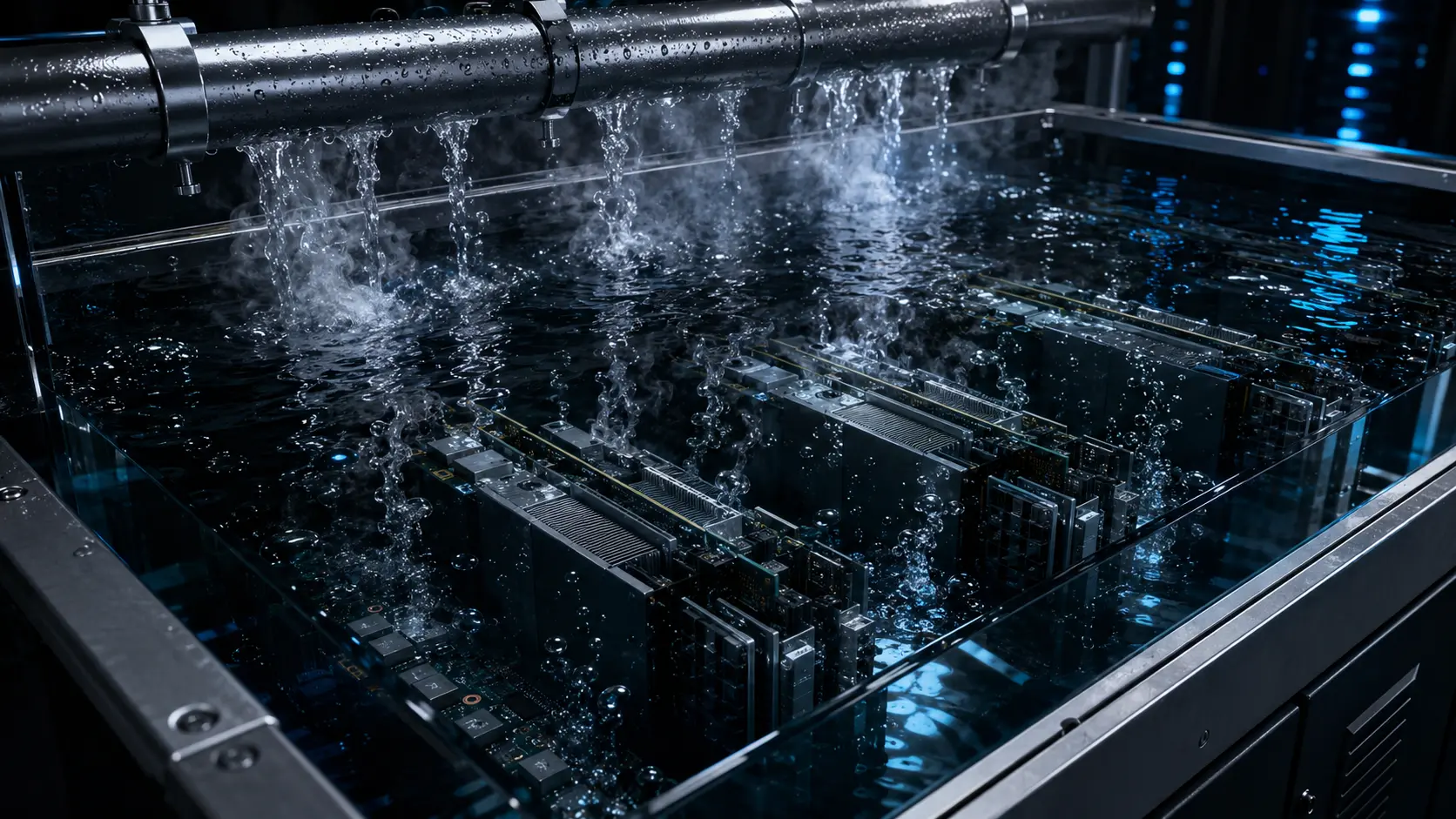
- Concept: The Condensation Loop: The vapor rises, hits a cold water pipe at the top of the tank, condenses back into liquid, and falls back into the bath, creating an infinite, pump-free cooling cycle.
HOW TWO-PHASE IMMERSION COOLING WORKS
Cooling a data center has historically relied on forcing massive volumes of chilled air across metal heat sinks. This method requires industrial-scale air conditioning units (CRACs), colossal ductwork, and thousands of mechanical fans. As artificial intelligence models scale, the silicon chips required to train them are drawing unprecedented wattage, frequently exceeding 1,000 watts per individual processor.
Air cooling mathematically fails at this density. The specific heat capacity of air is simply too low to physically absorb that much thermal energy fast enough. To prevent the silicon from literally melting, operators are forced to abandon air and utilize liquid, which is thousands of times more thermally conductive.
In a two-phase immersion system, the entire server motherboard—CPU, GPU, memory, and power delivery—is lowered directly into a sealed tank filled with a specialized dielectric fluid. This fluid, often a fluorochemical engineered by companies like 3M, is electrically non-conductive. You can submerge a live, high-voltage server into the liquid without triggering a short circuit.
The fluid is chemically formulated with a very low boiling point, typically around 50°C and 60°C. When a high-powered GPU processes a massive algorithmic calculation, the silicon rapidly heats up. The moment the surface temperature of the chip exceeds the fluid’s boiling point, the liquid in direct contact with the chip physically boils, undergoing a phase change from a liquid to a vapor.
This phase change leverages the Latent Heat of Vaporization. Boiling absorbs an immense, concentrated spike of thermal energy. The resulting vapor bubbles naturally rise to the surface of the tank, pulling the heat completely away from the electronic components without requiring any mechanical pumps. At the top of the sealed tank, the vapor encounters a condenser coil filled with basic facility water. The vapor transfers its heat to the water, condenses back into heavy liquid droplets, and rains back down into the bath, completing a continuous, perfectly passive thermodynamic loop.
WHY IT MATTERS NOW
The global artificial intelligence boom is constrained almost entirely by power availability and heat rejection. Microsoft, Google, and Meta are building hyperscale data centers that require gigawatts of electricity. A critical metric for these facilities is Power Usage Effectiveness (PUE)—a ratio comparing the total power entering the building to the power actually used by the computing equipment.
In a traditional air-cooled data center, the PUE often hovers around 1.5. This means for every 10 megawatts of power pushing data through the servers, the facility consumes an additional 5 megawatts simply running the massive air conditioning fans and chillers. This parasitic power draw represents millions of dollars of wasted electricity and severely caps the maximum number of servers a facility can legally install under strict regional power grid limits.
Two-phase immersion cooling fundamentally alters data center economics by driving the PUE down to near 1.02. By eliminating the mechanical fans on the servers and the massive air handlers in the facility, operators reclaim nearly all of that parasitic power. They can redeploy that reclaimed electrical capacity strictly for revenue-generating computation.
Furthermore, this thermodynamic efficiency drastically shrinks the physical footprint of the data center. Because the fluid rejects heat so effectively, operators can pack server blades infinitesimally close together. A single immersion tank the size of a jacuzzi can house the computational power that previously required an entire aisle of air-cooled server racks. This extreme spatial density allows AI startups to deploy exascale supercomputers in geographically constrained urban areas where real estate is at an absolute premium.
WHAT MOST PEOPLE MISS
Tech media widely assumes immersion cooling is a frictionless upgrade. They entirely miss the brutal chemical supply chain vulnerabilities underpinning the technology. The hyper-specialized dielectric fluids required for two-phase boiling are overwhelmingly composed of Per- and Polyfluoroalkyl Substances (PFAS)—commonly known as “forever chemicals.”
Because PFAS chemicals do not break down in nature and are increasingly linked to severe environmental and biological toxicity, they are facing aggressive, global regulatory bans. The European Union and the United States Environmental Protection Agency (EPA) are actively restricting their manufacture. If a data center designs a multi-billion dollar facility entirely around two-phase immersion, and the chemical manufacturer is legally ordered to halt production of the proprietary boiling fluid, the data center operator is left with unusable, dry tanks and mathematically uncoolable silicon.
THE TRAJECTORY
Next 12–36 Months: Hyperscale operators will temporarily pivot toward Single-Phase Liquid Cooling (where a thicker oil absorbs heat but does not physically boil) and Direct-to-Chip cold plates. These alternatives bypass the immediate regulatory risk of PFAS boiling fluids while still offering significant thermal upgrades over legacy air cooling.
Next Five Years: The aggressive commercialization of non-PFAS dielectric boiling fluids. Chemical engineering conglomerates are currently racing to synthesize new, eco-friendly liquids that mimic the exact boiling point and non-conductive properties of legacy fluorochemicals but naturally degrade in the environment within weeks of a spill. The patent holder of this replacement fluid will secure a multi-billion dollar monopoly over the future of hyperscale cooling.
Next Ten Years: The death of the raised-floor data center architecture. Future facilities will resemble chemical processing plants rather than IT rooms. Data centers will abandon the classic “hot aisle/cold aisle” layout, instead designing facilities strictly around massive plumbing manifolds, structural weight loads to support liquid-filled tanks, and direct heat-reuse networks that pump the boiling vapor energy straight into municipal district heating systems.
What Could Go Wrong: If a sealed two-phase tank loses internal pressure due to a microscopic mechanical failure or a poorly executed server maintenance extraction, the highly volatile, expensive dielectric fluid will rapidly vaporize into the surrounding server room. This instantly suffocates the submerged processors, triggering a massive, cascading thermal shutdown of the entire high-density AI cluster.
Most Likely Outcome: Air cooling will become obsolete for any application beyond basic enterprise networking. The physical limits of semiconductor thermodynamics dictate that the most powerful artificial intelligence models on Earth will be permanently trained entirely underwater.
KEY TERMS
- Two-Phase Immersion Cooling: A thermal management system where electronics are submerged in a liquid that actively boils and condenses, using phase change to remove heat.
- Dielectric Fluid: A specialized liquid that acts as an electrical insulator, preventing short circuits when live electronic components are completely submerged in it.
- Latent Heat of Vaporization: The physical energy required to transform a substance from a liquid state into a gaseous state at its boiling point, without changing its temperature.
- Power Usage Effectiveness (PUE): The standard metric used to determine the energy efficiency of a data center, calculated by dividing total facility power by IT equipment power.
- PFAS (Per- and Polyfluoroalkyl Substances): A group of highly stable synthetic chemicals widely used in industrial applications, currently facing severe regulatory bans due to their environmental persistence.
SOURCES
- American Society of Heating, Refrigerating and Air-Conditioning Engineers (ASHRAE) — Thermal Guidelines for Data Processing Environments
- Open Compute Project (OCP) — Immersion Cooling Requirements and Fluid Specifications
- Lawrence Berkeley National Laboratory (LBNL) — Data Center Energy Efficiency and PUE Optimization
- Environmental Protection Agency (EPA) — Regulatory Actions on PFAS and Industrial Fluorochemicals