Advertisement
)

AT A GLANCE
- Concept: Air Clearance: Standard open-air substations use massive amounts of empty space to prevent high-voltage lines from arcing to the ground.
- Concept: Molecular Dielectric: Sulfur hexafluoride chemically traps rogue electrons, extinguishing superheated electrical arcs instantly inside a sealed tube.
- Concept: Spatial Compression: By relying on pressurized gas instead of ambient air, engineers place live transmission wires mere inches apart.
- Concept: Urban Integration: This compressed architecture allows mega-cities to hide massive power routing nodes entirely beneath office buildings and public parks.
HOW A GAS-INSULATED SUBSTATION WORKS
High-voltage electricity constantly attempts to jump to the nearest conductive surface. To prevent a 400-kilovolt power line from short-circuiting to the earth, traditional Air-Insulated Substations (AIS) rely on sheer physical distance. Engineers build massive, sprawling yards, physically separating the live bare-metal components by dozens of feet of empty ambient air.
Air acts as a relatively weak dielectric, meaning it struggles to block electrons under high electrical stress. Sulfur hexafluoride SF6 operates entirely differently at the molecular level. It is a highly electronegative gas; its dense fluorine atoms aggressively attract and capture free-floating electrons.
When a mechanical circuit breaker opens to stop a high-voltage current, the electricity immediately attempts to leap across the opening gap as a superheated plasma arc. If this gap is flooded with pressurized SF6 gas, the heavy molecules physically absorb the kinetic energy of the rogue electrons. The gas instantly suffocates the plasma arc, dropping the temperature and extinguishing the current in milliseconds.
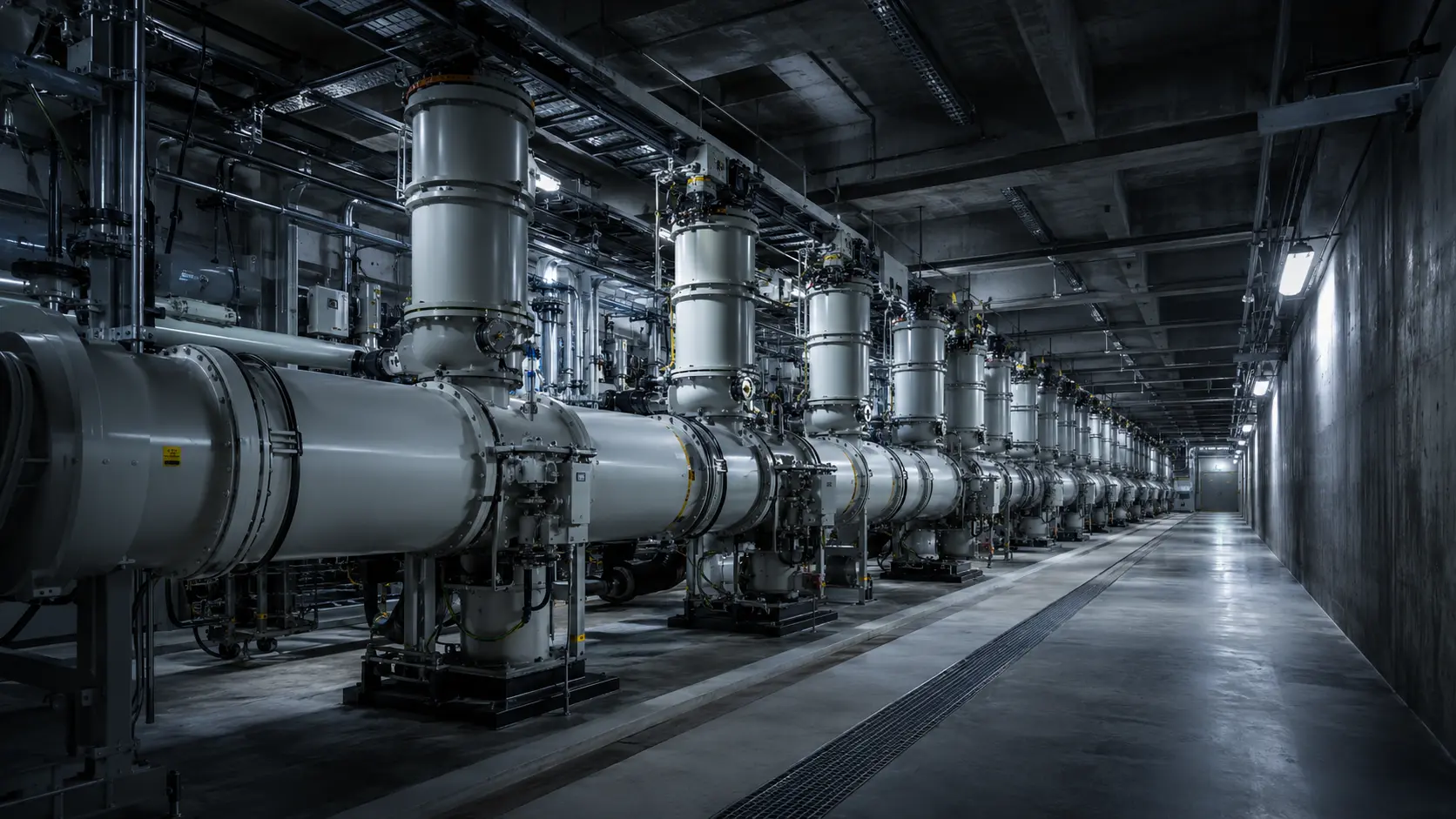
A Gas-Insulated Substation (GIS) utilizes this molecular electron-gating capability to compress physical geometry. Engineers place the live electrical conductors inside grounded, sealed aluminum pipes and pressurize the empty space with SF6. Because the gas insulates over three times better than atmospheric air, the live wires can safely sit just inches away from the metal enclosure without arcing.
WHY IT MATTERS NOW
The global transition to electrified heating and transportation requires mega-cities to effectively double their total electrical grid capacity. Supplying gigawatts of new power to a metropolis requires building new high-voltage substations directly in the center of the urban demand load. However, real estate in cities like Manhattan, Tokyo, or London costs thousands of dollars per square foot.
Utilities cannot legally or financially acquire ten acres of downtown real estate to build a sprawling, open-air electrical yard. GIS technology mathematically solves this urban zoning paradox. By collapsing the strict clearance geometry using SF6, a GIS shrinks the total required footprint of a grid node by up to ninety percent.
This extreme spatial compression allows grid operators to build entirely vertically. In central London, National Grid recently constructed a massive 400-kilovolt GIS node completely hidden beneath a public square. The enclosed metal architecture also renders the substation entirely immune to external environmental threats like hurricanes, salt fog, or urban pollution.
The capital expenditure of a GIS unit initially exceeds traditional air-insulated equipment by roughly thirty percent. However, the total project economics flip rapidly when factoring in land acquisition costs. Utilities secure massive geographic arbitrage by paying slightly more for dense gas hardware to avoid spending hundreds of millions on prime commercial real estate.
WHAT MOST PEOPLE MISS
Urban planners praise GIS for its architectural stealth, often ignoring the brutal chemical reality of sulfur hexafluoride. SF6 is the most potent greenhouse gas known to human science. A single pound of SF6 leaked into the atmosphere traps exactly as much thermodynamic heat as 23,500 pounds of carbon dioxide, persisting in the environment for over three millennia.
The hidden operational nightmare for utilities is the strict federal auditing of their gas inventories. Even microscopic leaks from a degrading rubber O-ring on a GIS pipe trigger massive environmental fines and reputational damage. Utilities are forced to deploy highly specialized maintenance crews using infrared cameras simply to prove they are not inadvertently venting civilization-ending volumes of synthetic greenhouse gas into the local atmosphere.
THE TRAJECTORY
Next 12–36 Months: Environmental regulators in the European Union and California will enact strict bans on the installation of any new high-voltage equipment utilizing SF6. Utilities will rapidly deploy newly developed fluoronitrile gas mixtures that offer similar dielectric strength with a fraction of the global warming potential.
Next Five Years: The mass commercialization of vacuum-break and synthetic air architectures. Equipment manufacturers will completely phase out fluorine-based gases for medium-voltage urban networks. They will rely on purified air compressed to extreme pressures, combined with pure vacuum chambers to handle the actual high-voltage arc extinction.
Next Ten Years: The deployment of subsea GIS nodes for offshore wind integration. Engineers will use the enclosed, pressurized nature of the architecture to build massive electrical substations directly on the ocean floor. This removes the need to build expensive, vulnerable steel platforms above the water to route offshore energy back to the mainland.
What Could Go Wrong: A catastrophic internal arc failure. If a microscopic metal shaving contaminates the inside of the pressurized pipe during maintenance, it disrupts the uniform electrical field. This creates a highly concentrated voltage spike that arcs straight through the SF6 gas, physically blasting a hole through the aluminum casing and releasing a lethal wave of vaporized metal into the enclosed urban basement.
Most Likely Outcome: The enclosed gas-insulated architecture will entirely replace open-air switchyards in all major metropolitan areas. Despite the aggressive regulatory phase-out of SF6, the fundamental physics of using pressurized dielectric fluids to compress electrical geometry remains the absolute only viable path to powering dense mega-cities.
KEY TERMS
- Gas-Insulated Substation (GIS): A compact electrical grid facility where major high-voltage components are completely enclosed in sealed metal pipes filled with a pressurized insulating gas.
- Sulfur Hexafluoride SF6: An inorganic, colorless, and non-flammable gas possessing extreme electronegativity, used exclusively to suppress electrical arcs in power infrastructure.
- Dielectric Strength: The absolute maximum electrical voltage a material can withstand without breaking down and allowing an electrical current to pass through it.
- Air-Insulated Substation (AIS): A traditional electrical grid facility that relies on vast physical distance and ambient atmospheric air to keep high-voltage components safely separated.
- Fluoronitrile: A synthetic chemical compound currently being developed by the heavy electrical industry to replace SF6 without contributing to extreme atmospheric warming.
SOURCES
- Institute of Electrical and Electronics Engineers (IEEE) — Physics of Arc Extinction in Gas-Insulated Switchgear
- International Council on Large Electric Systems (CIGRE) — Guidelines for SF6 Alternatives in High-Voltage Substations
- Environmental Protection Agency (EPA) — Electric Power Systems Partnership and SF6 Emission Reductions
- Siemens Energy — Technical Architecture of Clean Air and Blue GIS Portfolios