Advertisement
)

AT A GLANCE
- Concept: Unstructured Legacy: Older banking networks rely on free-text fields that automated software cannot reliably read.
- Concept: XML Dictionary: The standard forces financial data into mathematically rigid, universally defined software tags.
- Concept: Straight-Through Processing: Perfect data alignment allows computers to clear international payments instantly without human intervention.
- Concept: Anti-Money Laundering: Granular metadata gives regulators absolute visibility into the ultimate beneficiaries of global capital.
HOW ISO 20022 WORKS
Global capital does not physically move across borders; it relies entirely on electronic messaging between distinct national ledgers. Historically, commercial banks transmitted these settlement instructions using legacy SWIFT MT formats developed in the 1970s. These older formats relied heavily on unconstrained free-text fields to describe the sender, the receiver, and the purpose of the funds.
Free-text fields break computer automation. If a German bank lists a corporate address on a single line, and a Japanese receiving bank expects that exact address split across two lines, the automated clearing software throws a fatal syntax error. The transaction immediately drops into a manual review queue, forcing expensive human compliance officers to physically read the message and verify the data.
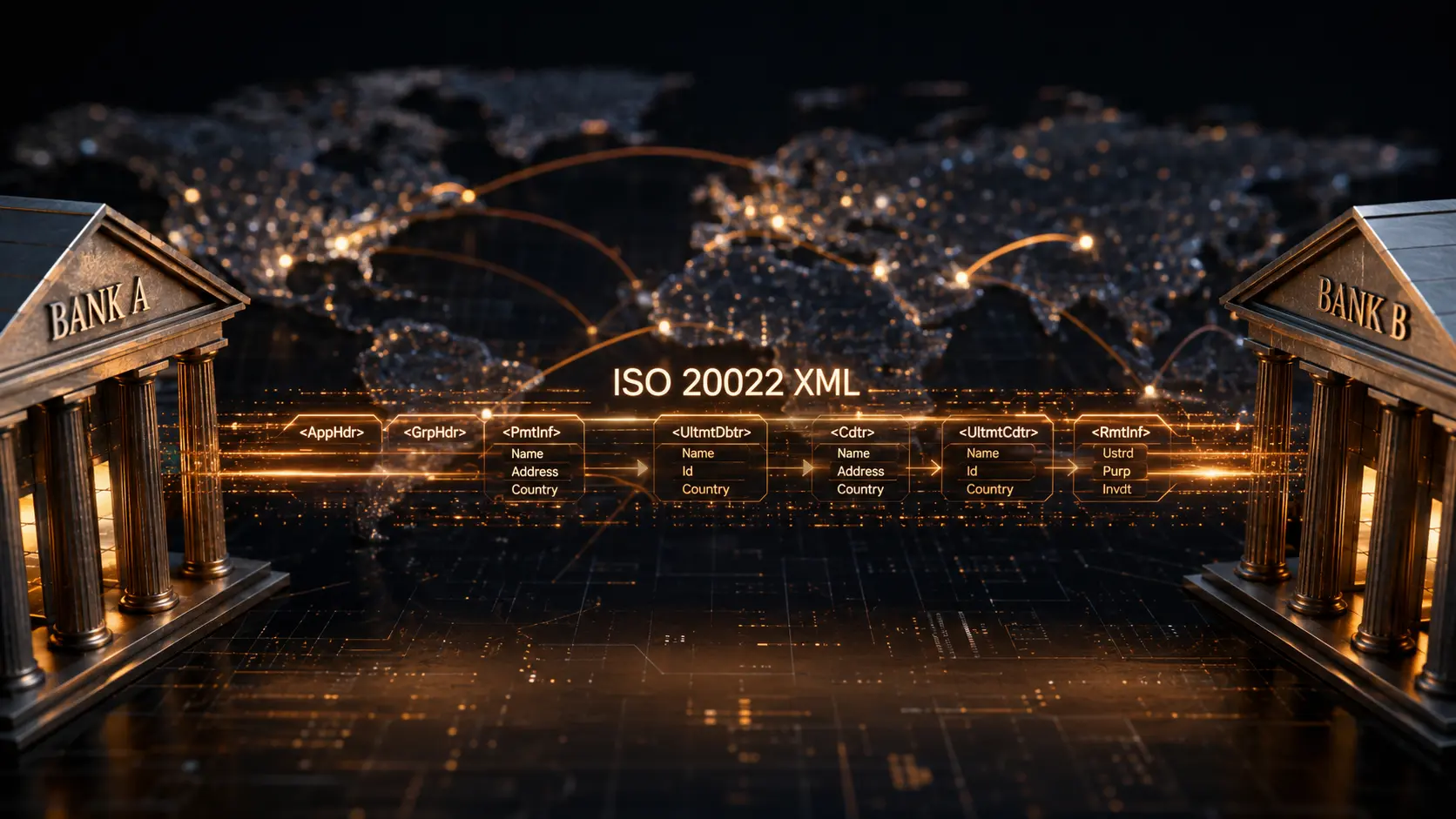
ISO 20022 solves this operational friction by introducing a rigidly structured Extensible Markup Language (XML) data dictionary. The standard entirely outlaws free-text approximations and regional formatting variations. Instead, it forces the sending bank’s software to break the transaction down into hundreds of specific, universally defined data tags.
When a multinational corporation initiates a cross-border wire, the banking software wraps the exact street name, building number, and postal code in distinct XML identifiers. The receiving bank’s server ingests these exact tags flawlessly. This architectural rigidity guarantees straight-through processing, allowing the receiving ledger to clear the funds in milliseconds without triggering false formatting alarms.
To maintain network integrity, modern clearinghouses operate strict validation layers at the edge of their infrastructure. If a regional bank attempts to submit an ISO 20022 message with a single missing XML bracket or an invalid country code, the network mathematically rejects the packet instantly. The sending bank must correct the syntax before the message ever enters the global interbank pipeline.
WHY IT MATTERS NOW
The global financial system is currently completing a mandatory, synchronized migration to this new data architecture. Major reserve banks, including the European Central Bank and the United States Federal Reserve, recently upgraded their domestic Real-Time Gross Settlement (RTGS) networks to accept exclusively ISO 20022 formatted data.
This hard protocol shift fundamentally alters the economics of correspondent banking. International money transfers historically suffered from a massive failure rate, with nearly ten percent of all cross-border wires requiring manual intervention. By enforcing XML standardization, banks strip billions of dollars in operational drag out of the clearing process, directly boosting profit margins on global capital flows.
A concrete example exists within international sanctions screening. Under legacy formats, a bank’s automated compliance filter might falsely flag a legitimate business transaction simply because a street name shared a partial spelling with a sanctioned entity. The filter lacked the structural logic to differentiate between a physical city and a human surname.
The ISO 20022 data dictionary isolates these variables mathematically. Regulators and compliance algorithms now scan specific tags identifying the UltimateCreditor and the exact PurposeCode of the transaction. This high-definition metadata allows sovereign governments to enforce precise geopolitical financial embargoes without accidentally freezing legitimate international trade.
Corporate treasuries also directly internalize these efficiency gains. Because ISO 20022 files carry massive payloads of remittance data natively alongside the payment, companies completely automate their accounts receivable reconciliation. The exact invoice numbers arrive cleanly attached to the incoming cash, allowing enterprise resource planning software to close out open ledgers instantly.
WHAT MOST PEOPLE MISS
Financial media frequently characterizes the ISO 20022 migration as a routine IT infrastructure upgrade designed merely to speed up banking applications. They entirely overlook the secondary consequence of structured metadata: the creation of a massive, monetizable corporate intelligence network.
Because the XML schema includes granular fields for product codes, tax details, and specific supply chain endpoints, commercial banks no longer just move money. They intercept perfect, structured datasets detailing exactly how global supply chains operate. Tier-one institutions quietly use this normalized data to train internal machine learning models, offering advanced cash-flow forecasting and localized credit risk products back to the exact corporate clients who generated the raw data.
Furthermore, the schema introduces a strict liability shift across the interbank network. In the legacy era, a receiving bank bore the cost of manually fixing a poorly formatted message to appease their client. Under ISO 20022, the rigid rejection protocols force the sending bank to eat the operational cost of any formatting error, aggressively penalizing institutions running outdated back-office software.
THE TRAJECTORY
Next 12–36 Months: Global clearinghouses will officially sever support for legacy MT messages, completing the final phase of the coexistence period. Regional banks that failed to upgrade their core banking systems will lose their ability to process cross-border payments natively, forcing them to rely on expensive third-party translation proxies.
Next Five Years: The integration of programmable payments via smart contracts. As XML messaging creates a perfectly predictable data environment, corporate treasurers will deploy autonomous algorithms that scan incoming ISO 20022 tags and automatically trigger secondary cross-border payments based on specific, predefined supply chain events.
Next Ten Years: The convergence of ISO 20022 with Central Bank Digital Currencies (CBDCs). Sovereign digital currencies will natively adopt the ISO 20022 data dictionary as their foundational operating system. This convergence will permanently merge the messaging layer and the settlement layer, allowing money and its associated contextual data to move as a single, atomic unit across global ledgers.
What Could Go Wrong: A highly sophisticated XML injection attack. If a nation-state hacker successfully compromises a tier-one bank’s message generation software, they could theoretically manipulate the extended remittance tags to hide malicious code payloads. When the receiving clearinghouse parses the heavily extended XML dictionary, it could inadvertently execute the hostile code, fracturing the integrity of the regional settlement network.
Most Likely Outcome: ISO 20022 will permanently establish itself as the universal language of global finance. The sheer economic efficiency gained by eliminating unstructured manual data entry guarantees that all future payment rails, from blockchain networks to legacy wire systems, will conform exclusively to this specific data dictionary.
KEY TERMS
- Extensible Markup Language (XML): A mathematical text format that uses predefined tags to describe the exact structure and meaning of data to automated software.
- Straight-Through Processing (STP): An automated financial mechanism where a transaction clears from start to finish without requiring any manual human intervention.
- Real-Time Gross Settlement (RTGS): A central bank clearing system where interbank money transfers finalize individually and instantly, rather than batching together at the end of the day.
- Data Dictionary: A centralized set of rules defining exactly how information must be categorized, formatted, and validated within a specific software ecosystem.
- Correspondent Banking: A financial network where a specialized tier-one bank provides clearing and settlement services on behalf of smaller, regional institutions.
SOURCES
- SWIFT — ISO 20022 Migration and the Economics of Structured Financial Messaging
- Bank for International Settlements (BIS) — Cross-Border Payments and the Impact of Global Data Standards
- European Central Bank (ECB) — TARGET2 and the Implementation of ISO 20022 RTGS Architecture
- Federal Reserve Board — Fedwire Funds Service and the Mandated Transition to XML Frameworks