Advertisement
)

AT A GLANCE
- Concept: Compute Starvation: The condition where a processor finishes its math so fast it must wait idly for new data.
- Concept: Global Memory (HBM): The massive, slow data pool where the total artificial intelligence model physically resides.
- Concept: Shared Memory (SRAM): The tiny, ultra-fast memory bank located directly next to the processing cores.
- Concept: Asynchronous Fetching: Moving data into the processor simultaneously while the processor executes math on entirely different data.
HOW THE TENSOR MEMORY ACCELERATOR WORKS
Artificial intelligence processors calculate math significantly faster than physical memory can feed them numbers. In older architectures, the processor explicitly asks for a block of data, waits for it to travel from High-Bandwidth Memory (HBM) into the local SRAM, and then calculates the matrix math. This synchronous cycle forces the expensive Tensor Cores to sit idle during every single memory fetch.
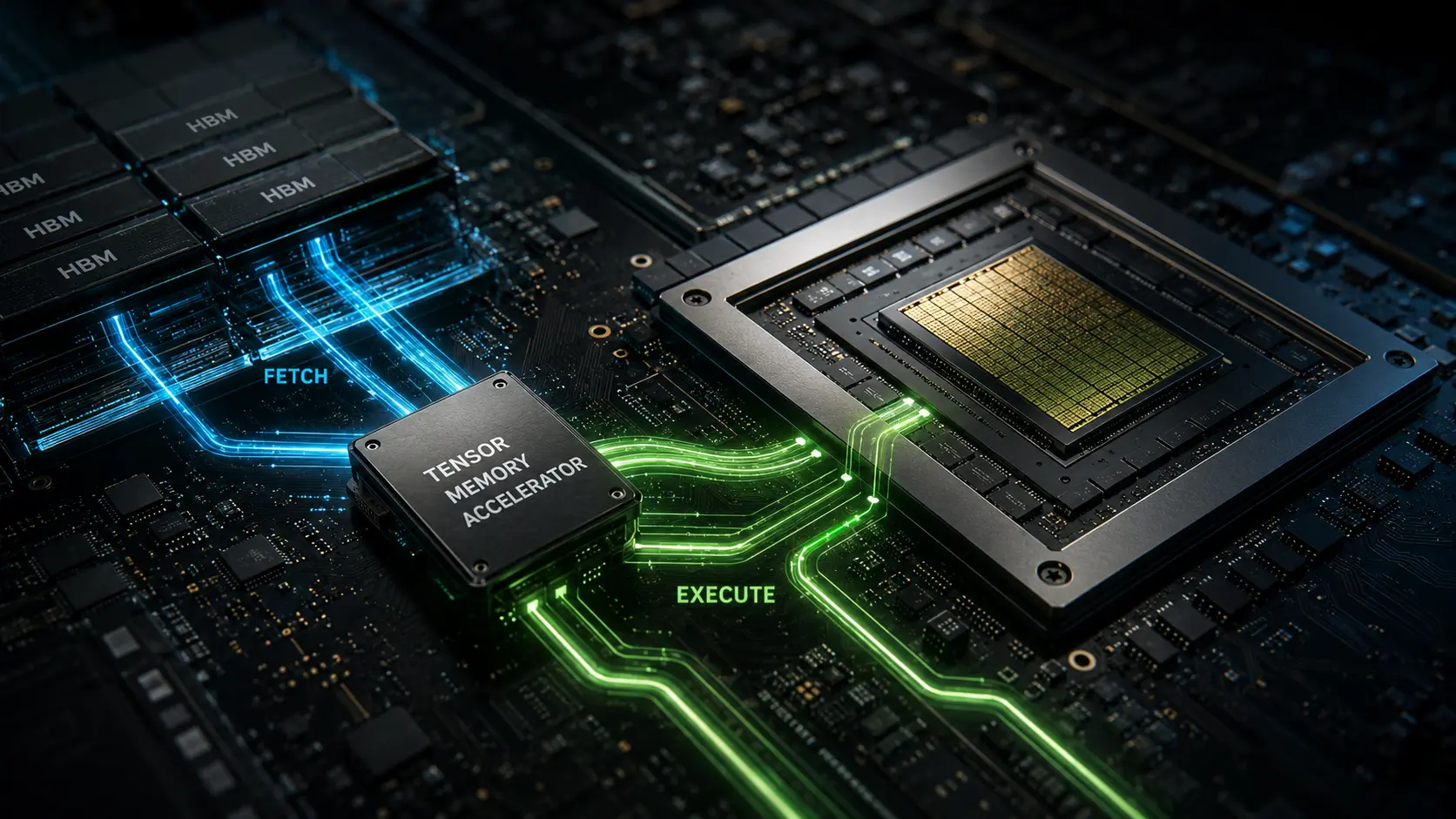
Nvidia solved this physical bottleneck in the Hopper architecture by embedding a dedicated hardware engine called the Tensor Memory Accelerator (TMA). The TMA acts as an independent data courier. Instead of the main processor managing every individual byte transfer, the processor issues a single command to the TMA, instructing it to fetch a massive, multidimensional block of data.
Once commanded, the TMA physically takes over the data routing across the silicon. It reaches into the HBM, calculates the complex memory addresses, and pulls the data directly into the local SRAM completely in the background. While the TMA executes this physical transfer, the main Tensor Cores remain fully engaged, executing matrix math on the previous batch of data.
To synchronize this split workload, the GPU utilizes warp specialization. The software compiler divides the processing threads into two distinct groups: producer warps and consumer warps. Producer warps do zero math; they only issue fetch commands to the TMA. Consumer warps perform zero fetching; they strictly calculate the matrix math the moment the TMA signals the data has physically arrived.
WHY IT MATTERS NOW
Serving large language models at commercial scale is an exercise in managing extreme memory bandwidth constraints. The cost of generating a single word of text is dictated almost entirely by how efficiently the GPU moves the model’s weights from global memory to the compute cores.
The physical existence of the TMA directly enables advanced software algorithms like FlashAttention-2. By utilizing asynchronous block transfers, FlashAttention software forces the GPU to overlap its memory fetches perfectly with its calculations. This hardware-software synergy physically prevents the massive matrices of modern AI from bottlenecking the compute pipeline.
This architectural shift dramatically alters the unit economics of enterprise artificial intelligence. When Tensor Cores run at maximum utilization rather than sitting idle, cloud operators generate more tokens per second on the exact same physical server. This directly lowers the wholesale cost of API calls for thousands of downstream software companies.
When organizations train massive models on PyTorch, the underlying compiler automatically recognizes Hopper-class GPUs and routes the memory requests through the TMA. Datacenters paying thirty thousand dollars for an H100 GPU actually extract the advertised processing speed because the hardware successfully bypasses the traditional memory wall that chokes older processors.
WHAT MOST PEOPLE MISS
Hardware commentators endlessly compare graphics cards by citing their total Floating-Point Operations Per Second (FLOPs). They completely miss that FLOPs are a theoretical maximum that a processor only achieves if the data arrives instantaneously. An AI chip with fewer total FLOPs but a superior asynchronous memory accelerator will mathematically outperform a higher-FLOP chip that uses synchronous fetching.
Software engineers frequently overlook the computational burden of calculating memory addresses. In legacy systems, the GPU cores wasted significant processing cycles just calculating the geometric grid coordinates to locate data inside a multidimensional matrix. The TMA physically assumes this entire index calculation workload, returning those lost processing cycles back to the Tensor Cores as pure mathematical profit.
THE TRAJECTORY
Next 12–36 Months: Open-source compiler frameworks like Triton will fully abstract TMA controls. Software engineers will deploy highly specialized asynchronous memory kernels without writing low-level CUDA code, instantly accelerating custom model inference across enterprise clusters.
Next Five Years: The structural expansion of multi-chip TMA networks. The memory accelerator will evolve to fetch data asynchronously not just from local HBM, but directly across NVLink fabrics from the SRAM of entirely different, physically adjacent GPUs.
Next Ten Years: Processing-in-Memory (PIM) will cannibalize the accelerator model. Silicon manufacturers will physically embed the matrix multiplication logic directly into the high-bandwidth memory stacks. This will eliminate the physical distance between data and compute, rendering traditional block fetching hardware completely obsolete.
What Could Go Wrong: Synchronization deadlocks. If a consumer warp attempts to calculate math before the TMA confirms the data has arrived, the GPU experiences a race condition. The processor will multiply corrupted, incomplete matrices, permanently poisoning the language model’s output without physically crashing the server.
Most Likely Outcome: Asynchronous memory accelerators will become the undisputed standard for all exascale logic processors. The physical speed limit of electrons traveling across silicon guarantees that hiding memory latency through background fetching remains the only viable path to scaling artificial intelligence.
KEY TERMS
- Tensor Memory Accelerator (TMA): A dedicated hardware unit that executes background data transfers between global and shared memory without using the main processor cores.
- High-Bandwidth Memory (HBM): The massive, primary storage bank physically stacked next to a GPU processor to hold multi-gigabyte artificial intelligence models.
- Shared Memory (SRAM): An ultra-fast, extremely small memory cache located directly on the processing core that holds data actively being computed.
- Warp Specialization: A programming architecture that explicitly divides computing threads into dedicated groups for fetching data and groups for calculating math.
- Compute Starvation: A hardware state where a processor remains completely idle because it calculates math faster than the memory system supplies new data.
SOURCES
- Nvidia Technical Blog — Hopper Architecture In-Depth and the Tensor Memory Accelerator
- Stanford University — FlashAttention-2: Faster Attention with Better Parallelism and Work Partitioning
- Institute of Electrical and Electronics Engineers (IEEE) — Overlapping Compute and Memory Transfers in Exascale Accelerators
- PyTorch Foundation — Optimizing GPU Memory Bandwidth with Asynchronous Data Movement