Advertisement
)

AT A GLANCE
- Concept: Pre-Training: Ingesting the internet to build a foundational understanding of grammar and facts.
- Concept: Self-Attention: The mathematical mechanism allowing the model to track relationships between distant words.
- Concept: Alignment: Adjusting raw text prediction into helpful, conversational dialogue using human feedback.
- Concept: Inference Compute: The massive hardware memory required to generate responses for millions of users.
IN SIMPLE WORDS
Imagine reading every book, article, and website ever written. You do not memorize the exact sentences. Instead, you learn how words connect to each other. You learn that “apple” usually follows “red,” and “capital of France” ends with “Paris.”
This is how a large language model starts. It absorbs raw text and plays a massive game of fill-in-the-blank, guessing the next word billions of times until it understands the underlying structure of human language.
However, predicting the next word only creates a babbling text generator. To make the model useful, engineers must train it a second time. They reward the model for acting like a helpful assistant and penalize it for generating toxic or incorrect answers. This two-step process turns a giant autocomplete calculator into an intelligent, highly capable chatbot.
HOW IT WORKS
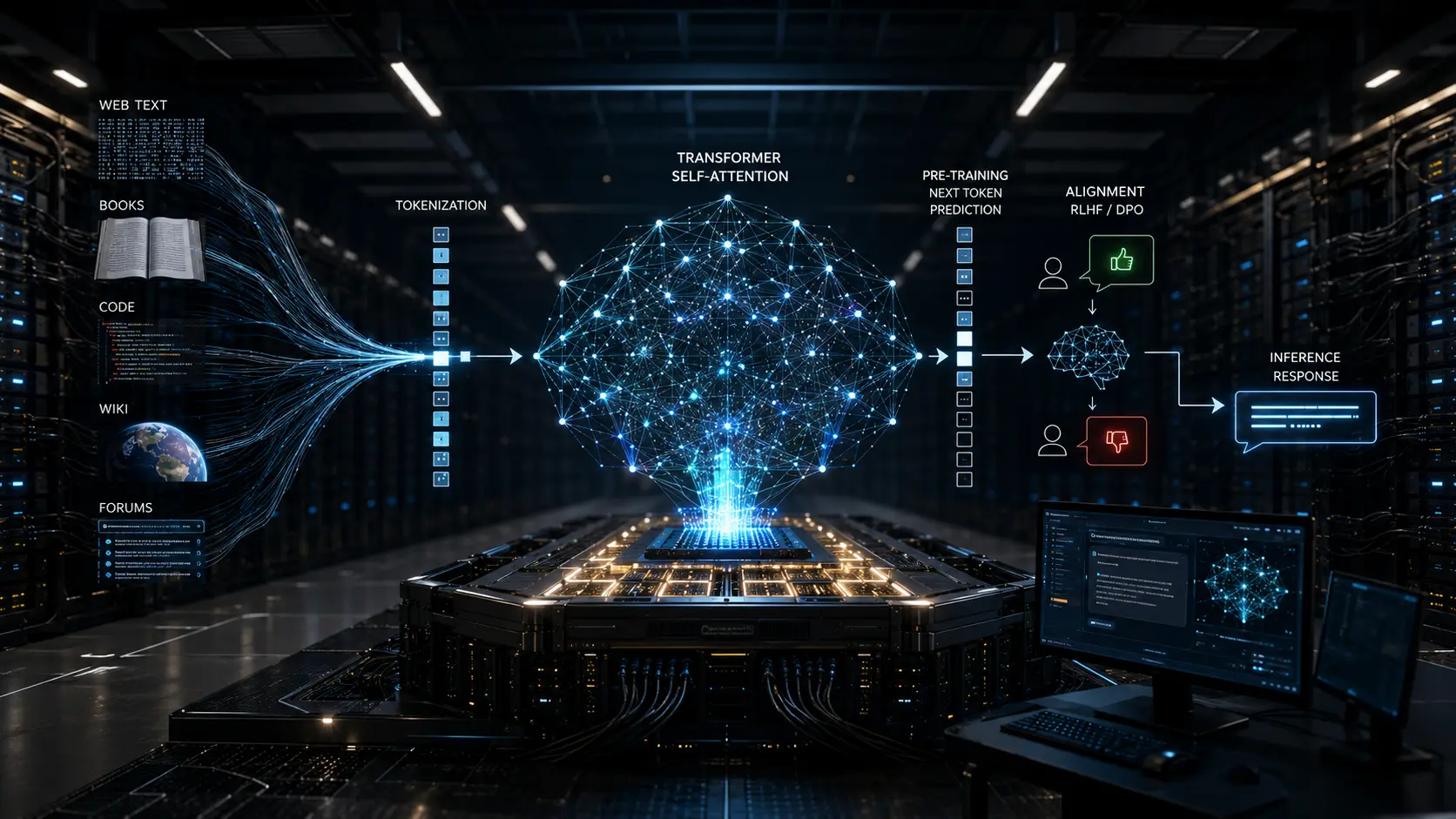
Creating a frontier artificial intelligence model requires three distinct phases: data preparation, pre-training, and post-training alignment.
The process begins with raw data collection. Engineers scrape trillions of words from the open internet, digitized books, and code repositories. They filter out low-quality text, remove duplicate pages, and strip away malicious content to create a pristine dataset.
The model cannot process English words directly. The system chops the text into smaller pieces called tokens. A token can be a single letter, a syllable, or a short word. The system assigns a unique mathematical vector to every single token.
During pre-training, the model attempts to predict the next token in a sequence. At first, its guesses are completely random. When it guesses wrong, a mathematical algorithm called backpropagation adjusts the internal weights of the neural network. Over months of continuous calculation across tens of thousands of graphics processing units (GPUs), these weights stabilize, and the model learns the structural logic of human thought.
The core of this learning relies on the Transformer architecture and its self-attention mechanism. As the model processes a sequence, self-attention calculates the mathematical relevance of every word to every other word in the prompt. This allows the model to understand context, determining if the word “bank” refers to a financial institution or a river.
Finally, the model undergoes alignment to become a usable product. Historically, engineers used Reinforcement Learning from Human Feedback (RLHF). Human testers graded the model’s responses, creating a reward system that trained the AI to prefer helpful, safe answers.
Modern systems increasingly use Direct Preference Optimization (DPO). DPO bypasses the complex reward model entirely. It feeds the model mathematical pairs of good and bad responses, directly adjusting the underlying weights to favor the preferred output without requiring a secondary neural network.
REAL WORLD EXAMPLE
OpenAI’s ChatGPT serves as the most visible manifestation of this training pipeline. The underlying GPT-4 model underwent months of pre-training inside Microsoft Azure data centers.
When a user asks ChatGPT to write a Python script, the model does not search a database for the answer. It calculates the statistical probability of the next correct token based on its training weights.
During this generation process, the model relies on a Key-Value (KV) cache. It temporarily stores the mathematical vectors of the user’s prompt and its own previous output in the GPU’s memory. This prevents the server from recalculating the entire conversation history for every single new word, allowing the chatbot to type its response in real time.
WHY IT MATTERS NOW
The physical scale of artificial intelligence training now dictates global technology infrastructure. Training a frontier model costs hundreds of millions of dollars in compute time and electricity. This financial reality restricts the creation of foundation models to a handful of massive technology corporations and well-funded sovereign states.
The global economy is restructuring around these models. Enterprise companies deploy fine-tuned versions of these systems to automate customer service, generate software code, and analyze financial data. The intelligence generated by these models acts as a new utility, similar to cloud storage or cellular bandwidth.
Geopolitically, the training pipeline creates a hard physical chokepoint. The entire process relies on advanced silicon, specifically tensor core GPUs. Nations that cannot secure these chips cannot train competitive models, effectively locking them out of the next industrial era.
Simultaneously, the industry is rapidly exhausting the supply of high-quality human data. AI companies have effectively scraped the entire accessible internet. To continue scaling the intelligence of these models, research labs must now develop synthetic data pipelines, where older AI models generate training data for newer, more capable models.
COMMON MISCONCEPTIONS
People frequently assume that large language models search the internet for facts before answering a question. In reality, the base model contains zero database queries; it relies entirely on the mathematical weights established during pre-training.
Many believe that a larger model automatically equals a smarter model. Training efficiency, data quality, and alignment techniques often matter more than raw parameter count. A small, highly optimized model frequently outperforms a massive, poorly trained one.
Users often mistake fluent text generation for actual human reasoning. The model does not think or understand the concepts it writes about. It executes highly complex statistical probability calculations to arrange words in a logically satisfying order.
Observers frequently assume alignment makes a model perfectly safe. In practice, RLHF and DPO only suppress specific mathematical pathways. Determined users can still construct specialized prompts to bypass these guardrails and force the model to access its underlying, unfiltered pre-training data.
WHAT MOST PEOPLE MISS
The true bottleneck in modern AI is not training; it is inference. Developing the model requires a massive, one-time expenditure of electricity and hardware. Serving the model to one hundred million daily users requires a continuous, exponentially larger infrastructure footprint.
Engineers are constantly fighting the memory constraints of the KV cache. When a user pastes a massive legal document into a prompt, the mathematical vectors for that text consume vast amounts of high-bandwidth memory. If a cloud provider cannot aggressively optimize this memory usage, the cost of serving the model quickly bankrupts the business.
THE ECONOMIC AND STRATEGIC IMPACT
Hardware manufacturers capture the immediate financial upside of this transition. Companies designing and fabricating specialized AI accelerators hold absolute pricing power over the software ecosystem.
Cloud service providers act as the gatekeepers. Only hyperscale operators possess the physical capital to string together 100,000 GPUs using high-speed optical networking. They extract rent from the entire software industry by providing the only physical environments where these models can be built.
Traditional search engines face structural disruption. As language models adopt retrieval-augmented generation (RAG) to pull real-time facts into their context windows, they bypass the traditional web browser experience. This threatens the foundational advertising models that built the modern internet.
Sovereign governments view foundation models as strategic defense assets. The ability to process vast amounts of unstructured intelligence, automate cyber-defense, and generate localized propaganda makes domestic AI production a strict matter of national security.
THE TRAJECTORY
Next 12–36 Months: Labs will shift focus from raw parameter scaling to reasoning architectures. Models will use specialized inference algorithms to calculate multiple possible answers internally before outputting the mathematically optimal response.
Next Five Years: The normalization of multi-modal training. Models will stop learning exclusively from text and begin ingesting massive streams of video, audio, and robotic telemetry. This will ground their mathematical logic in the physical physics of the real world.
Next Ten Years: The deployment of continuous learning architectures. Current models are frozen in time the moment their training completes. Future systems will update their internal weights in real-time as they interact with users, eliminating the need for massive, discrete retraining runs.
What Could Go Wrong: Model collapse. If synthetic AI-generated data floods the internet, future models will inadvertently train on the hallucinations of their predecessors. This mathematical feedback loop causes the underlying probability distributions to degrade, permanently lowering the intelligence of future generations.
Most Likely Outcome: The training pipeline will consolidate into a highly specialized heavy industry. Just as few companies build commercial jetliners, only a handful of global consortiums will possess the capital and engineering talent required to train frontier foundation models.
KEY TERMS
- Foundation Model: A massive artificial intelligence system trained on broad data that can be adapted to a wide range of specific tasks.
- Parameter: The internal mathematical variables that the neural network adjusts during training to learn the structure of data.
- Token: The basic unit of data processed by a language model, typically representing a word, syllable, or character.
- Self-Attention: A mechanism allowing the model to weigh the importance of every word in a sequence relative to all other words.
- Direct Preference Optimization (DPO): An alignment technique that trains the model using pairs of preferred and rejected responses to shape its behavior.
- Inference: The operational phase where a finished model receives a prompt and generates a response.
- KV Cache: A temporary hardware memory store that saves previous calculations to speed up text generation.
- Synthetic Data: Information generated by an artificial intelligence system used to train another artificial intelligence system.
BEGINNER FAQ
How long does it take to train an LLM? Training a frontier model takes several months of continuous calculation. The process runs 24 hours a day across tens of thousands of specialized graphics processing units.
How much does it cost to train an AI model? The compute cost for a state-of-the-art foundation model frequently exceeds one hundred million dollars. This does not include the salaries of researchers or the cost of acquiring proprietary data.
Why do language models hallucinate? Models hallucinate because they are statistical prediction engines, not factual databases. If the mathematical probability of a false statement is high based on its training data, the model will confidently state it as fact.
What is the difference between pre-training and fine-tuning? Pre-training teaches the model the general rules of language and logic. Fine-tuning adjusts the finished model to perform a highly specific task, like coding or customer support.
Can I train a large language model on my laptop? No. A laptop lacks the massive memory and computational bandwidth required for pre-training. However, you can run a smaller, already trained model locally.
Why do companies use human feedback? Raw models predict text without knowing if it is helpful or harmful. Human feedback provides a mathematical scoring system that forces the model to align with human values and safety constraints.
What is the context window? The context window is the maximum amount of text the model can process at one time. If a document exceeds the context window, the model physically cannot read the entire text.
How does the AI remember the conversation? The model does not have long-term memory between separate chats. During a single session, the server temporarily saves the chat history in its KV cache so it does not have to reread the conversation for every new sentence.
SOURCES
- OpenAI — GPT-4 Technical Report and Alignment Methodologies
- Stanford University — Direct Preference Optimization: Your Language Model is Secretly a Reward Model
- Google DeepMind — Scaling Laws for Neural Language Models
- Institute of Electrical and Electronics Engineers (IEEE) — Memory Bandwidth and KV Caching in Transformer Architectures