Advertisement
)

AT A GLANCE
- Concept: Superalloy: A metal mixture engineered to maintain extreme structural strength near its melting point.
- Concept: Grain Boundary: The microscopic physical seam where separate metal crystals meet, creating structural weakness.
- Concept: Directional Solidification: Slowly freezing liquid metal to force crystal growth in one specific direction.
- Concept: Ceramic Matrix Composite: Silicon-based non-metals that replace heavy alloys in the hottest engine zones.
IN SIMPLE WORDS
Imagine putting a metal spoon in a microwave, then placing it inside a high-speed blender. That is the environment inside a jet engine. Commercial aircraft engines burn fuel at temperatures hotter than the melting point of the metals they are built from.
If you poured liquid metal into a mold and let it cool normally, it would form millions of tiny, disjointed crystals. When heated and spun at high speeds, those crystals tear apart like wet paper. To fix this, engineers do not just mix metals; they control exactly how the metal freezes.
They build turbine blades out of one single, unbroken crystal of metal. They also coat these metals in specialized ceramics to act as microscopic heat shields. Advanced aerospace metallurgy is the science of tricking physics, allowing humans to fly across oceans and launch rockets into orbit without the engines melting mid-flight.
HOW IT WORKS
Jet engine performance relies on the fundamental laws of thermodynamics. A hotter engine generates exponentially more thrust while burning less aviation fuel. The high-pressure turbine sits immediately behind the combustion chamber to extract energy from the ignited exhaust.
This section experiences temperatures exceeding 1,500°C and centrifugal forces equivalent to hanging a commercial pickup truck from the tip of every spinning blade. Standard metals instantly deform under these conditions, a phenomenon known as thermal creep. To survive, aerospace foundries use nickel-based superalloys.
Nickel provides a highly stable atomic lattice. Foundries add trace elements like rhenium, tungsten, and hafnium, which act as atomic glue, pinning the lattice together to prevent the metal from stretching. However, mixing the right metals is mathematically insufficient to prevent structural failure.
Normal metal casting creates microscopic fault lines called grain boundaries wherever different cooling metal crystals meet. Foundries eliminate these boundaries entirely using a vacuum induction furnace. They pour the liquid superalloy into a heated mold sitting on a water-cooled copper chill plate, forcing the metal to freeze strictly from the bottom up.
As the metal grows upward, an automated elevator slowly pulls the mold out of the heat zone. The freezing metal passes through a corkscrew-shaped “grain selector” that physically chokes off all but one crystal. The entire turbine blade solidifies as a single, flawless atomic structure, permanently eliminating the internal fault lines.
REAL WORLD EXAMPLE
When an F-35 fighter jet executes a supersonic combat maneuver, the pilot pushes the Pratt & Whitney F135 engine to its absolute thermal limit. The high-pressure turbine blades inside this engine are subjected to thermal shocks that would instantly vaporize standard steel.
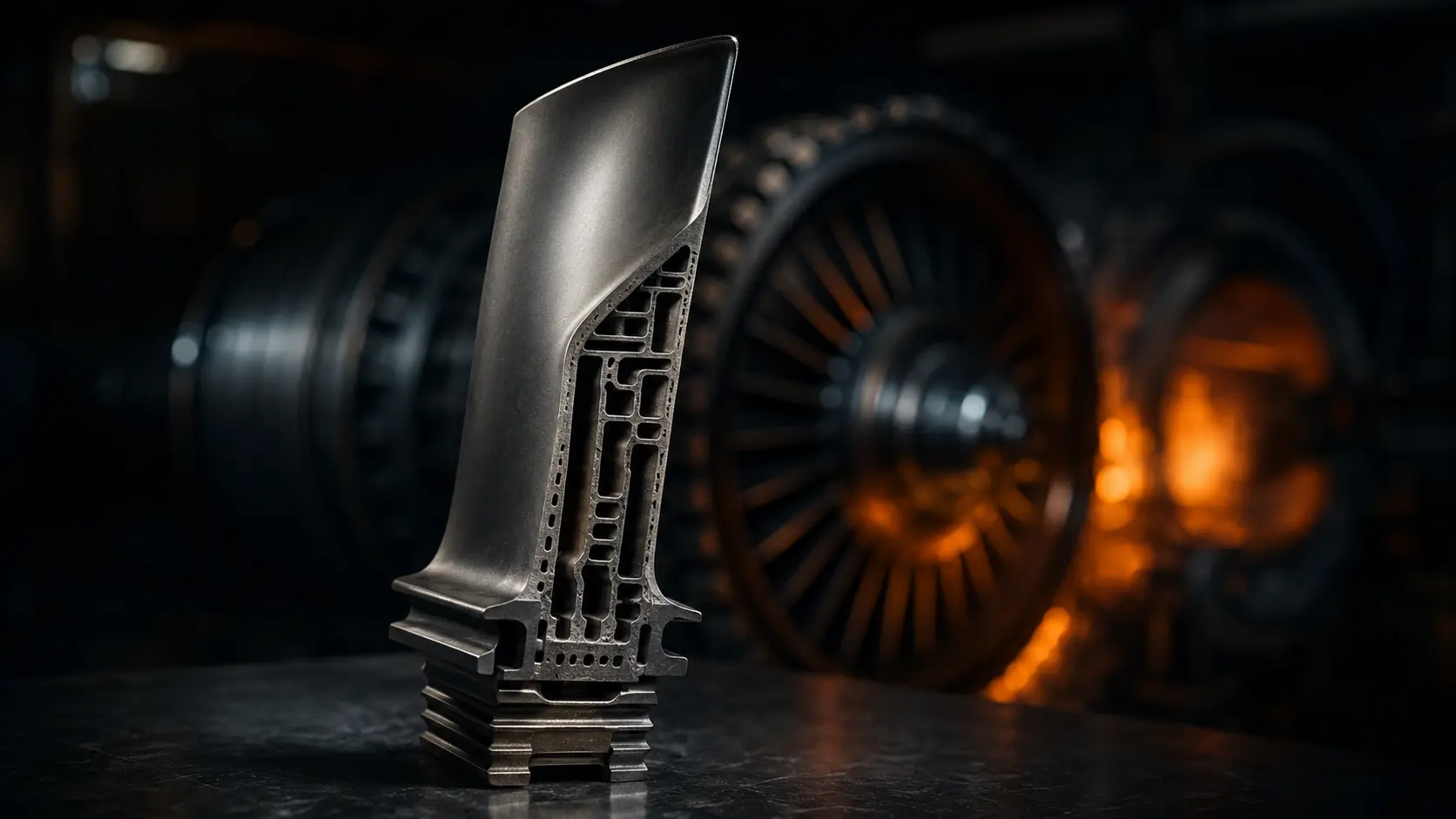
These blades survive because they are hollow, single-crystal nickel superalloys. The engine bleeds relatively cool air from the front compressor and forces it through microscopic, maze-like channels cast directly inside the hollow blade.
This continuous internal airflow bleeds heat away from the metal from the inside out. Simultaneously, the air exits through tiny holes on the blade’s surface, creating a thin film of cool air that insulates the metal from the direct blast of the combustion gas.
WHY IT MATTERS NOW
The global commercial aviation industry operates on razor-thin financial margins. Airlines survive solely on fuel efficiency. The ability of engine manufacturers to push turbine temperatures just a few degrees hotter translates directly to billions of dollars in saved aviation fuel globally.
Consequently, metallurgical yield rates act as the hard speed limit for global aircraft production. Both Boeing and Airbus face massive delivery backlogs because the supply chain for single-crystal turbine castings remains severely bottlenecked. Growing these flawless metal crystals takes hours of continuous furnace operation and suffers from notoriously high scrap rates.
In the defense sector, hypersonic weapons are forcing a total rewrite of aerospace material science. A missile traveling at Mach 5 experiences atmospheric friction that generates plasma fields around the airframe. Legacy nickel superalloys physically melt in this environment, stripping the weapon of its aerodynamics.
This operational reality forces defense contractors to rapidly commercialize ultra-high-temperature ceramics and refractory metals like tungsten and molybdenum. The nation that successfully scales the manufacturing of these specialized ablation barriers dictates the balance of global air superiority.
COMMON MISCONCEPTIONS
Many assume titanium is the strongest metal in an aircraft engine. While titanium is highly prevalent in the cooler front fan blades due to its light weight, it combusts if exposed to the extreme heat of the rear turbine section, which requires heavy nickel alloys.
People often think jet engines are solid chunks of metal. The most critical parts, like turbine blades, are entirely hollow and highly engineered to manage complex internal cooling airflow.
Observers frequently believe building an advanced jet engine is primarily an aerodynamic software challenge. In reality, it is almost entirely a material science and casting problem. Knowing the perfect shape of the blade is useless if a foundry cannot cast the metal without microscopic flaws.
Investors frequently view the aerospace supply chain through the lens of raw material availability. The true industrial chokepoint is the proprietary thermal gradient software required to run the vacuum induction furnaces, not just the raw metal supply.
WHAT MOST PEOPLE MISS
Industrial analysts fixate on the metallurgical properties of the nickel superalloy, but they completely miss the critical role of the ceramic core. To create the hollow cooling channels inside a single-crystal blade, foundries must insert a fragile, highly complex ceramic core into the mold before pouring the metal.
This ceramic must survive being submerged in 1,500°C molten nickel without melting or warping. After the metal freezes, the ceramic must safely dissolve away in a highly toxic chemical bath, leaving the hollow air channels behind.
The true industrial moat for elite aerospace foundries is not their metal recipes. It is their proprietary, highly guarded ceramic core chemistry. If the ceramic core shifts by a fraction of a millimeter during the casting process, the internal cooling channels block, and the blade will explode mid-flight.
THE ECONOMIC AND STRATEGIC IMPACT
The extreme capital costs of vacuum induction foundries create an impenetrable global oligopoly. A handful of specialized corporations dominate the global supply of critical engine components. This consolidation gives these material science firms absolute pricing power over both commercial airlines and sovereign militaries.
The barriers to entry are so high that emerging aerospace nations frequently struggle to domesticate engine production. This forces them to import Western hardware regardless of geopolitical tensions, turning metallurgy into a primary pillar of economic diplomacy.
Investors who understand this dynamic prioritize the sub-tier suppliers over the prime aerospace contractors. The companies that master high-temperature single-crystal casting capture the highest recurring profit margins in the defense sector, as these components must be frequently replaced during routine engine overhauls.
THE TRAJECTORY
Next 12–36 Months: Major aerospace foundries will integrate continuous acoustic and optical emission monitoring directly into the vacuum furnaces. These sensors will detect microscopic crystal nucleation errors in real time, salvaging blades before they fail quality control.
Next Five Years: The structural transition toward Ceramic Matrix Composites (CMCs). As military engines push operating temperatures toward 2,000°C, single-crystal nickel will reach its absolute physical exhaustion point. Manufacturers will replace the hottest metallic turbine stages with silicon carbide composites, fundamentally shifting aerospace supply chains.
Next Ten Years: The 3D printing of refractory metals will mature at an industrial scale. Additive manufacturing of tungsten-niobium alloys will enable complex, internal cooling geometries for hypersonic scramjets that are physically impossible to achieve through traditional mold casting.
What Could Go Wrong: A severe rare-earth supply shock. Single-crystal superalloys require a precise chemical cocktail of elements. A coordinated geopolitical embargo on aerospace-grade titanium, hafnium, or rhenium could instantly paralyze Western furnace operations, grounding future aircraft production lines.
Most Likely Outcome: Single-crystal casting will maintain its monopoly over the high-pressure turbine sections of commercial aircraft for the next decade. The extreme capital cost and proprietary learning curves of vacuum induction metallurgy will keep aerospace dominance consolidated among a few elite global manufacturers.
KEY TERMS
- Superalloy: A highly complex metal mixture engineered specifically to resist extreme heat, physical stretching, and chemical corrosion.
- Grain Boundary: The microscopic physical seam where two separate metal crystals meet and weaken the overall structure.
- Directional Solidification: An industrial casting technique that controls the cooling rate of liquid metal to force crystal growth in one specific direction.
- Vacuum Induction Melting: A process that uses electromagnetic fields to melt metal inside a vacuum, preventing atmospheric oxygen from contaminating the alloy.
- Thermal Creep: The slow, permanent stretching and deformation of solid metal when subjected to extreme heat and constant physical stress.
- Ceramic Matrix Composite (CMC): An advanced material made from silicon carbide fibers that offers the heat resistance of ceramics without being brittle.
BEGINNER FAQ
What is a superalloy? A superalloy is a high-performance metal designed to operate at a high fraction of its melting point. It maintains structural integrity under extreme heat and mechanical stress that would destroy normal steel.
Why are jet engines made of nickel? Nickel possesses a highly stable atomic structure that resists thermal expansion. When mixed with other elements, it forms a lattice that prevents the metal from melting or stretching in the combustion chamber.
What is single-crystal casting? It is a manufacturing process that grows a metal component from one continuous crystal. This eliminates internal fault lines, making the metal drastically stronger at high temperatures.
Why can’t we use titanium for the whole engine? Titanium is exceptionally strong and lightweight, making it perfect for the cool front fans of the engine. However, if exposed to the extreme heat of the rear turbine, titanium will structurally fail and catch fire.
How do turbine blades survive heat hotter than their melting point? Turbine blades are completely hollow and feature microscopic holes on their surface. The engine forces cool air through these internal channels, creating an invisible shield of cold air around the metal.
What is a thermal barrier coating? It is a microscopic layer of specialized ceramic sprayed onto the exterior of a turbine blade. This ceramic acts as physical insulation, drastically lowering the temperature of the underlying metal.
What are ceramic matrix composites? They are advanced materials combining ceramic fibers with a ceramic matrix. They are significantly lighter than metal and can withstand much higher temperatures without shattering.
Why is aerospace metallurgy a national security issue? The ability to manufacture heat-resistant materials dictates the speed and range of military aircraft and missiles. Nations that cannot cast these metals rely entirely on foreign powers for air superiority.
SOURCES
- National Aeronautics and Space Administration (NASA) — Advanced High-Temperature Engine Materials Technology Program
- Journal of Materials Processing Technology — Directional Solidification and Single-Crystal Casting of Nickel-Based Superalloys
- Department of Defense (DoD) — Supply Chain Vulnerabilities in Aerospace Precision Forging and Casting
- American Institute of Aeronautics and Astronautics (AIAA) — Thermal Barrier Coatings and Ceramic Matrix Composites in Modern Turbines