Advertisement
)

AT A GLANCE
- Concept: Alternating Current (AC): Standard electricity that constantly reverses direction, creating magnetic resistance that drains power over long distances.
- Concept: Direct Current (DC): Electricity that flows continuously in one direction, eliminating the alternating magnetic friction.
- Concept: Voltage-Source Converter (VSC): The massive, building-sized microchip stack that perfectly translates AC power into DC power and back again.
- Concept: Reactive Power: Wasted energy in an AC system caused by the continuous charging and discharging of the transmission line.
IN SIMPLE WORDS
Imagine trying to move a massive train full of cargo across the country. If you use the local road system (Alternating Current), the train constantly has to stop at traffic lights, turn corners, and negotiate traffic. All that starting and stopping burns immense amounts of fuel before the train ever reaches its destination.
If you build a dedicated, high-speed rail line with zero stops (Direct Current), the train can accelerate to maximum speed and glide across the continent using very little fuel.
For the past century, the world ran on Alternating Current because it was easy to manipulate locally. However, AC transmission lines act like giant electrical sponges over long distances, soaking up and wasting the power they are supposed to deliver. To bring wind power from remote oceans and solar power from empty deserts to crowded cities thousands of miles away, engineers use HVDC. It translates the power into a single, high-pressure stream, shooting electricity across continents efficiently.
HOW HVDC TRANSMISSION WORKS
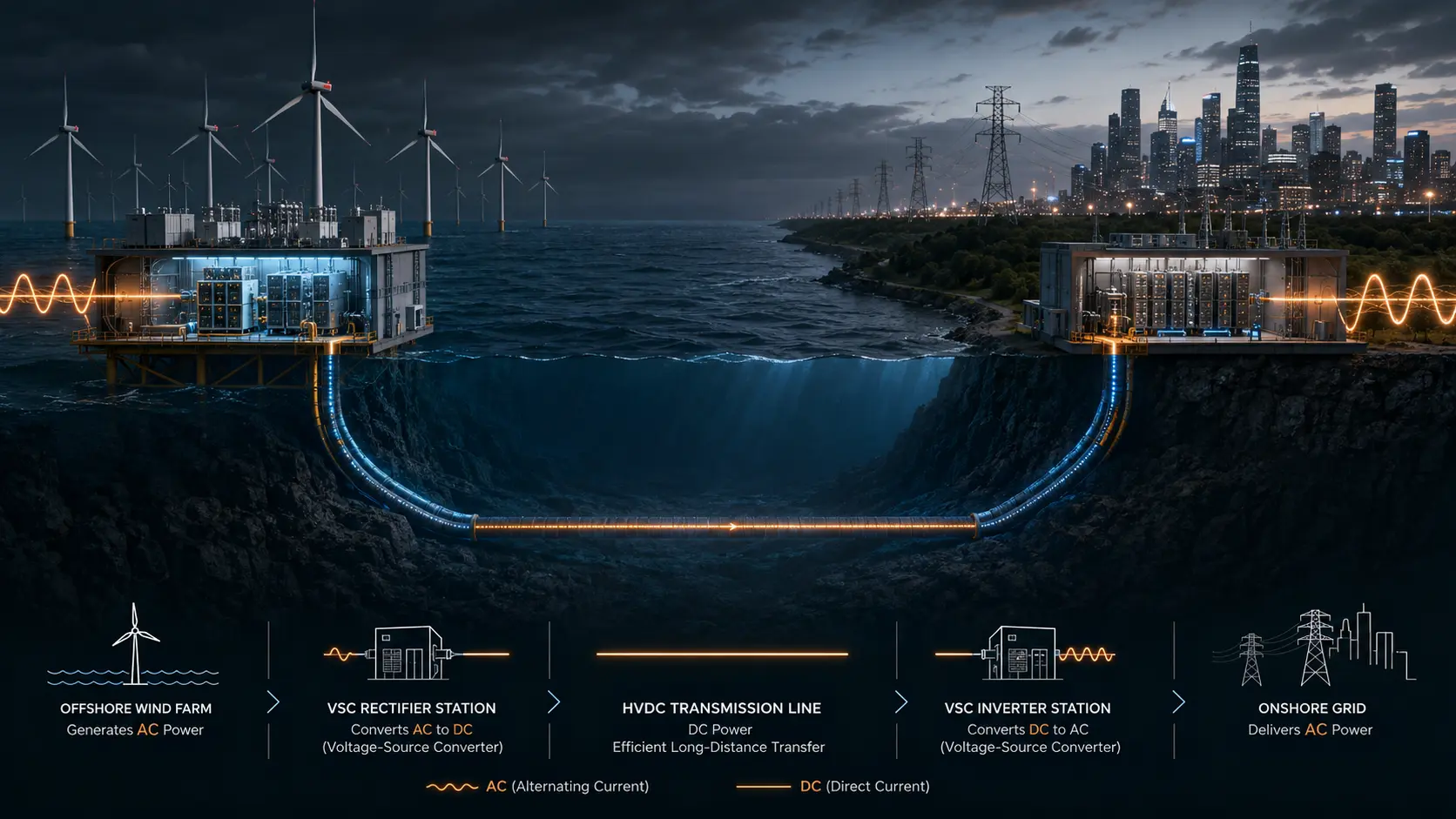
Moving power across a continent using HVDC requires three massive, specialized components: a rectifier station, the transmission line, and an inverter station.
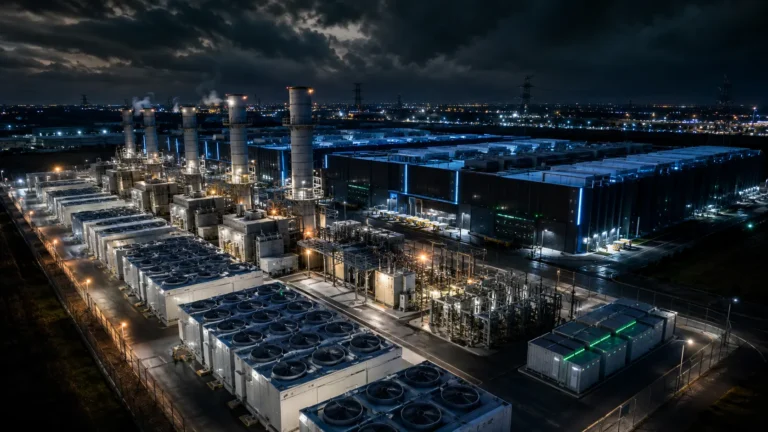
The process begins at a local Alternating Current grid, such as an offshore wind farm. The wind turbines generate standard AC power. This power flows into a massive facility known as an HVDC converter station, specifically operating as a rectifier.
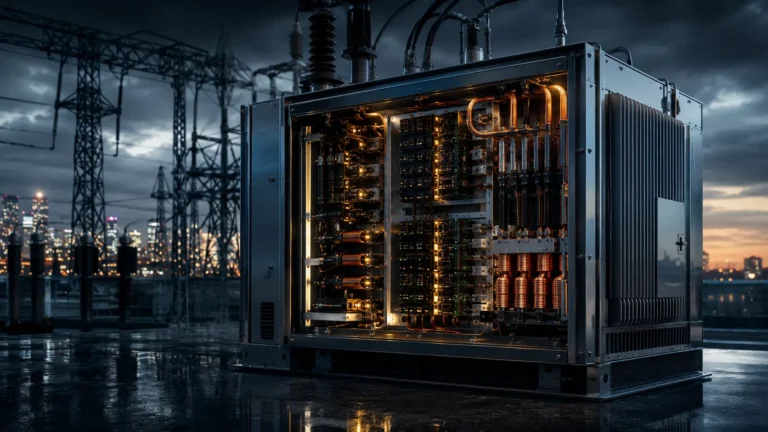
The rectifier strips away the alternating nature of the power. It relies on advanced power electronics, primarily Voltage-Source Converters (VSC) built from thousands of Insulated-Gate Bipolar Transistors (IGBT). These transistors act as microscopic, high-speed switches. They flip on and off thousands of times per second, perfectly smoothing the alternating electrical wave into a flat, high-pressure line of Direct Current.
Once converted to DC, the electricity enters the transmission line. In an AC system, the constant reversal of current creates severe inductance and capacitance—essentially, the wire fights against itself, generating “reactive power”. Reactive power performs no useful work but consumes massive amounts of space on the physical wire. Because DC flows continuously in one direction, it generates zero reactive power. The only loss is the natural resistive heating of the metal (I²R loss).
When the direct current reaches the destination city thousands of miles away, it enters an inverter station. The inverter performs the exact opposite mathematical operation. The IGBT valve stacks chop the flat DC signal back into a perfectly synchronized alternating wave, matching the exact frequency of the local city grid (like 50 Hz or 60 Hz) before distributing it to homes.
REAL WORLD EXAMPLE
The ultimate realization of this technology is the Changji-Guquan Ultra-High-Voltage Direct Current (UHVDC) project in China. It is the most powerful transmission line ever constructed by humanity.
Operating at an unprecedented 1,100 kilovolts (1.1 million volts), the line stretches 3,324 kilometers from the remote, energy-rich Xinjiang region in the northwest to the densely populated Anhui province in eastern China. The line transmits 12 gigawatts of continuous power—the equivalent output of 12 large nuclear reactors. By utilizing UHVDC, the system loses less than 2 percent of its power across a distance wider than the entire continent of Europe. It single-handedly replaces the need to burn roughly 38 million tons of coal annually near eastern Chinese population centers.
WHY IT MATTERS NOW
The fundamental geography of human energy is misaligned. For the past century, utilities simply built coal and gas plants right next to the cities that needed the power. In the renewable era, energy generation is dictated by geography. The strongest winds blow over deep, offshore oceans. The most intense sunlight hits remote deserts.
Transporting that clean energy to a city 1,000 miles away using traditional Alternating Current is economically and physically unviable. The AC power simply bleeds out into the atmosphere and the ground before it arrives. HVDC is the only physical mechanism that allows a civilization to connect vast, distant renewable generation hubs directly to urban load centers.
Furthermore, HVDC solves the nightmare of grid synchronization. If you attempt to connect the Texas power grid directly to the Eastern United States power grid using standard AC cables, the systems will instantly overload and explode because their alternating waves are completely out of phase.
Because HVDC converts the power into a flat direct current, it acts as a firewall between grids. You can pump massive amounts of emergency power from a grid operating at 60 Hz directly into a foreign grid operating at 50 Hz, perfectly synchronizing the power on the receiving end. This establishes total resilience against regional blackouts.
COMMON MISCONCEPTIONS
- “DC power is old and obsolete.” During the famous “War of the Currents,” Thomas Edison championed DC, while Nikola Tesla and George Westinghouse championed AC. AC won because, in the 1890s, we lacked the technology to efficiently step DC voltage up and down. Modern silicon microchips finally solved Edison’s problem, making DC superior for long-distance transport.
- “HVDC lines are dangerous to live near.” Actually, HVDC lines generate a static magnetic field, much like the natural magnetic field of the Earth. They do not emit the alternating electromagnetic radiation that causes interference near heavy AC lines.
- “You can plug a house directly into an HVDC line.” You cannot. The voltages are astronomically high (often 800,000 volts). The power must be physically caught by a multi-billion-dollar converter station and translated back down to local AC levels before it can enter a neighborhood.
WHAT MOST PEOPLE MISS
Geopolitical analysts focus on the massive overland towers, but they frequently overlook the hidden submarine supergrids.
Alternating Current completely fails underwater. Because water is highly conductive, the capacitance effect of an undersea AC cable essentially drains the entire power load into the surrounding ocean over distances greater than 50 kilometers. Offshore wind farms located far out at sea absolutely must use specialized HVDC extruded polymer cables. Without undersea HVDC, the entire global offshore wind industry is mathematically impossible.
THE ECONOMIC AND STRATEGIC IMPACT
The primary financial beneficiaries are the elite mega-engineering conglomerates capable of building Voltage-Source Converters. Firms like Hitachi Energy, Siemens, and ABB monopolize this sector. Building a converter station is closer to building a supercomputer than building a traditional electrical substation; it requires highly proprietary thermal cooling systems and millions of lines of active switching code.
Strategically, HVDC alters national security. By laying deep undersea DC cables, island nations can integrate securely into massive continental grids. For example, the United Kingdom heavily imports clean hydro-power directly from Norway via the North Sea Link—a 720-kilometer HVDC submarine cable. This binds European energy security together, physically linking sovereign grids across international waters without requiring them to synchronize their internal operations.
The economic losers are local, expensive baseload generators. If a utility can instantly import dirt-cheap solar power from a desert 2,000 miles away with zero transmission loss, expensive local fossil-fuel peaking plants become completely obsolete.
THE TRAJECTORY
Next 12–36 Months: The massive expansion of multi-terminal VSC networks. Historically, an HVDC line was strictly point-to-point (one start, one end). Engineers will aggressively deploy “multi-terminal” lines with off-ramps, allowing multiple cities and multiple wind farms to tap into the same DC superhighway simultaneously.
Next Five Years: The implementation of the ultra-high-voltage subsea links. Projects like the Australia-Asia PowerLink (SunCable) will attempt to lay 4,000 kilometers of HVDC cable across the ocean floor, exporting massive amounts of Australian desert solar power directly to the island grid of Singapore.
Next Ten Years: The construction of the intercontinental macro-grid. As voltage limits push past 1,100 kV and converter costs fall, nations will begin linking continents. Europe will lay massive capacity lines across the Mediterranean to tap into the limitless solar potential of the Sahara Desert, creating a unified Afro-Eurasian clean energy bloc.
What Could Go Wrong: A catastrophic cyberattack on the VSC control matrix. An HVDC converter station is fundamentally a massive, internet-connected computer switching millions of volts. If a hostile state actor hacks the firing sequence of the IGBT valves, they could force the station to rapidly reverse power flow, instantly tearing apart transformers and melting grid infrastructure across multiple states.
Most Likely Outcome: The concept of the “local grid” will disappear. HVDC technology will turn electricity into a true global commodity, physically transporting gigawatts of power across continents and oceans as easily as pipelines transport natural gas today.
KEY TERMS
- High-Voltage Direct Current (HVDC): A power transmission system that uses direct current for the bulk transmission of electrical power, highly efficient over long distances.
- Voltage-Source Converter (VSC): The advanced electronic facility that translates AC to DC using high-speed microchip switching rather than older, less efficient mechanisms.
- Reactive Power: Wasted electrical energy created by the alternating magnetic fields in AC lines; it performs no work but consumes capacity on the wire.
- Inverter: The specific part of the station that converts incoming direct current (DC) back into usable alternating current (AC) for the local grid.
- Rectifier: The specific part of the station that takes alternating current (AC) from a power plant and straightens it into direct current (DC) for transmission.
- Insulated-Gate Bipolar Transistor (IGBT): The high-voltage silicon microchips inside a converter station that rapidly switch on and off to manipulate massive electrical currents.
BEGINNER FAQ
What makes HVDC different from the power lines in my town? Your local power lines use Alternating Current (AC), which constantly pushes and pulls electricity back and forth. HVDC pushes electricity continuously in one single direction, like water flowing through a hose.
Why don’t we use HVDC everywhere? The converter stations required to change the power from AC to DC and back again are incredibly expensive. It is only financially worth building them if you need to move massive amounts of power hundreds of miles.
If DC is so much better, why didn’t we use it 100 years ago? A century ago, it was mechanically impossible to efficiently raise DC to high voltages for transport and then lower it safely for home use. We had to wait for modern silicon microchips to solve the problem.
How does this help wind and solar power? The best places for wind and solar are usually very far away from the major cities that need the electricity. HVDC acts as a fast, highly efficient highway to connect them without losing all the power along the way.
Can HVDC lines go underwater? Yes. In fact, they are the only type of electrical cable that can efficiently move massive amounts of power over long distances underwater, making them mandatory for offshore wind farms.
What is an Ultra-High-Voltage (UHVDC) line? It is an extreme version of HVDC that operates at 800,000 volts or more. Pushing the voltage that high drastically reduces the amount of heat lost by the wire, making the system hyper-efficient.
Do these lines cause power outages? No, they actually prevent them. Because an HVDC line can instantly control exactly how much power flows through it, operators use them to rapidly pump emergency power into a failing grid to stop a blackout.
Who is building the most HVDC lines? China is currently the undisputed global leader in constructing UHVDC supergrids, aggressively networking their vast interior energy resources with their coastal mega-cities.
SOURCES
- United States Department of Energy (DOE) — National Transmission Needs Study and HVDC Deployment
- International Energy Agency (IEA) — Electricity Grids and Secure Energy Transitions
- Institute of Electrical and Electronics Engineers (IEEE) — Voltage-Source Converter Technology for HVDC Transmission
- State Grid Corporation of China (SGCC) — Technical Specifications of the Changji-Guquan 1,100 kV UHVDC Project