Advertisement
)

AT A GLANCE
- Concept: Petrodollar Recycling: Converting national oil export revenues into global financial investments like US Treasuries or equities.
- Concept: Illiquid Assets: Investments like private equity, infrastructure, or real estate that cannot be sold quickly for cash.
- Concept: Strategic Asset Allocation: The mathematical formula determining how much of the fund is invested in stocks, bonds, or real estate.
- Concept: Geopolitical Leverage: Using state capital to buy strategic influence in foreign technology companies and infrastructure.
IN SIMPLE WORDS
Imagine you win the lottery, but you know the prize money will eventually run out. Instead of spending it all today, you put most of it into a massive savings account, buying real estate, stocks, and businesses worldwide.
Sovereign wealth funds do exactly this, but for entire countries. Nations that sell massive amounts of oil, like Saudi Arabia or Norway, realize their oil reserves are finite. Instead of spending all their profit on immediate domestic projects, they pool the extra cash into a massive national investment fund.
These state-owned funds buy up international office buildings, fund global technology startups, and purchase professional sports teams. By doing this, the nation ensures that even when their oil runs out, their economy will survive off the endless profits generated by the global assets they now own.
HOW SOVEREIGN WEALTH FUNDS WORK
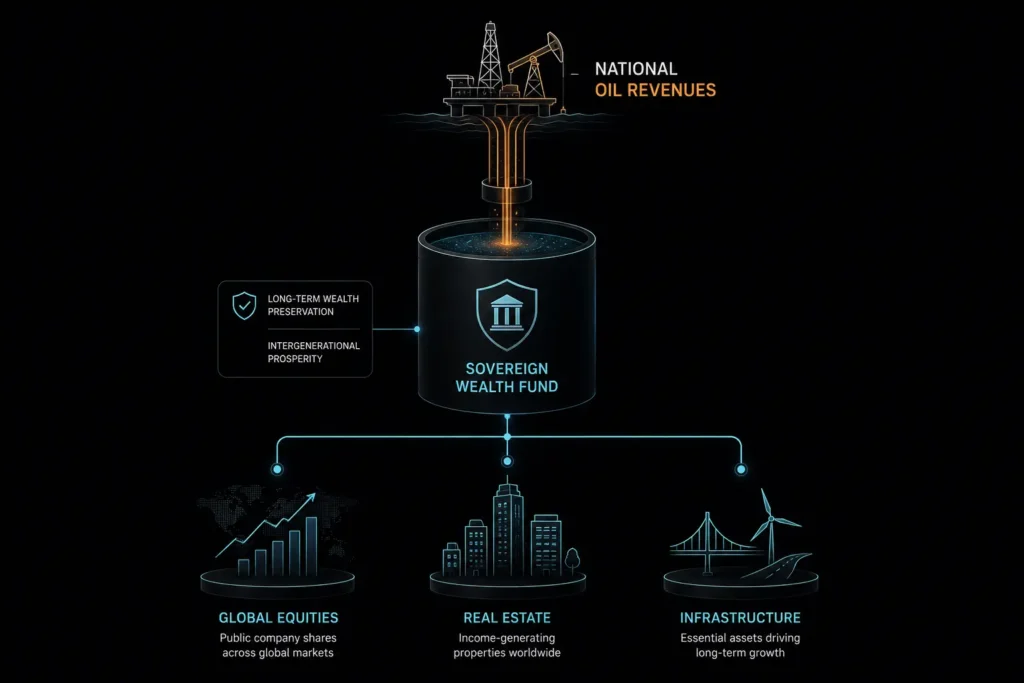
The mechanics of a sovereign wealth fund (SWF) start with massive, recurring capital inflows. These inflows usually originate from a macroeconomic trade surplus. When a country like Norway exports billions of dollars of North Sea oil, they are paid in foreign currency—primarily US dollars, creating the “petrodollar.”
If the government injected all those foreign dollars into their domestic economy at once, it would trigger massive inflation and currency appreciation, a phenomenon known as “Dutch Disease.” To prevent this, the state channels the excess capital into a sovereign wealth fund, pushing the money back out into the global financial system.
Once the capital is pooled, the fund’s managers execute a Strategic Asset Allocation (SAA) mandate. Unlike a traditional mutual fund that must hold cash in case investors want to withdraw, an SWF is backed by a sovereign state. It does not face short-term redemption pressure. This allows SWFs to deploy capital into highly illiquid alternative assets.
They target multi-decade investment horizons, pouring hundreds of billions into infrastructure projects, private equity buyouts, and global real estate. Because they do not need immediate cash, they can harvest the “illiquidity premium”—the higher return investors demand for locking their money away for ten or twenty years.
REAL WORLD EXAMPLE
Saudi Arabia’s Public Investment Fund (PIF) is aggressively rewriting global sports and technology. Governed by Crown Prince Mohammed bin Salman, the PIF controls nearly a trillion dollars.
To diversify the kingdom’s economy away from oil, the PIF uses its massive capital reserves to buy instant global market share. They backed the massive Vision Fund to dominate global tech venture capital. More visibly, they essentially bought the professional sport of golf by funding the LIV Golf league and forcing a merger with the PGA Tour. This demonstrates how a sovereign fund can use brute-force capital to acquire global cultural and economic assets in a matter of months.
WHY IT MATTERS NOW
Sovereign wealth funds have grown so massive that they are effectively replacing traditional investment banks as the ultimate power brokers of global capitalism. Together, these state-owned entities manage over 11 trillion dollars. They are no longer passive investors quietly buying stocks; they are aggressive kingmakers.
When a massive technology company wants to stay private for longer, they bypass Wall Street entirely and go directly to Abu Dhabi or Singapore. These funds can write a single 5-billion-dollar check, allowing startups to scale globally without the regulatory headaches of an Initial Public Offering (IPO).
Geopolitically, the rise of sovereign wealth alters the balance of power. Western nations rely on highly regulated, private corporate capital. Gulf and Asian nations rely on state-directed capital. When an SWF buys a port in Europe, a semiconductor plant in the US, or a lithium mine in Africa, it blurs the line between a financial transaction and a sovereign diplomatic maneuver.
This has triggered fierce national security debates. Western governments are increasingly blocking SWF investments in critical infrastructure, fearing that foreign state-owned capital will be weaponized to steal intellectual property or sabotage domestic supply chains during a geopolitical conflict.
COMMON MISCONCEPTIONS
- “They are just massive hedge funds.” Hedge funds use massive amounts of borrowed money (leverage) to make risky, short-term bets. Sovereign wealth funds use zero leverage—they invest pure cash—and plan their investments across decades, not financial quarters.
- “They belong to the politicians.” In well-managed funds like Norway’s Government Pension Fund Global, strict legal firewalls prevent politicians from touching the money. Independent central bankers manage the capital strictly for the citizens’ future.
- “Only oil-rich Middle Eastern countries have them.” While petrostates are prominent, non-oil nations like Singapore (GIC) and China (CIC) run massive funds built entirely from manufacturing exports and trade surpluses.
WHAT MOST PEOPLE MISS
Financial journalists focus heavily on what these funds are buying, but they completely ignore the macroeconomic stabilization effect.
During the 2008 financial crisis, when Western banks were collapsing and global credit markets froze, sovereign wealth funds stepped in as the lenders of last resort. Funds from Abu Dhabi, Kuwait, and Singapore injected billions of dollars of emergency equity into Wall Street banks like Citigroup and Merrill Lynch. Without this massive influx of state-owned capital, the Western financial system likely would have suffered a total systemic failure.
THE ECONOMIC AND STRATEGIC IMPACT
The primary financial beneficiaries are the elite alternative asset managers on Wall Street. Private equity firms like Blackstone and KKR earn billions of dollars in management fees simply by acting as the middlemen, deploying the massive capital of sovereign wealth funds into corporate buyouts.
The strategic winners are the sovereign states themselves. A massive fund provides ultimate fiscal resilience. If the price of oil crashes to zero tomorrow, a country like Norway or the UAE will simply pay for their government operations using the stock market dividends generated by their SWF, making their economies virtually bulletproof.
The losers are traditional retail investors. As sovereign wealth funds increasingly buy up the most profitable companies and real estate while they are still private, everyday investors are locked out of the best growth opportunities, forced to buy into mature, slower-growing public markets.
THE TRAJECTORY
Next 12–36 Months: The surge of sovereign investments in artificial intelligence. SWFs will aggressively pivot capital into securing AI computing power, directly funding massive sovereign data centers and specialized semiconductor packaging startups to avoid relying entirely on American tech monopolies.
Next Five Years: The rise of the “Sovereign Venture Capitalist.” Funds will move earlier into the tech pipeline. Instead of buying mature real estate or late-stage tech, SWFs will open massive offices in Silicon Valley and London, directly competing with elite venture capital firms to fund early-stage robotics and biotechnology.
Next Ten Years: The weaponization of the energy transition. Gulf state SWFs will use their massive oil wealth to entirely buy up the global supply chain for green energy. They will acquire the world’s largest lithium mines, battery gigafactories, and solar panel manufacturers, ensuring they control the clean energy era just as they controlled the oil era.
What Could Go Wrong: A catastrophic global asset seizure. If a major geopolitical conflict erupts—similar to the invasion of Ukraine—Western nations have proven they will instantly freeze the sovereign reserves of hostile states. If global trust in international property rights collapses, SWFs may rapidly pull their trillions of dollars out of Western markets, triggering an unprecedented global stock market crash.
Most Likely Outcome: Sovereign wealth funds will become the primary architecture of statecraft. Capital injection will replace military intervention as the preferred method of expanding national influence, as state-owned trillions silently buy up the foundational infrastructure of the global economy.
KEY TERMS
- Sovereign Wealth Fund (SWF): A state-owned investment fund that invests in real and financial assets globally to benefit the country’s economy.
- Petrodollar Recycling: The macroeconomic process of taking dollars earned from exporting oil and reinvesting them back into global financial markets.
- Illiquid Asset: An investment, like real estate or a private company, that cannot be quickly or easily sold for cash.
- Strategic Asset Allocation: The strict percentage rules dictating how much of a fund’s total money goes into stocks, bonds, or alternative investments.
- Dutch Disease: An economic phenomenon where a sudden spike in natural resource exports severely damages a country’s other manufacturing sectors.
- Alternative Investments: Financial assets that do not fall into conventional categories like publicly traded stocks, bonds, or cash.
BEGINNER FAQ
What is a sovereign wealth fund? It is a massive government savings account. When a country makes more money from exporting goods than it spends, it puts the extra cash into this fund to invest around the world.
Where do they get the money? Most get their money from selling oil and gas. Others, like China and Singapore, get it from exporting manufactured goods and maintaining massive national trade surpluses.
What do they buy? Everything. They buy stocks in Apple, skyscrapers in London, private technology startups, infrastructure like toll roads and airports, and even professional sports teams.
Why don’t they just spend the money on their own citizens today? Because the oil will eventually run out. By investing the money globally, the government ensures that future generations will have an income long after the natural resources are gone.
Is it dangerous for foreign governments to own our companies? It can be a national security risk. Western governments carefully monitor these funds to ensure they do not buy critical military contractors or sensitive infrastructure that could be weaponized.
How big are these funds? They are massive. Norway runs the largest fund in the world, managing nearly 1.5 trillion dollars. Combined, global sovereign wealth funds control over 11 trillion dollars.
Do they tell people what they buy? It depends on the country. Norway is highly transparent and publishes every single stock they own on the internet. Others, particularly in the Middle East and China, are highly secretive.
How does this affect normal people? Because these funds have so much cash, they drive up the prices of global real estate and stocks. When they buy thousands of homes or entire companies, it affects global market prices for everyone.
SOURCES
- Sovereign Wealth Fund Institute (SWFI) — Global Asset Allocation and Sovereign Wealth Rankings
- International Monetary Fund (IMF) — Macroeconomic Impact of Sovereign Wealth Funds and Petrodollar Recycling
- Bank for International Settlements (BIS) — The Role of State-Owned Capital in Global Financial Stability
- Global SWF — Annual Report on State-Owned Investors and Geopolitical Capital Flows