Advertisement
)


At a Glance
• Concept: Non-bank financial entities performing traditional credit and lending functions.
• Why it matters: It controls tens of trillions of dollars and funds a massive portion of global economic growth.
• Who uses it: Private equity firms, major corporations, and consumer mortgage borrowers.
• Biggest takeaway: Shadow banks provide essential economic liquidity but carry hidden systemic risks because they lack government backstops.
In Simple Words
When you need a loan, you normally go to a bank. The bank takes money from everyday depositors and lends it to you. Because the bank holds regular people’s savings, the government regulates it heavily and insures the deposits.
A shadow bank does the exact same thing—it lends money. However, instead of taking deposits from everyday people, it raises money from wealthy investors, pension funds, and insurance companies. Because it does not hold consumer deposits, it does not have to follow strict traditional banking rules.
This allows these institutions to move faster, take bigger risks, and lend massive amounts of money. Today, if a large corporation wants to borrow a billion dollars, it often skips the traditional bank and goes straight to this invisible credit network.
Why This Matters
The term “shadow banking” sounds sinister, but it is actually the financial engine keeping the modern economy running.
Following the 2008 financial crisis, global regulators forced traditional banks to become much safer. They must now hold more cash in reserve and avoid highly risky corporate loans. While this made traditional banks safer, the global economy still required debt to grow. Non-bank financial institutions stepped in to fill that exact void.
Today, this system—often referred to by regulators as “market-based finance”—controls roughly half of all global financial assets. When a family gets a mortgage through an online-only lender, they are using shadow banking. When a private equity firm buys a software company, it uses shadow banking to fund the purchase.
However, this system operates without the ultimate safety net. If a traditional bank runs out of money, the central bank steps in as a lender of last resort. If a shadow bank faces a sudden demand for cash from its investors, it must sell its assets immediately. In a crisis, this forced selling can trigger a panic that freezes the entire global financial system. Understanding this network is essential for anyone tracking global economic stability.
HOW THE SHADOW BANKING SYSTEM WORKS
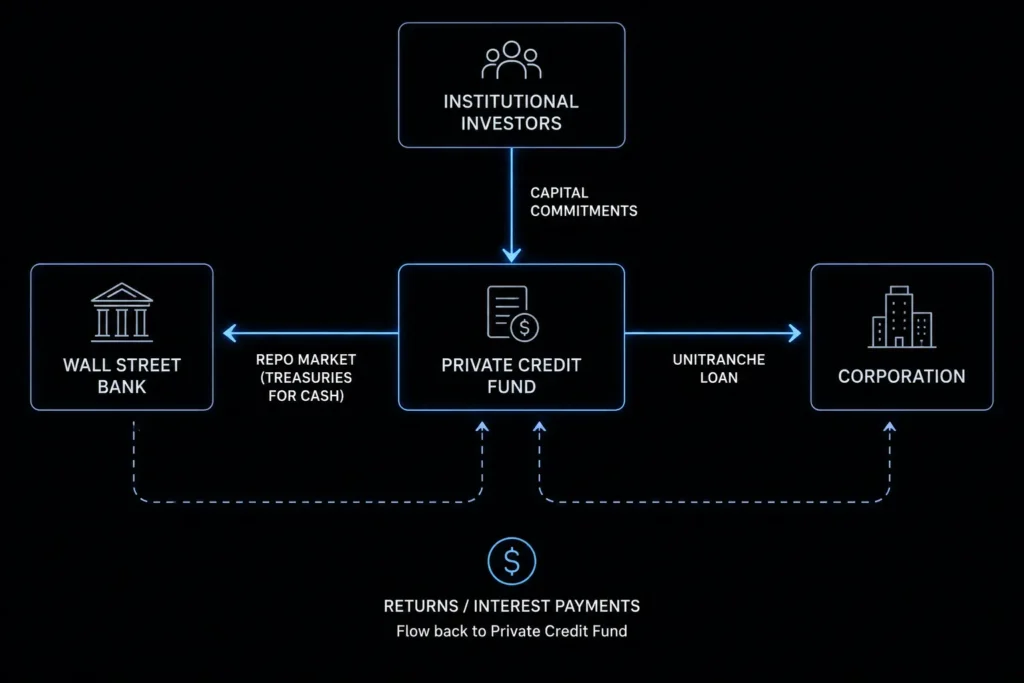
Shadow banking is essentially the process of turning investor capital into loans without using a traditional bank deposit. The system relies on a complex chain of financial engineering.
1. Capital Pooling: The process begins by gathering money. Instead of opening checking accounts for everyday citizens, a non-bank lender creates a massive fund. They collect billions of dollars from institutional investors, such as university endowments, sovereign wealth funds, and life insurance companies. These investors are looking for higher interest rates than traditional bonds can offer.
2. Direct Lending and Unitranche Debt: Once the fund has capital, it lends that money directly to corporations. Historically, a company buying another company would need a group of banks to organize the loan. Today, a single private credit fund can write a billion-dollar check.
They often use a structure called “unitranche debt.” This combines senior and subordinated debt into one single loan with a blended interest rate. It simplifies the borrowing process and allows the shadow bank to deploy massive amounts of capital quickly.
3. The Repo Market (Short-Term Funding): Shadow banks also need cash to manage their daily operations. They get this through repurchase agreements, known as the “repo” market.
In a repo transaction, a shadow bank sells a safe asset, like a US Treasury bond, to another financial institution and promises to buy it back the next day at a slightly higher price. It functions as an overnight loan. The shadow bank gets immediate cash to fund its operations, and the lender holds the bond as safe collateral.
4. Securitization and CLOs: To manage risk, shadow banks often package their loans together. They bundle hundreds of corporate loans into a single financial product called a Collateralized Loan Obligation (CLO).
They slice this CLO into different risk categories and sell them to other investors. This moves the risk of the loan off the shadow bank’s balance sheet, freeing up their capital to go make brand new loans.
5. The Liquidity Mismatch: The core vulnerability of this system is liquidity. Shadow banks often use short-term funding (like overnight repo loans) to finance long-term assets (like five-year corporate loans).
If the investors in the overnight market suddenly get spooked and refuse to roll over their loans, the shadow bank is instantly starved of cash. Because the shadow bank’s money is tied up in five-year corporate loans that cannot be sold easily, the firm faces immediate collapse. This dynamic is the equivalent of a modern bank run.
Real-World Applications
Shadow banking is visible across multiple sectors of the everyday economy.
Consumer Mortgages: Companies like Rocket Mortgage and United Wholesale Mortgage do not take deposits. They use lines of credit from Wall Street to fund home loans, then immediately package and sell those mortgages to investors. They are non-bank originators operating entirely within the shadow banking framework.
Private Credit: Massive asset managers like Apollo Global Management, Ares, and Blackstone operate private credit divisions. When a private equity firm buys a major retail chain or a software provider, these direct lenders write the checks, entirely bypassing traditional banks like JPMorgan or Bank of America.
Money Market Funds: When everyday consumers put their extra cash into a brokerage account’s money market fund, they are participating in shadow banking. The fund takes that consumer cash and lends it overnight to corporations and hedge funds through the repo market.
Economic & Strategic Impact
The growth of shadow banking shifts financial risk away from the heavily regulated public banking sector and into private markets.
For corporations, this provides a massive strategic advantage. Companies can secure financing in weeks rather than months, with custom-tailored loan terms that traditional banks are legally prohibited from offering. This accelerates corporate mergers, acquisitions, and technological investments.
For regulators, this creates a blind spot. Central banks can easily monitor the health of traditional banks. They cannot easily monitor the thousands of private funds trading complex credit instruments. When credit risk builds up in the shadow banking system, it remains invisible until something breaks.
Advantages
• Speed and Flexibility: Non-bank lenders can execute complex, billion-dollar loans in a fraction of the time it takes traditional banks.
• Economic Resilience: By spreading credit risk among thousands of pension funds and asset managers, the system prevents a single traditional bank failure from destroying the economy.
• Higher Yields for Investors: In an era of low interest rates, shadow banking provides institutional investors with the returns necessary to pay out pensions and insurance claims.
• Specialized Funding: Private credit funds employ specialized engineers and software analysts, allowing them to confidently lend to tech startups that traditional banks consider too risky.
Limitations
• Lack of a Safety Net: There is no Federal Deposit Insurance Corporation (FDIC) protection for shadow bank investors, meaning total losses are possible during a panic.
• Systemic Opacity: Regulators struggle to track exactly who owns which risk, making it difficult to predict how a market shock will spread.
• Procyclical Behavior: Shadow banks tend to lend aggressively when the economy is good and stop lending entirely at the first sign of trouble, which can make economic recessions much worse.
• Liquidity Illusions: Many investors believe they can pull their money out of private credit funds at any time, but the underlying corporate loans cannot be sold quickly to meet those withdrawal requests.
Common Misconceptions
Misconception: Shadow banking is illegal or involves black-market money.
Reality: The term simply refers to credit intermediation outside of traditional depository banking. It is a fully legal, highly institutionalized, and essential part of global finance.
Misconception: The shadow banking system is small compared to real banks.
Reality: According to the Financial Stability Board, non-bank financial institutions account for nearly half of all global financial assets, managing tens of trillions of dollars.
Misconception: Shadow banks are entirely unregulated.
Reality: While they are not regulated like traditional banks, they are still subject to securities laws, anti-fraud regulations, and oversight by agencies like the SEC.
What Most People Miss
Traditional banks and shadow banks are not entirely separate entities. They are deeply and dangerously intertwined.
While traditional banks have stepped back from making direct, risky corporate loans, they now lend massive amounts of money directly to the shadow banks. A private credit fund might have a billion dollars of investor capital, but it will borrow another billion dollars from a traditional bank to amplify its lending power.
If the corporate loans fail, the shadow bank takes the first loss. But if the shadow bank collapses, the traditional bank is left holding the empty bag. The risk never truly left the traditional banking system; it was simply hidden one layer deeper.
Comparison Table
| Feature | Traditional Banking | Shadow Banking |
| Primary Funding Source | Everyday consumer deposits | Institutional investors and capital markets |
| Regulatory Oversight | Extremely strict (Federal Reserve, FDIC) | Moderate (SEC, market regulators) |
| Safety Net | Government deposit insurance and central bank loans | None; relies entirely on market liquidity |
| Lending Speed | Slow, heavily standardized | Fast, highly customized |
| Primary Clients | General public, small businesses, standard corporate | Private equity, high-risk corporate, hedge funds |
| Complexity | Simple loans and mortgages | Securitization, CLOs, Repo agreements |
| Best Fit | Safe, predictable, highly liquid credit needs | Complex, high-yield, structured capital needs |
Case Study
Situation: In the early 2020s, a large private equity firm wanted to acquire a major cybersecurity software company.
Challenge: The software company had strong recurring revenue but very few physical assets (like real estate or factories) to post as collateral. Traditional banks, constrained by strict post-2008 regulations, were unwilling to lend the $2 billion required for the buyout. Organizing a syndicate of multiple banks would take months and risk the deal falling apart.
Solution: The private equity firm approached a massive direct lending shadow bank. The direct lender evaluated the software company’s cash flow and agreed to provide the entire $2 billion as a unitranche loan within three weeks.
Outcome: The acquisition closed rapidly. The direct lender earned a significantly higher interest rate than a traditional bank would have charged, and the private equity firm secured the asset without regulatory delays.
Lessons Learned: Speed, flexibility, and the ability to understand modern business models allow shadow banks to dominate the lucrative corporate buyout market, permanently taking market share from traditional Wall Street banks.
Future Outlook
Next 12–24 Months: Private credit will continue its aggressive expansion. Traditional banks will increasingly partner with shadow banks rather than competing against them, acting as middlemen who originate loans and immediately pass them to private funds.
Next 3–5 Years: Regulators will push for mandatory data reporting. The SEC and global central banks will demand greater visibility into the leverage (borrowed money) used by private funds to prevent hidden systemic risks from accumulating.
Next 10 Years: Shadow banking will become highly accessible to retail investors. Wealth management platforms will increasingly offer everyday citizens the ability to invest fractions of their retirement portfolios into private credit and CLO structures, expanding the funding base exponentially.
Most Likely Scenario: The shadow banking sector will become the dominant source of corporate credit globally. However, it will inevitably face a severe liquidity stress test during a major economic downturn. This will force central banks to step in and rescue non-bank lenders, permanently blurring the line between regulated banks and private market funds.
Key Takeaways
• Shadow banking involves creating credit and lending money outside the traditional, government-backed banking system.
• Instead of using consumer deposits, shadow banks pool capital from institutional investors like pension funds.
• The system provides critical speed, flexibility, and liquidity to the global economy.
• Shadow banks rely on short-term funding markets like repo to finance long-term loans.
• A mismatch between short-term debt and long-term assets makes the system vulnerable to panic and forced selling.
• Traditional banks heavily finance shadow banks, meaning the two systems are intimately connected.
• Direct lending and private credit are permanently replacing traditional bank loans for large corporate buyouts.
Glossary
Collateralized Loan Obligation (CLO): A financial product created by pooling multiple corporate loans together and selling slices of that pool to investors based on their risk appetite.
Direct Lending: A form of corporate finance where a non-bank lender provides a loan directly to a company, bypassing traditional banking syndicates.
Haircut: The difference between the market value of an asset used as collateral and the actual amount of the loan given against it.
Liquidity Mismatch: A dangerous financial situation where an institution relies on money it must pay back immediately to fund loans that will not be repaid for years.
Private Credit: An asset class consisting of loans made to companies by alternative investment funds rather than commercial banks.
Repurchase Agreement (Repo): A form of short-term borrowing where an institution sells government bonds to an investor and agrees to buy them back the next day at a slightly higher price.
Securitization: The process of taking an illiquid asset, like a mortgage or a corporate loan, and transforming it into a tradable financial security.
Unitranche Debt: A type of loan that combines senior and subordinated debt into a single package with one blended interest rate, heavily used in shadow banking.
Frequently Asked Questions
Why is it called shadow banking? The term was coined to describe financial activities that take place in the “shadows” of the regulated banking system. It does not mean the activity is illegal, only that it happens outside traditional regulatory oversight.
Are shadow banks safe for the economy? They provide necessary capital for economic growth, but they are inherently fragile during a panic. Because they lack a central bank safety net, a sudden loss of investor confidence can cause them to collapse rapidly.
Who funds the shadow banks? The primary funders are institutional investors seeking higher returns. This includes pension funds, university endowments, sovereign wealth funds, and life insurance companies.
What role did shadow banking play in 2008? It was central to the crisis. Non-bank lenders issued risky mortgages, packaged them into complex securities, and funded themselves with overnight repo loans. When the housing market fell, investors stopped lending overnight cash, causing the system to freeze.
Why don’t regulators just ban shadow banking? If shadow banking were banned, the global supply of credit would instantly shrink. Corporations would struggle to expand, mortgages would become scarce, and the economy would enter a severe recession.
Do regular people use shadow banks? Yes, frequently. Many online mortgage originators and auto-finance companies operate as shadow banks. Additionally, if you have a pension or a mutual fund, your money is likely invested in shadow banking assets.
What is the difference between a hedge fund and a shadow bank? A hedge fund is an investment vehicle. When that hedge fund uses its capital to originate a loan to a business, it is participating in the shadow banking system. Shadow banking is an activity, not a specific type of company.
How do traditional banks feel about shadow banks? It is a mixed relationship. Traditional banks lose direct lending business to shadow banks, but they also earn massive fees by providing lines of credit and trading services to those same shadow banks.
Can a shadow bank run out of money? Yes. This is the biggest risk in the system. If the investors providing short-term cash suddenly demand their money back, the shadow bank cannot easily sell its long-term corporate loans to pay them, leading to insolvency.
Will the government bail out shadow banks? Historically, no. However, during the March 2020 market panic, the Federal Reserve had to intervene in the corporate bond and repo markets to prevent the shadow banking system from freezing, effectively providing an indirect bailout.
Sources
• Financial Stability Board (FSB): Global Monitoring Report on Non-Bank Financial Intermediation
• Bank for International Settlements (BIS): Market-Based Finance and Systemic Risk
• International Monetary Fund (IMF): Global Financial Stability Report
• Federal Reserve Board: Private Credit and Financial Vulnerabilities